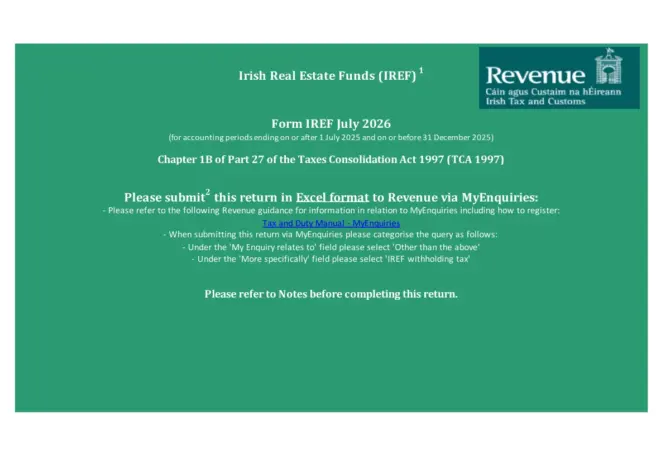
Form IREF is a spreadsheet. Revenue publishes it as an Excel workbook with nine sheets, asks for it back as an Excel file through MyEnquiries, and offers it on the Funds page in no other form. It is the annual return of an Irish Real Estate Fund, and it also carries the working for any IREF withholding tax the fund deducted from its unit holders.
This guide follows the version marked “Form IREF July 2026”, for accounting periods ending on or after 1 July 2025 and on or before 31 December 2025, together with Revenue’s Tax and Duty Manual Part 27-01B-02, last updated August 2026. The workbook sits under Chapter 1B of Part 27 of the Taxes Consolidation Act 1997 (TCA 1997).
Who completes it, and for which period
The return is made by the investment undertaking or, where the undertaking is an umbrella scheme, by the sub-fund that holds the IREF assets. Note 1 of the workbook says the same thing: the IREF is either the undertaking itself or the sub-fund in which the units are held. Under the Tax and Duty Manual an undertaking or sub-fund is an IREF where 25% or more of the value of its assets comes from real estate assets in the State, or where it is reasonable to consider that acquiring IREF assets or carrying on IREF business was one of its main purposes.
Every IREF files an annual return; the manual says so without exception, and adds that the return is separate from any filing under its section 2.4 on the Case IV charge. A fund that stops being an IREF during an accounting period still files for the period in which it ceased, on the same dates.
The Manual gives two deadlines for the return and for paying over any IREF withholding tax: 30 July for year-ends up to 31 December the prior year, and 30 January for year-ends up to 30 June the prior year. The July 2026 workbook fixes the date for its own period at 30 July 2026. That date had passed when this guide was last checked on 24 October 2026, and the Funds page still listed only this version of the form. Penalties for a late or incorrect return are covered near the end of this guide.
What counts as an IREF taxable event
Unit holders in an IREF may be subject to 20% IREF withholding tax when an IREF taxable event occurs. Note 10 of the workbook and the manual list the same seven events:
- a relevant payment
- the cancellation, redemption or repurchase of units, including on liquidation
- an exchange of units in one sub-fund for units in another sub-fund
- the issuing of bonus units
- an IREF ceasing to be an IREF
- the disposal of a unit, for instance on a sale
- the sale or transfer of a right to receive accrued IREF profits without the underlying unit
For the last two events, the workbook asks the IREF to include any information it knows and has readily available about the transaction.
The workbook, sheet by sheet
| Sheet | What it asks | Points from the notes |
|---|---|---|
| Front page | Title, period covered, filing instructions | Submit in Excel format via MyEnquiries; enquiry type “Other than the above”, more specifically “IREF withholding tax” |
| Notes | Thirteen notes | Definitions of the IREF, “material transactions”, “connected”, PPIREF, taxable event and return of capital; penalties; completion rule |
| Pay&File | Deadline, financial statements, payment | Covered in the sections below |
| Part 1, General | Identity of the fund and its service providers | Includes material transactions with unit holders and associated enterprises |
| Part 2, Personal portfolio IREF | Units in issue; PPIREF holders; holders of 10% or more | PPIREF status is decided for each unit holder separately |
| Part 3, Schedule of IREF assets | Fair value of assets by category, start to end of period | Geographic location should reflect the fund’s strategy |
| Part 4, Section 739R information | One row per taxable event: amounts and tax deducted | Totals feed the sum to be remitted to the Collector General |
| Part 5, Section 739T disposals | Disposals where the IREF knows of them | Seller, buyer, date and NAV |
| Part 6, Declaration | Signature, authorised signatory, capacity, date | Declaration that the return is correct under Chapter 1B |
Part 1: the fund and the people around it
Part 1 asks for the name of the undertaking and its Irish tax reference number, the sub-fund name where the return is for one sub-fund, the Central Bank of Ireland authorisation reference and date, the address and the accounting period with its start and end dates. It also asks which GAAP the accounts follow, how the fund is organised (designated investment company, ICAV, unit trust scheme or other) and its regulatory status (QIAIF or RIAIF), followed by name and address of promoter, investment manager, administrator, fund manager, depositary and trustee. Two free-text boxes close the sheet: material transactions with a unit holder or a connected person, other than IREF taxable events, and the names and tax reference numbers of associated enterprises within section 739KA TCA 1997 that the financial statements do not already disclose.
Parts 2 and 3: units and assets
Part 2 is a unit table with opening, new issues, redemptions, other and closing, plus the closing value in euro. Below it come two lists of unit holders, each with TIN, name, address and the percentage held at opening, the movement and the closing percentage: the holders in respect of whom the fund is a personal portfolio IREF, and every holder who owned 10% or more of the units at any point during the year.
Part 3 starts with the NAV of IREF assets as a percentage of total NAV. The schedule that follows is split into relevant assets (Dublin, Leinster outside Dublin, Ulster, Munster and Connaught residential, then retail, commercial, mixed-use, development land, agricultural land and other), shares in a REIT, shares deriving their value from land in the State, specified mortgages and units in another IREF. Each line runs from the fair value at the start of the period through additions, disposals, revaluations and other movements to the value at the end. Interest capitalised into the values is shown separately for related-party and third-party loans. For specified mortgages, note 9 asks for “Originated” where the IREF originated them, and otherwise for the name of the seller and, if known, of the originator.
Part 4: where the withholding tax is worked out
Each unit holder with a taxable event gets a row with name, address, TIN, unit holding, the date of the event (DD/MM/YY) and its amount excluding returns of capital. A return of capital is the return of the investor’s original investment; note 11 says it must not contain any profit or income element and must not itself be a taxable event, and it is shown in its own column together with the capital not yet returned.
The IREF taxable amount follows the formula from section 739L TCA 1997, A × B/C − D + E:
- A is the value of the event attributable to the IREF’s retained profits
- B is the retained IREF profit
- C is the retained profits of the IREF
- D is purchased IREF profits not previously distributed
- E is the difference between the value of the event and the balance-sheet value of the units, and applies to events under paragraph (b) of the definition
Three columns then split out IREF excluded profits by paragraph (a), (b) and (c) of the section 739K definition, and the next column holds the IREF withholding tax deducted. Where none was deducted, the row asks for the reason, per investor, and whether a declaration under Schedule 2C TCA 1997 is in place. The Tax and Duty Manual lists the unit holders who are not “specified persons” when they give the IREF a valid declaration, among them Irish pension funds, investment undertakings and life assurance companies (where the IREF is not a PPIREF for them), charities, credit unions and section 110 qualifying companies; TDM Part 27-02b-01 covers the declarations.
Below the total, amounts paid directly to indirect investors under section 739Q(3) are listed and deducted. The sheet ends on the sum to be remitted to the Collector General.
Financial statements travel separately
The return does not include the accounts. Full financial statements at sub-fund level, under S.I. No. 368 of 2018, must be filed in text-searchable PDF format through MyEnquiries by the same date, under the same enquiry type and the same “IREF withholding tax” subcategory. Section 739FA(4) TCA 1997 provides penalties for failing to file them on time or filing them in another form.
Paying the tax
IREF withholding tax is paid by electronic funds transfer to the Revenue account named on the Pay&File sheet and in the manual. The bank reference is “IREF”; the manual adds the customer reference number. After paying, the customer emails moneytrans@revenue.ie with the date of payment, the customer tax registration number, the sub-fund and umbrella name, the amount and the period the payment belongs to. The Pay&File sheet says to allow at least three working days for the payment to reach the Collector General by the due date. Late payment carries interest, and failure to pay on time can lead to enforcement proceedings with their own costs.
Before uploading
- Every applicable field is filled; note 13 says the return is correct and complete only then.
- The workbook is the Excel file itself, not a PDF or a scan, and the enquiry type matches the front page.
- The accounting period on Part 1 matches the version of the form: this one covers periods ending 1 July 2025 to 31 December 2025.
- Financial statements are ready as a text-searchable PDF at sub-fund level.
- Part 6 carries the declaration with the signatory’s name, capacity and date.
Penalties and late payment
Note 12 points to sections 1052, 1054 and 1077F TCA 1997 for failing to make a return, or deliberately or carelessly making an incorrect one. Financial statements carry the separate penalties of section 739FA(4), and unpaid or late tax carries interest.
Where to get the form
Form IREF is on Revenue’s Funds page for collective investment vehicles, described there as “Irish Real Estate Funds (IREF) return form”. Next to it sit two forms that are not this one: the IREF Withholding Tax refund claim form, for refunds of tax deducted from a payment in respect of an IREF taxable event, and Form 1 IREF, the tax return and self-assessment for an IREF within the income tax charge under sections 739LA, 739LB or 739LAA, which the manual says is filed, and the tax paid, by 31 October in the year after the accounting period ends. Funds with specific questions about PPIREF status or specified persons should read Part 27-01B-02 or ask their tax adviser.
Sources
- Revenue, Form IREF, Irish Real Estate Funds (IREF), July 2026, Excel workbook (revenue.ie)
- Revenue, Funds (collective investment vehicles) (revenue.ie)
- Revenue, Tax and Duty Manual Part 27-01B-02, Irish Real Estate Fund (IREF) Guidance Note, last updated August 2026 (revenue.ie)