A non-resident who needs an Irish tax registration but cannot use Revenue’s online eRegistration fills in TR1(FT). It covers individuals, partnerships, trusts and unincorporated bodies based abroad, and one form can register for income tax, VAT, employer PAYE, Relevant Contracts Tax and Capital Gains Tax together.
Revenue’s eRegistration page sets the split: TR1 is for resident customers, TR1(FT) for non-resident ones. A partnership or trust represented by a tax agent does not use paper at all; the agent applies through ROS.

Who should not use it
- PAYE employees starting their first job in Ireland. They use the Jobs & Pensions service in myAccount.
- A non-resident body that only wants a registration number to get a grant or tax clearance certificate. That is Form TC1.
- Collection agents for non-resident landlords where the Non-Resident Landlord Withholding Tax system is not being used. They have a separate collection agent registration form.
Part A: who is registering
An individual completes A1 and A3. A partnership, trust or other body completes A2 and A3.
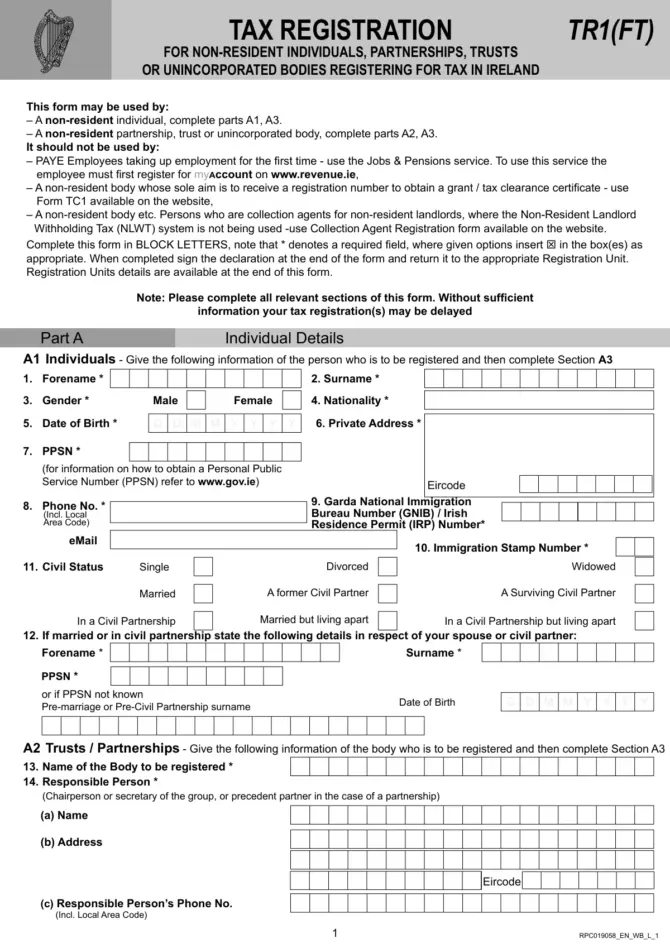
A1, individuals
Name, gender, nationality, date of birth, private address with Eircode, phone and PPSN are required. So are the GNIB or Irish Residence Permit number and the immigration stamp number. Civil status and the spouse’s or civil partner’s details follow.
A2, partnerships and trusts
The name of the body and a responsible person: the chairperson or secretary, or the precedent partner for a partnership. Question 17 lists every partner, trustee or officer with their capacity and Irish tax reference number, and the form requires at least two officers.
A3, the business
Trading name, legal format, business address and the kind of business. Question 21(b) asks for a precise description, and the form gives examples: “newsagent”, “property letting”, “dairy farmer”. It warns against vague terms like “consultant” or “computers”. Then the start date, the date annual accounts are made up to, expected turnover for the next twelve months, any accounting software or EPOS system, and the details of a tax advisor if there is one. If you rent premises in Ireland, question 29 wants the landlord’s name and private address, not the agent’s, along with the rent and the landlord’s tax reference.
Parts B to F: one box per tax
Part B, income tax (non-PAYE)
Your main source of Irish income, then a checklist that helps decide whether you have a permanent establishment under a tax treaty: a place of management, an office or site office, a factory or workshop, someone negotiating contracts for you, or a building or installation project lasting more than six months.
Part C, VAT
The start date, whether you are electing to register, a copy of the contract or service agreement, the cash receipts basis, expected Irish turnover, VAT numbers in other EU states, intra-community trading and the bank account for refunds.
Parts D to F
Employer PAYE/PRSI (D), Relevant Contracts Tax as principal or sub-contractor (E) and Capital Gains Tax with the date you need it from (F).
The VAT questions take longest
Cash receipts basis is available on one of two grounds the form lists: expected annual turnover below €2,000,000, or at least 90% of turnover from customers who are not VAT registered, such as hospitals, schools or the public. Anyone answering yes to supplying goods or services to other EU states must describe customers, due diligence checks, transport and proof that goods left the State, and is told they will have to file VIES returns. A business address must be backed by evidence, for example a copy of the lease or post received there.
Signing and sending
Write in block letters, sign the declaration at the end and send it to the right registration unit. Everyone else sends it to Business Registrations, Office of the Revenue Commissioners, P.O. Box 1, Wexford (businesstaxesregistrations@revenue.ie, 01 738 3630, or +353 1 738 3630 from abroad). Associates of existing Large Corporates Division customers, and some financial sector bodies such as investment funds, aircraft lessors and insurers, go to their own divisions in Anne Street, Wexford.
Once a trust or partnership is registered, Revenue says returns and payments must go through ROS.
Official PDF: TR1(FT) — Official PDF (revenue.ie)
Documents checked
- Revenue, Form TR1(FT) Tax registration for non-resident individuals, partnerships, trusts or unincorporated bodies, RPC019058 (revenue.ie)
- Revenue, eRegistration (revenue.ie)
- Revenue, How to register for tax as a trust or partnership (revenue.ie)