IHT420 is the two-page Inheritance Tax schedule for heritage property: works of art, historic buildings, outstanding land and the maintenance funds that pay for their upkeep. Personal representatives use it alongside IHT400 when they claim conditional exemption, when an asset in the estate was exempted on heritage grounds at some earlier point, or when a maintenance fund is involved. The form on GOV.UK carries the print code FKPA 09/14, and the publication page still lists that 2014 edition as the only version, with no later update.
When IHT400 sends you to IHT420
Question 47 on IHT400 asks whether any asset is already exempt, or exemption is now being claimed, because of its national, scientific, historic, artistic, scenic or architectural interest, and whether any such asset benefits from an approved maintenance fund. A yes to either part means IHT420. Page 1 of the schedule lists four situations:
- you are claiming heritage conditional exemption for assets in the estate
- conditional exemption was allowed on any of the assets in the past
- any asset in the estate is maintained from a maintenance fund
- the will leaves assets to the trustees of a maintenance fund and you are claiming exemption for that transfer
Both claims have a time limit. The IHT400 Notes (HMRC 04/26) say conditional exemption, and the exemption for property passing to a maintenance fund, must be claimed within 2 years after the death, except in exceptional circumstances.
What can qualify for conditional exemption
The notes list the kinds of property HMRC will consider:
- land of outstanding scenic, historic or scientific interest, for example an Area of Outstanding Natural Beauty, a famous battlefield or a Site of Special Scientific Interest
- buildings of outstanding historic or architectural interest, and the land needed to protect their character and amenities
- objects historically associated with such a building
- pictures, prints, books, manuscripts, works of art, scientific objects and other objects that produce no income, if they are pre-eminent for their national, scientific, historic or artistic interest
HMRC makes the decision with advice from the government’s heritage advisory bodies. In return for the exemption the new owner agrees to look after the asset, to allow public access without a prior appointment and, for a moveable object, to keep it in the UK. Tax normally becomes chargeable if that owner dies, sells or gives the property away, or breaks the agreement. The notes name three exceptions: a donee or legatee takes over the agreement, the sale is by private treaty to an approved national institution such as the British Museum or the National Trust, or the property is accepted in lieu of Inheritance Tax or donated under the cultural gift scheme.
A maintenance fund is a trust HMRC has approved for the upkeep of outstanding land or buildings, amenity land, or historically associated contents that would qualify for conditional exemption. Outright transfers of certain property into such a fund are exempt.
How to fill in IHT420, boxes 1 to 4
The top of page 1 takes the deceased’s name, the date of death and the IHT reference number if you have one. Every box after that asks you to identify each asset by the box number where it appears on IHT400, so finish the IHT400 asset pages, or at least know where each item sits, before starting.
| Box | Question on the form | What to enter |
|---|---|---|
| 1 | Assets on which conditional or maintenance fund exemption is being claimed | A description of each asset with its IHT400 box number, and its value at the date of death in pounds. |
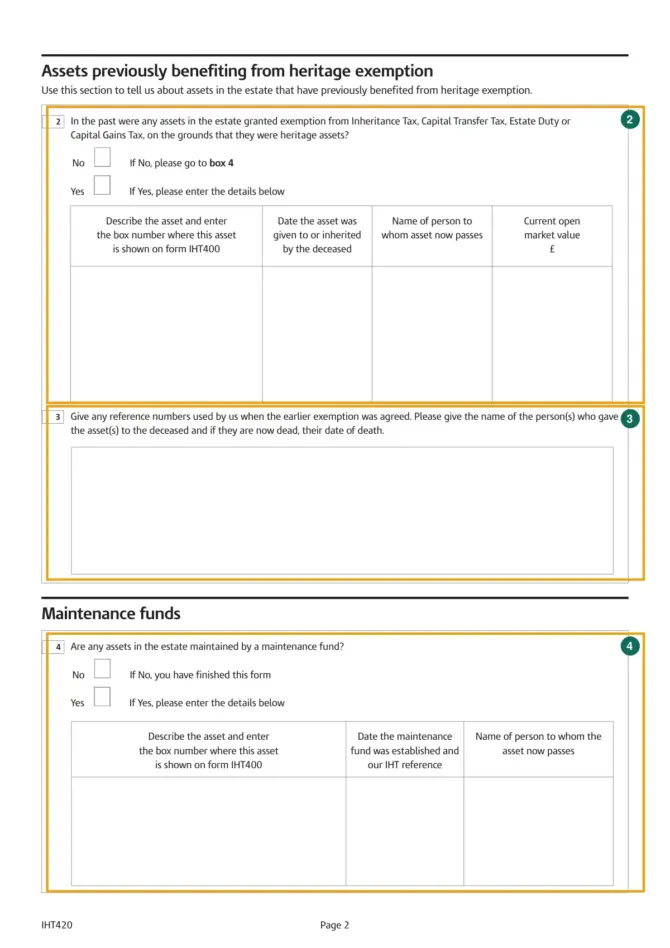
| 2 | Were any assets granted exemption in the past from Inheritance Tax, Capital Transfer Tax, Estate Duty or Capital Gains Tax as heritage assets? | Tick No and go to box 4, or tick Yes and give the description with its IHT400 box number, the date the deceased received or inherited the asset, the person it now passes to, and its current open market value. |
| 3 | Details of the earlier exemption | Any HMRC reference numbers from when that exemption was agreed, the name of whoever gave the asset to the deceased and, if that person has died, their date of death. |
| 4 | Are any assets in the estate maintained by a maintenance fund? | Tick No and the form is finished, or tick Yes and give each asset with its IHT400 box number, the date the fund was set up with HMRC’s IHT reference for it, and the person the asset now passes to. |
The two value columns differ: box 1 asks for the value at the date of death, box 2 for the current open market value. Box 3 is one free-text space for every asset listed in box 2.
Where the heritage values go on IHT400
IHT420 has no total to copy across to IHT400. The assets stay in the main account at their full value, and the exemption is deducted separately. The IHT400 Notes set out three routes:
- Land and buildings that are already conditionally exempt, supported by a maintenance fund, or now the subject of a claim: show the value in the right box on pages 7 and 8 of IHT400, deduct the exemption at box 93, and give full details on IHT405. Our guide to IHT405 for houses, land and buildings covers that schedule.
- Chattels in the same position: show the value in box 55, deduct the exemption at box 92, and describe the items on IHT407, household and personal goods.
- Money or other assets left by the will to a maintenance fund: enter the value in the relevant boxes on pages 7 and 8, then deduct the exemption at box 93 for land or buildings, or box 92 for everything else. Non-cash assets also need their own schedule.
Boxes 92 and 93 on IHT400 are the exemptions and reliefs deducted from assets in the deceased’s sole name, column A and column B respectively.
Heritage exemption next to Agricultural or Business Relief
The IHT400 Notes have a passage for estates with property that qualifies for heritage exemption as well as Agricultural or Business Relief. They say that for deaths on or after 6 April 2026, 100% relief on the combined value of qualifying agricultural and business property is limited to £2.5 million, with the excess relieved at 50%. A late spouse or civil partner’s unused £2.5 million allowance can be transferred if the claim is made within 4 years of the survivor’s death or within 6 months of the personal representatives starting their role.
Where an asset qualifies for both, the notes say heritage exemption usually takes priority and gives full exemption, so Agricultural or Business Relief is not needed for that asset. You cannot claim both on the same value.
Offering heritage assets in payment of tax
Inheritance Tax and interest still have to be paid before the grant of probate or confirmation is issued. You can tell HMRC at that point, or within 3 months afterwards, that you would like National Heritage assets accepted in payment of some or all of the tax and interest. If HMRC accepts them, it repays cash already paid up to the agreed amount. HMRC cannot accept the assets until after the grant or confirmation, but you can give notice earlier. The offer goes in a covering letter with IHT400, or in a letter within 3 months after the grant or confirmation. You may also want to claim conditional exemption on an asset you offer. The notes suggest phoning the Inheritance Tax Helpline and asking for the Heritage Team.
Getting IHT420 and sending it with IHT400
The fillable IHT420 PDF is on the GOV.UK IHT420 page, published on 4 April 2014. The same page says to email HMRC for a Welsh copy. Because the form dates from 2014, its help box still gives www.hmrc.gov.uk/inheritancetax/; the current IHT400 Notes give www.gov.uk/inheritance-tax instead.
If the boxes are too small, IHT420 tells you to continue on the “Additional information” pages 15 and 16 of IHT400. On the current IHT400 (HMRC 04/26) the “Additional information” space is on page 19. Use the “Additional information” section of the IHT400 you are actually sending; the helpline below can confirm where HMRC wants the overflow.
IHT420 is sent with IHT400 and the other schedules you have filled in. For a grant in England, Wales or Northern Ireland, or confirmation in Scotland, IHT400 gives the address as Inheritance Tax, HM Revenue and Customs, BX9 1HT. For a Northern Ireland grant the bundle also includes the IHT421 probate summary, which HMRC completes and sends back. The Inheritance Tax Helpline is 0300 123 1072, or +44 300 123 1072 from outside the UK.