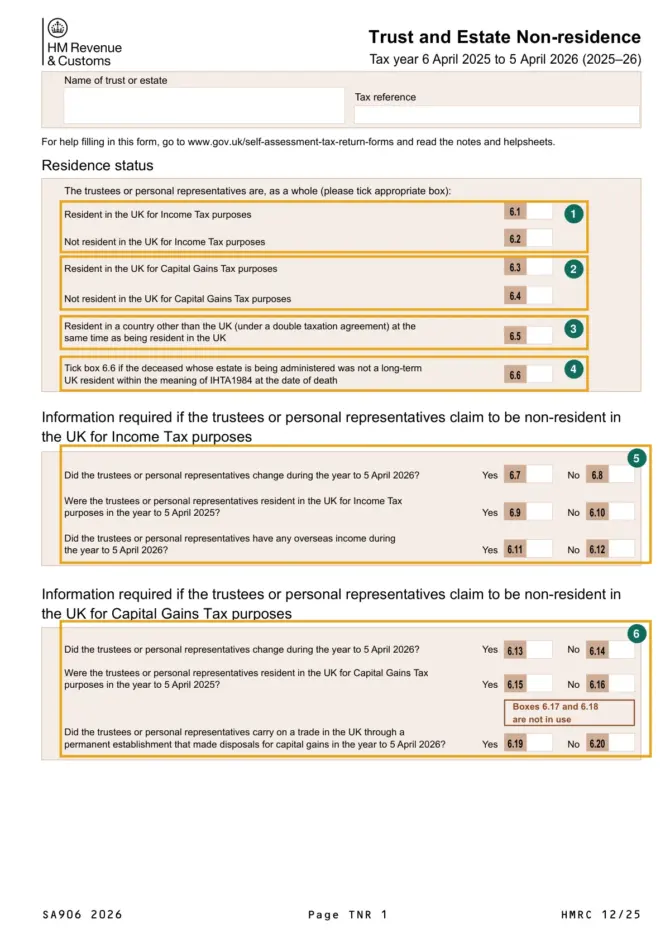
SA906, the Trust and Estate Non-residence pages, is a two-page supplement to the SA900 Trust and Estate Tax Return. Trustees and personal representatives use it to tell HMRC whether, taken as a whole, they were resident in the UK for Income Tax and for Capital Gains Tax, and whether they are claiming to be resident in another country under a double taxation agreement at the same time. The edition for the tax year 6 April 2025 to 5 April 2026 is printed “SA906 2026” and dated HMRC 12/25, and HMRC publishes separate SA906 Notes 2026 that explain which of boxes 6.1 to 6.34 to tick.

Who needs to fill in the SA906 pages
Question 6 on page 3 of the SA900 asks whether the trust is claiming to be not resident in the UK, or dual resident in the UK and another country, for all or part of the year. The Trust and Estate Tax Return Guide (SA950) tells you to complete the non-residence pages first if, for 6 April 2025 to 5 April 2026, you consider the trust or estate to be either:
- not resident in the UK for Income Tax and Capital Gains Tax purposes
- resident in the UK while also resident in a country with which the UK has a double taxation agreement
For an estate, SA950 lists three situations in which special rules apply and the personal representatives fill in SA906 before deciding on entries elsewhere in the return: the deceased died domiciled outside the UK before 6 April 2025, the deceased died not resident in the UK, or one or more of the personal representatives are resident outside the UK. A personal representative is the executor or administrator of the deceased person’s estate.
SA950 also says it is your responsibility to make sure you fill in the right supplementary pages, whether or not HMRC included them after page 12 of the return it sent you.
Deciding the trustees’ residence as a whole
The notes treat trustee residence as a two-stage test. You first find the residence of each person who is actually a trustee; for an individual trustee that means the Statutory Residence Test, which HMRC explains in RDR3 and in its Residence and FIG Regime Manual. You then use those results to decide the residence of the trustees as a whole, working through three questions:
| Notes question | If yes | If no |
|---|---|---|
| 1. Were all the trustees UK resident for the year to 5 April 2026? | Resident for Income Tax and Capital Gains Tax: tick 6.1 and 6.3. | Go to question 2. |
| 2. Were all the trustees not UK resident for that year? | Not resident for both taxes: tick 6.2 and 6.4, then fill in 6.7 to 6.16, 6.19 and 6.20 as appropriate. | Go to question 3 (mixed trustees). |
| 3. When funds were provided for the trust, was anyone who provided them (directly or indirectly) UK resident, or, for a trust created before 6 April 2025, UK resident or domiciled in some part of the UK? | Resident for both taxes: tick 6.1 and 6.3. | Not resident for both taxes: tick 6.2 and 6.4, then fill in 6.7 to 6.16, 6.19 and 6.20 as appropriate. |
Three notes adjust the answers. A trustee who is actually non-resident counts as UK resident for questions 1 and 2 when acting as trustee in the course of a business carried on in the UK through a branch, agency or permanent establishment. Split-year treatment under the Statutory Residence Test does not affect the answer to question 1 for an individual who was a trustee during the UK part of the year; an individual who was a trustee only during the overseas part can be treated as not resident for questions 1 and 2. If all the trustees were non-resident corporate trustees for part of the year to 5 April 2026, the trustees as a whole are not resident for Income Tax for that period: tick 6.2, fill in 6.7 to 6.12, leave out overseas income arising in the period of non-residence and include all income arising while resident.
HMRC’s non-resident trusts guidance sets out the same split by creation date. For a trust created on or after 6 April 2025, the settlor’s domicile is no longer a factor in deciding the trust’s residence.
Deciding residence for personal representatives
For Income Tax, notes questions 4 to 6 follow the same pattern. If all the personal representatives were UK resident for the year to 5 April 2026, tick 6.1. If none were, tick 6.2 and fill in 6.7 to 6.12. Where they are mixed, the answer turns on the deceased: if the deceased was UK resident at death, or, for a death before 6 April 2025, resident or domiciled in the UK, tick 6.1; otherwise tick 6.2 and fill in 6.6 to 6.12.
Capital Gains Tax has a single test, question 7: was the deceased UK resident at the time of death? Yes means box 6.3. No means box 6.4 plus boxes 6.13 to 6.16. If the estate has more than one set of personal representatives under general law, they are treated as a single body for Capital Gains Tax.
Box 6.6 can apply even when the personal representatives are UK resident. Where the deceased was not a long-term UK resident within the meaning of the Inheritance Tax Act 1984, the personal representatives are taxable only on UK income, and the notes tell you to tick 6.6. The 2025 edition of the form asked instead whether the deceased was domiciled outside the UK at the date of death, so a box 6.6 answer copied from last year’s pages may not fit the 2026 question.
How to fill in SA906 box by box
Page 1 starts with the name of the trust or estate and its tax reference, then has the six residence status boxes and two blocks of supporting questions. Page 2 is used only for a dual residence claim. There is no signature box on SA906; the declaration is on the SA900. Boxes 6.17 and 6.18 are printed as not in use.
| Box | What it asks | When you fill it in |
|---|---|---|
| 6.1 / 6.2 | Trustees or personal representatives, as a whole, resident or not resident in the UK for Income Tax | Always one of the two, from notes questions 1 to 6 |
| 6.3 / 6.4 | Resident or not resident in the UK for Capital Gains Tax | Trustees from questions 1 to 3; personal representatives from question 7 |
| 6.5 | Resident in another country under a double taxation agreement at the same time as being UK resident | Only if you intend to make a dual residence claim |
| 6.6 | Deceased was not a long-term UK resident (IHTA 1984) at the date of death | Estates only |
| 6.7 / 6.8 | Did the trustees or personal representatives change during the year to 5 April 2026? | Non-resident for Income Tax |
| 6.9 / 6.10 | Were they UK resident for Income Tax in the year to 5 April 2025? | Non-resident for Income Tax |
| 6.11 / 6.12 | Any overseas income in the year to 5 April 2026? | Non-resident for Income Tax |
| 6.13 / 6.14 | Did the trustees or personal representatives change during the year to 5 April 2026? | Non-resident for Capital Gains Tax |
| 6.15 / 6.16 | Were they UK resident for Capital Gains Tax in the year to 5 April 2025? | Non-resident for Capital Gains Tax |
| 6.19 / 6.20 | Did they carry on a trade in the UK through a permanent establishment that made disposals for capital gains in the year to 5 April 2026? | Non-resident for Capital Gains Tax |
| 6.21 to 6.34 | Country of dual residence and the treaty tie-breaker questions | Only with box 6.5 |
Boxes 6.9/6.10 and 6.15/6.16 look back to the previous tax year, ending 5 April 2025, while the other yes/no questions on page 1 are about the year to 5 April 2026. Page 2 ends by sending you to any other supplementary pages that apply, or back to page 4 of the SA900 to finish the return.
Claiming treaty relief or dual residence
The notes cover two kinds of treaty claim. Trustees or personal representatives who are not UK resident, but are resident in a country that has a double taxation agreement with the UK, may get relief from UK tax under that agreement on UK royalties, dividends and interest. Some agreements give the relief only if the income is taxed in the other country. The precise conditions are in each agreement, and HMRC’s Digest of Double Taxation Treaties lists the countries.
The second case is dual residence: resident in the UK under UK law and, for the same period, resident in another country under that country’s rules. Where the other country has an agreement with the UK, the agreement will usually have rules that decide, only for applying its own provisions, which of the two countries counts as the place of residence. The standard tests look at a permanent home, personal and economic relations, habitual abode and nationality; for trustees, they look at where the effective management of the trust is. Dual resident trustees or personal representatives may be able to claim the exemptions and reliefs from UK tax given to residents of the other country, and for certain Capital Gains Tax reliefs dual resident trustees are treated as not resident.
To claim, tick 6.5 and fill in page 2 as appropriate:
- 6.21: the country, other than the UK, where they were regarded as resident for 2025-26
- 6.22 / 6.23: whether they were also regarded as resident there for 2024-25
- 6.24 / 6.25: whether a majority of the trustees or personal representatives were UK resident for 2025-26
- 6.26 to 6.28: whether the people who supplied the settled property or funds had close personal and economic relations with the UK, the box 6.21 country or neither
- 6.29 to 6.31: where the general administration of the trust was mainly carried out in 2025-26
- 6.32 to 6.34: whether the trustees or personal representatives have closer personal and economic relations with the UK, the box 6.21 country or neither
The notes also ask you to contact HMRC for advice and to get a certificate from the overseas tax authority stating that it regards the trustees or personal representatives as resident under its domestic law for the period of the claim. The certificate is not sent with the return; keep it in case HMRC asks for it to support the claim.
What non-residence changes on the rest of the SA900
Trustees who are not resident for Income Tax are not liable on overseas income, so that income is left out of the Trust and Estate Trade, Partnership and Foreign pages and the other boxes of the return. A UK resident beneficiary claiming relief under Extra-Statutory Concession B18 may need details of that income, and HMRC Trusts may ask the trustees for it when the claim arrives. The notes give HMRC Trusts, BX9 1EL, United Kingdom, telephone 0300 322 9640 (from abroad +44 300 322 9640), as the office dealing with these claims.
Non-resident personal representatives are not taxable on foreign income and leave it out, and they also leave out income from UK government securities paid without deduction of tax. The notes point out that a UK resident beneficiary may still be chargeable on that income and may ask the personal representatives for details for their own return. UK resident personal representatives are taxed on UK and overseas income when the deceased was UK resident, and only on UK income when box 6.6 applies.
Non-resident trustees or personal representatives make no Capital Gains Tax entries on page 3 of the SA900 or on the Trust and Estate Capital Gains pages, with two exceptions. The first is a disposal of UK assets used for a trade carried on in the UK through a branch, agency or permanent establishment, where the disposal happens while that trade is carried on. The second is a disposal of an interest in UK residential property for which a non-resident Capital Gains Tax return had to be made. Both go on the Trust and Estate Capital Gains pages. Question 16 on page 9 of the SA900 asks separately whether the trust has at any time been non-resident or received capital from a trust that has.
SA906 deadlines and signing the return
SA906 travels with the SA900 and has no deadline of its own. For the 2025-26 return, a paper return, or one where you want HMRC to calculate the tax, must reach HMRC by 31 October 2026, and an online return by 31 January 2027. A return filed after its deadline gets an automatic £100 penalty even if no tax is due, with further penalties once it is more than 3 months late. Supplementary pages you need but do not send back on time count the same way: SA950 says HMRC will charge the initial £100 penalty and further penalties for continued delay. If you miss the paper deadline, you can still file online by 31 January 2027 without a penalty, as long as you did not send the paper return first.
Where HMRC gave the notice to file after 31 July 2026, the return is due by the later of the normal date and 3 months after the date of issue. Any tax the trust or estate owes for 2025-26 has to reach HMRC by 31 January 2027, together with any first payment on account for 2026-27.
The signature goes on the SA900, at Question 22 on page 12. Tick the “Trust and estate non-residence” box in the list of pages you are sending back, sign and date box 22.1, print your name in box 22.2 and give the capacity in which you sign in box 22.3. If an accountant or someone else completed the return, SA950 says you must still sign it yourself.
Where to get the official SA906 2026 pages
The SA906 publication page on GOV.UK has the 2026 pages and the SA906 Notes 2026, with the 2025, 2024 and 2023 editions for earlier years. A Welsh version can be requested from HMRC by email. The SA900 publication page links to the return, the SA950 guide and the other supplementary pages. Sending the return online needs commercial software for trust and estate returns; HMRC’s trustee guidance describes the paper alternative as filling in SA900 and posting it to HMRC by 31 October.
For questions about trust residence or treaty claims, HMRC’s trusts helpline is on 0300 322 9640 (+44 300 322 9640 from outside the UK), Monday to Friday, 9am to 5pm. The notes say the residence rules for treaty purposes can be complex and suggest asking HMRC or a tax adviser before deciding whether relief is due.
Official PDF: SA906 — Official PDF (assets.publishing.service.gov.uk)
Sources
- HMRC SA906 2026, Trust and Estate Non-residence, tax year 2025-26 (HMRC 12/25)
- HMRC SA906 Notes 2026, Notes on Trust and Estate Non-residence (HMRC 12/25)
- Self Assessment: Trust and Estate Non-residence (SA906), GOV.UK
- HMRC SA906 2025, Trust and Estate Non-residence, tax year 2024-25
- HMRC SA900 2026, Trust and Estate Tax Return
- HMRC SA950 2026, Trust and Estate Tax Return Guide
- Self Assessment: Trust and Estate Tax Return (SA900), GOV.UK
- Trusts and taxes: trustees’ tax responsibilities, GOV.UK
- Non-resident trusts, GOV.UK
- Trusts: enquiries, GOV.UK
- Digest of Double Taxation Treaties, GOV.UK