SA804 is where a partnership reports savings interest, UK dividends and taxable income that has no other home on the SA800 Partnership Tax Return. The 2026 edition (printed HMRC 12/25) covers the tax year 6 April 2025 to 5 April 2026. It has two pages, PS 1 and PS 2, numbered boxes 7.1 to 7.30, and HMRC publishes separate SA804 notes for the same year. Each total on the pages tells you which box of the Partnership Statement (full) receives it, and from there the figures are shared out between the partners.

Which partnerships fill in SA804
Question 7 on page 8 of the SA800 asks whether the partnership received any other income not already included elsewhere on the return. Page PS 1 of SA804 lists the cases that call for these pages:
- interest, dividends or other income from UK banks, building societies, unit trusts, National Savings and Investments, or other UK savings
- dividends, other distributions or stock dividends from UK companies or UK unit trusts
- other income that is not trading or professional income, foreign income, or land and property income
There is a shortcut. If the only savings income for the period was interest or alternative finance receipts paid with no tax deducted by banks or building societies, you leave SA804 aside and enter the total in box 7.9A on page 8 of the SA800, which is copied to box 13 of the short Partnership Statement. Several such accounts still fit that box as one total. Taxed interest, a dividend or income belonging in box 7.26 means the full SA804 pages are needed.
Two kinds of income that look similar go elsewhere. Interest and dividends from overseas savings and investments belong on the Partnership Foreign pages, SA802 (question 2 on the SA800), and foreign dividends reach box 14A of the Partnership Statement (full) from box 2.6A on those pages. Rent from UK land and property goes on the SA801 partnership UK property pages.
Once SA804 is in the return, the short Partnership Statement on pages 6 and 7 of the SA800 is no longer enough. Page 6 limits the short version to partnerships whose only income was trading or professional income and untaxed bank or building society interest; everyone else downloads the Partnership Statement (full), SA800(PS), which has room for six partners.
The SA804 notes and the Partnership Tax Return Guide (SA850) both list income that stays off the return altogether:
- interest, dividends or bonuses from tax-exempt investments such as National Savings and Investments Savings Certificates, unless something has made the income taxable
- Premium Bond, National Lottery and gambling prizes
- interest awarded by a UK court as part of damages for personal injury or death
- permanent health insurance receipts, except those treated as trading receipts because they help pay employees’ sick pay
- gains on UK life assurance policies, life annuities or capital redemption policies, which each partner shows on their own return
- accrued income on the transfer of securities
SA850 adds profits from selling certificates of deposit to that list.
Return period for boxes 7.1, 7.2, 7.24 and 7.25
SA804 mixes two time frames. Every taxed amount, with its tax deducted, is returned for the tax year 6 April 2025 to 5 April 2026. If the accounts run to another date, the notes tell you to apportion the figures from the sets of accounts that between them cover that year.
Untaxed income follows the partnership’s accounting period instead. For a trading or professional partnership, the untaxed sections show income for the accounting period ended in 2025-26. The start date goes in boxes 7.1 and 7.24 and must match box 3.4 on page 2 of the SA800; the end date goes in boxes 7.2 and 7.25 and must match box 3.5. More than one accounting period ending in the year can mean more than one set of SA804 pages. If no accounting period ends in 2025-26, only the taxed sections are completed.
A partnership that carries on no trade or profession (an investment partnership) enters 06/04/25 in boxes 7.1 and 7.24 and 05/04/26 in boxes 7.2 and 7.25. A CT Partnership, in which every member is liable to Corporation Tax, returns both taxed and untaxed income for its accounting period or periods ending between 6 April 2025 and 5 April 2026, according to page PTRG 5 of SA850.
How to fill in SA804, box by box
Start with the partnership name and tax reference at the top of page PS 1. Every box asks for a total across all accounts or sources, so add the figures up first and keep the account-by-account details in case HMRC asks for them later. Boxes 7.10 to 7.13 are not in use.
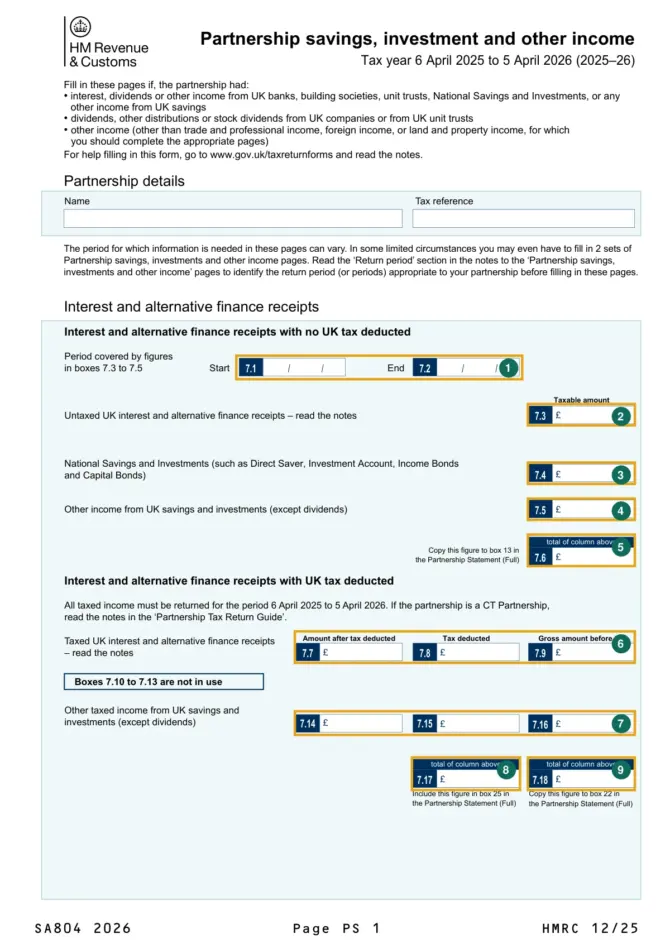
| Box | What to enter | Where the figure goes |
|---|---|---|
| 7.1, 7.2 | Start and end of the period for the untaxed interest in 7.3 to 7.5. | Same dates as SA800 boxes 3.4 and 3.5. |
| 7.3 | Untaxed interest and alternative finance receipts from UK banks and building societies, plus interest distributions from UK authorised unit trusts, open-ended investment companies and investment trusts. | Part of 7.6. |
| 7.4 | National Savings and Investments interest from Direct Saver, Investment Account, Income Bonds and Capital Bonds. | Part of 7.6. |
| 7.5 | Other untaxed interest: gilts, other loan stocks, loans to people or organisations, credit unions, friendly societies, disguised interest, deeply discounted securities. | Part of 7.6. |
| 7.6 | Total of 7.3 to 7.5. | Box 13. |
| 7.7, 7.8, 7.9 | Taxed UK interest: amount after tax, tax deducted, gross amount. | Feed the totals in 7.17 and 7.18. |
| 7.14, 7.15, 7.16 | Other taxed interest from UK savings and investments, in the same three columns. | Feed the totals in 7.17 and 7.18. |
| 7.17 | Total tax deducted (7.8 plus 7.15). | Included in box 25. |
| 7.18 | Total gross taxed interest (7.9 plus 7.16). | Box 22. |
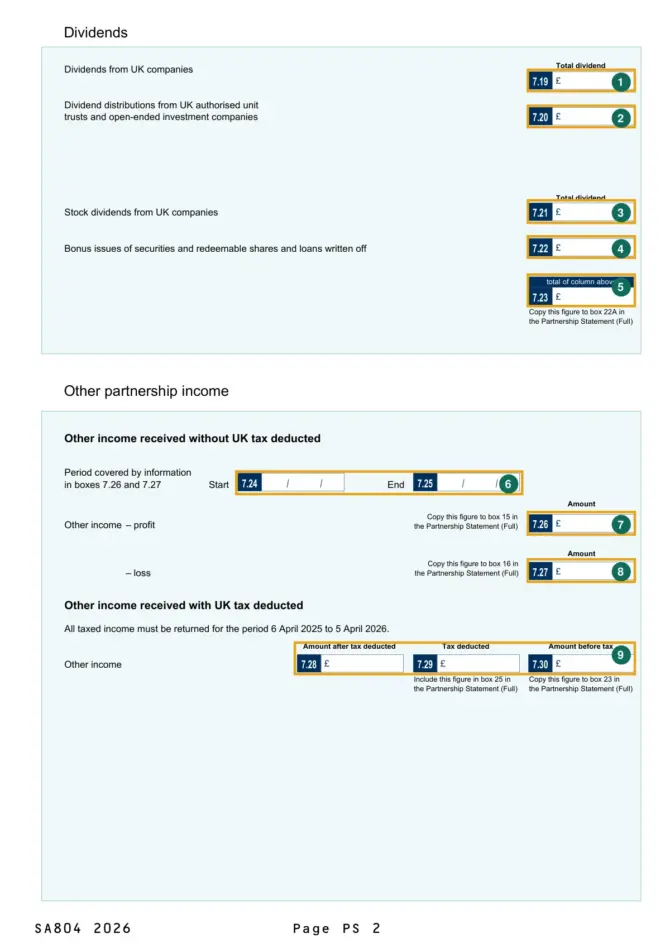
| 7.19 | Dividends and other distributions from UK companies. | Part of 7.23. |
| 7.20 | Dividend distributions from UK authorised unit trusts and open-ended investment companies. | Part of 7.23. |
| 7.21 | Stock dividends from UK companies. | Part of 7.23. |
| 7.22 | Bonus issues of securities and redeemable shares, and loans written off. | Part of 7.23. |
| 7.23 | Total of 7.19 to 7.22. | Box 22A. |
| 7.24, 7.25 | Start and end of the period for 7.26 and 7.27. | Same rules as 7.1 and 7.2. |
| 7.26 | Other untaxed income, after allowable expenses (profit). | Box 15. |
| 7.27 | Overall loss on that income. | Box 16. |
| 7.28, 7.29, 7.30 | Other income received with UK tax deducted: net, tax, gross. | 7.29 included in box 25; 7.30 to box 23. |
To collect the figures, the notes point to dividend vouchers, the electronic distribution details that unit trusts, open-ended investment companies and investment trusts can send in place of a paper voucher, interest statements or tax deduction certificates, and trust vouchers if the partnership is entitled to income of a trust.
Untaxed interest: boxes 7.3 to 7.6
The bank or building society statement shows the interest, including interest in kind, paid gross. Add up everything received in the return period for 7.3. Accumulation units in a unit trust or open-ended investment company still count: the interest distribution is entered in full even though it was reinvested. National Savings and Investments interest stays out of 7.3 and goes in 7.4; NS&I products that had tax deducted move down to boxes 7.7 to 7.9. Annual payments from UK unauthorised unit trusts are not interest for this purpose and go in 7.28 to 7.30.
Box 7.5 also takes disguised interest (an amount calculated like interest and practically certain to be received, from products and arrangements entered into from 6 April 2013) and the gain on a deeply discounted security, one whose discount or premium on redemption can exceed 15% of the redemption price or, if smaller, 0.5% of it for each year of its life. That gain is the difference between cost and the amount received on sale or redemption, with no Income Tax deducted. A loss on one is relieved only if the firm has held the security since 26 March 2003 and it was then, or had been, listed on a recognised stock exchange; that loss goes in box 7.27.
Where the partnership sold the right to income without selling the underlying asset, the date decides the entry. For a sale before 22 April 2009, the income paid on the securities is still partnership income and goes in 7.19 or 7.20. From 22 April 2009, the consideration receivable for the right (or the right’s market value, if that is substantially greater) is entered in the box the income itself would have gone in.
Taxed interest: boxes 7.7 to 7.18
A statement or passbook normally gives three figures: net interest, tax deducted and gross interest. Total them across all the partnership’s accounts for 6 April 2025 to 5 April 2026 and enter them in 7.7, 7.8 and 7.9. If you do not have the figures, ask the bank or building society for a tax deduction certificate. A bonus paid on the merger of two or more building societies also belongs here. A bonus from a building society’s conversion to a company, or its takeover by one, goes on the Partnership disposal of chargeable assets pages (SA803) instead.
The working sheet on page PSN 5 of the notes fills gaps account by account. With gross interest and tax known, net is gross minus tax. With only the net amount, tax is net multiplied by 25% and gross is net plus tax. Round the net and gross totals down to the nearest pound and the tax total up, which means 7.9 may not equal 7.7 plus 7.8 exactly; the notes accept that.
Boxes 7.14 to 7.16 take taxed interest that did not belong in 7.7 to 7.9: gilts (including those bought through the National Savings and Investments Stock Register), other loan stocks, loans to individuals or organisations, credit unions, friendly societies and interest in kind. For non-cash interest, the payer has to give you a statement of the value before tax, the tax taken off, the net value and the payment date. Box 7.17 totals the tax column and 7.18 the gross column.
Dividends from UK companies and funds: boxes 7.19 to 7.23
Page PS 2 opens with dividends. Boxes 7.19 and 7.20 take the amount shown on the dividend voucher, or in the details a fund manager provides electronically. None of the dividend boxes has a tax column.
Box 7.19 takes UK company dividends but not stock dividends. It also takes other distributions, where a company passes value to a shareholder, for example by selling it an asset below market value or paying more than a commercial rate of interest on a loan. Explain how such a distribution arose in box 3.116, the Additional information box on page 3 of the SA800.
Box 7.20 is for dividend distributions from UK authorised unit trusts and open-ended investment companies, again including accumulation units where the dividend was reinvested. Leave out any amount marked “equalisation” on the tax voucher: the notes describe it as a return of capital that is not taxed, which each partner deducts from the cost of units bought in the year when working out capital gains. Without a voucher, ask the manager of the unit trust, open-ended investment company or investment trust for one.
A stock dividend is shares taken up in place of a cash dividend. Enter “the appropriate amount in cash” from the company’s statement in 7.21, and ask the company for a statement if you have not received one. Box 7.22 takes the distribution on a bonus issue: for redeemable shares, nominal value plus any premium payable; for securities, the principal secured plus any premium, minus any new consideration given. A company loan or advance released or written off may be taxable, and if so the amount released goes in 7.22 as well.
Other partnership income: boxes 7.24 to 7.30
This section is for taxable income that appears nowhere else on the return. The notes give examples, including one-off freelance or other casual earnings, profits from isolated literary or artistic work, rent from leasing equipment the partnership owns, underwriting or sub-underwriting commissions, payments received after the business has been wound up (such as for the sale of copyright), a capital sum from selling patent rights, and annual payments from UK unauthorised unit trusts.
Taxable income here is the gross income the partnership was entitled to in the return period, whether or not received, minus allowable expenses of the same period. An expense is allowable only if it was incurred solely to earn the receipts, was not private, and did not buy something the partnership intends to keep for a while; capital allowances may be available for that last kind. No expenses can be set against annual payments.
Boxes 7.24 and 7.25 hold the return period under the rules above. Box 7.26 takes income minus expenses. If the result is a loss, enter 0 in 7.26 and the loss in 7.27. Where the basis of taxing the trade has changed, for example from the accounts basis to the earnings basis, receipts that will not otherwise be taxed during the life of the business go in 7.26; other post-cessation receipts belong on the partners’ personal returns.
Income received with tax taken off goes in 7.28 (net), 7.29 (tax) and 7.30 (gross). That includes annual payments, among them those from unauthorised unit trusts, and property income distributions from UK Real Estate Investment Trusts and Property Authorised Investment Funds, from which tax should already have been deducted.
Partnerships can own and trade accrued income securities, such as government and company loan stock or permanent interest bearing shares in a building society, but they are not themselves within the accrued income scheme. Give each partner full details of the securities bought and sold, including whether each deal was cum-dividend or ex-dividend, so they can work out their share of nominal holdings, any accrued income charge or relief, and the interest actually received.
Moving SA804 totals to the Partnership Statement (full)
Partners need the classes of savings, investment and other income kept apart to work out the tax on their shares, so the Partnership Statement (full) gives each a box of its own, as in the table above. Box 25, UK Income Tax, is shared: it adds the tax in 7.17 and 7.29 to box 1.22 from the SA801 pages if the partnership also has UK property income.
The amounts in boxes 11 to 30 are then allocated to each partner on page 7. SA850 says the allocation should in the first instance follow the commercial profit sharing arrangement for the period in which the item was returned, with special rules where that produces a mix of notional profits and losses or where the mixed membership rules apply (pages PTRG 26 to 29). If profits are not shared on a simple percentage basis, describe the arrangement in box 3.116. Each partner needs a copy of their own allocation to complete the Partnership (full) pages of their personal return.
When the SA800 and SA804 pages are due
SA804 has no deadline of its own: it goes in with the SA800, and HMRC expects supplementary pages to arrive on time with the rest of the return. For 2025-26 the dates are:
- 31 October 2026 for a paper Partnership Tax Return
- 31 January 2027 for one filed online
The notice to file sets a later date in two cases. If it was given after 31 July 2026 but on or before 31 October 2026, the return is due by the later of three months from the notice (paper) or 31 January 2027 (online). If it was given after 31 October 2026, both paper and online returns are due three months from the notice. HMRC normally treats a notice as delivered no more than seven days after the issue date on the front of the return. Where a company is a partner, SA850 ties the filing date to the partnership’s relevant period, normally the accounting period ending in the tax year. Section 12AA of the Taxes Management Act 1970 sets the earliest date HMRC’s notice may then specify: nine months after the end of the relevant period for a paper return, and twelve months after it for an online one. The date that applies is the one in the notice to file.
A late return costs each person who was a partner during the return period £100. After three months HMRC adds £10 a day for up to 90 days (£900), after six months a fixed £300, and after twelve months a further £300. Partners pay their own tax on their shares; 31 January 2027 is also the date for paying the balance for 2025-26 and the first payment on account for 2026-27.
Signing the SA800 and where to get SA804
The SA800 is sent by the partner the other members nominated, or by the named partner if HMRC issued it in a partner’s name. Under question 11 on page 8, tick the boxes for each set of pages you are sending, including “Partnership savings” and the full Partnership Statement, enter the number of additional statements in box 11.1 and the number of partners for the period in box 11.2. The nominated partner then signs and dates the declaration in box 11.3 and prints their name. That signature is still needed when an accountant or anyone else prepared the return. Someone signing in another capacity, such as a receiver, states that capacity in box 11.4 and gives details in box 3.116.
A paper return goes back to the HMRC office whose address is printed on the front of the SA800. Filing online needs commercial software and registration for Self Assessment Online for Partnerships, and gives an instant acknowledgement that the return has arrived.
The SA804 PDF and its notes for 2026 are on the GOV.UK SA804 page, which also keeps editions back to 2023 and a Welsh-language version. The SA800 itself and the Partnership Tax Return Guide are on the SA800 publication page, and the full statement on the SA800(PS) page. For questions about what to include, the notes give the Self Assessment helpline, 0300 200 3310.
Official PDF: SA804 — Official PDF (assets.publishing.service.gov.uk)
Sources
- HMRC SA804 2026, Partnership savings, investment and other income, HMRC 12/25
- HMRC SA804 Notes 2026, HMRC 12/25
- HMRC SA800 2026, Partnership Tax Return, HMRC 12/25
- HMRC SA850 Notes 2026, Partnership Tax Return Guide, HMRC 12/25
- HMRC SA800(PS) 2026, Partnership Statement (full)
- Self Assessment: Partnership savings, investments and other income (SA804), GOV.UK
- Self Assessment: Partnership Tax Return (SA800), GOV.UK
- Self Assessment: Partnership Statement (full) (SA800(PS)), GOV.UK
- Taxes Management Act 1970, section 12AA, legislation.gov.uk