SA802 is the set of supplementary pages a partnership adds to its SA800 Partnership Tax Return when it had income from outside the UK: interest, dividends and other income from overseas savings or investments, rent and other receipts from land and property abroad, and disposals of holdings in offshore funds taxed as income. The 2026 edition, printed HMRC 12/25, covers the tax year 6 April 2025 to 5 April 2026. It runs to four pages, PF 1 to PF 4, with boxes 2.4 to 2.35, and its totals feed the full Partnership Statement, SA800(PS), from which each partner fills in their own return.
Which partnerships fill in SA802
Question 2 on page 2 of the SA800 asks whether the partnership had any foreign income. If the answer is yes, the Partnership Tax Return Guide (SA850) sends you to the Partnership Foreign pages for interest, dividends, rental income and other income from overseas savings and investments. Page PF 1 repeats the test for the return period: savings or investment income from abroad, income from land and property abroad, and any other income from sources outside the UK.
Foreign income the partnership earns in the course of its trade or profession stays out of SA802. Page PF 1 tells you to include it in the Partnership Trade and Professional Income pages instead. Rent from property in the UK goes on the SA801 Partnership UK Property pages, not here.
Gains on disposals of holdings in offshore funds belong on SA802 only when the rules charge them to tax as income. Where that is not the case, the gain or loss goes on the Partnership Disposal of Chargeable Assets pages (SA803). A ‘CT Partnership’ reads page PTRG 5 of the SA850 first. Page PF 1 also notes that box numbers 2.1 to 2.3 are not used, so the first box you fill in is 2.4.
The return period in boxes 2.4 and 2.5
Boxes 2.4 and 2.5 give the start and end of the period for the untaxed foreign income on the pages, and the period depends on what the partnership does.
- A trading or professional partnership returns foreign untaxed income of the accounting periods that ended in 2025-26. The dates in 2.4 and 2.5 must match boxes 3.4 and 3.5 on page 2 of the SA800.
- If more than one accounting period ended in the year, you may need more than one set of SA802 pages (PF 1 warns that this happens “in some limited circumstances”).
- If no accounting period ended in 2025-26, a trading partnership fills in only the partnership details and the foreign savings section on page PF 1.
- A partnership that does not carry on a trade or profession enters 6/4/2025 in box 2.4 and 5/4/2026 in box 2.5, and apportions accounts drawn up to other dates so that they cover that tax year.
For a trading partnership, dividends and distributions from overseas sources are taxed in the same basis period as the trading income, unlike UK dividends, which follow the tax year. For property income, an accounting period ending on any day from 31 March to 4 April can be treated as ending on 5 April.
How to fill in pages PF 1 and PF 2
Pages PF 1 and PF 2 are a list of items in three columns. Column A is the country where the income arose, column B the amount before any UK or foreign tax, and column D the foreign tax paid or treated as paid. Each item goes on its own line: two accounts at the same overseas bank are two lines, and so are dividends from two foreign companies in the same country. Amounts go in pounds sterling, converted at the exchange rate when the income arose.
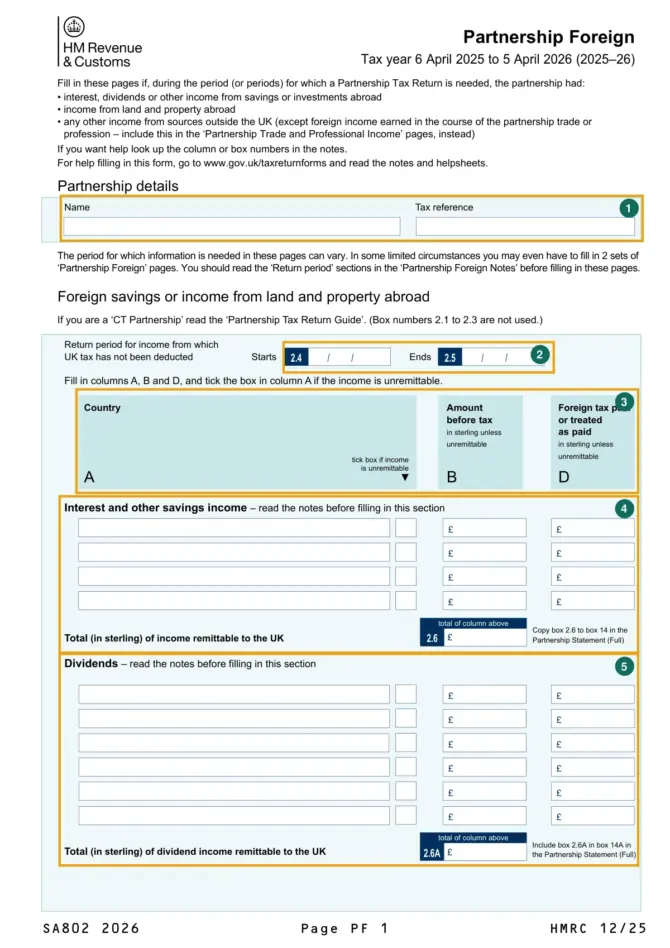
| Box or row | What to enter | Where it goes next |
|---|---|---|
| Name, tax reference | The partnership name and its tax reference | Repeat on every copy of page PF 3 |
| 2.4, 2.5 | Start and end of the return period (see above) | Same as SA800 boxes 3.4 and 3.5 for a trading partnership |
| Interest and other savings income | One line per account, loan stock, loan or fund, with country, gross amount and foreign tax | Total in 2.6 |
| 2.6 | Total in sterling of remittable interest and savings income | SA800(PS) box 14 |
| Dividends | One line per foreign company or offshore fund constituted as a company | Total in 2.6A |
| 2.6A | Total in sterling of remittable dividend income | SA800(PS) box 14A |
| Income from land and property | Profit from pages PF 3 and PF 4, with the foreign tax | Total in 2.7 |
| Chargeable premiums | Taxable part of any lease premium (working sheet below) | Total in 2.7 |
| 2.7 | Total of column B on page PF 2 | SA800(PS) box 17 |
| 2.8 | Total of all column D entries on pages PF 1 and PF 2 | SA800(PS) box 28 |
| 2.8A | ‘X’ if the property figures use traditional accounting and not the cash basis | Stays on SA802 |
| 2.9 | Offshore fund disposals charged as income | SA800(PS) box 18 |
| 2.10 | Loss on foreign let property, from box 2.29 or 2.34 | SA800(PS) box 21 |
| 2.10A | Residential property finance costs, from box 2.30A or 2.33A | SA800(PS) box 27 |
The interest section takes interest from foreign bank accounts, foreign company loan stocks and loans to people or organisations outside the UK. Interest from an overseas unit trust or fund is taken from the fund’s tax voucher, and income automatically reinvested in the fund may still have to be entered. Other income from overseas savings and investments also goes here, including gains on life assurance policies, life annuities and capital redemption policies. A distribution from an offshore fund with more than 60% of its assets in interest-bearing or economically similar form is treated as yearly interest, so it goes in the interest section and not under dividends.
The dividends section excludes distributions made in the liquidation of a foreign company, returns of the partnership’s capital, distributions in the company’s own shares, stock dividends and bonus shares from a stock dividend issue. A distribution of assets other than cash, such as shares the company held in another company, is entered at its value on the date of distribution. If the partnership took a cash option instead of shares, the cash is taxable and goes on page PF 1. For 2025-26 the notes give a dividend allowance of £500, which each partner applies to their own dividend income.
Unremittable income is income the partnership could not bring to the UK because of exchange controls or a shortage of foreign currency in the other country. For each such item, tick the box between columns A and B, enter the income and the foreign tax in the foreign currency with the £ sign crossed out, and leave both out of the totals at the foot of each column. The partners can then claim that this income is not taxed for 2025-26. Income that was unremittable in an earlier year and can now be remitted counts as arising in 2025-26 whether or not it is actually brought over, converted at the exchange rate on the day it became remittable.
Overseas let property: pages PF 3 and PF 4
Complete PF 3 and PF 4 before you write anything in the property rows of page PF 2. One page PF 3 is enough if the partnership had one overseas let property, or several in the same country with all the income remittable, or several in different countries with no foreign tax deducted and all the income remittable. If any of the rent was unremittable, or the properties were in different countries and some foreign tax was deducted, page PF 3 says to fill in a copy for each letting, with the partnership name and tax reference next to the address box on each copy.
| Box | What to enter |
|---|---|
| Address | Full address of the property, or of the first property; the others go in box 2.35 |
| 2.11 | Total rents and other receipts, without chargeable premiums. Include reverse premiums received as an inducement to take a property for letting. |
| 2.11A, 2.11B | Tick 2.11A if 2.11 covers more than one property; tick 2.11B if it includes unremittable income |
| 2.12 to 2.17 | Expenses: rent, rates, insurance and ground rents; repairs and maintenance; non-residential finance costs; legal and professional costs; services including wages; other expenses |
| 2.18, 2.19 | Total of 2.12 to 2.17, then 2.11 minus 2.18 (a loss in brackets) |
| 2.20, 2.21, 2.22 | Private use add-back, balancing charges, and their total |
| 2.21A, 2.21B, 2.21C | Electric charge-point allowance, Structures and Buildings Allowance, zero-emission car allowance |
| 2.23, 2.24, 2.25 | All other capital allowances, costs of replacing domestic items, and the total of 2.21A, 2.21B, 2.21C, 2.23 and 2.24 |
| 2.26, 2.27 | Adjusted profit (2.19 plus 2.22 minus 2.25), or 0 in 2.26 and the loss in 2.27 |
| 2.28 to 2.30A | One page PF 3 only: profit to column B on PF 2, loss to 2.10, foreign tax to column D, residential finance costs to 2.10A |
| Grid, 2.31 to 2.34 | Several pages PF 3: one line per property with country, profit or loss, foreign tax, amount chargeable and residential finance costs; totals in 2.31, 2.32, 2.33 and 2.33A, or an overall loss in 2.34 |
| 2.35 | Additional information, such as the addresses of further properties and first-time Structures and Buildings Allowance details |
Rent counts when it is earned under traditional accounting: rent paid in arrears after 5 April 2026 for the year belongs in 2.11, and rent paid in advance for a period after that date does not. Receipts other than rent are taxable too, for example ground rents, sporting rights, payments for tipping waste and a fee from a film crew using the land. If total property income before expenses is under £90,000, you can put all the expenses in box 2.17 as one figure.
The cash basis is open only to partnerships whose partners are all individuals, and receipts over £150,000 for the tax year mean traditional accounting is compulsory. Under the cash basis no capital allowances can be claimed except on cars. You tell HMRC each year by putting ‘X’ in box 2.8A when traditional accounting was used, and any transitional receipts or expenses after a change go in boxes 2.11 and 2.17.
For a residential let, non-corporate partners cannot deduct loan interest or the cost of arranging finance for 2025-26. Box 2.14 is only for non-residential property; the residential costs go in box 2.30A (one page PF 3) or 2.33A (several), then to 2.10A, and HMRC uses them to reduce the partners’ Income Tax. A partnership with both company and individual members works these costs out separately for the non-corporate partners only. Capital allowances are also not available on furniture, fixtures or appliances in a let dwelling house; replacing a domestic item such as a bed, carpet, fridge or crockery is claimed in box 2.24 instead, and only for a replacement, not the first item provided.
A lease premium for a lease over 50 years is treated as capital and not taxed as property income. For a lease of up to 50 years, page PFN 7 of the notes has a working sheet: take the premium (A), count the complete 12-month periods in the lease ignoring the first 12 months (B), work out 50 minus B (C), divide C by 50 (D), and multiply A by D (E). On a 10-year lease with a £20,000 premium, B is 9, C is 41, D is 0.82 and the chargeable premium is £16,400. Box E goes in the chargeable premiums row of column B on page PF 2, with any foreign tax apportioned to that taxable part in column D.
Where several properties are entered in the grid on page PF 4 and the partners will claim Foreign Tax Credit Relief, the notes say losses should be set off in the order most favourable, normally first against the property that suffered the lowest rate of foreign tax. The relief for each property cannot exceed the UK tax charged on the same income. Unremittable property income stays out of the “Taxable profit or loss” column.
Giving each partner their share of foreign income and tax
The SA800(PS) carries one total for each type of foreign income, but a partner claiming Foreign Tax Credit Relief needs their share of each item with its own foreign tax. The SA802 notes and page PTRG 28 of the SA850 tell the partnership to allocate every item of foreign income and the related tax to the partners, give each partner those details, and put a copy of the allocation in the same format in box 3.116 on page 3 of the SA800. Partners also need this breakdown if they share in income that could not be remitted.
Take a partnership of two partners sharing profits 60:40 that received £4,000 of interest from an account in one country, with £600 of tax withheld, and £1,500 of dividends from a company in another country, with £225 of tax withheld. The 60% partner is told £2,400 of interest with £360 of tax and £900 of dividends with £135 of tax; the 40% partner gets £1,600 with £240 and £600 with £90. The SA802 itself still shows £4,000 in 2.6, £1,500 in 2.6A and £825 in 2.8.
When SA802 is due and what late filing costs
SA802 has no filing date of its own: it goes in with the SA800, and the SA850 says the supplementary pages must reach HMRC on time with the rest of the return. For 2025-26 that is 31 October 2026 on paper or 31 January 2027 online. If HMRC gave notice to file after 31 July 2026 but on or before 31 October 2026, the date is the later of three months from the notice for a paper return or 31 January 2027 online; for a notice after 31 October 2026 it is three months from the notice either way. Where a company is a partner, the date depends on the partnership’s accounting period; section 12AA of the Taxes Management Act 1970 sets the earliest date a notice can give at nine months after the end of the relevant period for a paper return and twelve months for an online return.
A late Partnership Tax Return costs each partner who was a member during the return period £100. After three months HMRC adds £10 a day for up to 90 days (£900), after six months £300, and after twelve months a further £300. If the return is wrong through a failure to take reasonable care, each partner can face a penalty of 30% to 100% of the tax understated, and the SA850 says this could be up to 200% if the undeclared income arose outside the UK.
Before you send the SA800
- Each foreign item on its own line, with country, gross amount and foreign tax in sterling
- Unremittable items ticked, entered in the foreign currency and left out of every total
- Boxes 2.4 and 2.5 matching SA800 boxes 3.4 and 3.5, or 6/4/2025 to 5/4/2026 for an investment partnership
- Pages PF 3 and PF 4 completed before the property rows on page PF 2
- Box 2.8A marked ‘X’ if the property figures use traditional accounting
- 2.6, 2.6A, 2.7, 2.8, 2.9, 2.10 and 2.10A copied to boxes 14, 14A, 17, 28, 18, 21 and 27 of the SA800(PS)
- Amounts rounded as the SA850 asks: income down and tax credits up to the nearest pound, with no “per attached” or “to follow” entries
- Item-by-item allocation given to the partners and copied into box 3.116
Signing the SA800 and getting the SA802 form
SA802 has no signature box. In Question 11 on page 8 of the SA800, tick “Partnership Foreign” among the pages you are sending, and the nominated partner signs the declaration that the information is correct and complete. If someone signs for another person, the capacity (for example, executor or receiver) goes in the declaration and the names and addresses in box 3.116.
A paper return goes to the HMRC office shown on the front of the SA800. Filing online needs registration for Self Assessment Online for Partnerships and commercial software, and the SA800 says an online return gets an instant acknowledgement of receipt.
The 2026 SA802 PDF and its 12-page notes are on the GOV.UK SA802 page, together with the editions for 2023, 2024 and 2025 and a Welsh version, Partneriaeth Tramor. The SA800 and the SA850 guide are on the SA800 publication page. The notes point to Helpsheet 380 for the wider rules on partnership foreign income and to the Self Assessment Helpline, 0300 200 3310.
Official PDF: SA802 — Official PDF (assets.publishing.service.gov.uk)
Sources
- HMRC SA802 2026, Partnership Foreign, HMRC 12/25
- HMRC SA802 Notes 2026, Partnership Foreign notes, HMRC 12/25
- HMRC SA800 2026, Partnership Tax Return
- HMRC SA850 Notes 2026, Partnership Tax Return Guide, HMRC 12/25
- HMRC SA800(PS) 2026, Partnership Statement (full)
- Self Assessment: Partnership Foreign (SA802), GOV.UK
- Self Assessment: Partnership Tax Return (SA800), GOV.UK
- Taxes Management Act 1970, section 12AA, legislation.gov.uk