SA902 is the supplementary set of pages a trustee or personal representative adds to the SA900 Trust and Estate Tax Return when the trust or estate was a partner in a business. The 2026 edition, printed HMRC 12/25, covers the tax year 6 April 2025 to 5 April 2026. GOV.UK lists it as Trust and Estate Partnership, while page TP 1 of the PDF carries the heading “Trust and Estate Trade Partnership”. There are two pages, TP 1 and TP 2, with boxes 2.1 to 2.25, and the starting figures come from the Partnership Statement that the partnership itself produces with its SA800 return.
Who needs the SA902 pages
Question 2 on page 3 of the SA900 asks whether the trust or estate made any profit or loss, or had any other income, from a partnership. According to the SA902 notes, the pages are needed if at any time during 2025-26 the trust or estate was entitled to a share of profits, losses or income from a business it carried on in partnership. The notes also remind trustees and personal representatives that they are jointly responsible with the other partners for the partnership’s own tax return for the year.
One set of SA902 pages covers one Partnership Statement. The partnership prepares a separate statement for each partnership the trust or estate belonged to, for each business if the partnership ran more than one, and for income it received as a member of another partnership. You can photocopy the blank pages or download more copies; write the trust or estate name and tax reference at the top of each one.
If the trust or estate ran the same business as a sole trade for part of the year and in partnership for the rest, the notes give a four-step test. The change itself is not a start or end date for boxes 2.3 and 2.4. If the accounts for a period ending in 2025-26 were returned in the Partnership Tax Return, you complete SA902 and include the sole-trade periods in the box 2.8 adjustment. If they were not, the figures go in boxes 1.14 to 1.115 of the Trust and Estate Trade pages (SA901) and SA902 is left out.
Gains on partnership assets do not go on SA902. The trust’s or estate’s share of the proceeds belongs on the Trust and Estate Capital Gains pages, unless the total value of all assets it disposed of in 2025-26 (through the partnership or otherwise) was no more than £50,000 and the total chargeable gains do not exceed the £1,500 annual exempt amount.
Where the figures come from: the Partnership Statement
The partnership’s SA800 return contains a summary of each partner’s share of profits, losses and income for the period of membership. That summary is the Partnership Statement, and step 3 on the SA800(PS) says each partner needs a copy of their own allocation. It comes in two versions. The short statement, on pages 6 and 7 of the SA800, is for partnerships whose only income was trading income and interest received without tax deducted from banks, building societies or other deposit takers. Every other partnership uses the full statement, SA800(PS). If the partnership made up accounts to more than one date in 2025-26, there may be a separate statement for each period.
The printed text beside each box of the Partnership Statement (“Copy this figure to box 8” and so on) refers to the individual partner’s personal tax return. A trust or estate ignores those instructions and follows the copying tables on pages TPN 5 and TPN 6 of the SA902 notes, which point to SA902 and to pages 4, 5 and 11 of the SA900. The table further down this guide follows them.
Partnership rental profits are an example. The partnership reports UK rents on its SA801 partnership UK property pages, the result reaches box 19 of the full statement, and the trust’s share is copied to box 9.19 of the SA900 if it is a profit or box 9.22 if it is a loss.
How to fill in SA902, box by box
Page TP 1 deals with the share of trading or professional income; page TP 2 deals with investment income and has the additional information box. Boxes 2.5, 2.6, 2.9 to 2.11, 2.14A and 2.14B are printed as not in use.
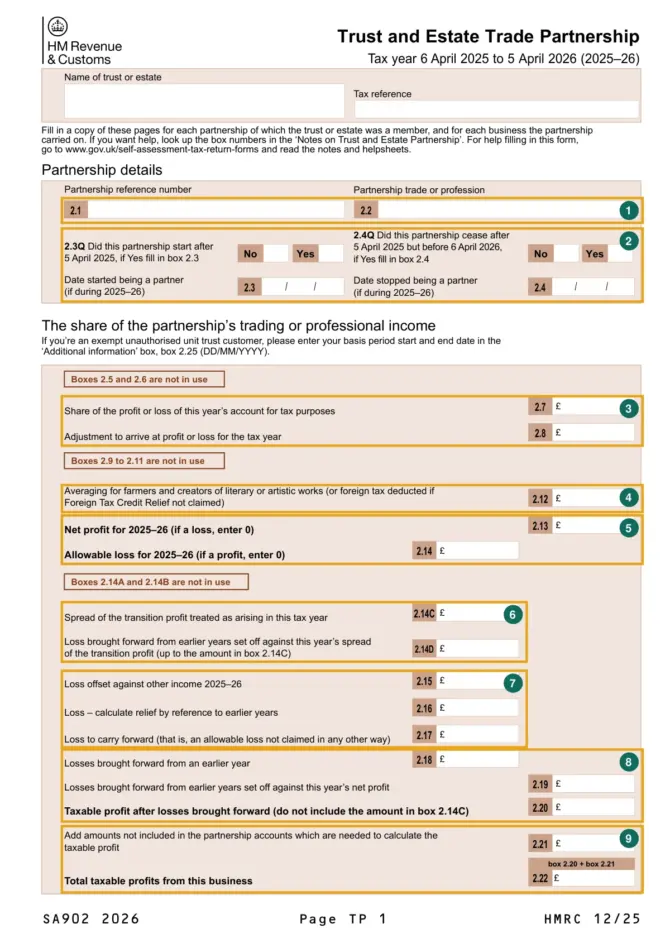
| Box | What to enter | Where the figure comes from |
|---|---|---|
| 2.1 | Partnership reference number. For a foreign partnership with no reference, enter the trust’s or estate’s own UTR instead. | The partnership’s tax reference |
| 2.2 | Description of the partnership trade or profession, for example “farming”. | Partnership records |
| 2.3Q, 2.3 | Yes if the trust or estate became a partner after 5 April 2025, with the date in 2.3. | Box 7 of the statement shows the appointment date |
| 2.4Q, 2.4 | Yes if it stopped being a partner before 6 April 2026, with the date in 2.4. | Box 9 of the statement shows the date it ceased |
| 2.7 | Share of the profit or loss of the accounting periods ending in 2025-26, combined if more than one ended. Leave blank if none ended in the year. | Statement box 11 (profit) or 12 (loss) |
| 2.8 | Adjustment from the accounting period figure to the profit or loss of the tax year. A deduction goes in brackets. No transition profit here. | Your own calculation (Helpsheet 222) |
| 2.12 | Averaging adjustment for farmers and creators of literary or artistic works, or foreign tax deducted if Foreign Tax Credit Relief is not claimed on the foreign pages. | Helpsheet 224 for farming averaging |
| 2.13, 2.14 | Net profit in 2.13 and 0 in 2.14, or the loss in 2.14 and 0 in 2.13. | 2.7 with the adjustments in 2.8 and 2.12 |
| 2.14C | Spread of transition profit charged this year: 33.3% of the remaining amount, or more if you elect to accelerate. | Basis period reform figures from 2023-24 |
| 2.14D | Trade losses brought forward set against the spread transition profit, up to 2.14C. | Earlier returns |
| 2.15 | Part of the 2025-26 loss set against other income of 2025-26. | Helpsheet 227 |
| 2.16 | Loss for which relief is to be calculated by reference to an earlier year or years. | Helpsheet 227 |
| 2.17 | Loss of 2025-26 not claimed any other way, carried forward against later profits. | The 2.14 loss |
| 2.18 | Unused losses of the same business brought forward from earlier years. | Earlier returns |
| 2.19 | Amount of those losses set against this year’s profit, no more than 2.13. | 2.18, capped at 2.13 |
| 2.20 | 2.13 minus 2.19. | Calculation |
| 2.21 | Amounts left out of the partnership accounts, and so out of the Partnership Tax Return, that are needed to work out the taxable profit. | The trust’s or estate’s own records |
| 2.22 | Total taxable profits from this business: 2.20 plus 2.21 only, never the 2.14C amount. | Calculation |
| 2.23 | Tick if the partnership had investment income; the share is then entered in the Question 9 boxes of the SA900. | Statement boxes listed in the next section |
| 2.24 | Share of losses on partnership investments. | Full statement box 21 |
| 2.25 | Additional information: foreign tax figure from 2.12, acceleration election for 2.14C, basis period dates for exempt unauthorised unit trusts. | Your own details |
The share in box 2.7 is the amount shown in the Partnership Statement, with no changes other than those the notes allow in boxes 2.8 and 2.12. The rules for trading income are applied to the share as if it came from a “notional” business carried on alone, which starts on the date the trust or estate became a partner and stops on the date it left. An estate taxable on the remittance basis on overseas profits enters in box 2.7 the share worked out under the rules for non-residents, which is the UK profit only.
When the partnership cannot prepare the accounts needed for the box 2.8 adjustment before the filing date, enter a provisional amount, tick box 21.5 on the SA900 and say in box 21.9 which boxes are provisional. The notes ask you to add there why final figures were not available and roughly when you expect to send them.
If you dispute the trust’s or estate’s share of the partnership profit or loss, the notes still require the statement figure in box 2.7. You then refer the dispute to the Tribunal Service and tell both the nominated partner and HMRC that you have applied. HMRC suggests trying to settle it with the nominated partner first.
Transition profits in box 2.14C only arise if the trust or estate became a partner before 6 April 2022 and was affected by basis period reform in 2023-24. Any untaxed remainder is spread over the next three tax years. If losses brought forward are bigger than the transition profit, the rest can be used against the net profit in box 2.18 or carried forward. Some claims must be made by 31 January 2028, and the notes warn that late claims cannot usually be accepted.
Copying the Partnership Statement to SA902 and the SA900
Only the trading result goes on page TP 1. The rest of the share is spread across the SA900 itself, mostly into Question 9 on pages 4 and 5. Page TP 2 refers to boxes 9.1 to 9.26 and the 2026 SA900 ends Question 9 at box 9.26; the notes mention boxes 9.1 to 9.40, a range the 2026 return does not have. All partners return investment income for the year to 5 April 2026, so shares for the partnership’s accounting periods may need converting to the tax year, as Helpsheet 222 explains.
| Statement box | What it holds | Copy to |
|---|---|---|
| 11 or 12 | Share of trading profit or loss | SA902 box 2.7 |
| 11A | Adjustment on change of basis | Not applicable |
| 13, 14 | Untaxed UK savings income, untaxed foreign savings income | SA900 box 9.1 |
| 14A | Foreign dividends | Not applicable |
| 15, 17, 23 | Other untaxed UK income, income from land and property abroad, other taxed income | SA900 box 9.19 |
| 16 | Loss from other untaxed UK income | SA900 box 9.22 |
| 18 | Income from offshore funds | SA900 box 9.24 |
| 19 | Profit or loss on UK property | SA900 box 9.19 (profit) or 9.22 (loss) |
| 21 | Loss on foreign let property | SA902 box 2.24 |
| 22 | Taxed savings income | SA900 box 9.4 |
| 22A | Dividend income | SA900 box 9.10 |
| 24, 24A | Construction industry deductions, other tax taken off trading income | SA900 box 9.18 |
| 25 | UK Income Tax | SA900 box 9.8 |
| 26, 27 | Finance costs on UK and foreign residential property | See the residential finance costs rules below |
| 29 | Partnership trade charges | See the charges note below |
| 30 | Proceeds from disposals of chargeable assets | Not applicable (capital gains pages) |
From the short statement only boxes 11, 11A, 12, 13, 24, 24A and 29 can carry figures, and they follow the same routes. Box 28 of the full statement (foreign tax paid) has no instruction for trusts and estates in the copying table. Separately, the notes for box 2.12 say that is where to claim credit for foreign tax deducted when relief is not being claimed on the Trust and Estate Foreign pages.
For partnership charges in box 29, the copying tables tell trustees and personal representatives to copy the share to box 10.1A of the SA900 and make a note in the additional information box on page 12. On the 2026 SA900 and in the SA950 guide, box 10.1A is labelled as personal representatives’ interest on loans and alternative finance payments to pay Inheritance Tax, and no other box is named for partnership charges. A trustee with an entry in box 29 should therefore confirm the treatment with HMRC before filing.
No residential property finance costs are deductible for 2025-26. If the partnership has a UK property business, the notes ask an accumulation or discretionary trust to give, in box 21.9 of the SA900, the UK property profit from box 19 and the residential finance costs from box 26 of the SA800(PS), labelled “residential property finance costs restriction UK”; for foreign property, boxes 17 and 27 with the label “residential property finance costs restriction foreign”. HMRC then calculates the basic rate tax reduction. The same notes also tell you to tick box 17.3, but on the 2026 SA900 that box is for tax overpaid for earlier years, so ask HMRC which box to tick. For an interest in possession trust or a deceased person’s estate, the beneficiaries use the finance costs instead, and you give them the profit and finance cost figures for each property business.
For property income, an accounting period ending on any day from 31 March to 4 April can be treated as ending on 5 April, so the profit is reported without apportioning the last few days.
When the SA900 and SA902 pages are due
SA902 has no filing date of its own. The SA950 guide says the supplementary pages you need must come back on time with the rest of the SA900, or HMRC charges an initial automatic penalty of £100 and more for continued delay. For 2025-26 the dates are:
- 31 October 2026 for a paper Trust and Estate Tax Return, and for any return where you want HMRC to calculate the tax
- 31 January 2027 for a return filed online
- 31 January 2027 to pay the balance of the tax for 2025-26 and any first payment on account for 2026-27
If the SA900 was issued after 31 July 2026, page 1 of the return gives you until the later of those dates or three months after the date of issue. A paper return that misses 31 October 2026 can still be filed online by 31 January 2027 without a penalty, provided the paper return was not sent first. A late return costs £100 even if no tax is due. After three months HMRC adds £10 a day for up to 90 days (£900); after six months £300 or 5% of the tax due, whichever is higher; after twelve months a further £300 or 5%, or more if information is deliberately withheld.
HMRC normally has until 31 January 2028 to open an enquiry into the Partnership Tax Return, and the notes ask you to keep the records used for the return until at least 31 January 2032.
Before you send the return
- One set of SA902 pages for each Partnership Statement, with the trust or estate name and tax reference on every copy
- Box 2.1 holds the partnership reference, or the trust’s or estate’s own UTR for a foreign partnership
- Box 2.22 equals 2.20 plus 2.21, without the 2.14C transition profit
- Box 2.23 ticked if the partnership had investment income, and the shares entered in Question 9 of the SA900
- Provisional figures flagged with box 21.5 and explained in box 21.9
- Amounts rounded as the SA950 guide asks: income down and tax deducted up to the nearest pound, with no “per attached” or “to follow” entries
- “Trust and estate partnership” ticked in Question 22 on page 12 of the SA900
Signing the SA900 and getting the SA902 form
SA902 has no signature box. Under Question 22 on page 12 of the SA900, tick the box for each set of pages you are sending, including “Trust and estate partnership”, then sign and date box 22.1, print your name in box 22.2 and enter the capacity in which you are signing (trustee or personal representative, for example) in box 22.3. The SA950 guide says you must sign yourself even when an accountant or another tax practitioner filled the return in.
Send the paper return back to HMRC with any loose supplementary pages; the phone number of your HMRC office is printed on the front of the SA900. Filing online first needs registration for Self Assessment Online for Trusts and commercial software bought from a third party, and an online return gets an immediate acknowledgement of receipt. You can file online even if HMRC sent you a paper return.
The 2026 SA902 PDF and its six-page notes are on the GOV.UK SA902 page, which also keeps the editions for 2023, 2024 and 2025. The SA900 and the SA950 Trust and Estate Tax Return Guide are on the SA900 publication page. The notes refer to Helpsheets 220 (more than one business), 222 (taxable profits), 224 (farmers and market gardeners) and 227 (losses) for the detailed rules.
Official PDF: SA902 — Official PDF (assets.publishing.service.gov.uk)
Sources
- HMRC SA902 2026, Trust and Estate Partnership, HMRC 12/25
- HMRC SA902 Notes 2026, Notes on Trust and Estate Partnership, HMRC 12/25
- HMRC SA900 2026, Trust and Estate Tax Return
- HMRC SA950 Notes 2026, Trust and Estate Tax Return Guide, HMRC 12/25
- HMRC SA800(PS) 2026, Partnership Statement (full)
- Self Assessment: Trust and Estate Partnership (SA902), GOV.UK
- Self Assessment: Trust and Estate Tax Return (SA900), GOV.UK
- Taxes Management Act 1970, section 8A, legislation.gov.uk