A new building on land you have opted to tax is covered by that option unless you exclude it. VAT1614F notifies HMRC that you want the new building excluded. The exclusion also covers the land within that building’s curtilage, but the new building must itself be outside the curtilage of an existing building.
Who can use VAT1614F?
Use this form when you construct a new building on opted land and want to exclude it from the existing option. Paragraph 2.7 of VAT Notice 742A sets out the conditions. An extension to an existing opted building is covered by the option; the notice also has separate rules for linked buildings. Check those rules before treating a development as a separate new building.
Exclusion permanently removes the new building from the existing option. You can make a fresh option later, with HMRC permission if required. Excluding the building can affect recovery of VAT on construction costs; section 9 of the notice deals with input tax.
When does the exclusion take effect?
Construction must have begun before you notify the exclusion. For this purpose, paragraph 2.7.2 defines commencement as work progressing above foundation level, normally when the first brick is laid.
The exclusion takes effect at the earliest of the first grant of an interest in the building, first use of the new building or any part of it, and completion. Notify HMRC normally within 30 days of that effective date. HMRC may allow longer in exceptional circumstances. The construction-start date and the date the exclusion takes effect answer different questions; record the relevant events before completing the date field.
How to fill in the opter, land and building sections
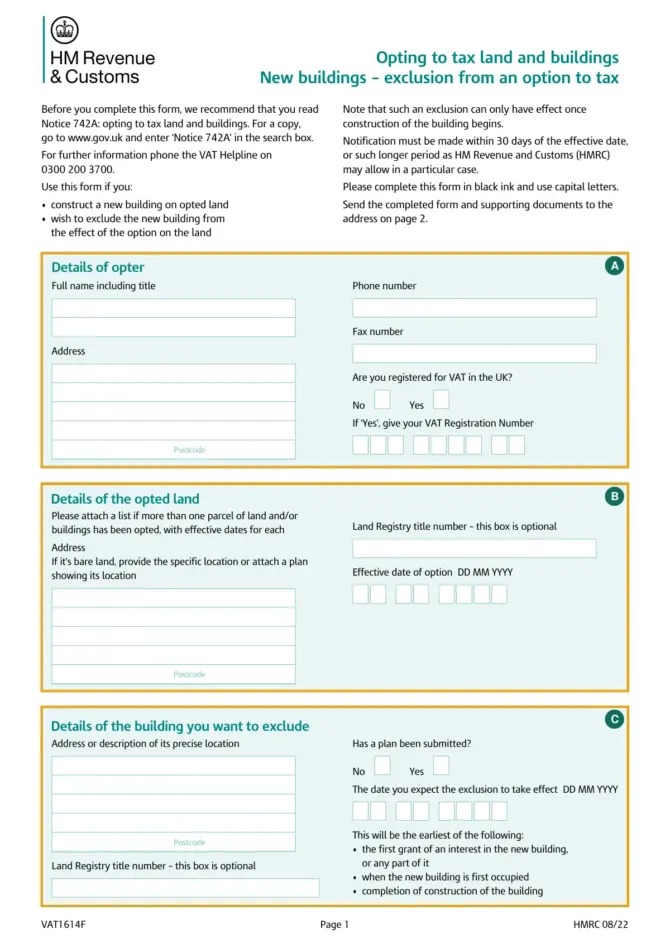
The three outlined areas in the illustration are labelled A to C for this guide. The form itself uses section headings. For a paper copy, HMRC asks for black ink and capital letters.
| Area | What to enter | Records to use |
|---|---|---|
| A: details of opter | Full name and title, address and postcode, telephone and fax number. Answer the UK VAT-registration question and give the registration number if registered. | The records of the person or entity that made the option. |
| B: opted land | Address and postcode, or the precise location or a plan for bare land; effective date of the option. The Land Registry title number is optional. | Original option notification and property records. Attach a list with the respective effective dates if more than one parcel or building was opted. |
| C: new building | Address or precise location, postcode, optional title number, whether a plan has been submitted, and the expected effective date of exclusion. | Development plans and the grant, occupation and completion dates relevant to paragraph 2.7.3. |
Who signs the declaration?
Page 2 asks for the signature, full name including title, date of notification and the signer’s status, such as director, company secretary, sole proprietor, partner or trustee. Answer both questions about whether a letter of authority is attached or has already been submitted.
If someone outside the listed capacities signs, the form requires signed authority to act. Attach the letter if HMRC has not already received it. Form 64-8 alone does not authorise an agent to sign for a client. Paragraph 7.6 of Notice 742A gives the authorised-signatory rules for different legal entities.
Official VAT1614F PDF and where to send it
Download the two-page VAT1614F PDF, HMRC 08/22, linked from HMRC’s publication page. Page 2 permits scanned copies by email to optiontotaxnationalunit@hmrc.gov.uk. Its postal destination is BT VAT, HM Revenue and Customs, BX9 1WR. Include the supporting documents and any required authority letter.
For questions about the form, the printed VAT Helpline number is 0300 200 3700. For a building being converted into dwellings, VAT1614D addresses a different certificate procedure; it does not replace a VAT1614F exclusion notification.