SA903, Trust and Estate UK Property, is the pair of supplementary pages (TL 1 and TL 2) that trustees and personal representatives add to the SA900 Trust and Estate Tax Return when a trust or estate lets land or buildings in the UK. The 2026 edition, printed HMRC 12/25, is for rent and other property receipts in the tax year 6 April 2025 to 5 April 2026. HMRC publishes it with a six-page set of notes (SA903 Notes 2026, pages TLN 1 to TLN 6) that the box numbers below follow.
When a trust or estate needs the UK property pages
Question 3 on page 3 of the SA900 asks whether the trust or estate received any UK property income. A Yes there means filling in SA903 if the trust or estate had any of these:
- rent and other receipts from land and property in the UK
- chargeable premiums from leases of UK land
- a reverse premium
The notes treat every letting by the trust or estate in the same capacity as one rental business, whether there is a single flat or a large portfolio, so all of it goes on one set of pages. That covers, for example, trustees letting a house held in trust, or executors letting the deceased’s flat while the estate is being administered. Some things stay off SA903:
- Land or property abroad. That income belongs on the SA904 Trust and Estate Foreign pages, and Foreign Tax Credit Relief is claimed on page TF 3.
- Property held in strict settlement under the Settled Land Act 1925, or property whose letting and management has been delegated to a beneficiary under section 29(1) of the Law of Property Act 1925 or section 9 of the Trusts of Land and Appointment of Trustees Act 1996. The notes say the tenant for life usually runs that rental business and reports it on their own return.
- Land used for a business such as canals, docks, mines and quarries (including sand and gravel pits), markets and fairs, tolls, bridges or ferries. These go on the Trust and Estate Trade pages.
- Dividends and distributions from Real Estate Investment Trusts or Property Authorised Investment Funds, which the page heading excludes; SA950 sends property income distributions to boxes 9.17 to 9.19 of the SA900.
Which year, which accounts, and cash basis for estates
The pages cover profits arising from 6 April 2025 to 5 April 2026. If the property accounts end on that date, copy the figures across. Accounts ending on any day from 31 March to 4 April can be treated as ending on 5 April, so you do not apportion those last few days. Accounts made up to any other date have to be apportioned so the figures cover exactly 6 April 2025 to 5 April 2026. Without accounts, you work out the profit under generally accepted accounting practice or, for an estate, on the cash basis.
Only estates can use the cash basis; trusts cannot. Under it you count property income received and allowable expenses paid in the year, and leave out money owed to or by the estate at the year end. An estate whose property receipts are over £150,000 for the year must use traditional accounting. An estate that uses traditional accounting must say so each year by putting X in box 3.19A. With the cash basis, capital allowances cannot be claimed except on cars. If you change method, transitional receipts go in box 3.20 and transitional expenses in box 3.29.
How to fill in SA903, box by box
Page TL 1 starts with the name of the trust or estate and its tax reference. Boxes 3.1 to 3.19 are printed as not in use, and the form says income and expenses from all let property go in boxes 3.19A to 3.47. Box 3.37 is not in use either. Losses are shown in brackets, and the SA900 rounding rule applies: no pence, income rounded down, tax deducted rounded up.
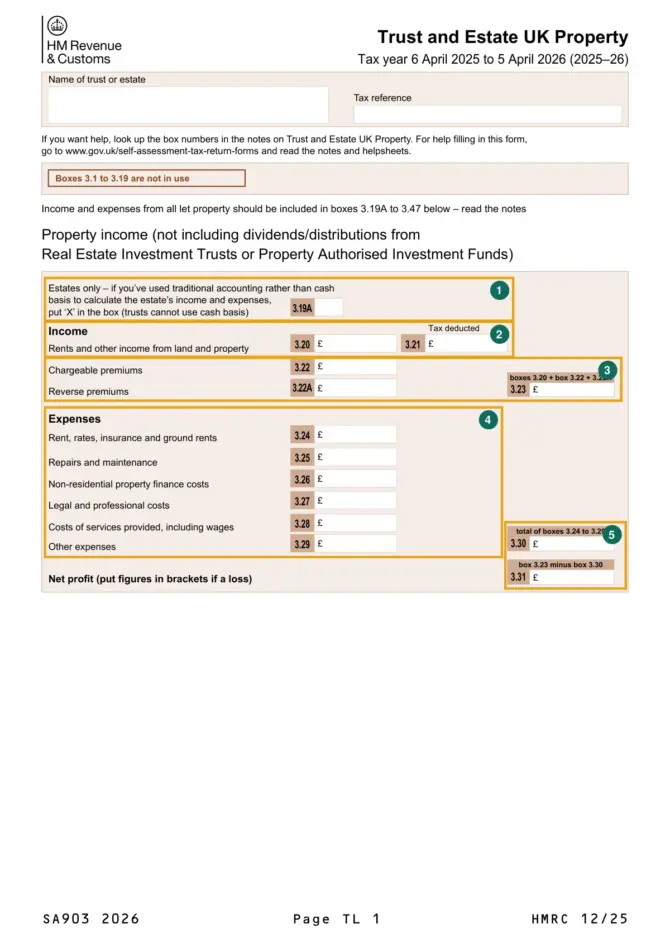
| Box | What goes in | Notes |
|---|---|---|
| 3.19A | X if an estate used traditional accounting | Trusts leave it blank |
| 3.20 | Rent and other income from land and property, including transitional receipts | Gross, before any tax deducted |
| 3.21 | Tax deducted from rent | Mainly where the landlord’s usual place of abode is outside the UK |
| 3.22 | Taxable part of a premium on a lease of up to 50 years | From the working sheet on page TLN 3 |
| 3.22A | Reverse premiums | Payment or benefit received as an inducement to take an interest in property for letting |
| 3.23 | Total income | 3.20 + 3.22 + 3.22A |
| 3.24 | Rent paid, business rates, Council Tax, water rates, ground rents, landlord’s insurance | All properties together |
| 3.25 | Repairs and maintenance | Not improvements or alterations |
| 3.26 | Finance costs for non-residential let property | Residential finance costs are not deducted here |
| 3.27 | Legal and professional costs | Allowable and non-allowable lists on page TLN 4 |
| 3.28 | Costs of services provided to tenants, including wages | Gardening, porterage, cleaning, communal hot water |
| 3.29 | Other expenses, transitional expenses, lease premium relief; or all expenses in one figure if income is under £90,000 | Wholly and exclusively for the letting |
| 3.30, 3.31 | Total expenses, then net profit (3.23 minus 3.30) | Loss in brackets |
| 3.32 to 3.34 | Private use adjustment and balancing charges, totalled in 3.34 | Add-backs |
| 3.33A to 3.36 | Charge points, Structures and Buildings Allowance, Freeport and Investment Zone SBA, zero-emission cars, other capital allowances, replacement domestic items | Totalled in 3.38 |
| 3.39, 3.40 | Adjusted profit, or 0 in 3.39 and the loss in 3.40 | 3.31 + 3.34 minus 3.38 |
| 3.41 to 3.44 | Loss brought forward, profit for the year, loss set against total income, loss carried forward | 3.42 = 3.39 minus 3.41 |
| 3.45 | X if the pages include property let jointly | Nominated record keeper’s details in SA900 box 21.9 |
| 3.46, 3.47 | Residential finance costs for the year, and unused costs brought forward | 3.46 only for accumulation or discretionary trusts |
When TL 2 is finished, the form sends you to any other supplementary pages that apply, or back to page 4 of the SA900.
Rent, premiums and tax deducted
Box 3.20 takes all rental income, furnished or unfurnished, residential or commercial, and from bare land, plus anything a tenant pays for the use of furniture. Under traditional accounting, income counts when it is earned: rent for the year to 5 April 2026 paid in arrears after that date goes in, and rent paid in advance for a later period stays out. Do not count money received this year that was already included in an earlier year.
Other receipts are taxable too. The notes list rent charges, ground rents and feu duties, sporting rights, letting others tip waste on the land, one-off payments such as a film crew paying to film on the land, and local authority grants towards repairs. Way leaves go in box 3.20 when the trust or estate also receives rent from the same land; if the land is used in a trade, they go in box 1.50 of the Trade pages, and otherwise in boxes 9.17 and 9.19 of the SA900. Payouts from insurance against loss of rent are income for box 3.20, while the premium for that insurance is a cost for box 3.24.
If tenants or agents deducted tax, enter the tax in box 3.21 and make sure box 3.20 shows the gross figure, that is, the amount received plus the tax taken off.
Premiums. On a lease of over 50 years the whole premium is capital and stays off these pages. On a lease of up to 50 years, part is treated as rent, worked out on the TLN 3 working sheet:
- A: the premium
- B: complete 12-month periods in the lease, ignoring the first 12 months
- C: 50 minus B
- D: C divided by 50
- E: A multiplied by D, copied to box 3.22
Take a 15-year lease granted for a premium of £30,000: B is 14, C is 36, D is 0.72, and £21,600 goes in box 3.22. Trustees are charged at the trust rate of 45% on the premium treated as rent even if they normally pay only the basic rate, but the amount taxed at 45% cannot exceed the total profit in box 3.42. Where box 3.42 is larger than box 3.22, the difference is taxed at 20%; where it is nil, none of the premium is taxed at 45%. The notes warn that assigning a lease can create a premium charge even when no premium was asked for.
Expenses: what goes in which box
If total property income before expenses is under £90,000 for the year, you do not have to split expenses: one total goes in box 3.29. Above that, use boxes 3.24 to 3.29. Personal expenses of a trustee or personal representative, the cost of buying, altering or extending property, and losses on selling property are never allowable.
For legal and professional costs in box 3.27, the notes allow fees for lets of a year or less, management fees such as rent collection, normal fees for renewing a lease of less than 50 years, fees for evicting an unsatisfactory tenant in order to relet, fees for an appeal against a compulsory purchase order, and accountancy fees. They do not allow costs of a first letting for more than a year (lease drafting, agents’ and surveyors’ fees), the part of renewal costs that relates to a premium, planning permission fees, or title registration on purchase.
Loan interest and other finance costs are split by property type. For a non-residential let, they go in box 3.26 as an expense. For residential lets in 2025 to 2026, no residential property finance costs are allowed as a deduction. What happens to them depends on who is filing:
- Accumulation or discretionary trusts enter the residential finance costs in box 3.46; they are used to work out a basic rate tax reduction. Unused costs from earlier years go in box 3.47 and any still unrelieved balance carries forward.
- Interest in possession trusts and estates leave box 3.46 empty. The beneficiaries claim the basic rate reduction, so you have to give them the profit of each property business and the finance costs that belong to it.
Where the trust or estate is itself a tenant subletting the property and a premium was paid for its lease, part of that premium may be deductible as lease premium relief in box 3.29. HMRC’s notes suggest asking them or a tax adviser before claiming.
Private use, capital allowances and losses
If a trustee or personal representative uses a let property for part of the year, either enter only the business share of each cost, or enter the full cost and add back the private part in box 3.32. For a cottage let for 9 months and used privately for 3, you could put the whole year’s insurance in box 3.24 and add back a quarter of it in box 3.32.
Capital allowances work differently for houses and flats. For a dwelling house, no capital allowances are given on the building, furniture, furnishings or appliances; instead, box 3.36 takes the cost of replacing a domestic item, such as a bed, carpets, curtains, a fridge or crockery, provided the old item is no longer available and the new one is solely for the tenants. You cannot claim the first purchase of an item, and an upgrade is limited to the cost of an equivalent replacement unless the new item is simply the nearest modern equivalent. Furnished lettings that are not residential can have capital allowances instead, but not both.
The allowance boxes for other property are:
- 3.33A: 100% first year allowance on new, unused electric vehicle charge points
- 3.33B: Structures and Buildings Allowance; for a first claim on a building, give the date it came into qualifying use (or the date of the expenditure, if later) and the total qualifying cost in SA900 box 21.9
- 3.33C: the enhanced allowance for Freeport and Investment Zone tax sites, with the site, the building’s address, the date of qualifying use and the date of the first construction contract in box 21.9
- 3.33D: 100% first year allowance on new, unused zero-emission or electric cars, reduced for any non-business use
- 3.35: all other capital allowances, including Business Premises Renovation Allowance on spending before 6 April 2017 (BPRA balancing events go in 3.33)
Buyers of second-hand business property with fixtures usually need the seller to have pooled the expenditure and fixed the value, normally by a joint section 198 CAA 2001 election made within 2 years of the transaction.
A rental loss is normally carried forward against future profits of the same rental business. Box 3.41 is the loss brought forward, taken from box 3.44 of last year’s pages. Box 3.43 is only for setting a loss against the trust’s or estate’s other income, and only where it comes from certain capital allowances or agricultural expenses (Helpsheet 251). That relief is capped at the lowest of capital allowances in box 3.35 less balancing charges in box 3.33, the loss in box 3.40, and the other income. Box 3.44 then shows what carries forward to 2026 to 2027.
Property let jointly with someone else
When the trust or estate owns a let property together with other people, only its share of the income goes in box 3.20 and its share of expenses in boxes 3.24 to 3.29. If you are told only the net figure after expenses, enter the profit share in box 3.20 and leave the expense boxes blank, or put a loss share in box 3.29. Put X in box 3.45, and give the name and address of the person nominated to keep the records in box 21.9 of the SA900.
Getting SA903 and sending it in
The 2026 pages and notes are on the GOV.UK SA903 publication page, which also keeps the 2023 to 2025 editions; a Welsh version can be requested from HMRC by email. SA903 is not filed on its own: GOV.UK tells you to include the supplementary pages you need with the SA900, and the SA900 declaration at Question 22 has a tick box for the UK property pages. The paper return was due by 31 October 2026 and an online return through commercial software is due by 31 January 2027.
For a figure the notes do not settle, such as whether a payment counts as a premium, HMRC’s Trust Helpline is 0300 322 9640 (+44 300 322 9640 from outside the UK); for an estate, the Deceased Estate Helpline is 0300 123 1071 (+44 300 123 1071), both Monday to Friday 9am to 5pm.
Official PDF: SA903 — Official PDF (assets.publishing.service.gov.uk)
Checks before the pages go with the return
- Every entry from the property accounts is transferred, and each is included only once.
- An expense that could fit two boxes goes in the same box as last year; the notes ask for consistency between years.
- Box 3.20 is gross where tax was deducted, with the tax in 3.21.
- Box 3.19A has an X if the estate used traditional accounting; trusts leave it blank.
- Residential finance costs are in 3.46 only for accumulation or discretionary trusts, and beneficiaries of other trusts and estates have their figures.
- Anything that needs explaining is in SA900 box 21.9. If the pages and box 21.9 still do not give a full picture, you can send accounts or calculations as well, but SA903 must still be completed.
Related forms
SA903 always goes with the SA900 return. Foreign property income goes on SA904, and a trade carried on from the land on SA901. For a house or land the deceased owned, its value for Inheritance Tax is given on a separate schedule, IHT405, with the IHT400; SA903 covers only the rent and costs after the death.
Questions about SA903
Do trustees fill in SA903 for a trust that owns one let house?
They do. The notes say the pages apply to a trust or estate with one property to rent as well as to large rental businesses, and all lettings together form a single business.
Where did the furnished holiday letting boxes go?
Boxes 3.1 to 3.19 are printed as not in use on the 2026 pages, and the form puts income and expenses from all let property in boxes 3.19A to 3.47. The 2026 SA950 guide still names furnished holiday lettings under Question 3; the 2026 SA903 has no separate boxes for them, so if you are unsure how a former holiday let should be shown, ask the Trust Helpline or Deceased Estate Helpline.
Can an estate use the cash basis for rent?
An estate can, unless its property receipts for the year are over £150,000. Trusts cannot use the cash basis at all.
Sources
- SA903 2026 Trust and Estate UK Property (HMRC 12/25)
- SA903 Notes 2026, Notes on Trust and Estate UK Property (HMRC 12/25)
- Self Assessment: trust and estate UK property (SA903), GOV.UK
- SA900 2026 Trust and Estate Tax Return (HMRC 12/25)
- SA950 Notes 2026, Trust and Estate Tax Return Guide
- Self Assessment: Trust and Estate Tax Return (SA900), GOV.UK
- IHT405, houses, land, buildings and interest in land, GOV.UK