SA900 is the Self Assessment return that trustees and personal representatives (executors and administrators) send to HMRC for the income and capital gains of a trust or of an estate in administration. The 2026 edition, printed HMRC 12/25, covers the tax year 6 April 2025 to 5 April 2026. HMRC sends pages 1 to 12; anything the trust or estate received beyond savings, dividends and other basic income goes on separate supplementary pages that you add to it.
Who has to send an SA900
Page 1 is a formal notice: it “requires you by law” to send a return of income and disposals of chargeable assets for the year. The legal basis for a trustee’s return is section 8A of the Taxes Management Act 1970, which lets an HMRC officer give the notice to any one trustee or to each of them.
For trusts, GOV.UK says that once a trust becomes liable for tax you must register it, and then report its income and gains on a trust and estate return after the end of each tax year. Where there are two or more trustees, one is nominated as the “principal acting trustee” to manage the tax, but the others remain accountable if the trust does not pay. A bare trustee does not need to send a return. The SA950 guide allows a bare trustee to complete one anyway to account for basic or lower rate tax on income received gross, if every beneficiary agrees, but capital gains and life policy gains stay on the beneficiaries’ own returns.
For a deceased person’s estate, the SA900 covers income the estate produced after the death. Income earned before the death goes on the deceased’s own Self Assessment return, which is a separate form. Not every estate needs an SA900. GOV.UK sets out three cases:
- From 6 April 2024, if the estate’s income from all sources is £500 or less in a tax year, you do not report it. Over £500, all of it is reported.
- A “simple” estate can settle its tax by letter to HMRC Bereavement Services at the end of the administration period (informal arrangements) if the estate was worth less than £2.5 million at death, total Income Tax and Capital Gains Tax is under £10,000, and no more than £500,000 of assets were sold in any one tax year.
- Any other estate must be registered online and an SA900 sent. For the 2025 to 2026 tax year the registration deadline was 5 October 2026; HMRC sends the estate’s Unique Taxpayer Reference within 15 working days of registration.
Deadlines, late filing and payment dates
The 2025 to 2026 return had two filing dates. A paper return, or any return where you want HMRC to work out the tax, had to reach HMRC by 31 October 2026. A return filed online has until 31 January 2027. To file online you need to buy commercial software that supports trust and estate returns; the GOV.UK form page says so directly. SA950 says that if you missed the 31 October paper date, you can still file online by 31 January 2027 without a penalty, provided you have not already sent the paper return.
If HMRC gave you the notice after 31 July 2026, the return is due by the later of the normal date and three months after the date of issue, and the tax is due by the same date. HMRC normally assumes the notice was delivered no more than 7 days after the issue date printed on the front.
Late filing penalties, from SA950 page 4:
- £100 as soon as the return is late, even if there is no tax to pay or the tax was paid on time
- over 3 months late: £10 a day for up to 90 days (£900)
- over 6 months late: a further £300 or 5% of the tax due, whichever is higher
- over 12 months late: another £300 or 5%, or up to 100% of the tax if information is deliberately withheld, and up to 200% where the undeclared income or gains arise outside the UK
Any tax owed for 2025 to 2026 is due by 31 January 2027, together with the first payment on account for 2026 to 2027 if one applies. Payments on account are normally half the previous year’s liability after tax deducted at source, due on 31 January in the tax year and 31 July after it. Tax not paid by 1 March 2027 attracts a 5% late payment penalty, with further 5% charges on tax unpaid after 2 August 2027 and after 2 February 2028. Interest runs from the due date in every case.
Step 1: questions you may be allowed to skip
Page 2 lists situations where most of the return can be left out. If one applies, you tick the box and go straight to Question 17 on page 10, which is where the tax calculation, repayment, contact and declaration questions are.
- A bare trust (other than an unauthorised unit trust) where the beneficiaries have absolute title to capital and income. If you choose to fill in the return anyway, do not tick the box.
- A personal representative whose estate had only UK income, all taxed before receipt, with no relief claims, no annual payments out of capital, no accrued income, deeply discounted securities, offshore income gains or untaxed policy gains, and no capital payments from a non-resident, dual resident or immigrating trust.
- An interest in possession trust (exclusively one) where there was no income, all income went straight to the beneficiaries, or the only income kept was UK income taxed at source, and a further list of conditions on page 2 also holds, including No at box 8.13, no added capital and no non-resident history.
In the second and third cases, if there were chargeable disposals you answer Questions 5 and 6 and then Questions 17 to 22. Charitable trusts follow part 4 of Step 1 and must also complete the charity pages: with full exemption you go to Question 7, answer Questions 10 and 11 if they apply, and complete Questions 19, 20 and 22.
Questions 1 to 7 and 23: which supplementary pages you need
Step 2 on page 3 is the checklist for extra pages. Each Yes means a separate set of pages, downloaded from GOV.UK and sent back with the return; the right-hand column of page 3 has a tick box for each set once you have it. If you use photocopies, put the trust’s or estate’s name and tax reference on each copy.
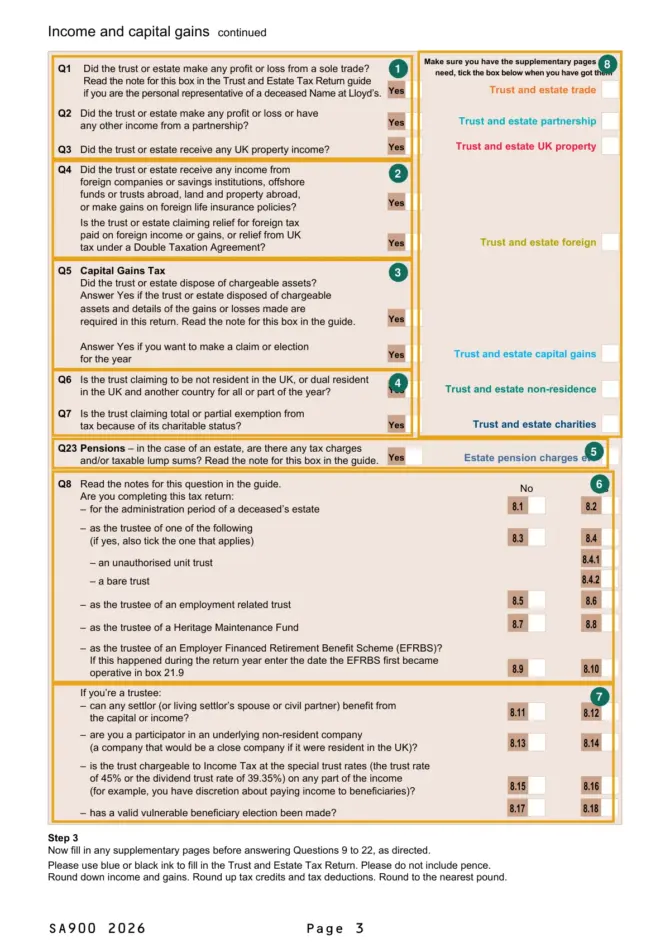
| Question | Answer Yes if, in 2025 to 2026, the trust or estate | Pages to add |
|---|---|---|
| Q1 | carried on a trade, profession or vocation on its own (personal representatives of a deceased Lloyd’s Name read the note first) | SA901 Trust and Estate Trade, or SA901L for Lloyd’s |
| Q2 | had a share of profit, loss or other income from a partnership | SA902 Trust and Estate Partnership |
| Q3 | received income from land and property in the UK | SA903 Trust and Estate UK Property |
| Q4 | had foreign company, savings, offshore fund, overseas trust or overseas property income, foreign policy gains, or is claiming foreign tax or treaty relief | SA904 Trust and Estate Foreign |
| Q5 | disposed of chargeable assets worth over £50,000, had gains above the annual exempt amount, or wants to claim a loss or make an election | SA905 Trust and Estate Capital Gains |
| Q6 | is claiming to be not resident, or dual resident, for all or part of the year | SA906 Trust and Estate Non-residence (fill these in first) |
| Q7 | is a trust claiming total or partial exemption as a charity | SA907 Trust and Estate Charities |
| Q23 | is an estate with pension tax charges or taxable lump sums (personal representatives only) | SA923 Estate Pension Charges etc |
SA950 puts the annual exempt amount for most trusts at £1,500 and for estates at potentially £3,000. A bare trust never fills in the capital gains pages; its gains belong on the beneficiaries’ returns. Only once the supplementary pages are done (Step 3) do you go on to Questions 9 to 22.
Question 8: what kind of return, and the rate of tax
Boxes 8.1 to 8.10 say what you are filing for: an estate’s administration period (8.2), an unauthorised unit trust or bare trust (8.4, with 8.4.1 or 8.4.2), an employment related trust (8.6), a Heritage Maintenance Fund (8.8) or an Employer Financed Retirement Benefit Scheme (8.10). For an EFRBS that first became operative during the year, put that date in box 21.9.
The trustee questions in boxes 8.11 to 8.18 decide which parts of pages 7 and 8 apply. The rates behind them, as SA950 gives them for 2025 to 2026:
- Personal representatives pay the basic rate (20%) and the dividend rate (8.75%), never the higher rates, and 24% on gains.
- Trustees pay either the standard rates (20% and 8.75%) or the special trust rates: the trust rate of 45% and the dividend trust rate of 39.35%. Trust gains are taxed at 24%.
SA950 page 10 works through eight questions to decide the trustee rate. Trustees are at the basic rate only (box 8.15) if they are an exempt unauthorised unit trust, hold only invested service charges for UK residential property, or have beneficiaries absolutely entitled to all the income as it arises. Otherwise a power to accumulate means the special trust rates (box 8.16) unless the beneficiaries are immediately entitled to the accumulated income; with no power to accumulate, the deciding question is whether anyone has discretion over the income. If the settlor or the settlor’s spouse or civil partner can benefit and none of the HS270 exceptions apply, the trust is settlor-interested: tick 8.12 as well. Box 8.18 is ticked whenever a valid vulnerable beneficiary election exists, even in a year with no claim.
Some income is taxed at the special trust rates even in a basic rate trust: boxes 9.14 to 9.16 and 9.23 to 9.26, box 3.22 on the UK property pages and boxes 4.6 to 4.8 on the foreign pages.
How to fill in pages 4 to 12, box by box
Write in blue or black ink, without pence. SA950 asks you to round income and gains down and tax credits and deductions up, box by box, so a total may not equal its parts exactly. Entries such as “per attached” or “to follow” are not accepted. Losses go in brackets.
| Boxes | What goes in | Where the figure comes from |
|---|---|---|
| 9.1 | Untaxed UK bank and building society interest and alternative finance receipts, gross | Bank and building society statements for 2025 to 2026 |
| 9.2 to 9.4 | UK interest paid with tax taken off: net, tax, gross | Tax voucher or interest statement (leave out any “equalisation”) |
| 9.5, 9.6 | National Savings & Investments: Direct Saver, investment account and income bonds in 9.5; First Option, Guaranteed Income and Guaranteed Growth Bonds in 9.6 | NS&I statements |
| 9.7 to 9.9 | Other UK savings income: gilts, loan stock, private loans, credit unions, the income part of a purchased life annuity | Payment certificates; gross in 9.9 |
| 9.10 to 9.13 | UK company dividends, unit trust and OEIC distributions, stock dividends (cash equivalent), bonus issues and close company loans written off | Dividend vouchers; REIT and PAIF property income distributions go in 9.17 to 9.19 instead |
| 9.14 to 9.16 | Gains on UK life insurance policies, life annuities and capital redemption policies | Policies with a UK insurer, UK branch of an overseas insurer or UK friendly society only |
| 9.17 to 9.22 | Other income after expenses, tax taken off, gross, and losses brought forward, used and carried forward | HS325 working sheet if there is more than one type |
| 9.23, 9.24 | Deemed income: Accrued Income Scheme profits, deeply discounted securities, offshore income gains | Offshore fund gains in 9.24 only where taxed as income; otherwise SA905 |
| 9.26 | Company purchase of its own shares (deemed dividend less deductible trust management expenses) | Company paperwork; box 9.25 is not in use |
| 9B.1 | Number of other trusts made by the settlor, or 0 | Ignore if you ticked 8.2 or 8.4 |
| 10.1A to 10.1C | Reliefs and annual payments | Notes to Question 10A in SA950 |
| 12.1 to 12.9 | Assets added to the trust in the year: settlor’s name and address, description, value when added | Value at the date each asset was added |
| 13.7 to 13.21 | Income not taxed at the special trust rates, and trust management expenses | SA950 Question 13 working sheet (boxes G1 to G36) |
| 14.1 to 14.15 | Discretionary income payments to beneficiaries, and unused tax pool brought forward | Payments made in the year; box 14.15 only if no payments |
Trustees of an exclusively interest in possession trust, and personal representatives, may leave out income taxed before they received it, subject to the exceptions printed on page 4 (accrued income scheme losses, and for trustees a payment on account that would otherwise not be due). If you do, tick Yes to the page 4 question asking whether you have received taxed income you are not including. Where the reliefs at Question 10A exceed the untaxed income, an estate has to include its taxed income so that a repayment can be worked out.
Box 9B.1 sets the tax free amount for a low income trust. Enter 0 where there is no income at the trust rates, the trust holds assets for a registered pension scheme, the settlor is taxed on the income, a vulnerable beneficiary election applies, or it is a Heritage Maintenance Fund; those trusts get £500. Otherwise count the settlor’s other trusts: 0 gives £500, 1 gives £250, 2 gives £167, 3 gives £125, and 4 or more gives £100. Above the amount, tax is charged on all the trust income.
Questions 10A to 11. Box 10.1A is for personal representatives only: interest on a loan taken out to pay the Inheritance Tax due when the Inheritance Tax account is delivered, limited to interest for 12 months from the date of the loan. Personal representatives cannot deduct other expenses. Trustees put annuities and other annual sums paid out of income in 10.2A to 10.4A; patent royalties go in 10.5A to 10.7A for information only, because relief stopped for payments from 5 December 2012. Box 10.1B is the vulnerable beneficiary relief against Income Tax (the Capital Gains Tax part goes in box 5.6E of SA905), and 10.1C is relief for an employee benefit trust’s discretionary employment income payments. Question 11 covers annual payments made out of capital or untaxed income.
Questions 12 to 16 are for trustees only. Personal representatives go from Question 11 straight to Question 17. If the trust was first created after 5 April 2025, Question 12 also asks for details of the original settlement. Pages 7 and 8 (Questions 13 to 15A) are only for trusts at the special trust rates, that is, those that ticked 8.16; trusts that ticked 8.15 skip to Question 16. Question 15 is about capital paid to a relevant child of the settlor (a minor who has never married or been in a civil partnership) during the settlor’s lifetime, and 15A about capital sums between trustees and settlors, with the settlors’ names in box 21.9. Question 16 asks for beneficiary names, addresses and amounts if the trust has ever been non-resident or received capital from a trust that has.
Trust management expenses can only be set against income taxed at the special trust rates, and must be properly chargeable to income under trust law: legal costs, investment advice and changes of investments belong to capital and are not deductible. Allowable expenses are set first against dividends, then savings income, then other income. HS392 covers what qualifies.
Questions 17 to 22: tax, repayment and signing
Working out the tax yourself is optional. If you do it, the Trust and Estate Tax Calculation Guide (SA951 Notes 2026) produces the figures for boxes 17.1 to 17.10, including the first payment on account for 2026 to 2027; under its Stage 8 working, if the figure in box T8.10 is less than £1,000 no payments on account are needed and you tick box 17.6. To reduce payments on account, tick 17.5, enter the reduced figure in 17.7 and give the reason in box 21.9.
Question 18 claims a repayment. Tick 18.1 for your own bank or building society account, or 18.2 for a nominee’s, with the account in boxes 18.3 to 18.7. If there is no account, tick 18.8A. A nominee authority in box 18.12 needs your own signature; a photocopy will not do. Tax paid by card is refunded to the card first, and an overpayment under £10 is normally set against the next bill.
Question 19 asks for a daytime phone number. Box 20.1 confirms that the Trust Register is up to date, or that you have confirmed no changes on it; that has to be done by 31 January after the tax year in which a change happened. Question 21 collects dates: death (21.1), end of the administration period (21.2), a will or intestacy trust arising at that point (21.3), and termination of a trust (21.4, with the reason in 21.9). Box 21.5 marks provisional figures; SA950 says pressure of work and complexity are not accepted reasons for them, and an inaccurate or unnecessary provisional figure can lead to a penalty. Boxes 21.7 and 21.8 take up to three tax avoidance scheme or promoter reference numbers and the year the advantage arises. Box 21.9 is the free text box, but changes of name or address for trustees, settlors or beneficiaries do not go there.
Question 22 is the declaration. Tick each set of pages you are sending, sign and date box 22.1, print your name in 22.2 and give the capacity in which you sign in 22.3. If an accountant or anyone else filled the return in, you still sign it yourself.
Where to get SA900 and where to send it
The 2026 form, the SA950 guide and the SA951 calculation guide are on the GOV.UK page for SA900, together with the 2023 to 2025 editions; a Welsh version can be requested from HMRC by email. The supplementary pages are each on their own GOV.UK pages.
Neither the 2026 form nor the SA950 guide prints a return address. Page 1 of a notice HMRC sends has panels for a phone number, a date and an issue address, and GOV.UK’s trustee guidance says only to post the paper form to HMRC. HMRC’s published postal addresses differ by route:
| Route | Address HMRC publishes | Source |
|---|---|---|
| Trust queries | HM Revenue and Customs, Trusts, BX9 1EL, United Kingdom | Trusts: enquiries contact page |
| Estates settled by letter (informal arrangements) | Bereavement Services, HM Revenue and Customs, BX9 2BS, United Kingdom | Dealing with the estate: reporting the estate |
The trusts contact page describes BX9 1EL as the address for help with queries about trusts, not specifically for returns. Before posting a paper SA900, check the address on your own notice, and if it is unclear ask HMRC: Trust Helpline 0300 322 9640 (+44 300 322 9640 from abroad) or Deceased Estate Helpline 0300 123 1071 (+44 300 123 1071), both Monday to Friday 9am to 5pm.
Tax can be paid by Faster Payments, CHAPS, Bacs, Direct Debit, debit or corporate credit card online (not a personal credit card), at a bank or building society, or by cheque through the post.
Official PDF: SA900 — Official PDF (assets.publishing.service.gov.uk)
What leads to penalties or a delayed calculation
- A paper return arriving after 31 October 2026 is charged £100 even when no tax is due; filing the paper return first and then online does not avoid it.
- Supplementary pages you needed but did not send on time with the rest of the return bring the same initial £100 penalty and further penalties for continued delay.
- Paper returns received after 31 October 2026 may not be processed in time for HMRC to tell you what to pay by 31 January 2027, so you would need to estimate and pay.
- Where HMRC calculates the tax, leaving out income taxed at source can make it calculate payments on account that are not needed, for example when 80% or more of the liability is met by tax deducted at source.
- Errors made without reasonable care can bring penalties of 30% to 100% of the extra tax. HMRC has 12 months from receipt to check the return.
- Failing to give a scheme reference number or promoter reference number when required leads to a penalty.
Forms that go with SA900
The supplementary pages in the table above are the main companions, and R185 (trust income) is the statement trustees give a beneficiary who asks for the income and tax figures. Inheritance Tax has its own forms and is not reported on the SA900; transferring money from the deceased’s bank, building society or investment account to pay it, for example, is done with IHT423.
Questions about SA900
Can a 2025 to 2026 SA900 still go in on paper after 31 October 2026?
It can, but HMRC charges the automatic £100 penalty for a late paper return. Filing online by 31 January 2027 avoids that penalty if no paper return has already been sent.
Does an estate with only a little bank interest need an SA900?
From 6 April 2024, an estate with income of £500 or less in a tax year does not report it. Above £500, all the income is reported, either by letter under informal arrangements or on an SA900 if the estate does not qualify for them.
Who signs when an accountant prepares the return?
The trustee or personal representative signs box 22.1 personally and gives the capacity in box 22.3. SA950 tells you to leave enough time to check and sign, particularly if you will be abroad near the deadline.
Sources
- SA900 2026 Trust and Estate Tax Return (HMRC 12/25)
- SA950 Notes 2026, Trust and Estate Tax Return Guide (HMRC 12/25)
- Trust and Estate Tax Calculation Guide 2026 (SA951 Notes)
- Self Assessment: Trust and Estate Tax Return (SA900), GOV.UK
- Trusts and taxes: trustees’ tax responsibilities, GOV.UK
- Dealing with the estate of someone who’s died: reporting the estate, GOV.UK
- Self Assessment tax returns: returns for someone who has died, GOV.UK
- Trusts: enquiries, HMRC contact page
- Bereavement and deceased estate enquiries, HMRC contact page
- Taxes Management Act 1970, section 8A
- Direct Payment Schemes for Inheritance Tax (IHT423), GOV.UK