The SA901L notes tell the personal representative of a deceased Lloyd’s member, or Name, to complete these pages when the member died on or before 31 December 2025. The 2026 pages form part of the 2025–26 Trust and Estate Tax Return. They combine Lloyd’s personal-fund income with underwriting receipts, expenses and foreign tax.
Who needs these pages and which records to use
Obtain CTA 1 (2022), covering the 2022 syndicate account, and CTA 2 (2025), the Lloyd’s Taxation Advice for the 2025–26 return. HMRC says the advices cross-reference their entries to SA901L boxes. The declaration-year basis brings 2022 account results into the 2025–26 tax year; many non-syndicate entries concern calendar 2025 rather than the tax-year end of 5 April 2026.
Use SA901L only for income arising on assets in personal funds at Lloyd’s. Income on other estate assets goes on the relevant return pages. Gains on disposals of personal-fund assets or syndicate capacity belong on the capital gains pages. Enter the name and tax reference on TLU 1. Estate administration may also involve separate Inheritance Tax reporting, including IHT409 for pensions; those pages do not replace SA900.
Completing Part 1: income from personal funds
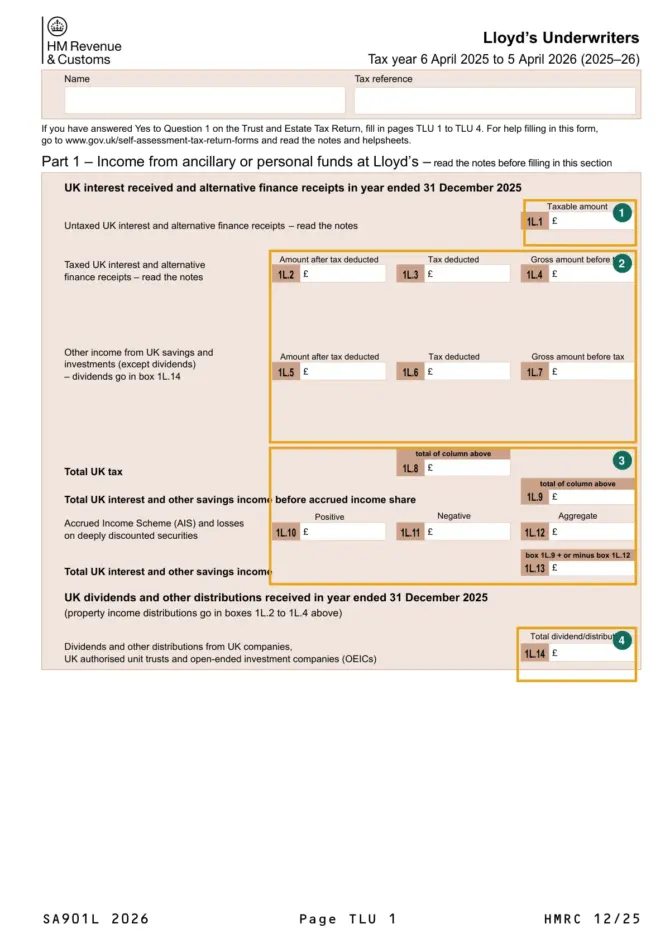
Use bank statements, tax vouchers and the Lloyd’s advices to separate income with tax deducted from income paid gross. Do not include the same personal-fund income again elsewhere on SA900.
| Boxes | Entry | How the totals work |
|---|---|---|
| 1L.1 | Untaxed UK interest and alternative-finance receipts | Use the gross receipt |
| 1L.2–1L.7 | Taxed UK interest and other UK savings income | Keep tax deducted, net and gross amounts in their printed columns; put dividends in 1L.14 |
| 1L.8–1L.13 | UK tax and income totals, then positive and negative Accrued Income Scheme adjustments | 1L.12 is the aggregate adjustment; 1L.13 is 1L.9 plus or minus 1L.12 |
| 1L.14–1L.17 | UK dividends, stock dividends and qualifying entries for bonus issues or redeemable shares | 1L.17 adds 1L.15 and 1L.16 |
| 1L.18–1L.25 | Foreign interest/other income, then foreign dividends | Separate net income, foreign tax and Special Withholding Tax/UK tax; total each income group in 1L.21 and 1L.25 |
| 1L.52–1L.55 | Foreign tax, withheld UK/special tax, gross foreign income and personal-fund income | 1L.52 adds 1L.19 and 1L.23; 1L.54 adds 1L.21 and 1L.25; 1L.55 adds 1L.13, 1L.14, 1L.17 and 1L.54 |
For accrued-income securities, the notes describe the £5,000 nominal-value condition across this and the preceding tax year, including Lloyd’s and non-Lloyd’s holdings. Use Helpsheet 343 for the calculation. Purchases ex-dividend or sales cum-dividend can produce a positive charge; purchases cum-dividend or sales ex-dividend can produce a negative allowance. The notes restrict losses on strips generally acquired on or after 15 January 2004 and allow other deeply-discounted-security losses only within the stated pre-26 March 2003 holding/listing exception.
Do not include voucher equalisation as taxable income. Reinvested dividends on accumulation units still count. Property income distributions from PAIFs or UK REITs go in 1L.2–1L.4, not the UK dividend box. In 1L.15 use the voucher’s cash-equivalent amount for shares taken instead of cash; 1L.16 values redeemable shares at nominal value plus premium and securities at secured principal plus premiums less new consideration, subject to the note’s qualifying-distribution exclusion.
Foreign offshore-fund reported income can be taxable even without a cash payment; if the fund is a company, use the non-UK dividend entry. Foreign dividend boxes exclude the distributions and capital returns listed in TLUN 3. Dividends received after 5 April 2016 do not carry the notional tax credit. Keep vouchers and other records, rather than sending the dividend vouchers with the return.
Parts 2 and 3: receipts and outgoings
Enter taxable compensation received in 2025 in 1L.57 and other non-syndicate income in 1L.58, explaining that latter amount in 1L.92. Life-policy gains belong here when the policy itself forms part of the Lloyd’s deposit; where only a guarantee secured on the policy backs underwriting, the notes direct the gain to SA900 boxes 9.14–9.16. The Lloyd’s trading treatment has no tax-treated-as-paid credit or Top Slicing Relief.
Put the CTA syndicate profit in 1L.58A, net Special Reserve Fund withdrawals in 1L.58C, stop-loss recoveries in 1L.58D and refunds of foreign tax previously relieved by deduction in 1L.58E. Do not use the inactive 1L.58B. Add the receipts in 1L.59, then add personal-fund income 1L.55 to get total incomings 1L.60.
SRF money released on cessation is treated separately for the last year assessed on the Name personally: follow the certificate and individual-page or Lloyds Underwriters Unit route in TLUN 4. Stop-loss recoveries include amounts payable for the relevant losses even where not yet received; when the exact amount is unknown, explain an estimate in 1L.92 and send corrected figures when available. Foreign-tax refunds use the exchange rate of the original relief, which may differ from the cash receipt’s sterling value.
| Outgoing | Box | Restriction or record |
|---|---|---|
| Annual guarantee/letter-of-credit renewal fees | 1L.62 | 2025 fees; initial setup is capital and not deductible here |
| Syndicate losses and members’ association expenses | 1L.63–1L.64 | CTA 1 loss; association confirms allowable subscription element |
| Personal Quota Share/Exeat premiums | 1L.66 | Apply TLUN 4’s cash-call, declared-loss and CTA 2 adjustments |
| Underwriting financing and SRF transfer | 1L.68–1L.68A | Eligible 2025 interest/alternative-finance payments; CTA net transfer |
| Members’ agent commission/salaries and accountancy | 1L.69–1L.70 | Exclude managing-agent salaries already in syndicate results and fees for unrelated tax work |
| Other expenses and total | 1L.71–1L.72 | Describe other claims in 1L.92; add 1L.62–1L.71 |
For quota-share premiums, TLUN 4 distinguishes a cash call followed by reinsurance, a declared loss reinsured before the call, and a premium below declared losses. The latter difference goes to 1L.58; Exeat/EPP adjustments come from CTA 2. Apply these rules to the contract rather than deducting every premium unchanged.
Keep financing certificates. Do not repeat interest on unfunded losses already deducted in syndicate results. In 1L.71 include eligible unrefunded stop-loss premiums. TLUN 5 also explains the FOTRA exempt-amount adjustment for the limited nonresident/non-domiciled category it identifies: positive amounts go to expenses, negative amounts to 1L.58, with details in 1L.92. Obtain specialist advice before applying that category.
Foreign tax and the profit or loss columns
Part 4 copies personal-fund foreign tax from 1L.52 into 1L.73, then adds US tax in 1L.74, Canadian tax in 1L.75, syndicate foreign tax in 1L.76 and qualifying earlier-year additional payments made in 2025 in 1L.77. Their sum is the foreign-tax pool in 1L.78. Refunds previously relieved by tax credit go in 1L.79 and SA900 17.2; those relieved by deduction belong in 1L.58E instead. For a self-calculated return, the notes also identify tax-calculation box T7.3.
When outgoings exceed incomings, complete only the loss side: 1L.82 equals 1L.72 minus 1L.60; add deductible foreign tax in 1L.83 to obtain 1L.84. Allocate relief against current-year income in 1L.85, earlier-year relief in 1L.86 and unused loss carried forward in 1L.87. Current-income relief cannot reduce income less deductions below zero. Explain an already-made earlier-year claim in 1L.92. Some 2025–26 loss-relief claims must be made by 31 January 2028; consult the applicable claim rules rather than treating that as every loss deadline.
When incomings exceed outgoings, complete only the profit side: 1L.88 equals 1L.60 minus 1L.72; deduct eligible brought-forward Lloyd’s losses in 1L.89, capped at 1L.88, and any foreign-tax deduction in 1L.90 to get 1L.91. Do not use 1L.90 if claiming foreign tax credit relief through the Foreign pages. The notes prohibit splitting the same pooled relief between deduction and credit. Use Helpsheet 240 for the detailed relief choice.
The unrelieved-loss working sheet takes losses brought forward, subtracts those used in 1L.89 and adds unused current losses in 1L.87. Record its result in 1L.92 as losses carried forward to 2026–27. The form marks 1L.26–1L.51, 1L.56, 1L.61, 1L.65, 1L.67 and 1L.80–1L.81 as unused; do not invent entries for those numbers.
When and where to send SA901L with SA900
Include TLU 1–TLU 4 and any other applicable supplementary pages with SA900, then complete the main return’s declaration. SA901L has no separate signature or standalone filing address. SA900 states 31 October 2026 for paper returns and 31 January 2027 for online filing using commercial software. A return issued after 31 July 2026 gets the later of the relevant deadline or three months from issue. Payment is due by 31 January 2027. Use the address on the issued return for paper filing.
If you are unsure these estate pages apply, the notes give HM Revenue and Customs, Lloyds Underwriters Unit S1278, BX9 1BN as the enquiry address. This is the notes’ specialist contact, not a replacement address for filing SA900. Seek advice on underwriting losses, reinsurance or foreign-tax relief before making a claim.
Official PDF: SA901L — Official PDF (assets.publishing.service.gov.uk)