Use the 2026 SA905 pages to report chargeable disposals and capital gains claims for a trust or deceased person’s estate in the tax year 6 April 2025 to 5 April 2026. The eight pages separate residential property from other assets, then reconcile losses, exemptions, reliefs and tax already charged on property returns.
Who must complete SA905 capital gains pages
The 2026 notes require these pages if chargeable assets disposed of exceed £50,000 in value, if a non-resident Capital Gains Tax return was required, if total chargeable gains before losses exceed the annual exempt amount, or if you want to claim a loss or make another capital gains claim or election. The £50,000 test excludes exempt assets and the specified no-gain deemed disposal on a life tenant’s death; partially exempt residences can still count.
Include all current-year losses you claim as allowable. Even when no return of gains is otherwise required, completing SA905 can establish a loss claim. The notes give 5 April 2030 as the deadline for claiming a 2025–26 loss if it is not claimed on these pages. A settlement with funds vested in different trustees normally files one return unless a sub-fund election applies.
Gather disposal and purchase contracts, invoices for allowable expenditure, valuation reports and earlier loss records. SA905 accompanies the Trust and Estate Tax Return, SA900; it is not an individual SA108 return. Estate administration can also involve separate Inheritance Tax forms, such as IHT409 for pensions; those filings do not replace this annual income and gains return.
How to fill in TC 1 and TC 2
Put residential property on TC 1 and other property, shares, cryptoassets and other assets on TC 2. Record gains in rows 1–6 and losses in rows 7–8. Enter the name and tax reference in the form’s identification fields. The notes generally require TC 1–TC 5, with additional transaction details on TC 6 or TC 7 where applicable; nonresident property returns have the separate reporting route in boxes 5.35–5.37.
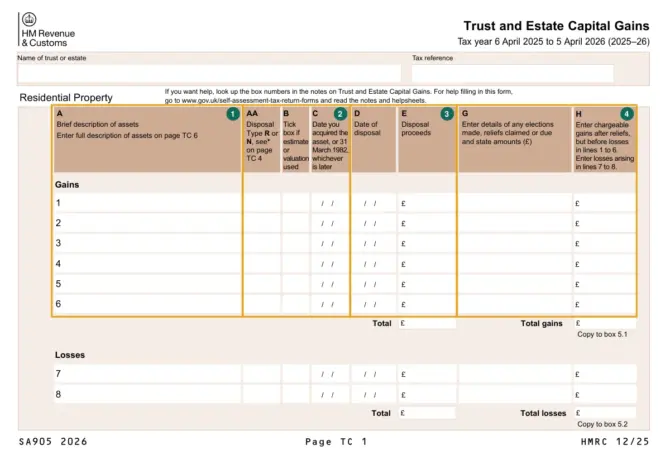
| Column | Entry | Record or decision needed |
|---|---|---|
| A | A short description of each asset or chargeable event | For listed shares, give company or fund name, share/security type and quantity |
| AA | Asset-category letter for each gain or loss transaction | TC 1: R for UK residential property, N for non-UK residential property. TC 2: Q listed securities, U other securities, L land/nonresidential property, C cryptoassets, O other assets |
| B | Tick where an estimate or valuation enters the calculation | Supply the corresponding supporting details on TC 6 or TC 7 |
| C–D | Acquisition and disposal dates | Column C takes the later of acquisition or 31 March 1982; use the CGT disposal date, which may depend on the contract |
| E | Total proceeds received or receivable | Apply the official proceeds rules, including market-value substitutions where required |
| G | Reliefs, claims and elections | Name the claim and give its amount where required; use TC 8 if space runs out |
| H | Gain or loss after applicable reliefs | Use the calculation under the notes’ cost, valuation and relief rules |
There is no column F. The notes define listed securities by their qualifying listing or fund status throughout ownership; AIM shares count as unlisted. A reorganisation does not turn an originally nonqualifying holding into Q merely because the replacement security is listed. Disposals to connected persons, inherited assets and pre-1982 holdings may require valuations. Read TCN 9–14 for the disposal, cost, share-identification, valuation and loss computations before entering a result.
TCN 9–10 describe special small-receipt cases. Within those specified cases, an amount no more than £3,000 or 5% of the asset value is treated as small; if it is also below allowable cost, the notes say no disposal entry is needed. If the limits are exceeded but you claim the receipt should still be treated as small, enter the transaction, explain the claim on TC 8 and exclude the gain/loss and relevant column E total as directed in TCN 10. Deferred gains becoming chargeable without a new disposal must also be described, identifying the event and original gain.
Use extra copies when needed, with name and tax reference on each. Enter aggregate numbered totals only on the final sheet. Computer-generated schedules may replace TC 1–TC 5 and the relevant supplementary pages if they follow the paper layout. Sending a separate computation does not remove the requirement for the transaction pages.
Relief claims and their attachments
Identify the relief in column G. Business Asset Disposal Relief and Investors’ Relief require the appropriate joint claim with the qualifying beneficiary. Business Asset Disposal Relief also uses 5.38–5.40A, while Investors’ Relief gains use 5.17A. The notes point to Helpsheets 275 and 308 for eligibility and claims.
Attach the official claim forms for Gifts Hold-Over Relief, Enterprise Investment Scheme Deferral Relief and Seed Enterprise Investment Scheme Reinvestment Relief when claiming them. For Business Asset Roll-over Relief the form is optional, but all requested information remains necessary. Describe any Employee Ownership Trust relief claim in column G. Use the specific helpsheets linked or named in the official notes rather than estimating relief from the form’s title.
TC 3: allocating losses and the annual exemption
Keep the residential and other-asset computations separate, while ensuring a loss or exemption is used only once.
| Boxes | What they contain | Calculation or restriction |
|---|---|---|
| 5.1–5.5 | Residential gains, current capital losses, eligible income losses and brought-forward losses | 5.5 is 5.1 minus 5.2, 5.3 and 5.4 |
| 5.6–5.8 | Vulnerable-beneficiary CGT relief, allocated annual exemption and taxable residential gains | Work out the applicable exemption in TCN 5; leave 5.8 blank if the exemption covers 5.5. Put qualifying Business Asset Disposal Relief gains in 5.17 |
| 5.8A–5.8B | Tax already charged on UK property returns and any residential CGT adjustment | Add payment references and dates to 5.42; apply the notes’ rate-change qualification for the adjustment |
| 5.9–5.13 | Other gains and losses, then eligible income and earlier-year losses | Cryptoasset gains/losses are included in the totals and separately identified in 5.9A/5.10A. 5.13 is 5.9 minus 5.10, 5.11 and 5.12 |
| 5.14–5.16 | Vulnerable-beneficiary relief, remaining annual exemption and taxable other gains | Do not include gains reported separately in 5.17 or 5.17A in 5.16 |
| 5.17–5.17B | Business Asset Disposal Relief gains, Investors’ Relief gains and other-asset CGT adjustment | 5.17 excludes deferred gains from before 23 June 2010; follow the notes for any adjustment |
Allocate eligible income losses first against residential gains as directed in TCN 5, then any balance against other gains. Combined current capital losses in 5.2 and 5.10 cannot exceed the year’s available losses; combined income-loss entries cannot exceed available income losses. Brought-forward losses are used subject to the annual-exemption rules, and 5.4 plus 5.12 cannot exceed the brought-forward amount. The annual exemption allocated across 5.7 and 5.15 cannot exceed the year’s entitlement.
The exemption depends on the type of trust, other trusts established by the settlor and any sub-fund settlements. TCN 5 explains the £1,500 and £3,000 categories and the applicable apportionment minima. Personal representatives have a £3,000 exemption in the year of death and in each of the next two tax years; later administration years have none. Use the notes to establish the category before allocating an amount. Vulnerable-beneficiary CGT relief requires a valid election and the associated income-tax treatment where applicable.
Boxes 5.8B, 5.17B and 5.37A were introduced for earlier CGT rate changes. The 2026 notes say they may not need completing if no rate change occurred in 2025–26; they are not automatic additional liabilities. The final tax calculation follows the SA900 calculation guidance, including the treatment of reliefs and tax already charged.
TC 4: transaction counts and the loss record
Tick the estimate/valuation, relief and clogged-loss boxes as applicable and count transactions by R, N, C, Q, U, L and O. Only trustees consider 5.18 and 5.19; personal representatives skip them. Box 5.19 identifies the disabled-person trust category.
There is a year mismatch in the source documents: the SA905 2026 form’s 5.18 asks about qualifying settlor trusts existing in the year to 5 April 2026, but TCN 7 says 5 April 2025. This guide does not choose one year for you. Ask HMRC’s Trusts Helpline on 0300 322 9640 which year to use for this entry.
For current losses, 5.20 totals 5.2 and 5.10; 5.21 records use against gains; 5.22 records transfers to beneficiaries or permitted carryback; 5.23 carries forward the balance. For earlier losses, 5.24–5.26 track 1996–97 and later years, and 5.27–5.28 track earlier years. Use the later-year pool first as printed. Box 5.29 combines 5.23 and 5.26; 5.30 is 5.27 minus 5.28. Keep clogged losses separately because their use is restricted to qualifying gains, including the connected-person rule.
TC 5: trust events and nonresident property entries
Trustees use 5.31 for a life tenant’s death, supplying name, address and death date; 5.32–5.33 for a beneficiary becoming absolutely entitled, supplying identity, entitlement date, asset, value and transferred loss; and 5.34 for the trustees leaving UK residence or becoming dual resident, with assets, change date and resulting gain. The loss total in 5.33 must equal the transfers recorded in 5.22. Personal representatives are directed to 5.35 and 5.41 rather than these trustee event boxes.
Tick 5.35 for the relevant nonresident property return and put references in 5.42. Boxes 5.36, 5.36A and 5.36B separate residential direct, nonresidential direct and indirect property disposals. Record losses as the form directs and offset them within the nonresident categories under the notes; 5.37 records tax already charged, with any applicable adjustment in 5.37A. Qualifying Business Asset Disposal Relief gains are moved to 5.17 with the corresponding nonresident adjustment described in TCN 7.
A second scope mismatch concerns 5.36B: the form says indirect disposals of any UK property or land, while TCN 7 describes indirect UK residential property. For a nonresidential indirect disposal, get HMRC’s direction on the entry using the Trusts Helpline above; the guide does not narrow the form based on that inconsistent sentence.
For Business Asset Disposal Relief, tick 5.38; separate pre-23 June 2010 deferred gains in 5.39 from later qualifying gains in 5.40, also included in 5.17. Enter the lifetime total of relief-related gains claimed through 5 April 2026 in 5.40A, including the current figures as required. Tick 5.41 if enclosing a computation.
TC 6 to TC 8: details, valuations and extra information
Provide a separate TC 6 section for each U securities disposal and each R, N or L property disposal. Securities details include company name, registration number if known, number, class, nominal value and any relevant reorganisation history. Property details include the full address, ownership interest, tenancies and the exact interest disposed of; attach a plan if helpful. TC 7 takes other assets, including cryptoassets, with enough description to identify them.
For each applicable transaction, state any connection to the other party and whether CG34 was already submitted. If using an estimate or valuation without CG34, give its date, amount and reason and attach the valuation obtained. Do not repeat information already supplied through the specified hold-over claim or valuation-check route. Photocopy the relevant section for more transactions.
TC 7 also asks for gross gains on excluded indexed securities in 5.41EG, gross QAHC share-repurchase/redemption gains in 5.41QG and QAHC losses in 5.41QL. These are additional disclosures of amounts already included in the relevant TC 2/TC 3 entries, not another gain to add. If excluded indexed securities were held in a QAHC, the notes also include those gains in the QAHC total.
Use 5.42 on TC 8 for overflow explanations, payment references and required supporting details. An unconditional contract made by 5 April 2026 but not completed when the return is filed must be described there, followed by the detailed calculation when completed. Changes to trustees, beneficiaries, settlors or other people controlling the trust go directly on the Trust Register, not in this box.
When to send SA905 with the main return
Attach the completed capital gains pages, additional transaction sheets and required claim forms to SA900. Complete the signature and declaration on the main return; SA905 has no separate signature or filing address. Use the issued return’s address for paper filing or compatible commercial software for online filing.
The SA900 2026 notice gives 31 October 2026 for paper returns and 31 January 2027 for online returns. For a return issued after 31 July 2026, the deadline is the later of the relevant date or three months after issue. Tax payment is due by 31 January 2027. Separate property-reporting obligations are not postponed by filing these annual pages. Consult a tax adviser for nonresident trusts, complex reliefs, connected parties or uncertain valuations.
Official PDF: SA905 — Official PDF (assets.publishing.service.gov.uk)