Alabama Form BPT-IN is the initial Business Privilege Tax return for an entity that incorporated, organized, qualified, registered or started doing business in Alabama. The 2026 form covers those events in 2026. It is separate from the annual CPT or PPT return, and a computed initial tax of $100 or less removes the filing requirement.
Who must file the initial return, and when?
Work through the calculation for the applicable entity type before deciding that a return is required. The Alabama Business Privilege Tax guidance and 2026 instructions say that taxpayers whose calculated tax is $100 or less do not file. A disregarded entity whose single member is itself subject to Alabama Business Privilege Tax has a separate exemption explained in Part A, line 12.
Where filing is required, the deadline is within two and one-half months after incorporation, organization, qualification or starting business. There is no extension for BPT-IN. For an entity formed outside Alabama, the instructions’ opening discussion uses the earlier of qualification with the Secretary of State or starting business in Alabama. The page-1 date box also asks for the first applicable event.
An annual federal-return extension does not extend this initial deadline. The warning against using BPT-IN as an annual return appears on the form; the instructions say doing so can result in a late-filing penalty.
How to fill out BPT-IN page 1
Use the entity’s own legal name and identifiers. A single-member LLC must not put its owner’s FEIN or Social Security number in the entity FEIN field. The illustration outlines the taxpayer type, date, identity, information and payment areas using their printed line numbers.
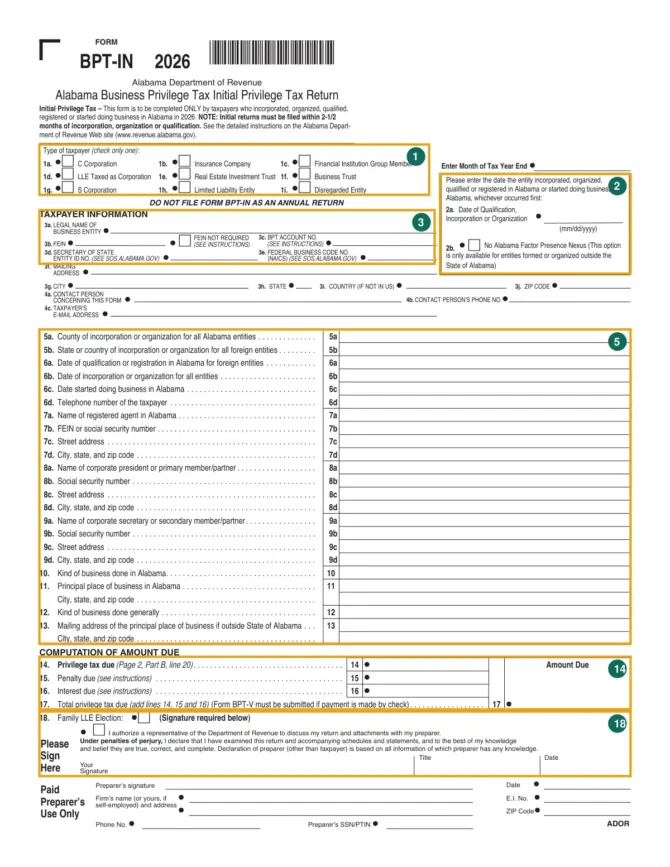
| Field | Entry and source |
|---|---|
| 1a–1i | Choose one entity classification: C corporation, insurance company, financial institution group member, LLE taxed as a corporation, REIT, business trust, S corporation, LLE or disregarded entity. |
| Tax-year-end month; 2a | Enter the month of tax-year end and the applicable incorporation, organization, qualification or business-start date from the entity’s records. |
| 2b | A foreign entity claiming no Alabama factor-presence nexus checks this box and attaches an apportionment schedule and a statement confirming the claim. |
| 3a–3e | Legal entity name, entity FEIN, BPT account number when no FEIN exists, last nine digits of the Secretary of State entity ID, and federal business activity/NAICS code. |
| 3f–3j; 4a–4c | Entity mailing address, city, state, country if outside the U.S., nine-digit ZIP code, preparation contact, telephone and taxpayer email. |
| 5a–5b; 6a–6d | Alabama incorporation county or foreign state/country; qualification, organization and business-start dates; taxpayer telephone number. |
| 7a–7d | Alabama registered agent’s name, FEIN/SSN and address. BPT-IN does not change the registered agent. |
| 8a–8d; 9a–9d | President or primary member/partner, then secretary or secondary member/partner: name, SSN and address for each. |
| 10–13 | Business activity and principal business address in Alabama; general business activity and principal-office mailing address outside Alabama when applicable. |
| 14–17 | Bring page 2, Part B, line 20 to line 14. Add any late-filing/payment penalty and interest on lines 15–16; total them on line 17. |
| 18 and signature area | Claim a qualifying family LLE election with Schedule BPT-E attached; complete signature, title and date. Complete the preparer information and discussion-authorisation checkbox as applicable. |
If the entity is applying for an FEIN, the instructions allow “applied for.” If no FEIN will be assigned, check “FEIN Not Required” and enter its BPT account number on line 3c. The Secretary of State ID is a different identifier; line 3d takes its last nine digits.
Page 2, Part A: choose one net-worth computation
Repeat the entity FEIN, legal name and applicable date at the top. Complete only Part A I, II or III. The 2026 BPT-IN instructions explain the related-party definitions, exempt payables and compensation adjustments. Related-party debt and receivables are not netted.
For corporations and entities taxed as corporations, lines 1–2 take capital stock/additional paid-in capital and retained earnings, with the specified zero floors and no treasury-stock reduction. Line 2 uses assets less liabilities for the specified non-stock entities. Line 3 adds qualifying related-party debt exceeding lines 1 plus 2; lines 4–5 cover the applicable shareholder compensation or distribution adjustments above $500,000 per shareholder. Line 6 totals lines 1–5.
For LLEs, line 7 takes member or partner capital accounts, not below zero. Line 8 adds the specified compensation/distribution excess over $500,000 per member or partner, and line 9 adds qualifying related-party debt exceeding line 7. Total these on line 10.
For disregarded entities, line 11 identifies the single member by name and FEIN/SSN. If the member is subject to the privilege tax, line 12 explains the entity’s exemption from tax and filing. Otherwise, line 13 starts with assets less liabilities, not below zero. Attach the explanation of why the owner is not subject to the tax; the instructions treat missing line-11 owner information as incomplete. Line 14 adds qualifying excess related-party debt, line 15 the specified owner compensation/distribution excess over $500,000, and line 16 totals lines 13–15.
Part B: exclusions, apportionment and deductions
Carry Part A line 6, 10 or 16 to Part B line 1. Exclusions and deductions require supporting documentation. Keep them in their separate sections so that the apportionment calculation occurs in the printed order.
| Part B lines | Calculation or supporting entry |
|---|---|
| 2–6 | Eligible equity investments in other taxpayers; qualifying financial-institution investments with over 50% ownership; purchased goodwill/core-deposit intangibles; elected FASB 106 post-retirement benefits; and the financial-institution adjusted-net-worth excess over 6% of assets. |
| 7–8 | Total exclusions, then subtract them from line 1. |
| 9–10 | Enter the initial-date Alabama apportionment factor and multiply line 8 by it. Financial institution group members use Alabama property divided by total property; other taxpayer types use Alabama sales divided by total sales. |
| 11–14 | Eligible Alabama bonds/securities issued before January 1, 2000; Alabama pollution-control investments; qualifying reclamation or similar reserves; and qualifying low-income housing investments. |
| 15–16 | Total deductions, then subtract line 15 from Alabama net worth on line 10. |
| 17–20 | Multiply taxable net worth by .00025; prorate using days remaining in the tax year divided by 365. Apply the printed filing threshold and the applicable maximum. |
For lines 2–3, attach the required investment listings with names, FEINs, addresses and book values. Line 3 is restricted to financial institutions; the instructions add the condition that the investee is not doing business in Alabama. Line 4’s goodwill listing identifies acquisition date, original cost, amortization and the acquired/acquiring businesses. Line 5 needs benefit descriptions, amortization and balance-sheet details; line 6 needs the computation.
The deduction records also differ. Line 11 requires bond details, issuance date, issuer and balance-sheet reporting, and excludes ordinary dealer inventory. Line 12 covers the specified Alabama pollution or radiological-hazard controls. Line 13 needs the law establishing the liability, the computation and site identification. Line 14 requires project name, FEIN, location, investment and balance-sheet reporting; the instructions say the return is incomplete without that listing.
Tax threshold, short-year example and signing
The initial rate on line 17 is .00025. Suppose taxable Alabama net worth is $1,600,000 and the supported short-year ratio is 0.50. Line 18 is $400 and line 20 is $200, before any applicable maximum. If the final calculated tax is $100 or less, line 20 says to stop and not submit a return.
The instructions list a $3 million maximum for financial institution groups and covered insurance companies, $15,000 for the other listed corporation/LLE/disregarded-entity classes, and $500 for a qualifying electing family LLE. A family LLE election requires both Schedule BPT-E and the signed page 1; omission disallows it. A single-member LLC treated as disregarded for federal purposes cannot make that election.
Sign and date the return and enter the signer’s title. The paid preparer completes their signature, date, firm/address, employer ID, telephone and SSN/PTIN fields. The optional discussion checkbox permits Revenue to discuss the return and attachments with that preparer.
For a late return, the instructions’ line-15 rules give 10% of tax or $50, whichever is greater, for late filing, and 1% per unpaid month up to 25% for late payment. Line 16 interest follows the statutory underpayment rate; use the current applicable rate rather than a fixed rate inferred from this form.
Official BPT-IN PDF, delivery and payment
Use the 2026 print-only BPT-IN PDF. Mail the signed return and supporting schedules to Alabama Department of Revenue, Business Privilege Tax Section, P.O. Box 327320, Montgomery, AL 36132-7320. The department also offers filing and payment through My Alabama Taxes; financial institution groups have an electronic-filing mandate described on its Business Privilege Tax page.
For a payment by check, include the voucher described in our BPT-V guide and use 2026 Form BPT-V and make the check payable to Alabama Department of Revenue. The voucher requires electronic payment for a single business tax payment of $750 or more. No voucher is required for electronic payment. Use the BPT-IN initial-return date for this filing, rather than the voucher’s general annual-return deadline wording.
For an account-number question, the BPT-IN instructions give 334-242-1170, option 8. The Business Privilege Tax page gives businessprivilege.tax@revenue.alabama.gov for obtaining the My Alabama Taxes registration letter with the business’s current mailing address.