Alabama Form CPT is the business privilege tax return for C corporations and the other corporate-type taxpayers listed at the top of its first page. The tax is levied for the privilege of being organized in Alabama or doing business there, and it is measured by net worth: page 2 starts from the balance sheet, removes exclusions, apportions what is left to Alabama, subtracts deductions and applies a rate picked by federal taxable income. This guide covers the 2026 form, which the Alabama Department of Revenue’s forms page lists as Form Year 2026, print only, together with the 2026 instructions. The form itself is headed “Alabama Business Privilege Tax Return”; the Department’s business privilege tax page still calls it the Return and Annual Report for C-Corporations and Other Specified Entities.
Who files Form CPT instead of Form PPT
Line 2 of page 1 lists the taxpayer types that belong on CPT, and only one box is checked:
- 2a, a C corporation filing federal Form 1120
- 2b, a C corporation filing federal Form 1120-F
- 2c, an insurance company
- 2d, a limited liability entity taxed as a corporation for federal purposes
- 2e, a member of a financial institution group, with Schedule G attached
- 2f, a real estate investment trust (REIT)
- 2g, a business trust
S corporations, ordinary limited liability entities such as LLCs and limited partnerships, and disregarded entities file Form PPT. Either way, the return is required only if the privilege tax works out to more than $100. Act 2022-252 fully exempts tax of $100 or less for taxable years beginning after December 31, 2023, so a corporation whose page 2 ends at $100 or below sends nothing for 2026.
A corporation registered in Alabama keeps owing the tax every registered year until it is formally dissolved or withdrawn through the Alabama Secretary of State, even if it has stopped doing business in the state. To withdraw, the Department’s page sends you first to a Request for Certificate of Compliance; the certificate cannot be more than six months old when the Secretary of State receives it.
A corporation formed outside Alabama that did not cross any factor presence nexus threshold checks line 1e. Act 2015-505 sets those thresholds at $68,000 of property, $68,000 of payroll, $675,000 of sales, or 25% of the corporation’s total property, payroll or sales. Line 1e needs an apportionment factor schedule and a statement confirming there is no factor presence nexus.
Taxable year 2026 and the balance sheet behind it
The 2026 return pays the tax for taxable year 2026, but its figures come from the determination period, which Section 40-14A-1 defines as the taxable year just before the current one. For a corporation with a December 31 year end, that is calendar 2025, and the net worth computation uses the balance sheet dated 12/31/2025. Check line 1a and enter only the start of the determination period. A fiscal-year corporation whose determination period ends in 2026 checks line 1b and fills in both dates; a 52-53 week filer checks line 1c in addition to 1b. The same balance sheet date goes in field 1c at the top of page 2.
Short year returns are limited to a change of tax year end, such as moving from a calendar year to a fiscal year. An acquisition or merger does not create a short year. When a corporation switches to a calendar year, the 2026 instructions treat the earlier, shorter year as the short year, so it is the return for that earlier year that gets amended with a prorated tax, while the new year’s return pays for a full year.
Line 1d marks an amended return. Attach a full explanation, the documents supporting each change and a computation of the extra tax or extra refund.
Taxpayer and incorporation details on page 1
Line 3a is the entity’s legal name, not an owner’s name and not a trade name. Line 3b is the FEIN; write “applied for” if one is on the way, or check “FEIN not required” if none will ever be assigned. Line 3d, the BPT account number, is filled in only when there is no FEIN. That number appears in the notice telling the corporation it owes business privilege tax and in the letter with its Sign-On ID and Access Code, and the Business Privilege Tax Section answers questions about it at (334) 242-1170, option 8.
The rest of the block is the mailing or street address (3c and 3e to 3h, with a nine-digit ZIP code and a country only for foreign addresses), the person who can answer questions about how the form was prepared and that person’s phone (3i, 3j), the entity’s email (3k) and the NAICS code from the federal return (3l). Lines 4a to 4c give the date, state and county of incorporation.
Filling in page 2, the privilege tax computation
Part A builds net worth from the balance sheet; Part B takes out exclusions, apportions, deducts and applies the rate. Enter negative numbers with a minus sign; parentheses are used only where the form prints them. The outlined lines on the image are the ones that carry a result to the next stage.
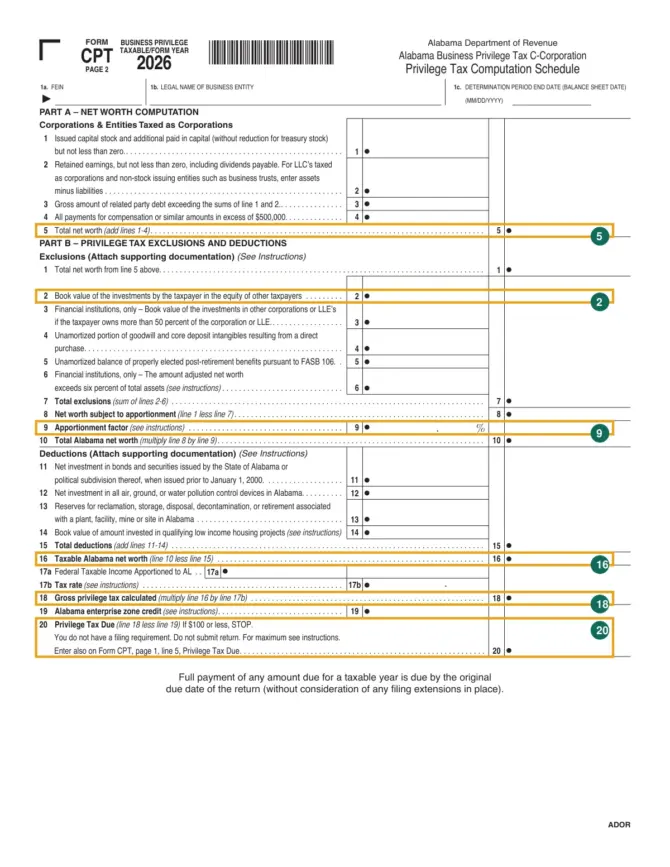
| Line | What goes on it | Rule from the 2026 instructions |
|---|---|---|
| Part A, 1 | Issued capital stock plus additional paid-in capital | Not reduced for treasury stock; not below zero |
| Part A, 2 | Retained earnings, including dividends payable | Not below zero. Business trusts, LLEs taxed as corporations and entities that issue no stock enter book assets minus liabilities instead |
| Part A, 3 | Related party debt above lines 1 and 2 combined | Gross amount, not below zero, under Section 40-14A-23 |
| Part A, 4 | Compensation or similar amounts above $500,000 | The excess for each covered shareholder, under Section 40-14A-23(f) |
| Part A, 5 | Total net worth | Lines 1 to 4 added; carried to Part B, line 1 |
| Part B, 2 to 7 | Exclusions | Each one documented; line 7 totals lines 2 to 6 |
| Part B, 8 to 10 | Apportioned net worth | Line 8 is line 1 less line 7; line 10 is line 8 times the line 9 factor |
| Part B, 11 to 16 | Deductions and taxable Alabama net worth | Line 15 totals lines 11 to 14; line 16 is line 10 less line 15 |
| Part B, 17a to 20 | Rate, gross tax, credit, tax due | Line 18 is line 16 times line 17b; line 20 is line 18 less line 19 |
Related party debt and shareholder pay in Part A
Related parties for line 3 are members of a controlled group under Internal Revenue Code Section 1563, plus limited liability entities that would be members if similar rules applied to them. Individual shareholders are not related parties. Related party debt is never netted against related party receivables. The instructions split related party payables into exempt payables, meaning trade debt, accounts payable or deposit liabilities owed to related parties doing business in Alabama, as defined in Section 40-14A-23(e)(2)(b), and non-exempt payables, which are every other related party debt.
The exclusions on lines 2 to 6
Line 2 removes the book value of the corporation’s investments in the equity of other taxpayers, listed one by one with the investee’s name, FEIN, address and book value. A securities dealer cannot use it for securities held for sale to customers. Line 4 removes unamortized goodwill and core deposit intangibles from a direct purchase of another corporation or LLE; the goodwill listing shows the amount originally acquired, the purchase date, accumulated amortization, the business bought and the buyer’s name and FEIN. Line 5 removes the unamortized balance of post-retirement benefits the corporation elected to amortize under FASB Statement 106, with a description of the benefits and the amortization schedule.
Lines 3 and 6 are for financial institutions only. Line 3 removes the book value of investments in corporations or LLEs in which the institution owns more than 50%, and the instructions say the return is not complete without the listing. Line 6 removes the amount by which net worth exceeds 6% of the institution’s total assets, with the computation attached.
The apportionment factor on line 9
A corporation that did all its business in Alabama during the determination period enters 100% and attaches nothing for this line. A multistate corporation uses the factor it used for the same period to apportion income under Alabama’s income tax law (Chapter 18 of Title 40) or its financial institution excise tax law (Chapter 16), and attaches that computation from the Alabama return. An insurer subject to the insurance premiums tax uses its Alabama premium income divided by nationwide total direct premiums, from Schedule T of the annual statement for the preceding calendar year, with a copy of that Schedule T. A corporation that filed none of those returns computes the factor as though it were subject to the income tax and attaches the computation.
Deductions on lines 11 to 14
- Line 11: the net amount invested in bonds and securities of the State of Alabama or its political subdivisions issued before January 1, 2000, with a schedule giving the issuer, issue date and balance sheet treatment of each. Securities dealers cannot deduct bonds they hold for sale to customers.
- Line 12: devices, facilities or structures in Alabama acquired or built mainly to control or reduce air, ground or water pollution or radiological hazards caused by the corporation’s Alabama activities.
- Line 13: reserves for reclamation, storage, disposal, decontamination or retirement at a plant, facility, mine or site in Alabama, with the law or regulation that creates the liability, its computation and the location.
- Line 14: the book value invested in qualifying low-income residential housing projects, listed with each project’s name, FEIN, site and net investment.
Rate, credit and tax due on lines 17a to 20
Line 17a is federal taxable income apportioned to Alabama, and it only selects the rate. C corporations, REITs and financial institutions use federal taxable income before net operating losses and special deductions, apportioned under Chapter 27 of Title 40, without any deduction for federal income tax; members of an Alabama affiliated group figure it on a separate company basis. A life insurer filing Form 1120-L uses total taxable income less the dividends received deduction and the net operating loss deduction, and a property and casualty insurer filing Form 1120-PC uses taxable income less the same two deductions.
| Federal taxable income apportioned to Alabama | Line 17b rate | Tax per $1,000 of taxable Alabama net worth |
|---|---|---|
| Under $1 | .00025 | $0.25 |
| $1 up to $200,000 | .00100 | $1.00 |
| $200,000 up to $500,000 | .00125 | $1.25 |
| $500,000 up to $2,500,000 | .00150 | $1.50 |
| $2,500,000 and over | .00175 | $1.75 |
Each band stops just below the next figure. As an illustration with invented numbers, a corporation with $3,200,000 of taxable Alabama net worth on line 16 and $640,000 on line 17a uses .00150, so line 18 is $4,800. A short taxable year prorates line 18 by the days in the short year over 365, with the computation attached.
Line 19 is the Alabama Enterprise Zone Credit, supported by documentation from the Alabama Department of Economic and Community Affairs (ADECA); a corporation claiming it must file on paper. Line 20, the privilege tax due, is line 18 less line 19 and is copied to page 1, line 5. The line points to the instructions for the maximum: $15,000 for C corporations, REITs and LLEs taxed as corporations, and $3,000,000 for financial institution groups and for insurers subject to the premiums tax.
Page 1, lines 5 to 12: amount due or refund
| Line | Entry |
|---|---|
| 5 | Privilege tax due from page 2, line 20 |
| 6 | Privilege tax already paid for taxable year 2026, such as an automatic extension payment sent with Form BPT-V by the original due date; on an amended return, the tax shown as paid on the original return. Overpayments from earlier years are left out. |
| 7 | Line 5 less line 6 |
| 8 | Penalties under Section 40-2A-11: for late filing, the greater of 10% of the tax shown or $50; for late payment, 1% of the tax shown for each month unpaid, up to 25% |
| 9 | Interest on tax unpaid at the original due date, at the rate Section 40-1-44 sets by reference to Internal Revenue Code Section 6621 |
| 10 | Lines 7, 8 and 9 added |
| 11 | Line 10 when positive, paid with the return |
| 12 | Line 10 when negative, refunded |
Financial institution groups filing a consolidated return carry the tax computed on Schedule G. The 2026 instructions place that note under line 5 but tell the group to enter the Schedule G amount on line 9, which on the 2026 page 1 is the interest line, while the line 20 instructions say consolidated members enter the total from their attached worksheet. If you file for such a group and the line is unclear, ask the Business Privilege Tax Section at (334) 242-1170 before filing.
An officer signs page 1 with a title and date. The box above the signature authorizes the Department to discuss the return and its attachments with the preparer, and a paid preparer adds a signature, firm name and address, phone, SSN or PTIN and the firm’s EIN.
Attachments for Form CPT
- Pages 1 to 6 of federal Form 1120. Insurance companies attach pages 1 to 8 of their federal return, the Annual Statement of Liabilities, Surplus and Other Funds and Schedule T.
- For a multistate corporation, the Alabama apportionment schedule from Form 20C or Form ET-1 for the determination period.
- For a financial institution group filing a consolidated CPT, Schedule G and a worksheet listing page 2, lines 1 to 20, for each member on a separate company basis.
- Documentation for every exclusion and deduction claimed on page 2.
- The balance sheet used for net worth, if the federal return copy does not include it.
- The apportionment schedule and no-nexus statement when line 1e is checked; the explanation and computations for an amended return; the proration for a short year; the ADECA documentation for an enterprise zone credit.
When Form CPT is due and how the tax is paid
Under Act 2017-363, Form CPT is due on the same date as the corporation’s federal income tax return, moved to the next business day when that date is a Saturday, Sunday or state holiday. A financial institution group files no later than its corresponding Alabama financial institution excise tax return. The automatic extension to file follows the corporation’s federal extension, but Alabama’s privilege tax law has no extension of time to pay: the full tax is due by the original due date.
Payments can be made through My Alabama Taxes with the Sign-On ID and Access Code the Department mails to each company, or by ACH credit after the corporation registers with Form EFT:001. Form BPT-V goes with any payment that is not electronic. The 2026 BPT-V adds that Section 41-1-20 requires any single business tax payment of $750 or more to be made electronically. The privilege tax voucher is separate from the corporate income tax voucher used with Form 20C, Form BIT-V, and from the excise tax voucher for financial institutions, Form FIE-V.
What the instructions flag as wrong or incomplete
- Leaving off the line 3 listing. For the financial institution exclusion of majority-owned investments, the instructions say the return will not be considered complete without it.
- Filing a short year return because of an acquisition or merger. The instructions say not to; only a change of tax year end produces one.
- Counting a prior-year overpayment on line 6. Only privilege tax paid for taxable year 2026 belongs there.
- Waiting for the extended due date to pay. Tax unpaid at the original due date draws the late-payment penalty and interest.
- Mailing a check without Form BPT-V, or paying $750 or more by check when the BPT-V says such payments must be electronic.
- Using federal taxable income after net operating losses or special deductions on line 17a, or reducing it for federal income tax.
Getting the 2026 Form CPT and where to send it
The 2026 Form CPT is on the Department’s forms page as a print-only PDF; the instructions are a separate four-page PDF. The Department’s Business MeF page lists CPT among the business forms that software can file electronically, and the business privilege tax page offers filing and paying online through My Alabama Taxes. Financial institution groups must file original returns electronically under Revenue Rule 810-2-8-.06 for determination periods beginning on and after January 1, 2015.
A paper return goes to one of two post office boxes, depending on whether money is enclosed:
| Return | Mail to |
|---|---|
| No payment | Alabama Department of Revenue, Business Privilege Tax Section, PO Box 327431, Montgomery, AL 36132-7431 |
| With Form BPT-V and payment | Alabama Department of Revenue, Business Privilege Tax Section, PO Box 327320, Montgomery, AL 36132-7320 |
The Business Privilege Tax Section’s number printed on the form is (334) 242-1170.
Official PDF: Form CPT — Official PDF (revenue.alabama.gov)
Questions about Alabama Form CPT
Does a C corporation that owes exactly $100 file Form CPT?
Line 20 tells a corporation whose privilege tax due is $100 or less to stop and not submit the return, and the 2026 instructions confirm there is no filing requirement at that amount.
Which form does an LLC taxed as a corporation file?
Form CPT, checking line 2d. On Part A, line 2 it enters book assets minus liabilities in place of retained earnings, and its maximum privilege tax is $15,000.
Official sources
- Form CPT 2026, Alabama Business Privilege Tax Return (print version)
- Form CPT 2026 instructions
- Form BPT-V 2026, Business Privilege Tax Payment Voucher
- Alabama Business Privilege Tax Return for C-Corporations and Other Specified Entities, ADOR forms page
- Alabama Business Privilege Tax, Alabama Department of Revenue
- Alabama Business MeF information, TY 2025-2026