Domestic property and casualty insurance companies, together with foreign insurers carrying on a nonlife insurance business in the United States, use IRS Form 1120-PC (U.S. Property and Casualty Insurance Company Income Tax Return) to report underwriting income, investment income, loss reserve deductions, credits, and federal corporate income tax under section 831. Unlike standard C corporations or specialized entities that file Form 1120-H, a property and casualty insurer computes its gross underwriting and investment income from the Statement of Income in its National Association of Insurance Commissioners (NAIC) annual statement, discounts its unearned premiums on Schedule E and unpaid losses on Schedule F, and applies the 25% proration hair-cut under section 832(b)(5)(B) to tax-exempt interest and dividends-received deductions.
What changed on the 2025 Form 1120-PC
The 2025 revision of Form 1120-PC (created October 20, 2025) and its January 28, 2026 instructions introduce several statutory and procedural changes for the 2025 tax year:
- Direct deposit routing and account fields now appear directly on page 1, lines 21c through 21e, so corporations requesting a refund on line 21b can receive electronic direct deposit into a U.S. checking or savings account.
- Under P.L. 119-21, new section 174A allows corporations to deduct domestic research and experimental expenditures paid or incurred in tax years beginning after December 31, 2024, or elect under section 174A(c) to capitalize and amortize them over at least 60 months (with transition options under Revenue Procedure 2025-28 for unamortized 2022–2024 costs).
- Under P.L. 119-21, new section 1062 allows corporations selling or exchanging qualified farmland property to qualified farmers in tax years beginning after July 4, 2025, to defer and pay the attributable net income tax in four equal annual installments using Form 1062 (Deferral of Tax on Gain From the Sale or Exchange of Qualified Farmland Property to Qualified Farmers). Form 1120-PC adds line 16g for the full section 1062 applicable net tax liability and line 15b for the first annual installment, with estimated tax penalty relief provided under Notice 2026-3.
- New section 139L (enacted by P.L. 119-21 for tax years ending after July 4, 2025; see Notice 2025-71) lets qualified lenders exclude 25% of interest income from loans originated after July 4, 2025, that are secured by rural or agricultural real property, fishing or seafood processing property, or aquaculture facilities. Schedule A, line 3b now collects tax-exempt interest under sections 103, 139H, and 139L.
- Notice 2025-27 extends relief from section 6655 estimated tax underpayment penalties attributable to a Corporate Alternative Minimum Tax (CAMT) liability for 2025 and provides an optional interim simplified safe-harbor method (less than $800 million of three-year average annual adjusted financial statement income) on Schedule I, Question 20.
- For returns required to be filed in 2026 that are more than 60 days late, the inflation-adjusted minimum failure-to-file penalty increased to the smaller of the tax due or $525.
- After the January 28, 2026 instructions were released, the IRS announced two post-release updates on the About Form 1120-PC page: on February 11, 2026, the IRS published the 2025 accident-year unpaid loss and salvage discount factors, and on February 20, 2026, the IRS announced penalty relief for not electronically filing Form 1120-PC for tax year 2025.
Who must file Form 1120-PC
Every domestic nonlife insurance company and every foreign corporation that would qualify as a nonlife insurance company subject to tax under section 831 if it were a U.S. corporation must file Form 1120-PC. This includes stock and mutual property and casualty insurers, reciprocal underwriters and interinsurers, title insurance companies, mortgage and lease guaranty insurers, Blue Cross and Blue Shield organizations and other health insurers described in section 833, and organizations described in section 501(m)(1) that provide commercial-type insurance.
Three categories of insurers file a different return instead of Form 1120-PC:
- Life insurance companies taxed under section 801 file Form 1120-L (U.S. Life Insurance Company Income Tax Return).
- Small nonlife insurance companies exempt from federal income tax under section 501(c)(15) file Form 990 (Return of Organization Exempt From Income Tax).
- A corporation formerly taxed under section 831 that has disposed of its insurance business and reserves (or otherwise ceased to qualify as an insurance company under section 831) while continuing its corporate existence to wind up and liquidate its affairs files Form 1120 (U.S. Corporation Income Tax Return).
If a foreign insurance company makes an election under section 953(c)(3)(C) to treat related-person insurance income as effectively connected U.S. business income and wholly owns a domestic disregarded entity, that domestic disregarded entity is treated as a separate domestic corporation under section 6038A and must file Form 5472 (Information Return of a 25% Foreign-Owned U.S. Corporation or a Foreign Corporation Engaged in a U.S. Trade or Business). This rule does not apply when the foreign insurer makes a section 953(d) domestication election.
Regular section 831(a) tax vs. the section 831(b) small-company election
Most property and casualty insurers compute combined underwriting and investment taxable income under section 832 on Schedule A (page 2) and carry the result from Schedule A, line 37 to page 1, line 1. By contrast, a qualifying small nonlife insurance company may elect under section 831(b)(2)(A)(iii) to be taxed solely on its taxable investment income computed under section 834 on Schedule B (page 3), ignoring underwriting gains or losses on Schedule A and carrying Schedule B, line 21 to page 1, line 2.
To make or maintain the section 831(b) election, the company checks the 831(b) box in Item D on page 1 and completes Schedule I, Question 14 (page 7) to confirm that it satisfies one of the two statutory diversification tests under section 831(b)(2)(B):
- Under the 20% policyholder test in section 831(b)(2)(B)(i)(I) (Question 14a), no more than 20% of the company’s net written premiums (or, if greater, direct written premiums) for the tax year may be attributable to any single policyholder (aggregating related policyholders).
- If the company answers No to Question 14a, it must satisfy the ownership-asset alignment test in section 831(b)(2)(B)(i)(II) (Question 14b), under which no specified holder (generally a descendant, spouse, or non-citizen spouse of an owner of the insured assets) holds a direct or indirect percentage interest in the insurer that exceeds by more than 2 percentage points their percentage interest in the insured specified assets.
Once made, a section 831(b) election remains in effect for all subsequent years in which the company qualifies unless revoked with IRS consent (streamlined revocation procedures are set out in Revenue Procedure 2025-13). Note two gaps in the 2025 Form 1120-PC instructions regarding section 831(b): first, while Item D (page 8) and Schedule I, Question 14 (page 26) reference “a small company as defined in section 831(b)(2),” the instructions do not print the inflation-adjusted annual net or direct written premium dollar ceiling under section 831(b)(2)(A)(i) and section 831(b)(2)(D) for 2025; second, the Specific Instructions for page 1, line 3a (page 9) state only to “Multiply taxable income (page 1, line 1) by 21%,” omitting a reference to page 1, line 2 even though an electing section 831(b) company leaves line 1 blank and multiplies its taxable investment income on page 1, line 2 by the 21% corporate tax rate on line 3a.
How to fill out Form 1120-PC page by page
Under section 843, the calendar year is the required tax year for every insurance company unless it joins in a consolidated return and adopts the fiscal year of its common parent corporation. Round all entries to whole dollars (or enter cents consistently throughout the return), and never write See Attached or Available Upon Request in place of a required line figure.
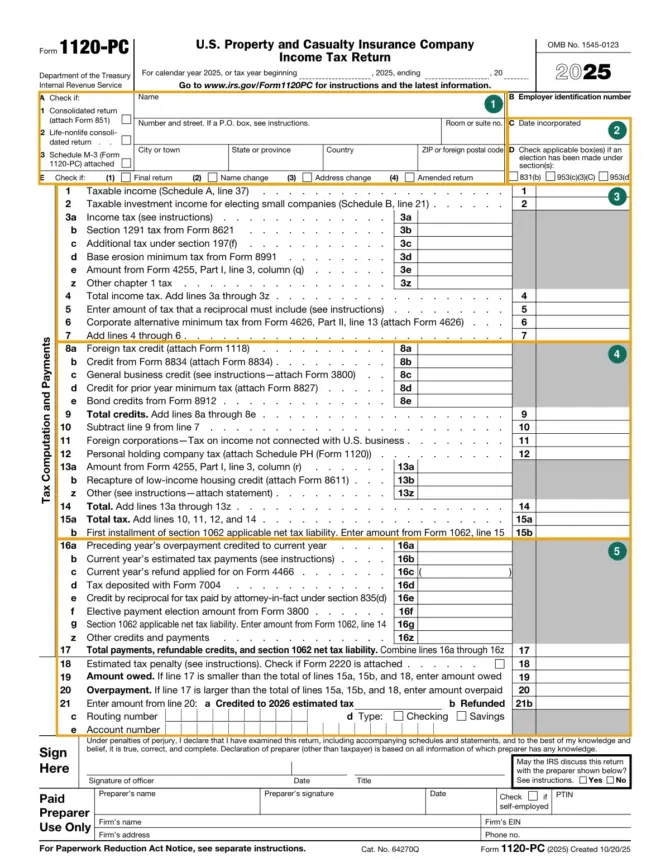
Header and Items A through E (page 1)
In the left and center header area (Marker 1), enter the company’s legal charter name and the street address of its principal office or place of business (never the address of a state registered agent). In Item A, check box 1 if filing a consolidated return and attach Form 851 (Affiliations Schedule) plus Form 1122 (Authorization and Consent of Subsidiary Corporation To Be Included in a Consolidated Income Tax Return) for each newly included subsidiary; also check box 2 if the return is a life-nonlife consolidated return under section 1504(c)(2) and Regulations section 1.1502-47 (available where life insurance members have belonged to the affiliated group for the five preceding tax years). When a nonlife insurer is a subsidiary member included in a consolidated return, attach a separate pro forma Form 1120-PC labeled Supporting Statement to Consolidated Return across the top of page 1. Check box 3 in Item A if attaching Schedule M-3 (Form 1120-PC) (Net Income (Loss) Reconciliation for U.S. Property and Casualty Insurance Companies With Total Assets of $10 Million or More), which is mandatory when year-end total assets (nonconsolidated or consolidated) reach $10 million or more. In Item E, check any applicable box for Final return, Name change, Address change (use Form 8822-B if an address or responsible party changes after filing), or Amended return.
In the right-hand header block (Marker 2, plus Item B immediately above it), enter the nine-digit EIN in Item B and the date of incorporation in Item C. In Item D, check 831(b) for the small-company investment income election, 953(c)(3)(C) if a foreign insurer elects to treat related-person insurance income as effectively connected U.S. business income, or 953(d) if a foreign insurer elects to be treated as a domestic corporation (any loss of a section 953(d) company is a dual-consolidated loss that cannot offset other group members’ income, and any additional tax under section 953(d) is written on the dotted line to the left of page 1, line 14).
| Page 1 lines | Section on Form 1120-PC | What to report and key instructions |
|---|---|---|
| Lines 1 and 2 | Taxable income or taxable investment income | Standard filers enter taxable income from Schedule A, line 37 on line 1. Small companies electing under section 831(b) leave line 1 blank and enter taxable investment income from Schedule B, line 21 on line 2. |
| Lines 3a–3z and 4–7 | Income tax, BEAT, reciprocal tax, and CAMT (Marker 3) | Multiply line 1 (or line 2 for a section 831(b) filer) by 21% (0.21) on line 3a. Add PFIC tax from Form 8621 on line 3b (put section 1291(c)(3) interest on line 13z), section 197(f) anti-churning tax on line 3c, Base Erosion Minimum Tax from Form 8991 on line 3d (required if gross receipts were at least $500 million in any of the three prior years), credit recapture tax reducible by credits from Form 4255, Part I, line 3, column (q) on line 3e, and other chapter 1 taxes on line 3z. Sum lines 3a–3z on line 4. Add section 835(b) reciprocal tax (21% of the section 835(b) amount when pre-adjustment taxable income is under $100,000) on line 5 and Corporate Alternative Minimum Tax from Form 4626, Part II, line 13 on line 6, then sum lines 4–6 on line 7. |
| Lines 8a–10 | Nonrefundable tax credits (top of Marker 4) | Enter foreign tax credit from Form 1118 (8a), prior-year electric vehicle passive credit from Form 8834 (8b), general business credit from Form 3800, Part II, line 38 (8c), prior-year minimum tax credit from Form 8827 (8d), and bond credits from Form 8912 (8e). Sum on line 9 and subtract from line 7 on line 10. |
| Lines 11–15b | Other taxes, total tax, and section 1062 installment (bottom of Marker 4) | Enter 30% (or treaty rate) section 881 tax on U.S.-source non-effectively connected income of foreign insurers on line 11 (reduced under section 842(c)(1) for any section 842(b) minimum effectively connected net investment income adjustment), Personal Holding Company tax from Schedule PH (Form 1120) on line 12, non-credit-reducible recapture from Form 4255, column (r) on line 13a, low-income housing recapture from Form 8611 on line 13b, and other taxes/interest (such as Form 8902 shipping tax or section 453A(c) interest) on line 13z. Sum lines 13a–13z on line 14, total lines 10, 11, 12, and 14 on line 15a, and enter the first installment of deferred farmland gain tax from Form 1062, Part III, line 15 on line 15b. |
| Lines 16a–17 | Payments, refundable credits, and section 1062 deferral (top of Marker 5) | Enter prior-year overpayment credit (16a), 2025 quarterly estimated tax payments (16b), subtract any quick refund applied for on Form 4466 before filing the return (16c), add tax deposited with Form 7004 (16d), credit for tax paid by an attorney-in-fact under section 835(d) (16e), elective payment election from Form 3800, Part III, line 6, column (j) (16f), full section 1062 applicable net tax liability from Form 1062, Part III, line 14 (16g), and other credits/payments such as Form 4136 fuel tax credit, Form 2439 credit, or backup withholding (16z). Combine lines 16a–16z on line 17. |
| Lines 18–21e | Estimated tax penalty, balance due, overpayment, and direct deposit (bottom of Marker 5) | Enter any Form 2220 penalty on line 18 (if the corporation has a CAMT liability, it must attach Form 2220 and enter an amount on line 18 even if 0 under Notice 2025-27). Enter net tax owed on line 19 or overpayment on line 20, split between 2026 estimated tax credit (21a) and refund (21b), with U.S. bank routing number (21c), account type (21d), and account number (21e) for direct deposit. |
Schedule A: Taxable Income Under Section 832 (page 2)
Standard filers compute gross underwriting and investment income on lines 1 through 14 and deductions on lines 15 through 36c. On line 1, carry over premiums earned from Schedule E, line 7; on line 2, carry over total dividends and inclusions from Schedule C, line 17, column (b). On lines 3a through 3d, report gross interest received (including accrued adjustments) in column (a) and bond premium amortization in column (b), subtracting tax-exempt interest under sections 103, 139H, and 139L on line 3b. Report gross rents (line 4), royalties (line 5), capital gain net income from Schedule D (Form 1120) (Capital Gains and Losses) (line 6), Form 4797 net gains or losses (line 7), the 2% inclusion on perpetual or refundable-deposit policies of mutual fire or flood insurers under section 832(b)(1)(D) (line 8), subtractions from special mortgage/lease/municipal-bond guaranty accounts under section 832(e) (line 9), legacy protection against loss (PAL) account inclusions (line 10), decreases in subscriber accounts of reciprocal underwriters (line 11), and other income (line 13, including one-eighth of any TCJA reserve transition adjustment under Revenue Procedure 2019-06 or section 842(b) minimum net investment income for foreign insurers).
Under Deductions, report deductible officer compensation on line 15 (attach a four-column schedule with officer name, SSN, percentage of business time, and compensation; note the $1 million cap under section 162(m) for publicly held companies and the stricter $500,000 cap under section 162(m)(6) for covered health insurance providers), salaries and wages net of employment credits on line 16, worthless agency balances and bills receivable on line 17, rents on line 18 (reducing vehicle lease deductions by the Pub. 463 inclusion amount when a leased car, truck, or van placed in service in 2024 or 2025 had an initial fair market value above $62,000), and deductible taxes and licenses on line 19. On lines 20a–20c, subtract section 265 and section 139L(d) tax-exempt interest expense from gross interest expense and apply any section 163(j) business interest limitation on Form 8990 (Limitation on Business Interest Expense Under Section 163(j)).
Continue with charitable contributions (line 21, capped at 10% of taxable income under section 170), depreciation from Form 4562 (line 22), depletion (line 23), pension and employee benefit plans (lines 24–25), deductible losses incurred from Schedule F, line 14 (line 26), abnormal-loss capital asset sales from Schedule G, line 12, column (g) (line 28), policyholder dividends (line 29), increases in reciprocal subscriber accounts credited before the 16th day of the 3rd month after year-end (line 30), and other deductions including ratably amortized specified policy acquisition expenses under section 848 and domestic R&E deductions under section 174A (line 31). After subtracting total deductions on line 33, deduct the section 833 special deduction from Schedule H, line 6 (line 34a), special guaranty account additions backed by tax and loss bonds (line 34b), dividends-received and section 250 deductions from Schedule C, line 30 (line 36a), and the net operating loss (NOL) deduction (line 36b). Unlike ordinary C corporations whose post-2017 NOL deductions are capped at 80% of taxable income, nonlife insurance companies taxed under section 831 retain a 2-year NOL carryback, a 20-year carryforward, and a 100% taxable-income offset under sections 172(b)(1)(C) and 172(f).
Schedule B: Taxable Investment Income of Electing Small Companies (page 3)
Small companies electing under section 831(b) complete Schedule B instead of Schedule A. Part I sums taxable interest, dividends, gross rents, royalties, non-insurance trade or business income, lease termination/modification income under section 834(b)(1)(B)–(C), and capital gain net income on lines 1a through 8, then subtracts real estate taxes and expenses, investment-asset depreciation, depletion, non-insurance business deductions, interest, Schedule G capital losses,investment expenses, and Schedule C special deductions on lines 9 through 20 to reach taxable investment income on line 21. If the company allocates any general expenses to investment expenses on line 17, it must complete Part II (lines 22 through 39) to cap line 17 at 0.25% (0.0025) of the mean of beginning and ending book values of invested assets plus 25% of the excess of the net investment income base over 3.75% (0.0375) of mean invested assets under section 834(c)(2).
Schedules C, E, F, G, and H: Insurance Reserves, Proration, and Special Deductions (pages 4 through 6)
| Schedule | Purpose on Form 1120-PC | Core calculation rules |
|---|---|---|
| Schedule C (page 4) | Dividends, Subpart F/GILTI inclusions, dividends-received deduction (DRD), and section 250 deduction | Separate post-August 7, 1986 dividends subject to section 832(b)(5)(B) proration in column (a) (excluding 100% dividends unless attributable to prorated amounts) from total dividends and inclusions in column (b). Compute the 50% DRD (less-than-20%-owned domestic/foreign stock), 65% DRD (20%-or-more-owned stock), debt-financed DRD, public utility DRD, 100% affiliated/foreign-subsidiary/section 245A DRD, and Form 8993 section 250 FDII/GILTI deduction, applying the section 246(b) taxable-income limit via the page 22 instructions worksheet. Carry line 27 (prorated DRD) to Schedule F, line 10, and line 30 (total DRD and special deductions) to Schedule A, line 36a or Schedule B, line 20. |
| Schedule E (page 5) | Premiums earned under section 832(b)(4) | Start with net premiums written on line 1, add prior-year deductible unearned premiums on line 2e, and subtract current-year deductible unearned premiums on line 4e. For most property and casualty lines, only 80% of undiscounted unearned premiums is included on lines 2d and 4d (a 20% hair-cut for premium acquisition costs). Enter 100% on lines 2a and 4a for life insurance reserves and for section 833 health organizations that met the 85% medical loss ratio (MLR) requirement, 90% on lines 2b and 4b for securities default insurance with maturities over 5 years, and present-value discounted unearned premiums on lines 2c and 4c for title insurance. |
| Schedule F (page 5) | Losses incurred and the 25% proration reduction under section 832(b)(5) | Combine losses paid net of salvage/reinsurance recovered (line 1, with an attached reconciliation to the NAIC annual statement) with the change in unpaid life losses and section 846 discounted unpaid losses (lines 2a–4c) and the change in discounted estimated salvage and reinsurance recoverable (lines 6–7) to reach tentative losses incurred on line 8. Then sum post-August 7, 1986 tax-exempt interest (line 9), prorated DRD from Schedule C, line 27 (line 10), and section 264(f) policy cash-value increases (line 11) on line 12, multiply line 12 by 25% (5.25% divided by the 21% corporate rate) on line 13, and subtract line 13 from line 8 to get deductible losses incurred on line 14. Note that while the January 28, 2026 instructions (page 24) state that 2025 section 846 discount factors were not yet published at release, the IRS issued the updated 2025 accident-year unpaid loss and salvage discount factors on February 11, 2026. |
| Schedule G (page 6) | Other capital losses under section 832(c)(5) and section 834(c)(6) | Unlike regular corporations that can deduct capital losses only against capital gains on Schedule D (Form 1120), a nonlife insurer may claim an ordinary deduction on Schedule A, line 28 (or Schedule B, line 15) for losses on capital assets sold to raise cash for abnormal insurance losses and policyholder dividends. Gross sales receipts reported on Schedule G, line 12, column (c) cannot exceed the excess of cash policyholder dividends, losses paid, and expenses paid (line 4) over cash investment income and net premiums received (line 9). |
| Schedule H (page 6) | Special deduction and ending adjusted surplus for section 833 organizations | Qualifying Blue Cross/Blue Shield and section 833(c)(3) health organizations with a section 833(c)(5) MLR of at least 85% (Schedule I, line 13) deduct the excess of 25% of current-year incurred healthcare claims and claim administration expenses (line 4) over beginning adjusted surplus (line 5), capped at pre-deduction health-business taxable income, and carry line 6 to Schedule A, line 34a. |
Schedules I, L, M-1, and M-2 (pages 7 through 9)
Schedule I (pages 7 and 8) collects 20 compliance disclosures: accounting method (line 1), mutual vs. stock status (line 2), 50%-or-more domestic subsidiary or shareholder ownership (lines 3–5), 25%-or-more foreign ownership triggering Form 5472 (line 6), current and prior-year undiscounted unpaid losses and unpaid loss adjustment expenses per the NAIC annual statement (lines 7a–7b), whether annual statement reserves are discounted (line 8), total tax-exempt interest (line 9), the irrevocable checkbox election to waive the 2-year NOL carryback period (line 10; consolidated groups must attach the Regulations section 1.1502-21(b)(3) statement), prior-year NOL carryovers before current-year use (line 11), whether Schedule UTP (Form 1120) (Uncertain Tax Position Statement) is required for audited corporations with $10 million+ in assets (line 12), section 833(c)(5) MLR numerator, denominator, and percentage (line 13), section 831(b) diversification compliance (line 14), the $500 million three-year gross receipts test for Form 8991 BEAT (line 15), disallowed hybrid interest or royalties under section 267A (line 16), section 163(j) elections and Form 8990 filing (lines 17–18, with a $31 million three-year average gross receipts small-business exemption for 2025), controlled group membership requiring Schedule O (Form 1120) (Consent Plan and Apportionment Schedule for a Controlled Group) (line 19), and CAMT applicable corporation and safe-harbor status (line 20).
Every filer must complete Schedule L (Balance Sheets per Books, page 8), reporting undiscounted unpaid losses, loss adjustment expenses, and unearned premiums on line 18 (Insurance liabilities). Insurers with ending total assets under $10 million complete Schedule M-1 (page 9) to reconcile book net income with tax return income before special deductions and NOLs (Schedule A, line 35 or Schedule B, line 19), while insurers with $10 million or more in ending total assets attach Schedule M-3 (Form 1120-PC) instead. All filers complete Schedule M-2 (page 9) to reconcile unappropriated retained earnings.
NAIC annual statement and attachment order
Under Regulations section 1.6012-2(c), a paper Form 1120-PC filing must include a copy of the corporation’s NAIC annual statement (or pro forma annual statement for a foreign insurer not required to file an NAIC statement). However, if the corporation files Form 1120-PC electronically, the IRS instructions (page 4) direct the filer not to attach the NAIC annual statement to the electronic return; instead, retain the NAIC statement in the company’s tax records and furnish it to the IRS upon request. Every corporation that does not file Schedule M-3 (Form 1120-PC) must still attach a reconciliation statement bridging its NAIC annual statement to Form 1120-PC.
When assembling attachments behind page 9 of Form 1120-PC, place forms in the sequence prescribed on page 4 of the instructions: Schedule N (Form 1120) (Foreign Operations of U.S. Corporations), Schedule O (Form 1120), Form 4626, Form 4136, Form 8978, Form 965-B, Form 8941, Form 3800, Form 8283, Form 4255, additional schedules in alphabetical order, additional forms in numerical order, and supporting statements last.
When and where to file Form 1120-PC
A calendar-year insurer (and most fiscal-year or short-period filers) must file Form 1120-PC by the 15th day of the 4th month after the end of its tax year (April 15, 2026 for a calendar-year 2025 return). A corporation with a fiscal year ending June 30, or a short tax year ending at any time in June, must file by the 15th day of the 3rd month after the close of its tax year (September 15). To obtain an automatic filing extension, submit Form 7004 (Application for Automatic Extension of Time To File Certain Business Income Tax, Information, and Other Returns) on or before the regular due date, and deposit any expected balance due electronically via EFTPS, IRS Direct Pay, or the IRS business tax account by the original due date.
Corporations may file Form 1120-PC electronically through Modernized e-File (MeF); under the IRS announcement of February 20, 2026 on About Form 1120-PC, the IRS will not assess a penalty for not electronically filing Form 1120-PC for the 2025 tax year. For paper returns, mail the package to the IRS Service Center based on the location of the corporation’s principal business, office, or agency:
| Principal business, office, or agency location | IRS mailing address for Form 1120-PC |
|---|---|
| The United States | Department of the Treasury, Internal Revenue Service, Ogden, UT 84201-0012 |
| A foreign country or U.S. territories (including section 953 elections) | Internal Revenue Service, P.O. Box 409101, Ogden, UT 84409 |
Common mistakes that delay processing or trigger adjustments
Deducting 100% of unearned premiums instead of applying the 20% hair-cut
On Schedule E, lines 2d and 4d, standard property and casualty insurers may include only 80% of undiscounted unearned premiums. Claiming 100% on lines 2a and 4a is restricted to life insurance reserves and section 833 health organizations that achieved an MLR of at least 85% on Schedule I, line 13c. If a section 833 organization drops below the 85% MLR threshold, it loses both the 100% unearned premium reserve treatment and the Schedule H special deduction and must file Form 3115 (Application for Change in Accounting Method).
Omitting the 25% section 832(b)(5)(B) proration reduction on Schedule F
Property and casualty insurers cannot claim a full losses-incurred deduction on Schedule F while simultaneously excluding 100% of post-August 7, 1986 tax-exempt interest and dividends-received deductions. Failing to carry prorated dividends from Schedule C, line 27 to Schedule F, line 10, or failing to reduce losses incurred by 25% of the combined tax-exempt interest, prorated DRD, and section 264(f) cash-value increase on Schedule F, line 13, results in an automatic math or exam adjustment.
Attaching the full NAIC annual statement to an e-filed return or omitting the reconciliation
While paper filers must enclose the NAIC annual statement under Regulations section 1.6012-2(c), electronic filers must keep the NAIC annual statement in their records rather than attaching it to the MeF transmission. Conversely, any filer with ending assets under $10 million that does not file Schedule M-3 (Form 1120-PC) must still attach the NAIC-to-Form 1120-PC reconciliation statement.
Leaving page 1, line 18 blank when reporting a CAMT liability
Under the 2025 instructions for line 18 (page 11) and Notice 2025-27, any corporation whose total tax includes a Corporate Alternative Minimum Tax liability on line 6 must complete and attach Form 2220 and enter a numeric figure on page 1, line 18 (even if that penalty amount is 0) to claim the 2025 CAMT estimated tax penalty waiver without triggering an automated penalty notice.
Frequently asked questions
Does the 80% taxable income limit on net operating losses apply to Form 1120-PC filers?
No. Under sections 172(b)(1)(C) and 172(f), nonlife insurance companies taxed under section 831 are exempt from the 80%-of-taxable-income cap and indefinite carryforward regime that applies to ordinary C corporations. A property and casualty insurance company may carry its net operating losses back 2 years and forward 20 years and offset up to 100% of taxable income on Schedule A, line 36b (or elect to waive the 2-year carryback period by checking Schedule I, line 10).
When must a property and casualty insurer file Schedule M-3 (Form 1120-PC) instead of Schedule M-1?
If the corporation’s total assets on the last day of the tax year (determined on a consolidated basis for all members included in a tax consolidation group, or on a nonconsolidated basis for a standalone filer) are $10 million or more, it must check Item A, box 3 on page 1 and attach Schedule M-3 (Form 1120-PC) in place of Schedule M-1. Insurers with less than $10 million in year-end assets complete Schedule M-1 on page 9 or may file Schedule M-3 (Form 1120-PC) voluntarily.
What are the quarterly estimated tax due dates and EFTPS cutoff times for Form 1120-PC?
A corporation expecting its net tax liability to be $500 or more must make quarterly electronic estimated tax deposits on the 15th day of the 4th, 6th, 9th, and 12th months of its tax year. On EFTPS, deposits of $1 million or less may be submitted up to 3:00 p.m. Eastern time on the business day the payment is due, whereas deposits exceeding $1 million must be submitted by 8:00 p.m. Eastern time on the business day before the due date (or remitted via same-day Federal Tax Collection Service wire).
How does a foreign insurance company report U.S. tax on Form 1120-PC?
A foreign insurer carrying on an insurance business in the United States reports its effectively connected U.S. insurance income on Schedule A (including any additional minimum effectively connected net investment income required under section 842(b) and Revenue Procedure 2024-20 on Schedule A, line 13) and reports the 30% (or treaty-reduced) section 881 tax on non-effectively connected U.S.-source income on page 1, line 11. Alternatively, a qualifying foreign insurer may check Item D to elect under section 953(d) to be taxed as a domestic corporation or under section 953(c)(3)(C) to treat related-person insurance income as effectively connected income.