Form 8990 works out how much business interest expense a taxpayer may deduct this year under section 163(j) and how much is pushed to next year. The deduction is capped at the total of three amounts: business interest income, 30% of adjusted taxable income (ATI), and floor plan financing interest expense. Whatever does not fit under that cap is carried forward. The form is attached to the taxpayer’s income tax return; the About Form 8990 page on IRS.gov lists the December 2025 revision as the current one, used with the Instructions for Form 8990 (Rev. December 2025), dated January 21, 2026.
What the December 2025 revision changed
The What’s New section of the December 2025 instructions has two items, both from P.L. 119-21, commonly known as the One Big Beautiful Bill Act:
- For tax years beginning after 2024, depreciation, amortization and depletion are added back again when ATI is figured. Line 11 of the form was revised for this: it now holds the deduction allowable for depreciation, amortization or depletion attributable to a trade or business. For tax years 2022 through 2024, ATI was figured with those deductions left in.
- Floor plan financing interest now also covers debt on trailers and campers designed for temporary living quarters (recreational, camping or seasonal use) that are towed by or affixed to a motor vehicle, for tax years beginning after 2024.
The same section looks one year further ahead. For tax years beginning after 2025, the limit will generally include capitalized interest, except interest capitalized under sections 263(g) and 263A(f), and ATI will leave out U.S. shareholder inclusions from controlled foreign corporations (CFCs).
Who files Form 8990 and who is excluded
Any taxpayer, whether an individual, corporation, partnership or S corporation, generally files Form 8990 if it has business interest expense, a disallowed business interest expense carryforward, or excess business interest expense from a partnership for the current or a prior year. Three filers are named on top of that:
- A partnership or S corporation that passes excess taxable income or excess business interest income to its owners files the form even if it has no interest expense at all.
- A regulated investment company that pays section 163(j) interest dividends files it. If it has no business interest expense for the year, it completes only Sections I and III of Part I.
- A U.S. shareholder of an applicable CFC that has business interest expense, a carryforward, or belongs to a CFC group attaches a Form 8990 to each Form 5471.
There are two exclusions. The first is the small business taxpayer: one that is not a tax shelter under section 448(d)(3) and whose average annual gross receipts for the 3 prior tax years are $31 million or less, for tax years beginning in 2025. That taxpayer does not file, unless it has excess business interest expense from a partnership. The threshold is adjusted for inflation; for tax years beginning after 2025 the instructions point to the instructions of your own income tax return, or to the Revenue Procedure linked from IRS.gov/InflationAdjustment, under “Limitation on Use of Cash Method of Accounting.” The instructions add a worksheet for the average: gross receipts for each of the 3 preceding years, plus receipts of related entities under the aggregation rules, totaled and divided by 3. A short year is annualized first.
The second exclusion covers interest that comes only from excepted trades or businesses: services performed as an employee, an electing real property trade or business, an electing farming business, and certain regulated utilities. Utilities that sell electricity, water, sewage disposal, or gas or steam through a local distribution system or by pipeline, at rates set on a rate of return and cost of service basis, are excepted automatically. The real property and farming exceptions need an election.
The election is irrevocable and is made by attaching a statement to a timely filed original return, extensions included. The statement is titled “Section 1.163(j)-9 Election” for real property or farming, or “Section 1.163(j)-1(b)(15)(iii) Election” for a utility, and gives the taxpayer’s name, address, SSN or EIN, a description of the business with its principal business activity code, and a sentence saying the election is made under section 163(j)(7)(B) or (C) or the utility regulation. The trade-off is depreciation: an electing real property business uses the alternative depreciation system (ADS) for nonresidential real property, residential rental property and qualified improvement property, and an electing farm uses ADS for farming property with a recovery period of 10 years or more. Neither may take the special depreciation allowance on that property. Revenue Procedure 2021-9 lets a business operating a residential living facility with assistive, nursing or routine medical services treat it as a real property trade or business.
How the 30% limit adds up
Before anything goes on the form, interest expense is sorted under Temporary Regulations section 1.163-8T into investment, personal and business interest; only business interest is limited. For a C corporation the sorting is simpler: for section 163(j) all of its interest expense is business interest expense and all of its interest income is business interest income, except amounts allocable to an excepted business. Section 163(j) applies after basis limits and before the at-risk, passive activity loss and excess business loss limits.
A worked example with round numbers shows the arithmetic. Take a calendar-year C corporation that bought equipment on credit and has $400,000 of interest expense, $20,000 of interest income, no floor plan interest and ATI of $1,000,000. Thirty percent of ATI is $300,000 (line 26). Adding the $20,000 of interest income gives line 29 of $320,000. Line 30 is the smaller of line 29 and line 5, so $320,000 is deductible this year, and line 31 shows $80,000 of disallowed interest. Next year the $80,000 goes on line 2, where it competes for room with that year’s own interest. The instructions set the order: current year interest is deducted first, then carryforwards, oldest year first.
Where the limit is applied depends on the entity. A consolidated group has one limit and files one Form 8990. A partnership applies the limit at the partnership level but does not keep the disallowed amount; it goes to the partners as excess business interest expense. An S corporation also applies the limit itself, keeps its disallowed interest and treats it as paid or accrued the next year. A taxpayer that was limited in an earlier year and qualifies as a small business taxpayer this year no longer limits its carryforward.
How to fill out Form 8990, Part I
Part I is for every taxpayer subject to section 163(j). Amounts are in U.S. dollars and, in Section II, entered as positive numbers unless the line says otherwise. If you hold an interest in a partnership or an S corporation, fill in Schedule A or Schedule B on page 3 first, because lines 3, 14, 15 and 24 take their totals.
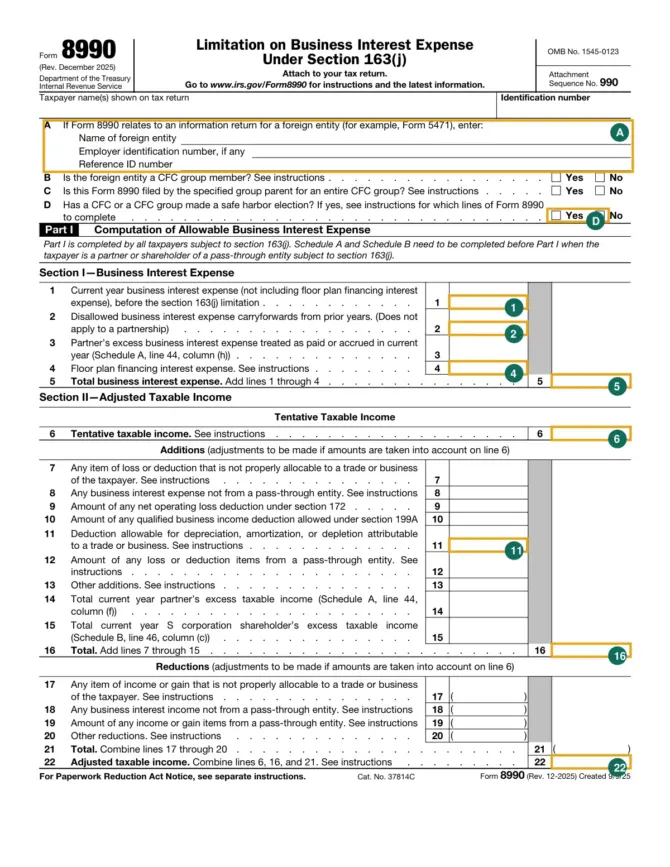
| Line | What goes there | Where the figure comes from |
|---|---|---|
| 1 | This year’s business interest expense, including elective capitalized interest, that would be deductible without section 163(j) | Your books; leave out floor plan interest, carryforwards and interest of an excepted business |
| 2 | Disallowed interest carried from earlier years (not for partnerships) | Line 31 of last year’s Form 8990 |
| 3 | Partner’s excess business interest expense treated as paid or accrued this year | Schedule A, line 44, column (h) |
| 4 | Floor plan financing interest expense | Interest on debt secured by vehicles, trailers or campers held for sale or lease |
| 6 | Tentative taxable income, figured as if all business interest were allowed | Generally, Form 1065: Analysis of Net Income (Loss), line 1, less guaranteed payments on Schedule K, line 4c. Form 1120-S: Schedule K, line 18 |
| 7 to 13 | Add-backs: nonbusiness losses, business interest expense not from a pass-through, NOL deduction, section 199A deduction, depreciation, amortization and depletion, pass-through losses, other additions | Only amounts that reduced line 6, and only to the extent they did |
| 14, 15 | Excess taxable income from partnerships and S corporations | Schedule A, line 44, column (f); Schedule B, line 46, column (c) |
| 17 to 20 | Reductions: nonbusiness income and gain, business interest income not from a pass-through, pass-through income and gain, other reductions such as floor plan interest | Only amounts included on line 6 |
| 22 | ATI: lines 6, 16 and 21 combined; zero if negative (CFC group members report a negative figure) | Your result |
| 23, 24 | Business interest income paid to you, plus excess business interest income from pass-throughs | Your books; Schedule A, line 44, column (g) and Schedule B, line 46, column (d) |
| 26 to 31 | 30% of line 22, the limit on line 29, the deduction on line 30, the carryforward on line 31 | Arithmetic on the form |
The instructions give an example for each side of the ATI adjustment. A personal casualty loss that lowered tentative taxable income goes on line 7, and gain on the sale of a personal residence goes on line 17, since neither belongs to a trade or business. Line 13 also takes capital loss carrybacks and carryovers, the income distribution deductions of a trust or estate under sections 651, 661 and 642(c), and, for a taxpayer subject to the limit that owns part of a pass-through which is not, its share of that entity’s items if the net is positive. That last group needs detail from the entity, and the taxpayer has to ask the entity to state the items separately.
On line 30, a partner who is not subject to the limit but has partnership excess business interest expense treated as paid this year enters Schedule A, line 44, column (h), and that amount is not limited again. If business interest is deducted in more than one place on the return, for example as ordinary business interest and as farm interest, and line 29 is below line 5, the disallowed part is spread across those places in proportion, and a schedule showing the amount and the return line for each is attached.
Schedules A and B: excess items from a K-1
Schedule A is for partners. Line 43 takes one row per partnership, with the figures the partnership reported on Schedule K-1: current year excess business interest expense in column (c), excess taxable income in column (f) and excess business interest income in column (g). Column (d) is last year’s column (i). Column (h) is the smaller of column (e) or columns (f) plus (g) from the same partnership, so a partner’s old excess interest is freed only by excess taxable income or excess business interest income from that same partnership. Column (i) is what remains for next year. Excess business interest expense suspended under the section 704(d) basis rules stays out of Schedule A, and any adjustment for “negative section 163(j) expense” needs an attached statement naming the partnership.
Schedule B is shorter. A shareholder lists each S corporation on line 45 with its excess taxable income in column (c) and excess business interest income in column (d), both from the K-1. Line 46, column (c) goes to line 15 of Part I; column (d) is added to Schedule A, line 44, column (g) and the total goes to line 24.
Parts II and III for partnerships and S corporations
Part II is completed only by a partnership subject to the limit. If line 31 shows disallowed interest, that figure goes on line 32 as excess business interest expense and lines 33 to 37 are skipped. Otherwise, lines 33 to 36 work out excess taxable income: the share of ATI that was not needed to support the interest deduction. Line 37 is the excess of business interest income over lines 1, 2 and 3. The partnership then splits these amounts among the partners with Worksheets A and B in the instructions, an 11-step calculation from Regulations section 1.163(j)-6(f), and keeps the worksheets with its records. A partnership that allocates every section 163(j) item proportionately in step 2 does not need the worksheets.
Part III is the S corporation version, lines 38 to 42, with the same formulas. The excess taxable income and excess business interest income it produces are passed to the shareholders pro rata and are not carried forward by the S corporation. If line 26 is zero, a partnership enters -0- on line 35 and an S corporation on line 40. How the amounts reach the owners’ K-1s is explained in the Instructions for Form 1065 and Form 1120-S.
Foreign corporations: lines A to D and Worksheet C
The questions at the top of page 1 are only for a Form 8990 tied to an information return for a foreign entity, such as Form 5471. Line A takes the foreign entity’s name, its EIN if it has one, and a reference ID number. Line B asks whether the entity is a CFC group member, line C whether the form is filed by the specified group parent for the whole CFC group, and line D whether a safe harbor election has been made.
With a CFC group election in effect, each member gets its own Form 8990 attached to Form 5471, with lines 1 to 25 for the member alone, lines 26 to 29 left blank, and the member’s deduction and disallowed amount on lines 30 and 31. A separate Form 8990 is filed for the group, with “Specified Group Parent” as the name on line A, zeros for the EIN, lines 1 to 25 added up across the members, and no Schedule A or B.
The safe harbor election is figured on Worksheet C. It is available when the business interest expense of a stand-alone applicable CFC or a CFC group is no more than its business interest income, or no more than 30% of the lesser of its qualified tentative taxable income or its eligible amount. If it applies, line D is checked “Yes”, Worksheet C is attached to the return, Schedules A and B are not completed, and Part I is filled in only on the lines Worksheet C names: lines 5 and 25, plus lines 6 and 22 when the 30% test was used.
Checks before you attach Form 8990
- Schedule A or Schedule B is completed before Part I if you own an interest in a partnership or S corporation subject to section 163(j).
- Line 6 is figured as if all business interest were allowed, without last year’s carryforward or prior excess business interest expense.
- Additions on lines 7 to 13 and reductions on lines 17 to 20 include only amounts that are in line 6.
- Depreciation, amortization and depletion are added back on line 11 for tax years beginning after 2024; pass-through amounts go on line 12, not line 11.
- A partnership leaves line 2 empty and moves line 31 to line 32.
- Line 31 is kept for next year’s line 2. If last year’s return with Form 8990 is not at hand, Form 4506 requests a copy of a filed return.
- Any statements the instructions call for are attached: the real property, farming or utility election, the allocation between excepted and non-excepted businesses under Regulations section 1.163(j)-10(c), the schedule of disallowed interest by return line, and the currency statement for an applicable CFC whose line 2 differs from last year’s line 31 because of exchange rates.
Getting the form and filing it with your return
The form and its instructions are on the About Form 8990 page at IRS.gov/Form8990, which also links to earlier revisions and to the IRS questions and answers on the business interest limitation. Form 8990 has no mailing address of its own: the top of the form says to attach it to your tax return, so it is filed together with that return. If the form relates to a foreign entity, it is attached to the Form 5471 for that entity, as described above.
Official PDF: Form 8990 — Official PDF (irs.gov)
Form 8990 questions
Does a small business with a bank loan have to file Form 8990?
Not if it is a small business taxpayer: not a tax shelter and average annual gross receipts of $31 million or less over the 3 prior years for tax years beginning in 2025. It still files if it has excess business interest expense from a partnership.
What happens to the interest that was not deducted?
The amount on line 31 is carried to line 2 of next year’s Form 8990, except for a partnership, which moves it to line 32 and passes it to its partners.
Can a rental real estate business avoid the limit?
A real property trade or business can make the irrevocable election to be an electing real property trade or business. It then uses ADS for its nonresidential real property, residential rental property and qualified improvement property.
Is a car dealer’s floor plan interest limited?
The instructions say floor plan financing interest expense is not subject to the section 163(j) limitation; it is entered on line 4 and added to the limit on line 28. Since tax years beginning after 2024 that includes debt on trailers and campers held for sale or lease.
Sources
- Internal Revenue Service, Form 8990 (Rev. December 2025), Limitation on Business Interest Expense Under Section 163(j)
- Internal Revenue Service, Instructions for Form 8990 (Rev. December 2025), January 21, 2026 (PDF)
- Internal Revenue Service, Instructions for Form 8990, web version
- Internal Revenue Service, About Form 8990