Form 8827 is the one-page worksheet a corporation attaches to its income tax return when it paid alternative minimum tax (AMT) in an earlier year and wants to use that tax as a credit now. The form adds the prior year’s AMT to any credit still carried forward, limits the credit by comparing this year’s regular tax with this year’s tentative minimum tax, and leaves the unused part on line 12 for later years. The credit lands on Form 1120, Schedule J, line 5d. The AMT figures on the form now come from Form 4626, which large “applicable corporations” use to compute the corporate alternative minimum tax (CAMT).
Who files Form 8827
The instructions printed on the form say it should be filed by corporations that had an AMT liability in a prior year. In practice that means a corporation with an amount on Form 4626, Part II, line 13 for last year, or a minimum tax credit carryforward on line 12 of last year’s Form 8827, or both. A corporation that never owed AMT has nothing to put on lines 1 and 2 and no reason to file.
Whether a corporation owes CAMT in the first place depends on the applicable corporation test. Under the 2025 Instructions for Form 4626, a corporation is an applicable corporation subject to CAMT when its average annual adjusted financial statement income (AFSI) for the prior three tax years exceeds $1 billion, with income of the whole controlled group counted for the test. S corporations, regulated investment companies and real estate investment trusts are outside CAMT altogether. Foreign-parented groups have their own test with a $100 million leg, explained in the same instructions.
What changed on the December 2025 revision
The What’s New note on the form has one item: applicable corporations subject to the new corporate alternative minimum tax use Form 8827 to figure any credit for prior-year minimum tax. The line references follow from that. Line 1 now points to Part II, line 13 of the prior year Form 4626, and line 9 to Part II, line 9 of the current year Form 4626, which is the tentative minimum tax under CAMT.
The IRS used to number Form 8827 by tax year; its prior-year list shows editions for 2024, 2022 and earlier years. The current edition is a revision dated December 2025, posted on April 28, 2026, and the About Form 8827 page lists it as the current revision with no recent developments. Because the form carries no tax year, the same revision is used until the IRS replaces it.
Numbers to collect before filling in Form 8827
- Last year’s Form 4626, Part II, line 13 (alternative minimum tax).
- Last year’s Form 8827, line 12 (minimum tax credit carryforward).
- This year’s regular tax liability under section 26(b), plus any positive section 6226 adjustment from Form 8978.
- This year’s base erosion minimum tax under section 59A, if the corporation owes it (Form 1120, Schedule J, line 1f, according to the Form 4626 instructions).
- This year’s Form 1120, Schedule J, lines 5a through 5c: the foreign tax credit, the credit from Form 8834 and the general business credit.
- This year’s Form 4626, Part II, line 9 (tentative minimum tax).
How to fill out Form 8827, line by line
The top of the form asks only for the corporation’s name and employer identification number. Everything else is twelve lines, and only lines 1, 2, 4, 5, 7 and 9 take a figure from somewhere else; the remaining lines are arithmetic.
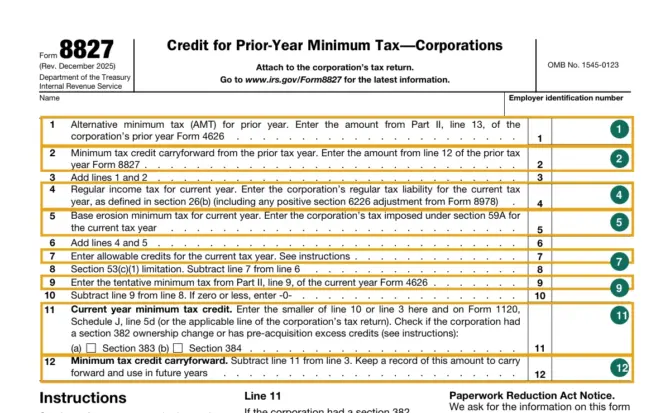
| Line | What goes there | Where the number comes from |
|---|---|---|
| 1 | AMT for the prior year | Prior year Form 4626, Part II, line 13 |
| 2 | Minimum tax credit carryforward | Line 12 of the prior tax year Form 8827 |
| 3 | Lines 1 plus 2 | Arithmetic: the most credit available this year |
| 4 | Regular income tax for the current year | Regular tax liability as defined in section 26(b), including any positive section 6226 adjustment from Form 8978 |
| 5 | Base erosion minimum tax for the current year | Tax under section 59A |
| 6 | Lines 4 plus 5 | Arithmetic |
| 7 | Allowable credits for the current year | Credits under Chapter 1, Subchapter A, Part IV, subparts B, D, E and F; on Form 1120, Schedule J, lines 5a to 5c |
| 8 | Section 53(c)(1) limitation | Line 6 minus line 7 |
| 9 | Tentative minimum tax | Current year Form 4626, Part II, line 9 |
| 10 | Line 8 minus line 9 | Enter -0- if zero or less |
| 11 | Current year minimum tax credit | The smaller of line 10 or line 3; also goes on Form 1120, Schedule J, line 5d |
| 12 | Carryforward to future years | Line 3 minus line 11; keep a record of it |
A few lines need more than the table can hold.
Line 1
Use the AMT itself, Part II, line 13 of the prior year Form 4626, which is what remains after the regular tax and base erosion tax are subtracted from the tentative minimum tax. Line 9 of that same Part II is the tentative minimum tax before that subtraction, and it belongs on Form 8827 only for the current year, on line 9.
Line 7
The instructions list the credit subparts of the Internal Revenue Code that count, and give the shortcut for Form 1120 filers: include all credits on Schedule J, Part I, lines 5a through 5c. On the 2025 Form 1120 those lines are the foreign tax credit (Form 1118), the credit from Form 8834, and the general business credit from Form 3800. Line 5d, the prior-year minimum tax credit itself, is left out, since that is the number Form 8827 is computing.
Line 11
The credit allowed this year cannot exceed the amount on line 10, the room between the section 53(c)(1) limitation and the tentative minimum tax, nor the credit available on line 3. The same line has two checkboxes. Box (a), section 383, applies if the corporation had an ownership change as defined in section 382(g): pre-change minimum tax credits may then be limited in tax years ending after the change, and the credit for the change year has to be split between the pre-change and post-change periods with the same method (ratable allocation or closing of the books) used for section 382. Box (b), section 384, applies because pre-acquisition excess credits of one corporation generally cannot offset tax on recognized built-in gains of another corporation. If either box is checked, the corporation attaches its own computation of the minimum tax credit allowed. Regulations section 1.382-6 has the allocation rules.
Line 12
Nothing on line 12 goes on the return. It becomes line 2 of next year’s Form 8827, so the corporation keeps it in its records.
A worked example with round numbers
The figures below are invented to show the arithmetic; they do not come from any IRS example.
Suppose a calendar-year corporation owed $2,000,000 of AMT on last year’s Form 4626, Part II, line 13 and has no older carryforward. This year its regular tax on line 4 is $5,000,000, it owes no base erosion tax, and its foreign tax credit and general business credit on Schedule J, lines 5a to 5c total $500,000. Line 8 is $4,500,000. If its tentative minimum tax on this year’s Form 4626, Part II, line 9 is $3,000,000, line 10 is $1,500,000. Line 3 is $2,000,000, so line 11 is the smaller figure, $1,500,000, and that amount goes on Schedule J, line 5d. The remaining $500,000 is line 12 and moves to line 2 of the following year’s form.
Had the tentative minimum tax been $4,500,000 or more, line 10 would be zero and no credit could be used this year; the whole $2,000,000 would carry forward.
Before attaching Form 8827
- Line 1 is from Part II, line 13 of the prior year Form 4626, not line 9.
- Line 7 excludes Schedule J, line 5d, the credit being figured.
- Line 11 matches the amount entered on Form 1120, Schedule J, line 5d, or the corresponding line of another corporate return.
- If box (a) or (b) on line 11 is checked, the computation of the allowed credit is attached.
- Line 12 is saved for next year’s line 2.
Where to get Form 8827, and when and where it is filed
The Form 8827 PDF (Rev. December 2025) is linked from the IRS About Form 8827 page; its instructions are printed on the form itself, so there is no separate instructions booklet. The form says “Attach to the corporation’s tax return.” It has no mailing address or due date of its own: it is filed with Form 1120, or the corporation’s other income tax return, by that return’s deadline and through the same channel. The Instructions for Form 1120 repeat the step for line 5d: enter the allowable credit from Form 8827, line 11, and complete and attach Form 8827.
This page walks through the form; it is not tax advice for a particular corporation. Questions about section 383 or 384 limits, or about whether a corporation is an applicable corporation, belong with the corporation’s tax adviser.
Questions about Form 8827
Where does the Form 8827 credit go on Form 1120?
Schedule J, line 5d, “Credit for prior year minimum tax (attach Form 8827).” Other corporate returns use their own matching line, as line 11 of the form says.
Can the credit reduce the tax below the tentative minimum tax?
The form does not allow it. Line 10 is the regular tax and base erosion tax, minus other credits, in excess of the current year’s tentative minimum tax, and the credit on line 11 cannot be larger than line 10.
What happens to credit the corporation cannot use this year?
It stays on line 12 as a carryforward and is entered on line 2 of the next year’s Form 8827.
Is there a separate instructions document for Form 8827?
The instructions are on the form: What’s New, Purpose of Form, Who Should File, and notes for lines 7 and 11. The Instructions for Form 4626 cover how the AMT and tentative minimum tax figures are computed.
Official sources
- Internal Revenue Service, Form 8827 (Rev. December 2025), Credit for Prior-Year Minimum Tax, Corporations
- Internal Revenue Service, About Form 8827
- Internal Revenue Service, Prior year forms and instructions, Form 8827
- Internal Revenue Service, Forms, instructions and publications, Form 8827
- Internal Revenue Service, Form 4626 (2025), Alternative Minimum Tax, Corporations
- Internal Revenue Service, Instructions for Form 4626 (2025)
- Internal Revenue Service, Form 1120 (2025), U.S. Corporation Income Tax Return
- Internal Revenue Service, Instructions for Form 1120 (2025)