Form 14039, the Identity Theft Affidavit, is how an individual tells the IRS that someone used a Social Security number or ITIN for tax purposes: a fraudulent federal return, a dependent claimed by someone else, or wages reported under a stolen number. It can be filed for yourself, for a dependent, or for another person, living or deceased. The form runs to two pages, Sections A to E are required, and the IRS takes it online, by fax or by mail.
The current English form is the February 2026 revision (Rev. 2-2026). The IRS forms list shows it posted on March 18, 2026, while the Spanish version, Form 14039 (SP), on the same list is still the September 2023 revision. Businesses, trusts, estates and tax-exempt organizations use a different form, Form 14039-B, Business Identity Theft Affidavit.
When to file Form 14039, and when the IRS says not to
The IRS identity theft guide for individuals states plainly that most people don’t need to file this form. It lists the cases where the affidavit only slows things down:
- You already sent Form 14039 for the same incident, or filed it through IdentityTheft.gov.
- The IRS has already sent you a letter or notice about it.
- The identity theft isn’t tax-related.
- You used, or the IRS told you to use, the Identity and Tax Return Verification Service.
- The victim is a business, trust, estate or tax-exempt organization (Form 14039-B instead).
The same page says to file only if the IRS tells you to, if you can’t use the verification service, or if you want to report possible tax-related identity theft the IRS doesn’t have on file, such as a data breach. The form itself adds one more limit at the end of Section B: if your situation is not one of the three listed there, do not file, and report the incident to the Federal Trade Commission at IdentityTheft.gov instead.
Two IRS pages seem to pull in different directions on notices. The guide for individuals lists “We already sent you a letter or notice” as a reason not to file, yet Section A, box 2 of the February 2026 form exists for an affidavit sent “in response to an IRS Notice or Letter received.” The IRS page on how victim assistance works explains one side of this: Letters 5071C, 4883C and 5747C from the Taxpayer Protection Program ask you to verify your identity and say “Do not file a Form 14039.” Neither page lists which notices do ask for the form, so follow the instructions in the letter itself, and if they are unclear, call the IRS identity verification line at 800-908-4490 before sending anything.
How to fill out Form 14039, section by section
Page 1 holds Sections A to D. Page 2 has the signature in Section E, Section F for anyone signing on someone else’s behalf, and the submission instructions. The markers on the image match the section letters in the table.
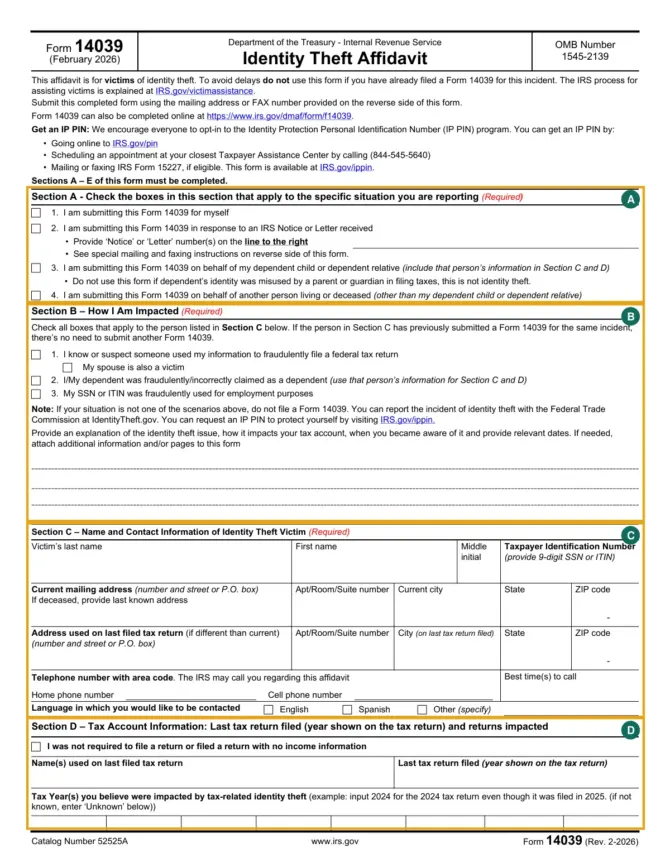
| Section | What you fill in | Points the form spells out |
|---|---|---|
| A, required | Who is submitting and why: box 1 for yourself, box 2 in response to an IRS notice or letter, box 3 for a dependent child or dependent relative, box 4 for another person, living or deceased | Box 2 needs the notice or letter number on the line to the right. Box 3 is not for a dependent whose identity a parent or guardian misused in filing taxes; the form says that is not identity theft. |
| B, required | How the person in Section C is affected: box 1 a fraudulent federal return (with a separate box if your spouse is also a victim), box 2 a dependent claimed fraudulently or incorrectly, box 3 an SSN or ITIN used for employment | Check every box that applies, then write the explanation: what happened, how it affects the tax account, when you found out, and the dates. Extra pages may be attached. |
| C, required | The victim’s name, 9-digit SSN or ITIN, current mailing address, the address on the last filed return if different, home and cell phone, best time to call, and preferred language (English, Spanish or other) | For a deceased victim, give the last known address. The form warns that the IRS may call about the affidavit. |
| D, required | Name(s) on the last filed return, the year of that return, and the tax years you believe were affected | Enter the year shown on the return, not the year you filed it: 2024 for the 2024 return filed in 2025. Write “Unknown” if you don’t know. A checkbox covers people who were not required to file or filed with no income information. |
| E, required | Signature and date under penalty of perjury | Signed by the taxpayer, representative, conservator, parent or guardian. |
| F, if filing for someone else | One of five reasons, plus the representative’s name, mailing address and phone | Check only one box. Each box has its own attachment rule, set out below. |
Section B, box 2: a dependent claimed on someone else’s return
The IRS guide treats this case separately, because a duplicate claim can come from a mistake or a misunderstanding as well as from fraud. Beginning with 2024 tax returns, the IRS accepts e-filed Forms 1040, 1040-NR and 1040-SS even when the dependent has already been claimed, provided the primary taxpayer on the second return enters a valid Identity Protection PIN (IP PIN). The dependent does not need an IP PIN unless one was issued before. If you file on paper instead, the guide says return processing takes 6 to 8 weeks before the IRS looks into the claim, and any refund is delayed. The IRS will not tell you who claimed your dependent.
Section B, box 3: wages under your SSN
If a Form W-2 or Form 1099 arrives from an employer you never worked for, the guide says not to put that income on your return or amend a return you already filed, and to contact the Social Security Administration. Box 3 on Form 14039 is where the employment misuse is reported to the IRS, if you decide the affidavit is needed.
Section F: signing for another person
- Box 1, surviving spouse of a deceased taxpayer: no attachments, not even a death certificate.
- Box 2, court-appointed or certified personal representative of a deceased taxpayer: attach the court certificate showing the appointment.
- Box 3, deceased taxpayer with no appointed representative: attach a death certificate or a formal notice from a government office informing next of kin of the death, and state your relationship (child, parent or legal guardian, other).
- Box 4, the taxpayer can’t complete the form and you are the appointed conservator or hold authority under Form 2848: attach the conservatorship or power of attorney documents, and enter your nine-digit CAF number if the IRS issued one.
- Box 5, your dependent child or dependent relative: state whether you act as parent or legal guardian, as fiduciary under Form 56, under a power of attorney, or other.
Where to send Form 14039: online, fax or mail
Page 2 asks you to choose one method, online, mail or fax, and not to use all of them. The online form at IRS.gov is marked as the preferred method, but attachments can’t be added there, so a Section F filer who has to attach a court certificate or death certificate will need fax or mail.
| Your situation | Where it goes |
|---|---|
| Any case, online | https://www.irs.gov/dmaf/form/f14039 (no attachments) |
| Section A, box 2, and the IRS notice or letter gives a fax number | That fax number |
| Section A, box 2, and the notice gives no fax number | Mail it, with a copy of the notice or letter if possible, to the address in the notice or letter |
| Section B, box 1 or 2, and you can’t e-file because your SSN or ITIN, or your spouse’s or dependent’s, was misused | Attach Form 14039 to the back of your paper tax return and mail both where you normally file |
| All others, by fax | 855-807-5720 (toll-free), with a cover sheet marked “Confidential” |
| All others, by mail | Department of the Treasury, Internal Revenue Service, Fresno, CA 93725 |
The Fresno address and the fax number are for the affidavit only. The form says an original tax return goes to the IRS location where you normally file, not to that address or fax. The IRS victim assistance page also allows the paper return and the affidavit to be mailed separately if you prefer. To avoid delays, the form asks that photocopies or images of anything you add be clear and readable.
Official PDF: Form 14039 — Official PDF (irs.gov)
What happens after the IRS gets the affidavit
According to the IRS page on how victim assistance works, the case goes to the Identity Theft Victim Assistance (IDTVA) organization. Staff there check which tax years are affected and whether other people are listed on the fraudulent return, process your real return and release any refund due, remove the fraudulent return from your records and mark your account with an identity theft indicator. You get a letter when the case is resolved. The same page says this is generally within 120 days, but that identity theft cases are taking 550 days on average to resolve. The IRS Processing status for tax forms page shows which month’s Form 14039 receipts are being worked; when this guide was checked in November 2026, it listed affidavits received in September 2025.
Do not send a second Form 14039 or call to ask about the status; the IRS says both cause delays. Answer any IRS request for information promptly. All confirmed victims are placed in the IP PIN program and get a new six-digit IP PIN each year, mailed as a CP01A notice.
To see what was filed under your number, the IRS guide points to Form 4506-F, Identity Theft Victim’s Request for Copy of Fraudulent Tax Return.
Getting an IP PIN alongside Form 14039
The top of Form 14039 encourages everyone to opt in to the IP PIN program, which stops anyone else from filing a return with your SSN or ITIN. You don’t have to wait for the case to close. The form and the IRS IP PIN page list three ways in: online at IRS.gov/pin, through the IRS app or your online account; an appointment at a Taxpayer Assistance Center (844-545-5640); or Form 15227, which is open only if the adjusted gross income on your last return was below $84,000, or $168,000 for married filing jointly, and you can’t set up an online account. An IP PIN is valid for one calendar year and is used only on Forms 1040, 1040-NR, 1040-PR, 1040-SR and 1040-SS.
Questions about Form 14039
Can Form 14039 be filed online?
Through the IRS online form at irs.gov/dmaf/form/f14039, which the form calls the preferred method. Attachments are not accepted online, so use fax or mail if you must attach documents.
Do I still file my tax return?
The IRS guide says to file returns and pay tax as usual. If you can’t e-file because your SSN or ITIN was misused, file on paper with Form 14039 attached to the back of the return, or mail the two separately.
Can I file Form 14039 for a parent who died?
Section A, box 4 covers another person, living or deceased. In Section F, a surviving spouse needs no attachments; a court-appointed representative attaches the court certificate; anyone else attaches a death certificate or a formal government notice of death.
My data was in a breach but no fraudulent return has shown up. Should I file?
The IRS guide lists a data breach as an example of possible tax-related identity theft the IRS may not have on file, and that is one of the cases where it says to file. If the theft is not tax-related, report it at IdentityTheft.gov instead.
This page explains the form and the IRS process; it is not legal or tax advice. For an open case, the IRS identity verification line is 800-908-4490, and general tax account questions go to 800-829-1040.
Official sources
- Internal Revenue Service, Form 14039 (Rev. February 2026), Identity Theft Affidavit
- Internal Revenue Service, Identity theft guide for individuals
- Internal Revenue Service, How IRS ID theft victim assistance works
- Internal Revenue Service, Get an identity protection PIN
- Internal Revenue Service, Processing status for tax forms
- Internal Revenue Service, Forms, instructions and publications, Form 14039
- Internal Revenue Service, Identity theft central