Schedule D (Form 1065) is where a partnership totals its capital gains and losses for the year and splits them into short-term (Part I) and long-term (Part II). The 2025 version is a single page, attached to Form 1065 or Form 8865. The schedule itself lists almost no sales: individual transactions go on Form 8949, and Schedule D picks up the totals, adds gains from installment sales, like-kind exchanges and other partnerships, and sends two net figures to Schedule K.
What a partnership reports on Schedule D (Form 1065)
The 2025 instructions list six things that belong on the schedule:
- totals of the transactions reported on Form 8949
- certain transactions that do not have to go on Form 8949 (lines 1a and 8a)
- capital gains from installment sales, taken from Form 6252
- capital gains and losses from like-kind exchanges and section 1043 conflict-of-interest sales, from Form 8824
- the partnership’s share of net capital gains and losses from other partnerships, estates and trusts, including specially allocated amounts
- capital gain distributions
A capital asset, in the instructions’ definition, is any property the partnership held, connected with its business or not, except listed categories such as inventory, receivables from customers, depreciable or real property used in the business (even when fully depreciated), certain copyrights and patents, and supplies used in the business.
Several sales never reach Schedule D. Property used in a trade or business, depreciable or amortizable property and noncapital assets go on Form 4797. Casualty and theft losses go on Form 4684, and section 1256 contracts and straddles on Form 6781. A partnership that trades securities and made the mark-to-market election reports each trade in Part II of Form 4797 instead of on Form 8949.
Gains the partnership itself specially allocates to a partner are kept off the schedule as well. The Form 1065 instructions say specially allocated items are entered on Schedule K and the partners’ Schedules K-1, not on Schedule D. The same applies when a partnership elects out of the installment method for gain that is specially allocated: the full gain goes on Schedule K (line 8, 9a or 11) and in each partner’s box 8, 9a or 11, on a timely filed return including extensions.
Form 8949 comes first
The instructions say to complete all necessary pages of Form 8949 before filling in line 1b, 2, 3, 8b, 9 or 10. Each of those lines is the total of the Form 8949 pages with a particular box checked, so the box chosen on Form 8949 decides the Schedule D line:
| Form 8949 box | Transactions | Schedule D line |
|---|---|---|
| A or G | Short-term, Form 1099-B or 1099-DA shows basis reported to the IRS | 1b |
| B or H | Short-term, basis not reported to the IRS or not shown | 2 |
| C or I | Short-term, no Form 1099-B or 1099-DA received | 3 |
| D or J | Long-term, basis reported to the IRS | 8b |
| E or K | Long-term, basis not reported or not shown | 9 |
| F or L | Long-term, no Form 1099-B or 1099-DA received | 10 |
Boxes G to L are for digital asset transactions. The Form 8949 instructions say not to use box C or box F for digital asset transactions.
A partnership does not have to list each sale on its own row. Under the Form 8949 instructions’ special provision for partnerships, corporations and certain other entities, a Form 1065 filer that must report more than five transactions for a part may enter summary totals on a single row: box C or I checked in Part I, or box F or L in Part II, even when the totals include box A, B, D or E type sales; “Available upon request” in column (a); columns (b) and (c) blank; code M in column (f); and the totals in columns (d), (e), (g) and (h). Totals from all brokers go on that one row. The provision is not available for gain deferred by investing in a qualified opportunity fund (QOF), which must be reported investment by investment. When it is used on an e-filed return, no Form 8453 or attached statement is required.
Lines 1a and 8a skip Form 8949 altogether. They take aggregate totals of sales (other than collectibles) for which the partnership received a Form 1099-B or 1099-DA, or a substitute statement, showing basis reported to the IRS, with no adjustment in box 1f or 1g of Form 1099-B or box 1h or 1i of Form 1099-DA, the “Ordinary” and “QOF” checkboxes not checked, and no change needed to basis, gain or holding period. Transactions put on line 1a or 8a are not repeated on Form 8949. If basis was not reported to the IRS, or the reported basis is wrong, the sale goes on Form 8949 instead.
How to fill out Schedule D (Form 1065), line by line
The page has a header, one yes/no question and two parts with the same four columns. The markers in the image below follow the line numbers printed on the form; N is the name and EIN, Q is the QOF question.
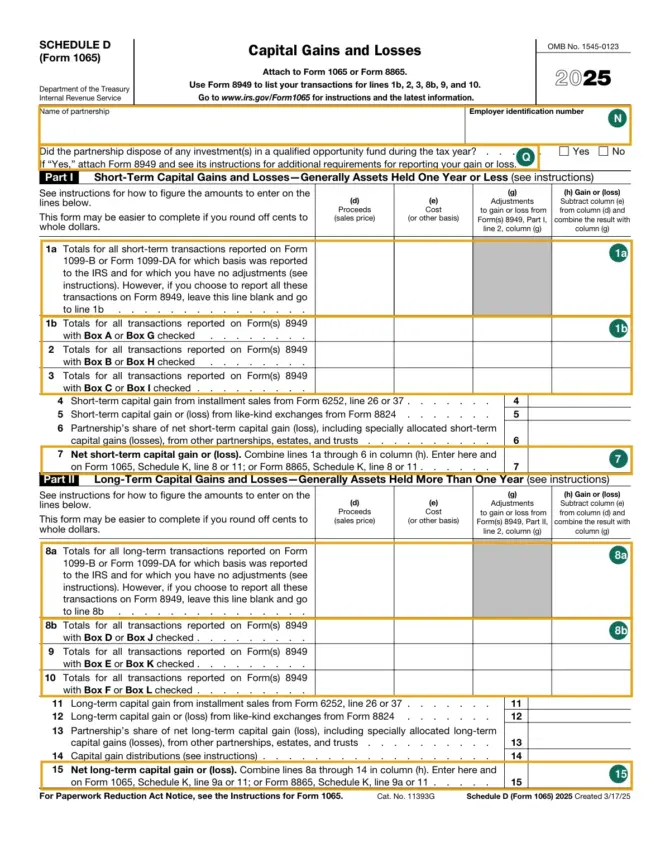
| Line | What goes on it | Where the figure comes from |
|---|---|---|
| Header | Name of partnership, employer identification number | The partnership’s own name and EIN |
| QOF question | Yes if the partnership disposed of an investment in a qualified opportunity fund during the tax year | If Yes, Form 8949 is attached; its instructions add reporting requirements |
| 1a | Short-term totals from 1099-B or 1099-DA statements with basis reported and no adjustments; column (g) is shaded | Broker statements; leave blank if you put these sales on Form 8949 |
| 1b, 2, 3 | Short-term totals in columns (d), (e), (g), (h) | Form 8949, Part I, line 2, boxes A/G, B/H, C/I |
| 4 | Short-term gain from installment sales | Form 6252, line 26 or 37 |
| 5 | Short-term gain or loss from like-kind exchanges | Form 8824 |
| 6 | Share of net short-term gain or loss from other partnerships, estates and trusts | Schedule K-1 or other information from that entity |
| 7 | Net short-term capital gain or loss: lines 1a through 6, column (h) | Goes to Schedule K, line 8 or 11 (Form 1065 or Form 8865) |
| 8a | Long-term version of line 1a | Broker statements |
| 8b, 9, 10 | Long-term totals | Form 8949, Part II, line 2, boxes D/J, E/K, F/L |
| 11 | Long-term gain from installment sales | Form 6252, line 26 or 37 |
| 12 | Long-term gain or loss from like-kind exchanges | Form 8824 |
| 13 | Share of net long-term gain or loss from other partnerships, estates and trusts | Schedule K-1 or other information from that entity |
| 14 | Total capital gain distributions paid to the partnership during the year | Distribution statements |
| 15 | Net long-term capital gain or loss: lines 8a through 14, column (h) | Goes to Schedule K, line 9a or 11 (Form 1065 or Form 8865) |
Column (h) is figured the same way on every row that has all four columns: proceeds in (d) minus cost or other basis in (e), combined with any adjustment in (g). A row with $40,000 of proceeds, $31,500 of basis and a ($1,200) adjustment shows $7,300 in column (h). Losses are entered in parentheses. On lines 1a and 8a there is no adjustment, so (h) is simply (d) minus (e), and several qualifying sales are added together into one line.
Cents may be rounded to whole dollars, but then every amount on the schedule has to be rounded: under 50 cents drops, 50 cents or more goes up. When a line is the sum of several amounts, add them with cents and round only the total.
Holding periods and sales that need extra steps
Short-term generally means held one year or less, long-term more than one year. The exception is an applicable partnership interest under section 1061, an interest held in connection with substantial services in an applicable trade or business: gain or loss on it is long-term only after more than 3 years and short-term if held 3 years or less.
Several situations from the 2025 instructions change what goes on Form 8949 before the totals reach Schedule D:
- Wash sale: the sale goes on Form 8949 with “W” in column (f) and the disallowed loss as a positive number in column (g). A wash sale means the partnership acquired substantially identical stock or securities, or a contract or option to acquire them, within 30 days before or after the sale; only a dealer selling in the ordinary course of its business can deduct such a loss.
- Rollover of qualified small business stock held more than 6 months, when other QSB stock was bought during the 60 days starting on the sale date: “R” in column (f), the postponed gain as a negative number in column (g), and a statement attached to Form 1065 identifying the replacement stock, the basis adjustment and the purchase dates. The rolled-over gain is also stated separately on Schedule K, line 11.
- Gain invested in a qualified opportunity fund within 180 days: the gain is reported on Schedule D as if no election were made, the deferral follows the Form 8949 instructions, and Form 8997 is attached every year until the QOF investment is disposed of.
- Undistributed long-term gain shown on Form 2439: Form 8949, Part II, box F, “From Form 2439” in column (a), the gain in column (h), other columns blank.
- Collectibles held long-term, such as art, antiques, bullion, gems, stamps or coins: the sale goes on Form 8949, Part II, and the 28% rate gain or loss included on lines 8a through 14 is also reported on Schedule K, line 9b.
Losses on sales to certain related persons are not allowed (sections 267 and 707(b)), except for distributions in a complete liquidation of a corporation, and securities that become worthless are treated as sold on the last day of the tax year.
Where lines 7 and 15 go on Schedule K
The net amounts do not go on page 1 of Form 1065. The Form 1065 instructions direct the portfolio part of line 7 to Schedule K, line 8, and the portfolio part of line 15 to Schedule K, line 9a. Each partner’s share then appears in box 8 or box 9a of Schedule K-1. Gain or loss from selling nondepreciable personal property used in a trade or business may not be portfolio income; that amount goes to Schedule K, line 11, and each partner’s share to box 11 of Schedule K-1.
Schedule K, line 9b (collectibles 28% gain) is figured from the amount on Schedule D, line 15. If the partnership also has a long-term gain specially allocated to one partner, Schedule K, line 9a carries both the Schedule D, line 15 figure and the specially allocated gain, and that partner’s box 9a includes both.
What changed on the 2025 Schedule D (Form 1065)
The 2025 instructions list one change. Codes G, H, I, J, K and L were added to lines 1b, 2, 3, 8b, 9 and 10 for digital asset transactions, matching the new boxes G to L on Form 8949. The instructions point to Form 1099-DA, Digital Asset Proceeds From Broker Transactions, and to Form 8949 for the details.
When and where Schedule D (Form 1065) is filed
The schedule has no signature line and no due date of its own. It is filed with Form 1065, which is due by the 15th day of the 3rd month after the partnership’s tax year ends: March 15 for a calendar-year partnership. Under the weekend and holiday rule, 2025 calendar-year returns were on time through March 16, 2026. Form 7004, filed by that regular due date, extends the time to file. In the return package, Schedule D comes after pages 1 to 6, Schedule F and Form 8825, and before Form 4797 and Form 8949. A Schedule D attached to Form 8865 goes in with that form under the Form 8865 rules.
A partnership that files 10 or more returns of any type during the year, or has more than 100 partners, must file Form 1065 and its related forms and schedules electronically. A paper return goes to the IRS address in the Form 1065 instructions, which depends on the state of the principal business, total assets at year end and whether Schedule M-3 is filed. If the partnership’s mailing address changes after the return is filed, the Form 1065 instructions point to Form 8822-B.
The 2025 schedule (Cat. No. 11393G, created 3/17/25) and its separate instructions, dated November 18, 2025, are on the About Form 1065 page at irs.gov.
Official PDF: Schedule D (Form 1065) — Official PDF (irs.gov)
Questions about Schedule D (Form 1065)
Does a partnership have to list every stock sale on Form 8949?
A Form 1065 filer with more than five transactions in a part can enter one summary row on Form 8949 with box C or I (short-term) or F or L (long-term), “Available upon request” in column (a) and code M. Sales that meet the line 1a or 8a conditions can go straight to Schedule D.
Where do crypto sales go on Schedule D (Form 1065) for 2025?
Digital asset sales are listed on Form 8949 with box G, H or I (short-term) or J, K or L (long-term), and the totals go on lines 1b to 3 and 8b to 10. Sales on a Form 1099-DA showing basis reported to the IRS and needing no adjustment can be totaled on line 1a or 8a.
Does gain from another partnership’s Schedule K-1 go on Form 8949?
Schedule D (Form 1065) has its own lines for it: line 6 for the short-term share and line 13 for the long-term share, using the K-1 or other information the other partnership, estate or trust supplied.
Official sources
- Internal Revenue Service, Schedule D (Form 1065), Capital Gains and Losses, 2025
- Internal Revenue Service, Instructions for Schedule D (Form 1065), 2025 (HTML version)
- Internal Revenue Service, About Form 1065, U.S. Return of Partnership Income
- Internal Revenue Service, Instructions for Form 1065 (2025)
- Internal Revenue Service, Instructions for Form 8949 (2025) and Form 8949 (2025)
- Internal Revenue Service, About Form 8949, Sales and Other Dispositions of Capital Assets