Schedule D (Form 1120) is the one-page summary where a corporation totals its capital gains and losses for the year and carries a single figure to line 8 of Form 1120, page 1. Individual sales are listed on Form 8949 or entered as broker totals; Schedule D separates them into short-term (Part I) and long-term (Part II), adds gains from installment sales, like-kind exchanges and Form 4797, and nets everything in Part III. This guide covers the 2025 schedule (the PDF footer reads “Created 2/14/25”) and the 2025 instructions dated November 12, 2025.
Who attaches Schedule D (Form 1120), and to which return
The header of the schedule names the returns it is attached to: Form 1120, 1120-C, 1120-F, 1120-FSC, 1120-H, 1120-IC-DISC, 1120-L, 1120-ND, 1120-PC, 1120-POL, 1120-REIT, 1120-RIC, 1120-SF, and certain Forms 990-T. It travels with that return and has no signature line of its own.
The instructions list what the schedule reports:
- the overall gain or loss from transactions on Form 8949
- certain transactions that do not have to go on Form 8949 (lines 1a and 8a)
- gain from Form 6252 or from Part I of Form 4797
- gain or loss from like-kind exchanges on Form 8824
- an unused capital loss carryover
- capital gain distributions not reported directly on Form 1120, line 8, or the matching line of the other returns
Business property is reported first on Form 4797. Sales of real property or depreciable property used in the trade or business, involuntary conversions other than casualty or theft, and the section 291 adjustment to section 1250 property go there, and Schedule D, line 11, picks up the gain from Form 4797, line 7 or 9. Casualties and thefts are reported on Form 4684, and section 1256 contracts and straddles on Form 6781.
Under section 1221(a) every item of property the corporation held is a capital asset unless it falls in an excluded group. The exclusions include inventory and property held mainly for sale to customers, accounts or notes receivable from the ordinary course of business, depreciable or real property used in the business (even fully depreciated), certain copyrights, patents and similar created property, certain hedging transactions, and supplies regularly used in the business.
What changed on the 2025 Schedule D (Form 1120)
The What’s New section of the 2025 instructions lists two items. First, codes G, H, I, J, K and L were added to lines 1b, 2, 3, 8b, 9 and 10 so the schedule can carry digital asset transactions; the instructions point to Form 1099-DA, Digital Asset Proceeds From Broker Transactions, and Form 8949 for the details. Second, a corporation that elected to defer gain invested in a qualified opportunity fund, and whose investment meets the 7-year holding period threshold, may be eligible for a basis adjustment; the instructions refer to Form 8997 for details.
How to fill out Schedule D (Form 1120), line by line
Complete every Form 8949 the corporation needs before touching lines 1b, 2, 3, 8b, 9 or 10, because those lines take the totals from Form 8949, line 2 of each part. Lines 1a to 3 and 8a to 10 have four money columns: (d) proceeds, (e) cost or other basis, (g) adjustments from Form 8949, and (h) gain or loss, which is (d) minus (e) combined with (g). Losses are entered in parentheses. Above Part I, the header asks only for the corporation’s name and employer identification number. The numbers on the image match the first column of the table.
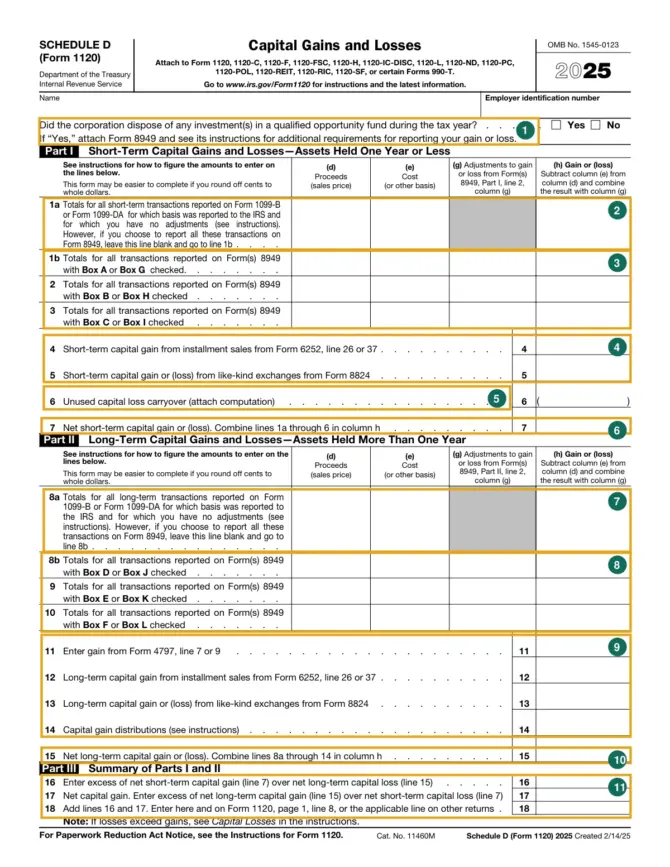
| Marker | Line | What goes there | Where the amount comes from |
|---|---|---|---|
| 1 | QOF question | Yes if the corporation disposed of any investment in a qualified opportunity fund during the year | The corporation’s QOF records; a Yes requires Form 8949 |
| 2 | 1a | Short-term totals from broker statements with basis reported and no adjustments | Form 1099-B or Form 1099-DA; column (g) is shaded |
| 3 | 1b, 2, 3 | Short-term totals from Form 8949, Part I | Line 1b: Box A or G; line 2: Box B or H; line 3: Box C or I |
| 4 | 4, 5 | Short-term installment sale gain; short-term like-kind exchange gain or loss | Form 6252, line 26 or 37; Form 8824 |
| 5 | 6 | Unused capital loss carryover, in parentheses | The corporation’s own computation, attached |
| 6 | 7 | Net short-term capital gain or loss | Lines 1a through 6, column (h) |
| 7 | 8a | Long-term totals from broker statements with basis reported and no adjustments | Form 1099-B or Form 1099-DA |
| 8 | 8b, 9, 10 | Long-term totals from Form 8949, Part II | Line 8b: Box D or J; line 9: Box E or K; line 10: Box F or L |
| 9 | 11 to 14 | Form 4797 gain, long-term installment and like-kind amounts, capital gain distributions | Form 4797, line 7 or 9; Form 6252; Form 8824; RIC and REIT statements |
| 10 | 15 | Net long-term capital gain or loss | Lines 8a through 14, column (h) |
| 11 | 16 to 18 | Net short-term gain over net long-term loss, net capital gain, and their sum | Lines 7 and 15; line 18 goes to Form 1120, line 8 |
Lines 1a and 8a: broker totals without Form 8949
A corporation may put aggregate totals straight on line 1a (short-term) or 8a (long-term) only when every condition holds: the Form 1099-B shows basis was reported to the IRS and nothing in box 1f or 1g, or the Form 1099-DA shows basis reported and nothing in box 1h or 1i; the Ordinary checkbox (box 2 of Form 1099-B, box 6 of Form 1099-DA) and the QOF checkbox (box 3 of Form 1099-B, box 3b of Form 1099-DA) are blank; and no change to basis, type of gain or the gain itself is needed. Collectibles never qualify. Transactions entered this way are left off Form 8949, and no explanatory statement is attached.
If a broker reported basis that the corporation knows is wrong, the transaction goes on Form 8949 with an adjustment, not on line 1a or 8a. The same applies when the statement says basis was not reported. For example, a corporation with two long-term stock sales on a Form 1099-B, both with basis reported and no adjustments, $14,200 of proceeds and $9,800 of basis combined, would enter $14,200 in column (d), $9,800 in column (e) and $4,400 in column (h) of line 8a.
Lines 1b to 3 and 8b to 10: Form 8949 totals
Form 8949 uses one box per page, so a corporation with several kinds of transactions completes a separate page for each box. Boxes A and D are Form 1099-B transactions with basis reported to the IRS, B and E are Form 1099-B transactions without reported basis, and C and F are non-digital transactions not reported on either Form 1099-B or Form 1099-DA. The 2025 boxes G and J, H and K, and I and L are the digital asset counterparts: Form 1099-DA with basis reported, Form 1099-DA without basis reported, and digital asset transactions not reported on Form 1099-DA or Form 1099-B. A corporation must report a taxable sale or exchange of digital assets even if it received no Form 1099-B or Form 1099-DA.
Lines 4 to 6 and 11 to 14
Lines 4 and 12 take the gain from Form 6252, line 26 or 37, split by holding period. Lines 5 and 13 take gain or loss from Form 8824 only for exchanges of capital assets. Line 6, which sits in Part I, is the unused capital loss carryover from earlier years; carried losses count as short-term, and a statement showing how the carryover was computed must be attached. If the earlier returns are needed to rebuild that computation, a copy of a filed return with its attachments can be ordered with Form 4506.
Line 11 is the gain from Form 4797, line 7 or 9. Line 14 takes all capital gain distributions paid by a RIC or REIT during the year, however long the corporation held the shares. It also includes an amount from a RIC or REIT that qualifies as a distribution in complete liquidation under section 332(b) and that the fund designated as a capital gain distribution.
Lines 7, 15 and Part III
Line 7 combines lines 1a through 6 in column (h), and line 15 combines lines 8a through 14. Line 16 is the amount by which a net short-term gain on line 7 exceeds a net long-term loss on line 15. Line 17, the net capital gain, is the amount by which a net long-term gain exceeds a net short-term loss. Line 18 adds 16 and 17 and goes to Form 1120, page 1, line 8, or the corresponding line on the other 1120-series returns.
Suppose line 7 shows a $3,000 short-term loss and line 15 shows a $7,500 long-term gain. Line 16 is zero because there is no short-term gain, line 17 is $4,500, and line 18 is $4,500. Reverse the figures, a $3,000 short-term gain against a $7,500 long-term loss, and neither line 16 nor line 17 has an excess to enter, so line 18 stays at zero and the $4,500 net capital loss falls under the carryback and carryforward rules below. The note under line 18 sends the reader to the Capital Losses section of the instructions for this case.
What happens to a net capital loss
A corporation can deduct capital losses only up to its capital gains for the same year. The excess is carried back 3 years and then forward up to 5 years, and in each of those years it is treated as a short-term capital loss. A carryback is allowed only to the extent it does not create or increase a net operating loss in the year it is carried to. Foreign expropriation capital losses cannot be carried back but carry forward up to 10 years, and a RIC can carry a net capital loss forward without a year limit.
Several rules limit losses before they reach the schedule:
- No loss is allowed on a sale or exchange between the corporation and certain related persons under section 267, except in distributions in complete liquidation.
- A wash sale loss on stock or securities, including tokenized securities, is not deductible when substantially identical stock or securities are acquired within 30 days before or after the sale. The transaction is still reported on Form 8949 with code W in column (f) and the disallowed loss as a positive number in column (g). Dealers selling in the ordinary course of business and redemptions of floating-NAV money market fund shares are outside the rule.
- A security that becomes worthless during the year is treated as a capital loss on the last day of the tax year, except for securities held by a bank (section 582).
- After an ownership change, sections 382 and 383 can limit the capital gains that prechange capital losses may offset, and section 384 can apply after an acquisition of another corporation.
- A closely held or personal service corporation with a passive activity gain or loss may have to complete Form 8810 before Form 8949 and Schedule D.
Transactions that need special handling
Gains and losses passed through from a partnership, S corporation, estate or trust are entered on Form 8949: a net short-term amount in Part I with box C or I checked, a net long-term amount in Part II with box F or L checked. Undistributed long-term gains shown on Form 2439 also go in Part II with box F or L, with “From Form 2439” in column (a), the gain in column (h) and the other columns left blank. Gain or loss figured under the NAV method for money market fund shares goes in Part I with box C or I, the fund name followed by “(NAV)” in column (a) and only column (h) filled in.
A corporation that sells property at a gain and receives a payment in a later year generally reports on the installment method, except for stock or securities traded on an established market. To elect out, the full gain is reported on Form 8949 for the year of sale on a return filed by the due date, including extensions. A corporation that filed on time without electing out can still elect on an amended return filed within 6 months after the original due date (not counting extensions), with “Filed pursuant to section 301.9100-2” written at the top.
Eligible capital gain invested in a qualified opportunity fund within 180 days of the date it was realized can be deferred until the tax year that includes the date the investment is disposed of or December 31, 2026, whichever comes first. The gain is reported on Form 8949 and Schedule D as usual, with the deferral handled under the Form 8949 instructions, and Form 8997 is attached every year until the investment is gone. Gain on a QOF investment held at least 10 years may be excluded permanently under section 1400Z-2.
A short sale is reported in the year it closes. One that closed in 2025 but was opened before 2011, so that no 2025 Form 1099-B or Form 1099-DA was issued, goes on Form 8949 with box C or I (short-term) or box F or L (long-term), with column (a) naming the property and stating the year the short sale was opened and that it has closed. A 2025 Form 1099-B or Form 1099-DA that leaves out the proceeds is handled the same way. If the corporation used a basis other than actual cost, for example for property received in a transfer to another corporation (section 358) or in the liquidation of another corporation (section 334), it attaches an explanation.
Where to get the 2025 Schedule D (Form 1120)
The 2025 Schedule D (Form 1120) PDF is a fillable single page on irs.gov. The Instructions for Schedule D (Form 1120) (2025) are published as a web page and as a six-page PDF (Catalog Number 26358T). The schedule goes in with the corporation’s return, so it is filed the same way and at the same address as that return.
On November 1, 2026, the About Schedule D (Form 1120) page carried an IRS notice that it is designated as historical content and no longer updated. It still listed the 2025 schedule and instructions as the current revision, and the only recent development shown was an Empowerment Zone notice from March 8, 2021.
The schedule may be completed with cents, but the instructions ask for all amounts on the return either rounded to whole dollars or all with cents. Rounding drops amounts under 50 cents and raises 50 to 99 cents to the next dollar; when several amounts are added for one line, cents are kept until the total is rounded.
Before attaching Schedule D to the return
- Every Form 8949 page completed, one box per page, with its line 2 totals carried to lines 1b to 3 and 8b to 10.
- The QOF question answered; a Yes means Form 8949 is attached.
- Form 8997 attached if the corporation held a qualified investment in a QOF at any time during the year.
- A statement showing how the line 6 carryover was computed.
- An explanation for any basis other than actual cost.
- Line 18 copied to Form 1120, line 8, or the applicable line of the other return.
Questions about Schedule D (Form 1120)
Can a corporation deduct a net capital loss against ordinary income?
For a corporation, capital losses are allowed only up to capital gains in the same year. The unused amount is carried back 3 years and forward 5 as a short-term capital loss, and it returns to Schedule D on line 6 in a later year.
Where do mutual fund capital gain distributions go on a corporate return?
Capital gain distributions paid by a RIC or REIT go on line 14, regardless of how long the corporation held the shares. Undistributed long-term gains reported on Form 2439 go on Form 8949, Part II, with box F or L checked.
Does a corporation need Form 8949 if all its sales are on a Form 1099-B with basis reported?
Form 8949 can be skipped for those sales when the statements show no adjustments in box 1f or 1g, the Ordinary and QOF boxes are blank, and nothing needs correcting. The totals can go directly on line 1a or 8a, though the corporation may still choose to list them on Form 8949 and leave those lines blank.
Official sources
- Internal Revenue Service, Schedule D (Form 1120), Capital Gains and Losses, 2025 (Created 2/14/25)
- Internal Revenue Service, Instructions for Schedule D (Form 1120) (2025)
- Internal Revenue Service, Instructions for Schedule D (Form 1120) (2025), PDF dated November 12, 2025
- Internal Revenue Service, About Schedule D (Form 1120), Capital Gains and Losses
- Internal Revenue Service, Form 8949, Sales and Other Dispositions of Capital Assets, 2025