Form W-12 is the paper application for a Preparer Tax Identification Number (PTIN), the number a paid preparer enters, when applicable, in the paid preparer section of a federal return. The same form renews a PTIN, and every PTIN expires on December 31. The revision in use is Form W-12 (Rev. October 2026), and its line 13 prints the fee to obtain or renew a PTIN for 2027: $18.75. The IRS PTIN system online asks the same questions and generally issues the number as soon as the application and payment are complete; for a paper application the IRS says to allow 6 weeks.
Who needs a PTIN, and who can skip it
The separate Instructions for Form W-12 put it in one sentence: anyone who is a paid tax return preparer must apply for and receive a PTIN, and enrolled agents (EAs) must have one too. A tax return preparer here is any individual compensated for preparing, or assisting in preparing, all or substantially all of a federal tax return or claim for refund. Applicants must be at least 18. A PTIN belongs to one person; an office cannot share one number among its staff.
The IRS FAQ “Do I need a PTIN?” works through real office situations. They split like this:
- Interns who prepare simple returns need their own PTIN even when the preparer reviews and signs every one, and so does anyone a preparation business hires to prepare returns.
- Associates who walk clients through interview software need a case-by-case look: the FAQ says the answer depends on whether they make determinations that affect the tax liability.
- A bookkeeper who organizes receipts, or an assistant doing data entry, does not, as long as the preparer makes the substantive determinations.
- A VITA volunteer preparing returns for no pay does not.
- An employee who prepares only the employer’s own federal returns does not.
- Attorneys and CPAs need one only if they prepare, for compensation, all or substantially all of a return or claim for refund.
- A reporting agent filing Forms 94X with no tax advice to clients does not; one who advises clients, for example on whether workers are employees or contractors, does.
- Someone paid to prepare only Form 2290 does.
Some forms do not count toward the requirement at all. The IRS list includes Form SS-4, the W-2 series, the 1098 and 1099 series, Form W-7, Form 2848, Form 8821 and the Form 5500 series; a person paid to prepare only forms on that list does not need a PTIN. The FAQ adds that preparing returns for pay without a current PTIN can bring section 6695 penalties, an injunction or discipline by the IRS Office of Professional Responsibility.
Applying online or mailing Form W-12
The online application in the IRS PTIN system is the same Form W-12 in electronic form. You create an account, answer the questions, and the system passes you to the IRS partner bank to pay $18.75 by credit, debit or ATM card, or by eCheck. The instructions say a PTIN is generally provided immediately after you complete the application and payment online; the IRS PTIN page estimates about 15 minutes for most first-time applicants. The application checklist lists what to have ready: your Social Security number (SSN), personal and business details, your previous year’s individual return (name, address and filing status, used to authenticate you), and explanations for any felony conviction or tax compliance problem. If you filed your latest return in the past 8 weeks, the checklist says to use the year before.
Paper is the slower route. The form, its instructions and the IRS PTIN page all give 6 weeks for processing. If the paper application is incomplete, the IRS asks for the missing information within a set time and cannot process the form if you do not supply it.
Two groups without an SSN follow extra steps. A U.S. citizen with a conscientious religious objection to having an SSN completes Form W-12, online or on paper, plus a paper Form 8945 with documents proving identity, citizenship and membership of a recognized religious group. A foreign person who is not eligible for an SSN can register online and upload two notarized identity documents through the PTIN account, or file Form 8946; the IRS allows 6 weeks to review those documents. The signature block on the W-12 carries a warning for this group: a foreign preparer living outside the U.S. who gets a PTIN without a U.S. issued SSN is not authorized to prepare federal returns in the U.S. for compensation.
When a PTIN must be renewed
PTINs are issued by calendar year, not tax year. All PTINs expire on December 31, and the IRS FAQ says renewal season opens in mid-October for the following year. On its PTIN page (last reviewed October 29, 2026) the IRS says applications and renewals for 2027 are now being processed and that a valid 2027 PTIN is needed before preparing returns. Online renewal runs from the “Renew my PTIN” tile in your account.
Line 2 of the paper form handles the overlap. A new applicant submitting between October 1 and December 31 checks “Current calendar year” (valid only until December 31) or “Next calendar year” (not valid until January 1). Leave both blank and the IRS processes the application for the current year.
Missed years are renewed on the same form. Check “Renewal application” on line 1 and list each prior year in YYYY format on line 2; one W-12 covers several prior years, with a separate payment for each. You need an active PTIN for every calendar year in which you prepared federal returns for pay. A PTIN that has been inactive or expired for more than 3 consecutive years cannot be renewed: you file a new registration. A preparer taking a full calendar year off can mark the PTIN voluntarily inactive in the online account and reactivate it within 3 years; EAs must keep a current PTIN to keep the EA credential.
How to fill out Form W-12, line by line
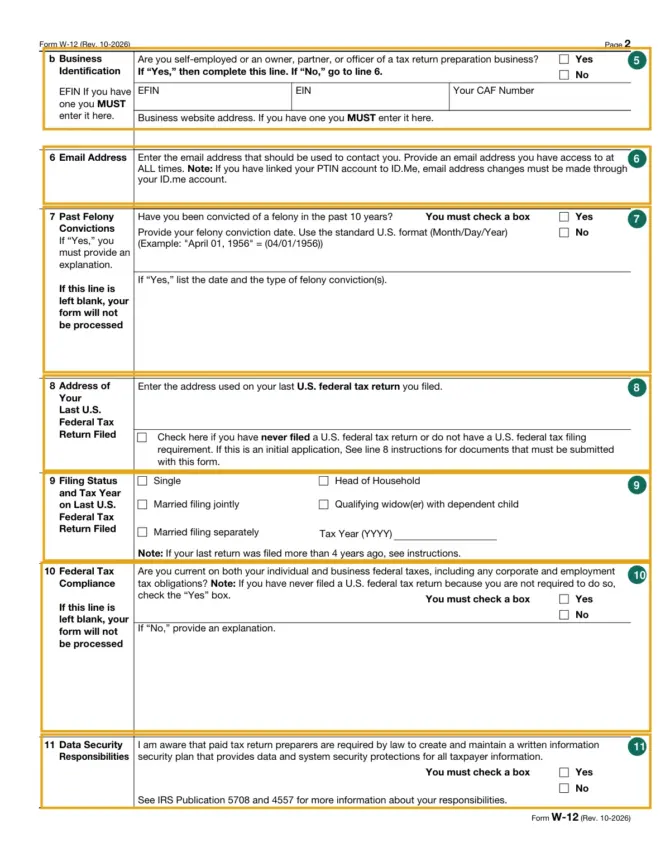
The form runs to three pages and 13 numbered lines plus the signature. The table follows the order of the PDF; the image below marks lines 5b to 11 on page 2, where the questions that stop processing sit.
| Line | What you enter | Note from the instructions |
|---|---|---|
| 1 | Legal name; initial or renewal box (with your PTIN after the printed “P” for a renewal); Yes or No to “current IRS employee” and “current TIGTA employee” | Name as on your last filed federal return. IRS and TIGTA employees may not prepare returns for pay |
| 2 | Current or next calendar year, and any prior years (YYYY) | Only asked between October 1 and December 31, plus prior-year renewals |
| 3a | U.S. issued SSN, or the N/A box; date of birth as MM/DD/YYYY | Neither SSN nor N/A means rejection |
| 3b, 3c | Whether you ever received an ITIN or IRSN; if yes, the number and the name it was issued under | More than one: list on an attached sheet |
| 4 | Personal mailing address and phone | Paper PTIN letters go here. A USPS post office box only if mail is not delivered to your street; no private mailbox company |
| 5a | Business name, address and phone | Everyone completes it, employee or owner. This address appears in the public preparer directory if you qualify |
| 5b | Self-employed, owner, partner or officer of a preparation business? If yes: EFIN, EIN, CAF number, website | With several EINs or EFINs, give the one used most on returns you prepare; include any letters in the CAF number |
| 6 | Email address | Most PTIN correspondence goes to email. If the account is linked to ID.me, change the email there |
| 7 | Felony conviction in the past 10 years: Yes or No, with dates and type if Yes | Blank line: form not processed |
| 8 | Address on your last federal return, or the “never filed” box | Never filed: notarized identity documents (see below) |
| 9 | Filing status and tax year of that return | More than 4 years ago: same documents as line 8 |
| 10 | Current on individual and business federal taxes: Yes or No, with an explanation if No | Blank line: form not processed |
| 11 | Yes or No: aware that preparers must keep a written information security plan | Points to Publications 5708 and 4557 |
| 12 | Current professional credentials with jurisdiction, number and expiration date, or “None” | No expired or retired credentials; no write-in option |
| 13 | No entry: the fee rules and the payment | Payment missing: application rejected |
| Sign here | Signature in blue or black ink and date (MM/DD/YYYY) | Signed under penalties of perjury |
Lines 7 and 10: felony and tax compliance
Both lines carry the same printed warning: if left blank, the form will not be processed. A Yes on line 7 is not an automatic refusal. The instructions say a felony conviction may not necessarily disqualify you and that all facts and circumstances are considered, but that someone currently incarcerated for a felony generally will not be allowed to obtain or renew a PTIN. Give the conviction date and type in the space provided.
For line 10, the IRS FAQ defines compliance in two parts: every individual and business return that is due has been filed (or extended), and every tax due has been paid or covered by an acceptable payment arrangement. Corporate and employment tax obligations are part of the question. If you answer No, describe the problem and the steps you have taken to fix it. Someone who has never filed because they were never required to checks Yes. The FAQ also says a balance due that is in bankruptcy status does not fail the test, provided the IRS debt was included in the bankruptcy filing. False or misleading answers are a criminal offense and a separate ground to deny or terminate the PTIN.
Lines 8 and 9: when identity documents go with the form
An applicant with an SSN who has never filed a federal return, has not filed one in the past 4 years, or has no filing requirement (the instructions mention certain individuals from Puerto Rico) sends two notarized copies with the W-12: the Social Security card and one other current government photo ID, such as a passport, driver’s license, state ID, military ID or national ID. Documents must be unexpired and show your name. A U.S. notary, a JAG officer, the State Department, a U.S. consulate or embassy employee, or a notary authorized in your local jurisdiction can certify the copies. The IRS suggests not sending originals.
Line 12: professional credentials
Seven boxes are offered: attorney, CPA, enrolled agent, enrolled actuary, enrolled retirement plan agent (ERPA), state regulated tax return preparer, and certifying acceptance agent (CAA). State regulated preparers are those current with the Oregon Board of Tax Practitioners, the California Tax Education Council or the Maryland State Board of Individual Tax Preparers; the instructions note the list can change. A credential with a blank or incomplete expiration date is simply not added to your PTIN record. If your credential never expires, the IRS FAQ says to enter December 31 of the year you are applying for, such as 12/31/2027 for a 2027 renewal. A CAA enters an EFIN or the eight-digit office code from the CAA application. An EA can update the address on the EA account in the space under line 12; that address is public under the Freedom of Information Act.
Line 12 is not the only public part of the application. The instructions list name, business name, business address, business phone, business website and credentials as information that may be released to the public.
The PTIN fee and how to pay it on paper
Line 13 and the instructions set the fee by the calendar year the PTIN covers:
| Calendar year of the PTIN | Fee per year |
|---|---|
| 2027 and 2026 | $18.75 |
| 2021 to 2025 | $19.75 |
| 2020 and earlier | No fee |
The IRS FAQ splits the $18.75 into $10 per application or renewal plus $8.75 for the third-party contractor. The fee is a processing fee, nonrefundable and non-transferable, and EAs, attorneys and CPAs pay it in addition to their own licensing fees.
On paper, each calendar year needs its own check or money order, with the year written on it, payable to “IRS Tax Pro PTIN Fee”. Do not clip or staple the payment to the form. A preparer who was paid for returns in 2024 without a PTIN and now renews for 2024 and 2027 therefore mails one W-12 with two payments: $19.75 marked 2024 and $18.75 marked 2027. The instructions also ask you to sign and date the check and make sure the amount in words matches the figure. If a payment is returned, the PTIN goes into Suspended status until the correct payment arrives.
What gets a paper W-12 rejected or held up
The form and its instructions name these outcomes directly:
- Line 3a left without an SSN and without the N/A box checked: the application is rejected.
- Line 7 or line 10 left blank: the form is not processed.
- Payment missing or short: the application is rejected. One check covering several years does not meet the one-payment-per-year rule.
- A returned check or money order: the PTIN is placed in Suspended status.
- A credential with no full expiration date: that credential is not added.
- Missing information that the IRS requests and you do not supply within the time it gives: the application cannot be processed.
Where to mail Form W-12 and get the official PDF
The fillable Form W-12 (Rev. October 2026) and the Instructions for Form W-12 (Rev. October 2026) are on the IRS About Form W-12 page. The footer of page 3 of the PDF still reads “Rev. 10-2025”; pages 1 and 2 and the PDF title say October 2026. Mail the signed form, the payments and any documents to the address printed under “How To File”:
IRS Tax Professional PTIN Processing Center
PO Box 380638
San Antonio, TX 78268
The IRS PTIN web page writes the first line as “IRS Tax Pro PTIN Processing Center” with the same PO box. Do not send the W-12 to the Washington, DC address in the paperwork notice; the instructions say that address is for comments only. For questions about the form or the status of an application, the instructions give 1-877-613-7846 from the U.S., 1-877-613-3686 for TTY/TDD and +1 915-342-5655 from abroad (not toll-free), generally Monday to Friday, 8:00 a.m. to 5:00 p.m. Central time.
Questions about PTINs and Form W-12
How do I check whether my PTIN application went through?
The status shows in the information window at the top right of the main menu of your online PTIN account. If nothing appears there, either no PTIN has been issued yet or your PTIN is not linked to the online account.
Will I get the same PTIN when I reapply?
The system reassigns your old number if a previous PTIN was in active status for the same SSN. Once a new PTIN is assigned, the IRS cannot reissue the earlier one, so use the new number on every return.
Do I need an EFIN as well as a PTIN?
They are separate numbers. The PTIN identifies the individual preparer and carries a fee; the EFIN is issued free to individuals or firms approved as IRS e-file providers. The IRS FAQ says most preparers need both. If you have an EFIN and you are self-employed or own a preparation business, line 5b requires it.
I stopped preparing returns. Do I have to tell the IRS?
The IRS FAQ says to place the PTIN in voluntary inactive status from the “Edit Account Information” tile in the online account. While inactive, you cannot prepare federal returns for pay. EAs must keep an active PTIN.
Official sources
- Internal Revenue Service, Form W-12, IRS Paid Preparer Tax Identification Number (PTIN) Application and Renewal, Rev. October 2026
- Internal Revenue Service, Instructions for Form W-12, revised October 2026
- Internal Revenue Service, About Form W-12
- Internal Revenue Service, PTIN requirements for tax return preparers
- Internal Revenue Service, Frequently asked questions: Do I need a PTIN?
- Internal Revenue Service, Frequently asked questions: PTIN application and renewal assistance
- Internal Revenue Service, PTIN application checklist
- Internal Revenue Service, PTIN renewal checklist
- Internal Revenue Service, How much does it cost to obtain or renew a PTIN?
- Internal Revenue Service, How do I check my PTIN status?