Schedule B-1 (Form 1065) is the one-page list a partnership attaches to its return when someone holds 50% or more of it. Two questions on page 2 of the 2025 Form 1065, in Schedule B, decide whether you need it: question 2a asks about corporations, partnerships, trusts, tax-exempt organizations and foreign governments, and question 2b asks about individuals and estates. A “Yes” to either one means the owners behind that answer go on Schedule B-1. The current revision is dated August 2019 and is still the version listed on the IRS page for Form 1065.
Who has to attach Schedule B-1
The instructions printed on page 2 of the schedule say it must be filed by every partnership that answers “Yes” to question 2a or question 2b of Schedule B. The two questions map to the two parts of the schedule:
- A “Yes” to question 2a means you complete Part I, for entities: a foreign or domestic corporation, a partnership (including any entity treated as a partnership), a trust, a tax-exempt organization or a foreign government.
- A “Yes” to question 2b means you complete Part II, for individuals and estates.
A partnership with both kinds of owners above the line answers “Yes” to both questions and fills in both parts. If both answers are “No”, Schedule B-1 is not attached. Both questions look at ownership at the end of the partnership’s tax year.
The schedule still mentions question 3a and question 3b “for 2009 through 2017”. That reference is for older returns only; on the 2025 Form 1065 the questions are 2a and 2b, and both of them end with “If ‘Yes,’ attach Schedule B-1”.
Working out the 50% test
The Form 1065 instructions measure ownership three ways: the owner’s share of profit, of loss and of capital, each worked out separately at the end of the tax year under the partnership agreement. The “maximum percentage” is the highest of the three. An owner with 55% of profit, 45% of loss and 40% of capital is a 55% owner for Schedule B-1, and 55% is the number that goes in the last column. The instructions point to item J of Schedule K-1, the partner’s profit, loss and capital percentages, for more on how those shares are set.
Direct ownership is only the start. For question 2 the constructive ownership rules of section 267(c) apply, without section 267(c)(3), and you add the direct and indirect percentages together:
- An interest held by an entity (corporation, partnership, estate, trust or tax-exempt organization) is treated as owned proportionately by that entity’s own owners. Corporation P owns 20% of your partnership directly and 80% of an LLC taxed as a partnership that owns another 40%. P’s total is 20% plus 80% of 40%, which is 52%, so P belongs in Part I.
- An individual is treated as owning what their family owns, where family means only a spouse, brothers, sisters, ancestors and lineal descendants. The attribution works only if the person receiving it also owns an interest directly, or indirectly through a corporation, partnership or trust. A father with 30% and a daughter with 25% held directly can each be counted at 55%.
- Foreign governments follow their own rule: section 892 defines the term, and an interest held by an integral part or controlled entity of a foreign sovereign counts as owned proportionately by that sovereign under Temporary Regulations section 1.892-5T(c)(1)(i).
Two listing rules in the schedule’s own instructions change who appears in Part I. For an affiliated group filing a consolidated return, list the parent corporation, not the subsidiary members. For a disregarded entity, list its owner; when that owner is an individual, the individual goes in Part II.
How to fill out Schedule B-1, column by column
Above both parts are two header lines, the partnership’s name and its employer identification number, copied exactly as they appear on Form 1065. In the image below, N marks that header, I marks the Part I table and II marks the Part II table. Each table has seven rows.
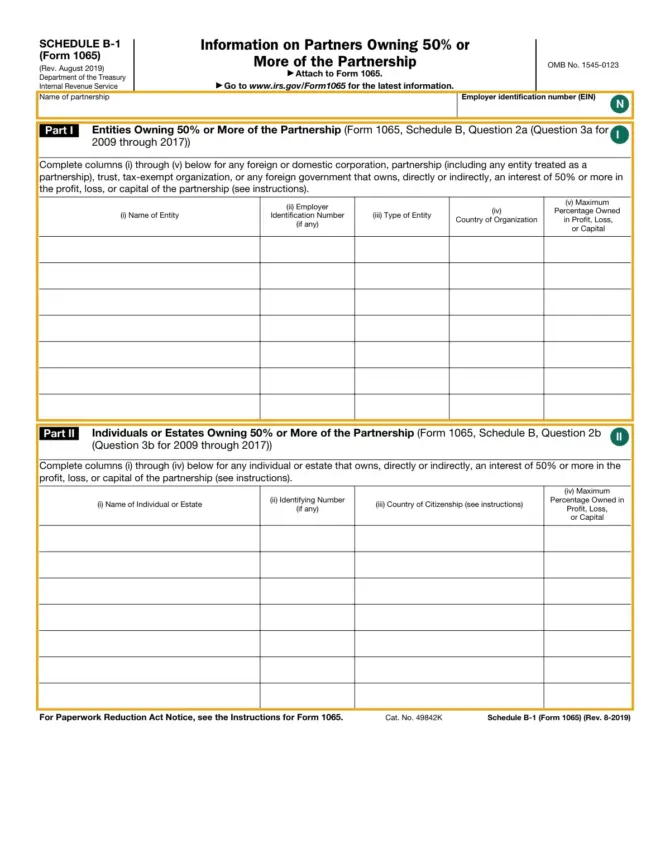
| Part and column | Printed label | What goes in it |
|---|---|---|
| Header | Name of partnership; Employer identification number (EIN) | The legal name and EIN from page 1 of Form 1065. |
| Part I, (i) | Name of Entity | Each entity that owns 50% or more, directly or indirectly, at year end. The parent of a consolidated group, the owner of a disregarded entity. |
| Part I, (ii) | Employer Identification Number (if any) | The entity’s EIN. The column says “if any”. |
| Part I, (iii) | Type of Entity | Corporation, partnership, trust, tax-exempt organization or foreign government. For an exempt owner, write “tax-exempt organization”. |
| Part I, (iv) | Country of Organization | The country where the entity is organized. |
| Part I, (v) | Maximum Percentage Owned in Profit, Loss, or Capital | The highest of the three year-end percentages, direct and indirect combined. |
| Part II, (i) | Name of Individual or Estate | Each individual or estate that owns 50% or more, directly or indirectly, at year end. |
| Part II, (ii) | Identifying Number (if any) | The social security number or employer identification number. |
| Part II, (iii) | Country of Citizenship | The person’s country of citizenship. For an estate, the decedent’s citizenship. |
| Part II, (iv) | Maximum Percentage Owned in Profit, Loss, or Capital | The highest of the three year-end percentages, including attributed interests. |
Every owner that passes the test gets its own row, including an owner reached only through attribution. In the 52% example above, P is listed with 52%; the LLC holding 40% is not listed, because its own percentage is below 50%. Rows run out at seven per part. The Form 1065 instructions cover that case for all schedules: attach separate sheets in the same size and format as the printed form, put them at the end of the return and show the partnership’s name and EIN on each one.
If the partnership’s mailing address or responsible party changes after the return is filed, the instructions send you to Form 8822-B, not to a corrected Schedule B-1.
When Schedule B-1 is due and how it is filed
Schedule B-1 has no date or signature of its own; it is due with Form 1065, which is signed by a partner or LLC member. A domestic partnership files by the 15th day of the 3rd month after its tax year ends, which is March 15 for a calendar-year partnership. A due date on a Saturday, Sunday or legal holiday moves to the next business day, so calendar-year partnerships had until March 16, 2026 for 2025 returns. Form 7004, filed by the regular due date, gives an automatic extension for the whole return, schedules included.
A partnership that files 10 or more returns of any type during the year, or that has more than 100 partners, must file Form 1065 and its schedules electronically, so Schedule B-1 goes in the same e-file transmission. Paper filers place it after Schedule K-1 and Form 8938 in the stack, with the other schedules in alphabetical order.
Where to get Schedule B-1 and where the return goes
The Schedule B-1 (Form 1065), Rev. August 2019 PDF is a fillable two-page file: page 1 is the form and page 2 holds its instructions. It is linked from the IRS page About Form 1065. A paper return, with Schedule B-1 attached, goes to the address set by the partnership’s principal place of business and its total assets at year end (Form 1065, page 1, item F):
| Principal business, office or agency in | Total assets at year end | Address |
|---|---|---|
| Connecticut, Delaware, District of Columbia, Georgia, Illinois, Indiana, Kentucky, Maine, Maryland, Massachusetts, Michigan, New Hampshire, New Jersey, New York, North Carolina, Ohio, Pennsylvania, Rhode Island, South Carolina, Tennessee, Vermont, Virginia, West Virginia, Wisconsin | Less than $10 million and no Schedule M-3 | Department of the Treasury, Internal Revenue Service Center, Kansas City, MO 64999-0011 |
| Same states | $10 million or more, or less than $10 million with Schedule M-3 | Department of the Treasury, Internal Revenue Service Center, Ogden, UT 84201-0011 |
| Alabama, Alaska, Arizona, Arkansas, California, Colorado, Florida, Hawaii, Idaho, Iowa, Kansas, Louisiana, Minnesota, Mississippi, Missouri, Montana, Nebraska, Nevada, New Mexico, North Dakota, Oklahoma, Oregon, South Dakota, Texas, Utah, Washington, Wyoming | Any amount | Department of the Treasury, Internal Revenue Service Center, Ogden, UT 84201-0011 |
| A foreign country or U.S. territory | Any amount | Internal Revenue Service, P.O. Box 409101, Ogden, UT 84409 |
What the instructions treat as an incomplete filing
The penalty for a late partnership return also applies to a return “that fails to show all the information required”. The 2025 instructions set it at $255 for each month or part of a month, up to 12 months, multiplied by the number of people who were partners at any time during the year. Once question 2a or 2b is answered “Yes”, the return asks for Schedule B-1, so its entries count toward that information. The points the instructions single out:
- Writing “See attached” in place of the entries. The Form 1065 instructions say not to do this and warn that penalties may be assessed for an incomplete return.
- Listing the subsidiary members of a consolidated group in Part I. Only the parent corporation goes there.
- Listing a disregarded entity under its own name. The owner is listed, and an individual owner moves to Part II.
- Attributing a relative’s interest to someone who owns nothing in the partnership, directly or through a corporation, partnership or trust. Family attribution does not reach that person.
- Entering only the direct percentage in the last column when the owner also holds an interest indirectly. The column asks for the maximum percentage owned directly or indirectly.
If a penalty notice arrives, the instructions say the partnership may send an explanation for reasonable cause after receiving it; no explanation is attached to the return itself.
Questions about Schedule B-1
Does a partner with exactly 50% go on Schedule B-1?
The threshold on both questions and on both parts of the schedule is “50% or more”, so an owner at exactly 50% of profit, loss or capital is listed.
Is there a 2025 version of Schedule B-1?
The IRS page About Form 1065 links the August 2019 revision as the current Schedule B-1, and it is attached to the 2025 Form 1065. The schedule carries no tax year line.
What do I enter for an owner with no taxpayer identification number?
Both identification columns are labeled “(if any)”. The Part II instructions ask for a social security number or employer identification number, and say nothing further for an owner that has neither.
Official sources
- Internal Revenue Service, Schedule B-1 (Form 1065), Information on Partners Owning 50% or More of the Partnership, Rev. August 2019
- Internal Revenue Service, Form 1065, U.S. Return of Partnership Income, 2025
- Internal Revenue Service, Instructions for Form 1065 (2025)
- Internal Revenue Service, About Form 1065, U.S. Return of Partnership Income