Form 5471 is the information return a U.S. person files for a foreign corporation in which it is a shareholder, officer or director in one of the situations the IRS calls filer categories. It is not a tax return of its own: it rides along with the filer’s income tax return and reports who owns the foreign company, its income statement and balance sheet, and the shareholder’s share of its income. The current form is the December 2025 revision, which the About Form 5471 page lists as the current revision, used with the Instructions for Form 5471 (Rev. December 2025). One Form 5471, with its schedules, is completed for each foreign corporation.
What changed in the December 2025 revision
The What’s New section of the December 2025 instructions lists these changes:
- Schedule G, question 3b, is new on page 4. If the foreign corporation had one or more qualified business units under section 989(a) with a functional currency different from its owner, check “Yes” and enter the number of Forms 8964-TRA attached to Form 5471.
- Schedule G, line 21, is new on page 6. If any increase or decrease to the corporation’s earnings and profits (E&P), including previously taxed E&P (PTEP), came from a section 304 transaction, check “Yes” on line 21a, then enter the change in PTEP under section 959(c)(1) and (c)(2) on line 21b(1) and the change in other E&P under section 959(c)(3) on line 21b(2), both in functional currency.
- The separate Schedule E instructions for Part I, Section 1, column (j) now ask for a statement on taxes allocated under section 70352(c)(1)(C) of Public Law 119-21 (the One Big Beautiful Bill Act).
- In the Schedule G, line 14 table, question 22 became question 22a, and a new question 22b identifies dividends paid or deemed paid by a CFC that may fall under the Pro Rata Share Transition Rule (Notice 2025-75). Schedule I, Worksheet A, line 46 instructions were added for the same rule.
- For a tax year of a specified foreign corporation beginning after November 30, 2025, the corporation may no longer have a tax year beginning one month earlier than the majority U.S. shareholder’s year.
After the instructions came out, the IRS posted a further change dated September 14, 2026, under “Recent developments” on the About Form 5471 page. It rewrites the Schedule E, Part I, Section 1, column (j) instructions for CFCs whose tax year changes because the one-month deferral election was repealed: the Form 5471 for the CFC’s “first required year” lists each foreign income tax allocated to that year, with an attached statement giving the line number, payor, EIN or reference ID, total tax, the amounts allocated to the first required year and the succeeding year, and the allocation method.
Who has to file Form 5471: the nine filer categories
Item B on page 1 has nine boxes, one per category. The category decides which schedules you complete, so it is worth settling first. “U.S. person” in every category includes a U.S. citizen or resident, a domestic partnership, a domestic corporation and a domestic estate or trust; Category 4 also includes nonresident aliens with an election under section 6013(g) or 6013(h) in effect.
| Category | Who it covers (summary of the instructions) |
|---|---|
| 1a, 1b, 1c | A U.S. shareholder (10% or more of vote or value, counting direct, indirect and constructive ownership) of a section 965 specified foreign corporation who owned the stock on the last day it was one. 1b is an unrelated shareholder that owns stock under section 958(a) in a foreign-controlled SFC; 1c is a related shareholder that owns only constructively; 1a is everyone else. |
| 2 | A U.S. citizen or resident who is an officer or director of a foreign corporation in which a U.S. person acquired stock meeting the 10% test, or an additional 10% or more. |
| 3 | A U.S. person who acquires stock that brings it to 10% of value or voting power, who becomes a U.S. person while holding 10%, who sells down below 10%, or who is treated as a U.S. shareholder under section 953(c). |
| 4 | A U.S. person who controlled the foreign corporation during its annual accounting period: more than 50% of the voting power or of the total value of the stock. |
| 5a, 5b, 5c | A U.S. shareholder (10% test) that owned stock of a controlled foreign corporation (CFC) at any time during its tax year and on the last day it was a CFC. 5b and 5c mirror 1b and 1c for foreign-controlled CFCs. |
A CFC, for Category 5, is a foreign corporation in which U.S. shareholders own more than 50% of the voting power or the value of the stock on any day of its tax year. Control in Category 4 runs down a chain: the instructions’ example shows that a company owning 51% of a company that owns 51% of a third company is treated as controlling the third.
Two common situations from the instructions themselves. The sole owner of a CFC (a U.S. citizen owning all the stock of a foreign company is one) is both a Category 4 and a Category 5a filer, completes all six pages of Form 5471 and the separate Schedules E, G-1, H, H-1, I-1, J, M, P, Q and R, and checks only the Category 4 box in item B (the instructions say to leave 5a blank when both apply). A U.S. corporation that is a member of a consolidated group and owns a foreign subsidiary does not file in its own name: the common parent is listed as the filer, with its EIN in item A, and each U.S. shareholder appears in Schedule B, Part I.
Category 1 reporting does not stop on its own: it continues as long as the corporation has section 965 accumulated E&P reportable on Schedule J or the filer has section 965 PTEP reportable on Schedule P.
When you do not have to file
- Constructive owners. In Categories 1, 3, 4 and 5 you are excused if you own no direct interest, you are reporting only because of constructive ownership from another U.S. person, and that person files a Form 5471 with all the information required of you. Categories 1, 4 and 5 have a second version: no direct or indirect interest, and the constructive ownership comes from a nonresident alien. No statement is attached to your return for either exception.
- Foreign-controlled CFCs. A Category 5 filer has nothing to file when no U.S. shareholder owns stock of a foreign-controlled CFC under section 958(a) on the last day it was a CFC; the same relief exists for Category 1. An unrelated U.S. shareholder that owns no section 958(a) stock of a foreign-controlled CFC (or SFC) is also excused.
- Category 2. No filing if, right after the acquisition, three or fewer U.S. persons own 95% or more of the value and the acquiring person files as a Category 3 filer, or if the U.S. person concerned owns no direct interest, is covered only through constructive ownership from another U.S. person, and that person furnishes all the information.
- Joint filing. One person may file for others who have the same or smaller filing requirements; a 5b filer and a 5c filer cannot file jointly. For Category 3, only a person with an equal or greater interest can file for another. Everyone named in item H then attaches a statement to their own return (described in the page 1 table below).
- Insurance companies that elected under section 953(d) to be treated as domestic corporations and filed a U.S. return need no Form 5471 from their shareholders.
A dormant foreign corporation, as defined in Rev. Proc. 92-70, can use a summary filing: only page 1 is completed, labeled at the top “Filed Pursuant to Rev. Proc. 92-70 for Dormant Foreign Corporation”, with the filer’s name and address, items A through C, the tax year, the corporation’s annual accounting period and items 1a, 1b, 1c and 1d.
Which schedules each category completes
The chart “Filing Requirements for Categories of Filers” in the instructions sets this out. Every category completes the identifying information on page 1 above Schedule A. When a required schedule has nothing to report, it is still filed with one or more zero amounts.
| Schedule | Categories that complete it |
|---|---|
| Schedule A (stock) | 3, 4 |
| Schedule B, Part I (U.S. shareholders) | 3, 4 |
| Schedule B, Part II (direct shareholders) | 1a, 1c, 3, 4, 5a, 5c |
| Schedules C and F (income statement, balance sheet) | 3, 4 |
| Schedule G (other information) | 1c, 3, 4, 5a, 5c |
| Schedule I (shareholder’s income) | 4, 5a, 5b |
| Separate Schedule E (foreign taxes) | 1a, 4, 5a; 1b and 5b only when claiming deemed paid taxes under section 960; 1c and 5c without Schedule E-1 |
| Separate Schedule G-1 (cost sharing) | 1c, 3, 4, 5a, 5c |
| Separate Schedules H and R | 4, 5a |
| Separate Schedule H-1 (CAMT) | 4, 5a, 5b, only for an applicable corporation under the corporate alternative minimum tax |
| Separate Schedule I-1 (GILTI information) | 4, 5a, 5b, 5c |
| Separate Schedule J (accumulated E&P) | 1a, 4, 5a |
| Separate Schedule M (related party transactions) | 4 |
| Separate Schedule O | Part I: 2; Part II: 3 |
| Separate Schedule P (PTEP) | 1a, 1b, 4, 5a, 5b |
| Separate Schedule Q (CFC income groups) | 4, 5a, 5b |
The separate schedules carry their own revision dates: December 2024 for H-1 and Q, December 2023 for G-1, December 2021 for E, H, I-1 and M, December 2020 for J, P and R, and December 2012 for O. Their line-by-line instructions are in the same Instructions for Form 5471, under “Instructions for Separate Schedules”.
When and where Form 5471 is filed
Attach Form 5471 to your income tax return, or to the partnership or exempt organization return if that is the return you file, and file both by the due date of that return, including extensions. There is no separate mailing address or separate deadline. The form reports the foreign corporation’s tax year that ends with or within your tax year; Schedule O is the exception and reports acquisitions, dispositions and reorganizations during your own tax year.
If you later find a filed Form 5471 incomplete or wrong, file a corrected Form 5471 with an amended return, following the amended return instructions for the return it was originally attached to. Write “Corrected” at the top of the form and attach a statement identifying the changes. When you need a copy of the return as originally filed, attachments included, the request goes on Form 4506.
How to fill out page 1 of Form 5471
The numbers in the table match the markers on the image of page 1. The form states that all information must be in English and all amounts in U.S. dollars unless a line says otherwise.
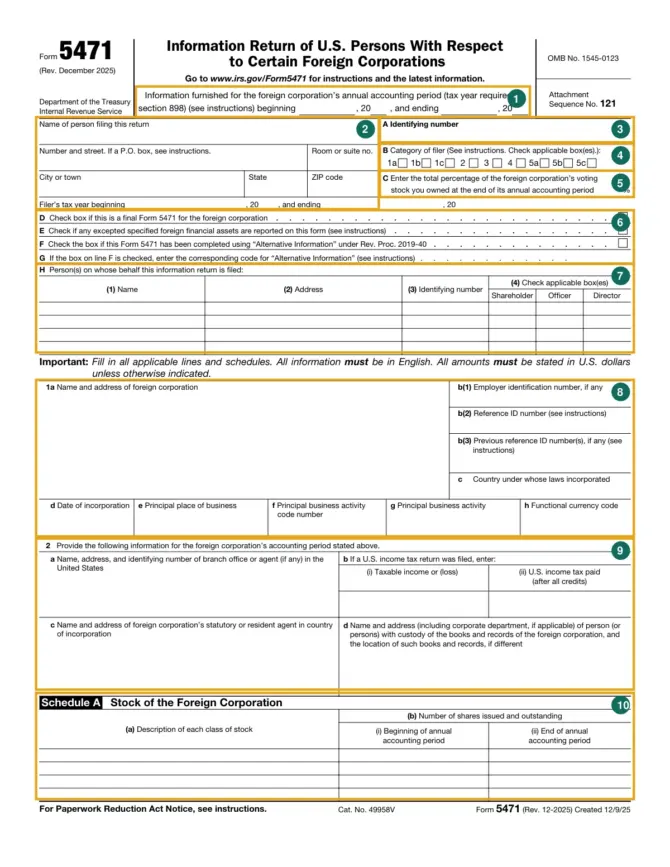
| Marker | Item | What to enter |
|---|---|---|
| 1 | Annual accounting period | The foreign corporation’s tax year that ends with or within your tax year. A section 898 specified foreign corporation generally uses its majority U.S. shareholder’s tax year. |
| 2 | Name, address, filer’s tax year | The U.S. person in the filer category; for a consolidated return, the U.S. parent. A name change within the past 3 years goes in parentheses after the current name. A foreign address is entered as city, province or state, and country, without abbreviating the country. |
| 3 | A, identifying number | SSN for an individual, EIN for everyone else; the common parent’s EIN for a consolidated group. |
| 4 | B, category of filer | Every category that applies, except that a filer meeting both 4 and 5a checks only 4. A person filing for others checks only its own categories. |
| 5 | C, voting stock owned | Total percentage of the voting power you owned directly, indirectly or constructively at the end of the corporation’s annual accounting period. |
| 6 | D to G | D: final year of the corporation’s existence as a corporation (reorganization, liquidation, election to be disregarded); then Schedule O is required. E: excepted specified foreign financial assets reported here, which then need only Form 8938, Part IV, line 17. F and G: alternative information under Rev. Proc. 2019-40, with code 01 to 08 in G. |
| 7 | H, persons on whose behalf the return is filed | Name, address, identifying number and role of each person covered by a joint filing (only direct owners for a consolidated group). |
| 8 | 1a to 1h, the foreign corporation | Name and address, EIN if any (1b(1)), reference ID number (1b(2)), previous reference ID numbers (1b(3)), country of incorporation, date of incorporation, principal place of business, business activity code and description from the list at the end of the instructions, and the ISO 4217 three-letter functional currency code (1h). |
| 9 | 2a to 2d | U.S. branch office or agent; taxable income and U.S. income tax paid if the corporation filed a U.S. return; statutory or resident agent in the country of incorporation; the person who keeps the books and records, and where. |
| 10 | Schedule A | Each class of stock and the number of shares issued and outstanding at the beginning and end of the annual accounting period (Categories 3 and 4). |
The reference ID number in item 1b(2) is one you create yourself; there is nothing to request from the IRS. It is required only when item 1b(1) has no EIN. It must be alphanumeric, without spaces or special characters, up to 50 characters, and the same number has to be used for that corporation every year. A number that falls out of use, for example after a liquidation, cannot be given to another foreign corporation. “FOREIGNUS” and “APPLIED FOR” are no longer accepted in an EIN or reference ID field. After a merger or acquisition, the new number goes in 1b(2) and the old ones in 1b(3), separated by a space, in the first year only. An entity classification election on Form 8832 requires the corporation to have an EIN: the first Form 5471 after the election shows the new EIN in 1b(1) and the old reference ID number in 1b(2).
For each person listed in item H (other than members of the filer’s consolidated group), a statement goes on that person’s own tax return: the foreign corporation’s name, address and EIN or reference ID, a statement that the filing requirement has been or will be met, the name, address and identifying number of the taxpayer whose return carries Form 5471, and the IRS service center where it was filed, or “e-file”. Spouses filing a joint Form 1040 skip this statement. Persons in item H who are Category 1a, 1b, 4, 5a or 5b filers also complete their own Schedule P and attach it to the statement.
Schedules B, C and F: owners, income statement, balance sheet
Schedule B, Part I, filled in by Category 3 and 4 filers, lists U.S. persons that owned 10% or more of the vote or value at any time during the year, directly or through foreign entities, with a description of each class of stock that matches Schedule A, column (a), shares at the beginning and end of the year, and in column (e) each shareholder’s percentage of subpart F income. Part II lists the direct shareholders. Category 4 filers list all direct owners of the CFC; Categories 1a, 3 and 5a list the direct owners through which they own indirectly; 1c and 5c list those from whom ownership is attributed to them. A CFC owned through a foreign disregarded entity is shown with the regarded owner’s name in parentheses after the entity’s name. A person who is both a U.S. shareholder and a direct shareholder appears in both parts.
Schedule C (page 3) is the income statement, prepared under U.S. GAAP in the corporation’s functional currency and translated into U.S. dollars; if the functional currency is the dollar, only the U.S. Dollars column is used. A few lines have specific rules:
- Line 8a takes unrealized and line 8b realized foreign currency transaction gain or loss from the income statement.
- Line 16 is for transactional taxes; income taxes belong on line 21, split into current (21a) and deferred (21b) expense or benefit.
- Line 20 is for “unusual or infrequently occurring items” as U.S. GAAP defines them; prior period adjustments not shown separately on the income statement stay off this line.
- Lines 23a to 24 are other comprehensive income: translation adjustments, other items such as certain hedging gains or pension amounts, and the tax allocated to them.
Schedule F (page 4) is the balance sheet in U.S. dollars, beginning and end of the annual accounting period, from cash on line 1 to total liabilities and shareholders’ equity on line 24. Derivatives go on line 3 (assets) and line 17 (liabilities) without netting positions. Corporations using the dollar approximate separate transactions method (DASTM) prepare Schedule F under Regulations section 1.985-3(d) instead of U.S. GAAP.
Schedule G: the yes-or-no questions on pages 4 to 6
Schedule G is completed by Categories 1c, 3, 4, 5a and 5c; 1b and 5b filers skip it for foreign-controlled corporations. Each “Yes” usually brings an amount, a code or an attachment:
| Question | If “Yes” |
|---|---|
| 1, 10% interest in a foreign partnership | Statement for each partnership: name and EIN, whether it filed Form 1042, 1065 or 8804, partnership representative, and its tax year dates. |
| 3a, foreign disregarded entity or branch | Category 4, 5a and 5c filers attach Form 8858; other filers outside Categories 1b, 4 and 5 attach a statement with the entity’s name, country and EIN. |
| 3b, qualified business units (new) | Number of Forms 8964-TRA attached, for tax years 2025 and 2026. |
| 4a to 4c, base erosion payments | Total payments and total base erosion tax benefits, when the corporation is a related party under section 59A(g). |
| 5a and 5b, section 267A | Interest or royalty deductions disallowed under the hybrid rules. |
| 6a to 6d, FDII | Gross receipts from sales of general property, intangible property and services to the corporation, in dollars at the average exchange rate. |
| 7, cost sharing | A separate Schedule G-1 for each arrangement. |
| 9a and 9b, section 367(d) property | E&P reduction in functional currency, also shown on Schedule H, line 2i. |
| 11, reportable transaction | Form 8886 if required. |
| 14, line 14 table | Code or codes in capital letters, separated by spaces, with the statement the table describes. |
| 15 and 16, section 163(j) | For a corporation that files a U.S. return such as Form 1120-F: the amount from Form 8990, line 31 (current year for 15, prior year for 16). |
| 19a and 19b, section 385 | Only when the filer is a domestic corporation. |
| 20a and 20b, Top-up Tax | Amounts of IIR, QDMTT and UTPR (or similar taxes) paid or accrued. |
| 21a and 21b, section 304 (new) | Change in PTEP and in other E&P, in functional currency. |
Schedule I and where the amounts go on your own return
Schedule I, on page 6, reports in U.S. dollars one U.S. shareholder’s share of subpart F income and of dividends from the corporation. Category 4, 5a and 5b shareholders each get a separate Schedule I; when one person files for others, it sends each of them a copy of theirs. Lines 1e to 1h come from Worksheet A in the instructions, line 2 (section 956 amount) from Worksheet B, line 19. Noncorporate shareholders leave line 1a blank.
| Schedule I line | Corporate shareholder | Noncorporate shareholder |
|---|---|---|
| 1a | Form 1120, Schedule C, line 16a | Left blank |
| 1b | Form 1120, Schedule C, line 16b | Schedule 1 (Form 1040), line 8n |
| 1c to 1h, 2 and 4 | Form 1120, Schedule C, line 16c | Schedule 1 (Form 1040), line 8n |
| 5a, dividends eligible for section 245A | Form 1120, Schedule C, line 13, column (a) | No line given in the instructions |
| 5b to 5e, other dividends | Form 1120, Schedule C, line 14, column (a) | No line given in the instructions |
| 6, currency gain or loss on a PTEP distribution | Form 1120, page 1, line 10 | Schedule 1 (Form 1040), line 8z |
Lines 7a and 7b ask about blocked income, lines 8a to 8c about extraordinary disposition account balances (with a statement explaining changes), and line 9, for a domestic corporation shareholder of a CFC, the sum of its hybrid deduction accounts at the close of the CFC’s year.
Exchange rates and attachments
Every exchange rate on Form 5471 and its schedules is written as units of foreign currency per one U.S. dollar, rounded to at least four places, and never as dollars per unit of foreign currency. The method of translation (average rate, spot rate) depends on the schedule. When a section needs more room than the form gives, fill every entry space first and put only the rest on additional sheets that follow the IRS layout; “See attached” alone in a section is not accepted. Software-generated versions that match the official form exactly need no IRS approval. A statement for a section 362(e)(2)(C) election is not attached to Form 5471.
What happens when Form 5471 is late or incomplete
- Under section 6038(a) (Form 5471 and Schedule M), the penalty is $10,000 for each annual accounting period of each foreign corporation. If the information is still missing 90 days after the IRS mails a notice, another $10,000 per foreign corporation is charged for each 30-day period or part of one, up to $50,000.
- The same failure reduces the foreign taxes available for credit under sections 901 and 960 by 10%, plus 5% for each 3-month period the failure continues beyond 90 days after the notice, within the limits of section 6038(c)(2).
- Under section 6046 (Form 5471 and Schedule O), each reportable transaction not reported costs $10,000, with the same $10,000 per 30 days after the 90-day period, up to $50,000 (section 6679).
- Criminal penalties under sections 7203, 7206 and 7207 can apply. A person who lets someone else file Form 5471 and Schedule J, M or O for them can still be penalized if that filing is not correct.
- Certain section 6038 and 6662 penalties may be waived under section 7 of Rev. Proc. 2019-40, and the section 6662(j) penalty is not imposed where the taxpayer shows reasonable cause and good faith.
Questions about Form 5471
Does Form 5471 go to a separate IRS address?
The instructions give none. Form 5471 is attached to the income tax, partnership or exempt organization return and filed with it by that return’s due date, including extensions.
Do I also report the foreign company on Form 8938?
Items reported on Form 5471 are not reported again on Form 8938. If you check item E on Form 5471, you complete only Form 8938, Part IV, line 17 for those assets.
Is the reference ID number something the IRS issues?
You assign it yourself, with no application. It must stay the same for that foreign corporation every year. The same number goes on Form 8858 when the corporation is listed there as the tax owner of a foreign disregarded entity or branch, and on Schedule A or B (Form 8992) for the same CFC.
The foreign company had no activity this year. Do I still file all pages?
If it meets the definition of a dormant foreign corporation in Rev. Proc. 92-70, page 1 alone can be filed under the summary procedure, labeled at the top as filed under that revenue procedure.