Form 7203 tracks what your S corporation stock and your loans to the corporation are worth for tax purposes, year after year. That figure, your basis, caps how much of the corporation’s losses and deductions you can take on your own return, decides whether a distribution is tax free, and decides how much of a loan repayment is taxable. The form has three parts on two pages: stock basis, debt basis, and the allocation of losses when basis runs short. It is attached to your income tax return; the S corporation does not file it for you.
Who has to attach Form 7203
The instructions (Rev. December 2022) require the form from an S corporation shareholder who, for the year:
- claims a deduction for a share of an aggregate loss from the corporation, including a loss that basis did not allow last year;
- received a non-dividend distribution;
- disposed of stock in the corporation, whether or not there was a gain;
- received a repayment of a loan made to the corporation.
A shareholder in a profitable S corporation who took no distributions and lent nothing may not need to file in a given year. The instructions still suggest completing and keeping the form in those years, because line 1 of next year’s form starts from this year’s ending basis. You are the one responsible for keeping the records; the Schedule K-1 (Form 1120-S) gives you the year’s items but not a running basis figure.
The 2025 Schedule E instructions tie the form to Part II of Schedule E: if you report a loss, receive a distribution, dispose of stock or receive a loan repayment from an S corporation, you check the box in column (e) of line 28, “basis computation is required”, and attach Form 7203. Married couples filing jointly who each received a Schedule K-1 complete a separate Form 7203 for each spouse, using the name shown on that spouse’s K-1.
What the December 2022 revision added
The “What’s New” note in the instructions lists two new items on the form. Item D has five checkboxes for how you acquired the stock: original shareholder, purchased, inherited, gift, or other, with a blank to describe the other method. Item E is a single checkbox for shareholders who have a Regulations section 1.1367-1(g) election in effect for the year for that corporation. The same revision is still listed as current on the IRS About Form 7203 page.
The form itself replaced the three-part basis worksheet that used to sit in the Shareholder’s Instructions for Schedule K-1 (Form 1120-S).
How to fill out Form 7203, Part I (stock basis)
Part I follows the order of basis adjustments in section 1367: income first, then distributions, then nondeductible expenses, then losses. The marked page shows the header items D and E and the lines discussed below, numbered as on the form. Stock basis and debt basis are figured separately, so nothing about loans goes into Part I except the restoration amount on line 12.
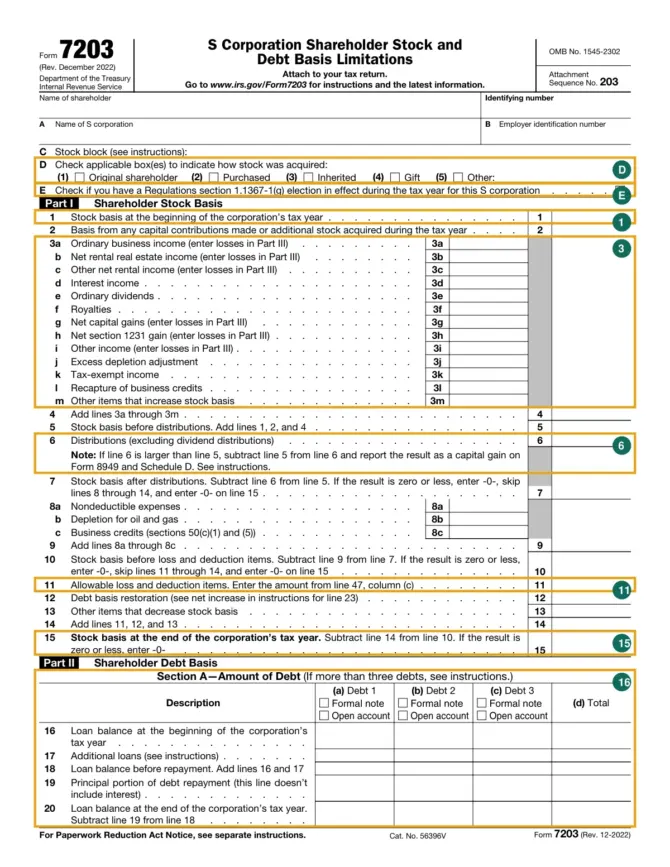
| Line | What goes there | Where the figure comes from |
|---|---|---|
| Header, A and B | Your name and identifying number; the corporation’s name and EIN | Your Schedule K-1 (Form 1120-S) |
| C | The stock block the form covers, when blocks have different bases or part of the stock was sold or redeemed | Your purchase and transfer records |
| 1 | Stock basis at the start of the corporation’s tax year; never below zero; no loan basis | Line 15 of last year’s Form 7203, unless this is your first year |
| 2 | Capital contributions and stock acquired during the year; not loans | Cost, carryover basis in a section 351 exchange, value at death for inherited stock, donor’s basis for gifts |
| 3a to 3m | Income items, positive amounts only | Schedule K-1; 3j from box 15, code C; 3k is box 16, codes A and B added together |
| 6 | Non-dividend distributions | Schedule K-1, box 16, code D; not Form 1099-DIV dividends from old C corporation earnings |
| 8a to 8c | Nondeductible expenses, oil and gas depletion, section 50(c) credit reductions | 8a is box 16, code C; leave all three blank if you have the 1.1367-1(g) election |
| 11 | Losses and deductions allowed against stock basis | Line 47, column (c), from Part III |
| 12 | Debt basis restoration | Line 23 of Part II |
| 13 | Other decreases, including the basis of stock sold or redeemed, and election amounts | Your records; with the election, the line 8 items and prior-year carryovers go here |
| 15 | Stock basis at the end of the year, zero at the lowest | Becomes line 1 next year |
Two lines on the form send you to a shortcut. If line 7 (basis after distributions) or line 10 (basis before losses) comes out at zero or less, you enter -0-, skip to line 15 and enter -0- there.
Line 3i picks up other income that increases basis. The instructions point to Notice 2020-69: a subpart F inclusion or GILTI inclusion attributable to a controlled foreign corporation owned by the S corporation increases stock basis under section 961(a). Excluded discharge of indebtedness income of the corporation under sections 108(a) and 108(d)(7)(A) does not increase basis. Losses never go on line 3; they go in Part III.
A worked example, using only the form’s arithmetic: line 1 is $10,000, line 3a shows $4,000 of ordinary business income, and box 16, code D shows $18,000 of distributions. Line 5 is $14,000. Line 6 is $18,000, so the $4,000 difference is reported as a capital gain on Form 8949 and Schedule D, line 7 is -0-, lines 8 through 14 are skipped and line 15 is -0-. The $4,000 gain does not add to basis.
If you sold or a redemption took part of your stock during the year, the instructions ask for two forms: one that figures stock basis at the date of sale and one for stock and debt basis at year end.
The Regulations section 1.1367-1(g) election
Normally nondeductible expenses reduce basis before losses do. The election reverses that order, so losses are taken against basis first; any nondeductible expenses that exceed your stock and debt basis then carry to the next year. You make it by attaching a statement to a timely filed original or amended return saying you agree to the carryover rule of Regulations section 1.1367-1(g) and naming the S corporation. It applies to that year and every later year for that corporation unless the IRS agrees to revoke it. With the election, you check item E, leave lines 8a to 8c blank and enter those amounts on line 13.
Part II: money you lent to the S corporation
Part II is required if you personally lent money to the corporation. A loan you only guaranteed or co-signed gives no basis, except to the extent you actually make payments on it. Distributions do not reduce loan basis.
Each formal note, meaning a loan with a written instrument, gets its own column; you cannot combine notes in one column. Loans without a written instrument are open account debt and are not tracked loan by loan; advances and repayments are netted at year end and the net advance goes on line 17 in the open account column. An open account balance over $25,000 at year end becomes a formal note at the start of the next tax year and is tracked separately from then on. With more than three loans you use extra copies of Part II and put the grand total on the first one only.
| Lines | Section | What you enter |
|---|---|---|
| 16 to 20 | A, amount of debt | Each loan’s face balance: start of year, new formal notes or net open account advances (17), principal repaid (19), end of year |
| 21 to 24 | B, debt basis | Debt basis at the start of the year, the line 17 amount again, restoration (23), basis before repayment |
| 25 and 26 | B | Line 24 divided by line 18, times the repayment: the part of the repayment that is a tax-free return of basis |
| 27 to 31 | B | Nondeductible items and losses that stock basis could not absorb (28 and 30), ending debt basis (31) |
| 32 to 34 | C, gain on repayment | Repayment less the nontaxable part: the reportable gain |
Line 23 is where reduced debt basis comes back. If line 21 is lower than line 16, basis was reduced in an earlier year, and it can only be restored by a net increase: line 4, minus line 6, minus line 9, minus line 13 where it applies, minus line 47 columns (a) and (b). Restoration stops at the face amount of the loan. With several loans, the net increase goes first to a loan repaid during the year, to the extent needed to avoid gain, and the rest is shared in proportion to each loan’s reduced basis. The total from line 23 also goes to line 12 in Part I.
The gain on line 34 depends on the kind of debt. A formal note produces capital gain, reported on Form 8949 and Schedule D. Open account debt produces ordinary gain, reported on Form 4797. The gain does not increase basis.
Part III: losses larger than your basis
When stock and debt basis together cannot absorb every loss and deduction item, Part III splits what is allowed among the items pro rata and carries the rest forward. Suspended items keep their character and carry forward indefinitely.
- Column (a): each loss or deduction from the Schedule K-1, lines 35 to 46.
- Column (b): amounts disallowed in earlier years and carried forward, from last year’s column (e).
- Column (c): the part allowed against stock basis. Skip it if line 10 is zero. The line 47 total cannot exceed line 10, and it goes to line 11.
- Column (d): the part allowed against debt basis. Skip it if line 29 is zero or if column (c) already used less than all of line 10. The line 47 total cannot exceed line 29, and it goes to line 30.
- Column (e): what is left over, carried to next year’s column (b). If you disposed of all your stock, the instructions refer you to Regulations section 1.1366-2(a)(6).
Two Schedule K-1 items have their own place in Part III. Foreign taxes from box 16, code F go in column (a) of line 46, according to the 2025 Shareholder’s Instructions for Schedule K-1 (Form 1120-S). The undistributed capital gains credit, box 13, code H, is taxes a RIC or REIT paid on capital gains it did not distribute; you claim it on Schedule 3 (Form 1040), line 13a, and the IRS says to reduce stock basis by entering the amount on Form 7203, Part III, line 45.
Where Form 7203 goes and where the results end up
The form is downloaded from IRS.gov (link under sources) and attached to your income tax return; the header says “Attach to your tax return” and it carries attachment sequence number 203. There is no separate mailing address or due date. Allowed amounts from columns (c) and (d) of Part III are reported in the right places on your return, where other limits still apply.
Basis is only the first test. The instructions list the order: basis (Form 7203), then at-risk limits (Form 6198), then passive activity limits (Form 8582), then the excess business loss limit (Form 461). Schedule E line 28 has its own column (f) for at-risk amounts.
If you lost track of an earlier year’s ending basis, a copy of a return you filed with Form 7203 attached can be requested on Form 4506, which asks for the return “and all attachments as originally submitted”.
Official PDF: Form 7203 — Official PDF (irs.gov)
Points the instructions single out
- Line 1 and line 2 hold stock basis only; loans go in Part II.
- Line 6 excludes dividend distributions reported on Form 1099-DIV.
- Line 8b covers oil and gas depletion only, up to your share of the property’s basis.
- Guaranteed or co-signed corporate loans are left out of Part II until you pay on them.
- Each formal note has its own column in Part II.
- Nondeductible expenses that exceed stock and debt basis do not carry forward unless you have the 1.1367-1(g) election.
- A partial sale or redemption means two Forms 7203 for the year.
Questions about Form 7203
Does the S corporation fill out Form 7203 for its shareholders?
The form is filed by the shareholder with the shareholder’s own return. The corporation’s Schedule K-1 supplies the year’s income, losses, distributions and other items, but the instructions place responsibility for basis records on the shareholder.
Can I use Form 7203 if I own stock through more than one S corporation?
Item A and item B name one S corporation and its EIN, and the item E election is made per corporation, so each corporation has its own form. Schedule E, line 28 has a separate row for each.
Is a bank loan to my S corporation that I guaranteed part of my basis?
The guarantee alone gives no basis. Basis arises only to the extent you make payments under the guarantee.
What happens to losses that basis did not allow?
They are suspended in Part III, column (e), keep their character and carry forward with no time limit. Next year they go in column (b) and are allowed if basis is available then.
Sources
- Form 7203, S Corporation Shareholder Stock and Debt Basis Limitations (Rev. December 2022)
- Instructions for Form 7203 (Rev. December 2022)
- About Form 7203
- Reporting amounts from Schedule K-1 (Form 1120-S), box 13, code H, on Form 7203
- Shareholder’s Instructions for Schedule K-1 (Form 1120-S) (2025)
- Instructions for Schedule E (Form 1040) (2025)
- Schedule E (Form 1040) (2025)