Form 5472 is the information return a U.S. corporation files when a foreign person owns at least 25% of it and it had reportable dealings with a related party during the year. A foreign corporation doing business in the United States files it too. For tax years beginning on or after January 1, 2017, and ending on or after December 13, 2017, a U.S. entity that is disregarded for income tax and wholly owned by a foreign person is also treated as a corporation for this one purpose. The form in use is Rev. December 2023; its instructions are Rev. December 2024. A missed or substantially incomplete Form 5472 carries a $25,000 penalty.
What changed in the December 2024 instructions
The instructions list one change. In the definition of a foreign person, the exception for a foreign person filing a joint return now cites Code sections 6013(g) and (h), in line with Regulations section 1.6038A-1(f)(1). The form itself is still the December 2023 revision, and the IRS forms page for Form 5472 showed no recent developments when checked.
Who has to file Form 5472
The filer is called the reporting corporation. It is one of these:
- A 25% foreign-owned U.S. corporation, meaning at least one foreign person owned, directly or indirectly, at least 25% of the vote or value of its stock at any time during the tax year.
- A foreign-owned U.S. disregarded entity (DE): a domestic entity disregarded from its owner and wholly owned by one foreign person.
- A foreign corporation engaged in a trade or business within the United States.
Being foreign owned is not enough on its own. The reporting corporation files when it had a reportable transaction with a related party, foreign or domestic. Related parties include any 25% foreign shareholder, persons related to the corporation or to a 25% foreign shareholder under section 267(b) or 707(b)(1), and anyone related under section 482. Corporations that join in the same consolidated return are not related parties for this purpose.
One situation the rules reach directly is a single-member LLC formed in a U.S. state by a nonresident individual or a foreign company. Under the Form 8832 default rule, a domestic eligible entity with a single owner is disregarded unless it elects otherwise, and LLCs are eligible entities. If that owner is a foreign person, the LLC is a foreign-owned U.S. DE. Money the owner puts in to set the company up, distributions back out, and payments for its formation or dissolution are the kind of transactions Part V asks about.
Another is a U.S. subsidiary of a foreign group that buys inventory from, pays royalties to, borrows from or bills services to its foreign parent. Those amounts go in Part IV.
When no Form 5472 is required
The instructions give six exceptions. Several of them are closed to foreign-owned U.S. DEs.
| Exception | Available to a foreign-owned U.S. DE? |
|---|---|
| 1. No reportable transactions of the types in Parts IV and VI (and, for a DE, Part V) | Yes, but Part V counts for the DE |
| 2. A U.S. person who controls the foreign related corporation files Form 5471 with a Schedule M showing all the transactions | No |
| 3. The related corporation is a foreign sales corporation filing Form 1120-FSC | No |
| 4. A foreign corporation with no U.S. permanent establishment under a treaty that timely files Form 8833 | Applies to foreign corporations |
| 5. A foreign corporation whose gross income is all exempt under section 883 and that complies with sections 883 and 887 | Applies to foreign corporations |
| 6. Neither the reporting corporation nor the related party is a U.S. person, and the transactions produce no U.S.-source or effectively connected income or related deductions | No |
When and where Form 5472 is filed
A corporation that files an income tax return, such as Form 1120 or Form 1120-F, attaches Form 5472 to it and files by the due date of that return, including extensions. If the income tax return is e-filed, the instructions refer you to that return’s own e-file instructions.
A foreign-owned U.S. DE has no income tax return of its own, so the rules build one for it:
- It files a pro forma Form 1120 with Form 5472 attached, by the due date of that Form 1120, including extensions. The 2025 Form 1120 instructions set the general due date at the 15th day of the 4th month after the tax year ends.
- On the Form 1120, only the DE’s name and address and items B and E on page 1 are required, and “Foreign-owned U.S. DE” is written across the top.
- The DE’s tax year is the one its owner uses for U.S. filing, or the calendar year if the owner has none.
- It cannot file Form 5472 electronically and does not use the Form 1120 mailing addresses.
The DE sends the package either by fax, at 300 DPI or higher, to 855-887-7737, or by mail to:
Internal Revenue Service
1973 Rulon White Blvd
M/S 6112 Attn: PIN Unit
Ogden, UT 84201
For more time, the DE files Form 7004 by the regular due date, enters the Form 1120 code in Part I, line 1, writes “Foreign-owned U.S. DE” across the top, and faxes or mails it to the same number or address, not the regular Form 7004 address. If the DE’s address changes after it files, the Form 1120 instructions point to Form 8822-B.
How to fill out page 1: the reporting corporation and its foreign owners
Everything goes in English, with money in U.S. dollars. A separate Form 5472 is filed for each related party with which the corporation had a reportable transaction, so a company dealing with its foreign parent and a foreign sister company files two. The numbers below match the marked image.
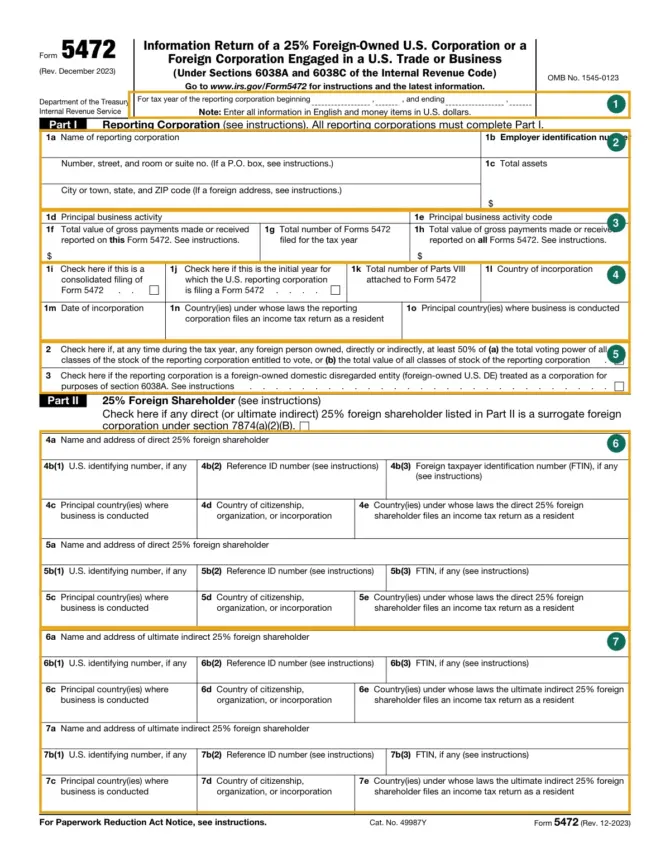
| Mark | Lines | What to enter |
|---|---|---|
| 1 | Tax year | Beginning and ending dates of the reporting corporation’s tax year |
| 2 | 1a to 1c | Name and address (suite or room after the street; foreign address as city, province or state, then the country written out), EIN, and total assets: Form 1120, page 1, item D for a domestic filer, or Form 1120-F, Schedule L, line 17, column (d) for a foreign one |
| 3 | 1d to 1h | Principal business activity and its code from the Form 1120 or 1120-F list; line 1f, the dollar total of foreign related party transactions on this form (lines 22 and 36 plus the fair market value of Part VI items, and Part V for a DE); line 1g, the number of Forms 5472 filed for the year, this one included; line 1h, the total of line 1f across all of them |
| 4 | 1i to 1o | Consolidated filing box, first-year box, number of Parts VIII attached, country and date of incorporation, countries where it files as a resident, and the principal countries where it does business (not “worldwide”, and not countries reached only through a subsidiary) |
| 5 | 2 and 3 | Line 2 if any foreign person owned at least 50% of the vote or value at any time in the year; line 3 if the filer is a foreign-owned U.S. DE |
| 6 | 4a to 5e | The direct 25% foreign shareholders: the largest on lines 4a to 4e, the second largest on lines 5a to 5e |
| 7 | 6a to 7e | The ultimate indirect 25% foreign shareholders, largest and second largest, with an attached explanation of how ownership is attributed |
Line 1f is left blank when the reportable transaction is with a U.S. related party.
Line 1c has a gap for a DE. Line 1c tells domestic reporting corporations to enter total assets from Form 1120, page 1, item D, while the same instructions say a DE’s pro forma Form 1120 needs only the name, address and items B and E. Neither the Form 5472 instructions (Rev. December 2024) nor the 2025 Form 1120 instructions say where a DE takes its line 1c figure from if item D is left blank. The IRS business line, 800-829-4933 (7 a.m. to 7 p.m. local time), can answer that for your case.
For a foreign-owned U.S. DE, the foreign owner’s details go on the 25% foreign shareholder lines in Part II. If more than two shareholders of either kind need reporting, the rest go on an attached sheet. The checkbox in the Part II heading is for a 25% foreign shareholder that is a surrogate foreign corporation under section 7874(a)(2)(B), resulting from an inversion in the current year or the previous 10 years.
Identifying numbers on lines 4b to 7b
Each shareholder line has three boxes. Box (1) is the U.S. identifying number if there is one: an SSN or ITIN for an individual, an EIN for anyone else. Box (2), the reference ID number, is needed only when box (1) is empty. Box (3) is the foreign taxpayer identification number (FTIN).
The FTIN box works differently depending on the filer. A foreign-owned U.S. DE must enter an FTIN for each direct and ultimate foreign owner, or “None” or “N/A” if the owner has none. Other filers may enter an FTIN but must still give a U.S. number or reference ID, and leave the FTIN box blank if there is no FTIN.
The corporation creates the reference ID number itself; there is no IRS application. It must be alphanumeric, up to 50 characters, with no spaces or special characters, and it stays the same for that foreign person every year. Once retired, for example after the shareholder is liquidated, it cannot be given to anyone else. After a merger or acquisition, a new reference ID is correlated with the old one in the first year it is used, in the format “new number, space, old number”. When a Form 8832 classification election is made for the foreign person, which requires it to have an EIN, the first Form 5472 afterward shows the new EIN in box (1) and the old reference ID in box (2).
Parts III to VI: the related party and the money
Part III is required on every Form 5472, even when the related party is the same person already listed in Part II. Check whether the related party is a foreign person or a U.S. person, then give its name, address, identifying number (reference ID only for a foreign party with no U.S. number), business activity and code, the relationship boxes on line 8e, and the countries on lines 8f and 8g.
Part IV is completed only when the related party is foreign. Lines 9 to 21 are amounts the reporting corporation received and line 22 totals them; lines 23 to 35 are amounts it paid, totaled on line 36. “Paid” and “received” include accruals, and an accrual-method corporation uses accrued amounts throughout.
| Lines | Transaction | Point from the instructions |
|---|---|---|
| 9, 10 and 23, 24 | Sales and purchases of inventory and other tangible property | Amounts in U.S. dollars, with a schedule of the exchange rates used |
| 11 and 25; 12 and 26 | Platform contribution and cost sharing transaction payments | Reported without netting; line 12 only if the corporation itself incurred intangible development costs |
| 13a, 13b and 27a, 27b; 14 and 28 | Rents, royalties and intangible property rights | Lines 13 and 27 exclude intangible property rights, which go on 14 and 28 |
| 15 and 29; 16 and 30 | Services and commissions | Technical, managerial, engineering, construction, scientific or similar services |
| 17 and 31 | Amounts borrowed and loaned | Beginning and ending balances on a and b, or skip a and enter the monthly average on b |
| 18 and 32 | Interest received and paid | Line 32 shows only interest allowed as a deduction under section 163(j) for the year |
| 19, 20 and 33, 34 | Insurance premiums and loan guarantee fees | Received on the upper lines, paid on the lower |
| 21 and 35 | Other amounts | Only to the extent they enter the corporation’s taxable income |
Two shortcuts are allowed. Where actual amounts can’t be determined, a reasonable estimate is permitted: anything from 75% to 125% of the actual amount, and the estimates box at the top of Part IV is checked. Any amount of $50,000 or less may be entered as “$50,000 or less”. For transactions between a related party and a partnership the reporting corporation partly owns, only the corporation’s percentage share is reported, unless it owns less than 25% of the partnership.
Part V is only for foreign-owned U.S. DEs. Check the box and attach a statement describing any other transaction under Regulations section 1.482-1(i)(7) not already in Part IV, including amounts paid or received for the entity’s formation, dissolution, acquisition or disposition, and contributions to and distributions from the entity. For an LLC whose foreign owner wired in start-up capital or took money out, this is where it appears.
Part VI covers nonmonetary and less-than-full-consideration transactions with a foreign related party. Check the box and attach a schedule describing the property, rights, obligations and services that moved each way, with a reasonable estimate of fair market value or another indicator of value.
Parts VII to IX: the additional questions
Every reporting corporation answers Part VII:
- Lines 37 and 38: imports from a foreign related party and whether the basis or inventory cost exceeds the customs value; a Yes on 38a needs a statement of reasons and an answer on 38c about supporting documents.
- Line 39: whether the foreign parent took part in a cost sharing arrangement; a Yes leads to Part VIII.
- Lines 40a and 40b: interest or royalties disallowed under section 267A, with the total on 40b.
- Lines 41a to 41d: an FDII deduction under section 250 tied to the related party, with gross receipts from sales of general property, intangible property and services; a No on 41a skips 41b to 41d.
- Lines 42a and 42b: loans under the safe-haven rate rules, with interest inside or outside 100% to 130% of the applicable federal rate.
- Lines 43a and 43b: covered debt instruments under Regulations section 1.385-3, for domestic corporations only; a foreign-owned U.S. DE skips them.
Part VIII is completed once for each cost sharing arrangement the corporation took part in during the year, and line 1k counts them. Part IX reports base erosion payments (line 50), base erosion tax benefits (line 51) and qualified derivative payments (line 52) under section 59A; line 53 is reserved.
What the IRS treats as a failure to file
- A substantially incomplete Form 5472 counts as a failure to file and draws the same $25,000 penalty as no form at all.
- The penalty also applies when the records required by Regulations section 1.6038A-3 are not kept.
- If the failure continues more than 90 days after the IRS sends notice, another $25,000 applies for each related party for each 30-day period, or part of one, that it continues.
- In a consolidated filing, each member is a separate reporting corporation, liable for its own $25,000 penalty, and the members are jointly and severally liable.
- The penalty covers failing to file when due and in the manner prescribed. For a foreign-owned U.S. DE the prescribed manner is fax or mail to the dedicated Ogden address; e-filing is not available and the Form 1120 addresses are not used.
Criminal penalties under sections 7203, 7206 and 7207 may also apply for failing to provide information or for false or fraudulent information.
Questions about Form 5472
Does a foreign-owned single-member LLC with no income still file Form 5472?
The test is reportable transactions, not income. A foreign-owned U.S. DE that had any transaction of the kinds in Parts IV, V or VI with a related party, including the owner’s contributions or distributions, files the pro forma Form 1120 with Form 5472 attached.
Can a foreign-owned LLC file Form 5472 electronically?
The instructions say a foreign-owned U.S. DE cannot file Form 5472 electronically. It faxes the package to 855-887-7737 or mails it to the Ogden PIN Unit address.
How many Forms 5472 does a company file?
One for each related party, foreign or U.S., with which it had a reportable transaction. Line 1g shows the total, and line 1h adds up the line 1f amounts from all of them.
Does the reference ID number need IRS approval?
The corporation assigns it without applying to the IRS. It has to follow the format rules and stay the same for that person from year to year.