When several people share the cost of supporting a qualifying relative, Form 2120 can identify which eligible contributors have agreed not to claim that relative as a dependent. The taxpayer making the claim attaches Form 2120 to Form 1040 or 1040-SR and keeps the other contributors’ signed waivers.
The IRS Form 2120 page lists the December 2025 revision as its current form. This is a multiple-support declaration for a qualifying relative. Its rules do not apply to claiming a qualifying child.
Who can use a multiple support declaration?
The form defines an eligible person as someone who could have claimed the dependent except for not paying more than half of that person’s support. A claimant who did not personally provide more than half may use the multiple-support rules only when all five conditions in the form’s instructions are met:
- The claimant and one or more other eligible people together paid more than half of the relative’s support.
- The claimant paid more than 10% of the support.
- No person alone paid more than half.
- The other dependency tests are met.
- Every other eligible person who paid more than 10% gives the claimant a signed agreement not to claim the relative for that year.
The other tests are not waived by Form 2120. Publication 501 explains the qualifying-relative tests, including the relationship or household test, gross income test, support test and the requirement that the person not be a qualifying child. Publication 501 also covers the dependent-taxpayer, joint-return and citizenship/residency tests, including their exceptions. Use that publication and the applicable return-year instructions to determine support and eligibility.
For a simple illustration of the percentages, three otherwise eligible siblings contributing 40%, 35% and 25% of a parent’s total support would together pay more than half, while none pays more than half individually. If the other dependency tests are satisfied, only the agreed claimant claims the parent; the other eligible contributors provide the required waivers. The percentages alone do not establish dependency.
How to fill out Form 2120
Begin with the claimant’s return details and the calendar year to which the support declaration relates. The four contributor blocks identify the other eligible people, rather than repeating the claimant’s own information.
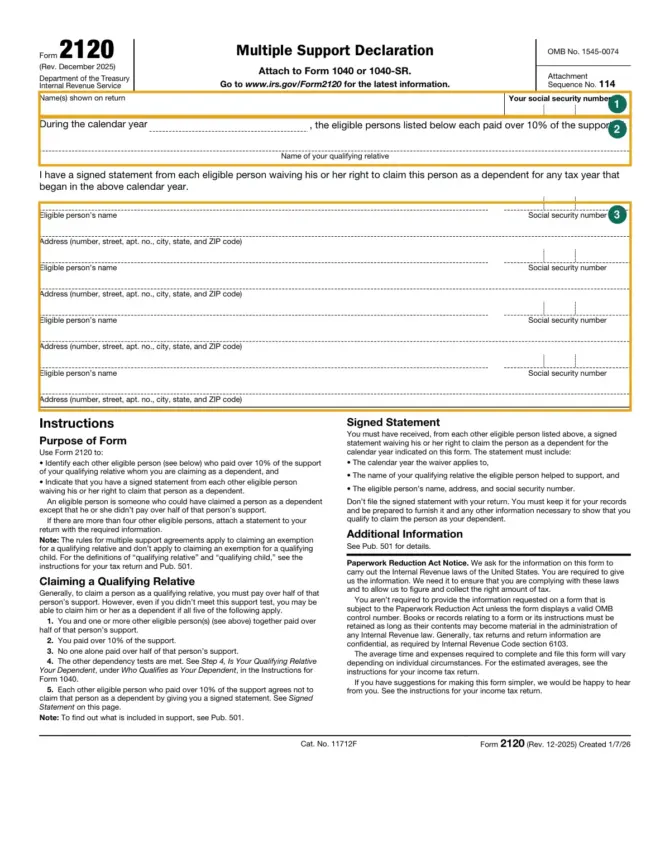
| Form area | Entry | Record to use |
|---|---|---|
| Name(s) shown on return and your SSN | The claimant’s return names and social security number. | The Form 1040 or 1040-SR being filed. |
| During the calendar year | The calendar year for the support and waivers. | The year covered by the multiple-support agreement. |
| Name of your qualifying relative | The person being claimed as a dependent. | The relative’s identity and dependency records. |
| Other eligible contributors | Each eligible person’s name, SSN and full address, including street, apartment if applicable, city, state and ZIP code. | The details of each other eligible person who paid more than 10% and supplied a waiver. |
If there are more than four other eligible contributors, attach a statement to the return giving the required information for the additional people. There is no separate signature line on Form 2120; the signed statements described below are separate records.
What each signed waiver must contain
Each other listed eligible person must provide a signed statement waiving the right to claim the relative for the calendar year on Form 2120. Include that calendar year, the qualifying relative’s name, and the contributor’s name, address and SSN.
Do not file the signed waivers with the return. Keep them and be prepared to provide them, together with any other information needed to show that the claim qualifies. The declaration on Form 2120 states that the claimant has received those signed waivers.
Official PDF and where to file Form 2120
Use the December 2025 Form 2120 PDF, which includes its instructions on the same page. Attach the completed form and any overflow contributor statement to Form 1040 or 1040-SR. Follow the filing instructions for that income tax return.
Keep the distinction between the submitted contributor information and the retained signed waivers. A support agreement with missing eligibility or waiver evidence is not repaired by attaching an unsigned list of contributors.