Alabama Schedule BC (Form 20C) is where a C corporation works out which business credits it can use against its 2025 Alabama income tax. The seven-page schedule lists 21 credits as Parts A through U, applies them to the Form 20C tax row by row and ends with two totals: nonrefundable credits for Form 20C page 1, line 18, and refundable credits for line 20f.
Who attaches Schedule BC to a 2025 Form 20C
ALDOR’s corporate income tax FAQ says the department requires Schedule BC when a corporation claims business tax credits, and that the amounts on it carry over to Form 20C page 1. Every page of the schedule repeats the corporation’s name and federal employer identification number as shown on Form 20C.
A corporation that receives a credit through Schedule K-1 from a pass-through entity enters its allocable share on the matching Schedule BC line and attaches that K-1. Parts C, M, P, Q, R, S and T each have a K-1 line with a space for the entity’s FEIN; when the share comes from more than one entity, a separate schedule is attached.
The form marks some credits with an asterisk and says they must be submitted through My Alabama Taxes (MAT) before Schedule BC is completed. On the 2025 form those are Parts C, D, E, F, G, H, I, K, M, N, R, S, T and U. The coal credit instructions add one exception: if the coal credit comes from a partnership or S corporation, the entity submits the claim in MAT and the corporation does not. Negative numbers take a minus sign; parentheses are only for fields that print them.
Credit parts A through U and what each one needs
The table follows the order of Section B. “Allowable” lines are the amounts that move to Section C, Column 3.
| Part and credit | Lines to complete | Paperwork or MAT step from the 2025 instructions |
|---|---|---|
| A, Alabama Enterprise Zone | A1 credit available | Business approved by ADECA; Certificate of Certification and computations attached to Form 20C |
| B, Basic Skills Education | B1 certification number, B2 sponsoring employer, B3 provider and address, B4 and B5 yes/no tests, B6 expenses, B7 = B6 × 20% | Approved certification notice from the Alabama Department of Education attached |
| C, Coal | C1 tons in 2025, C2 tons in 1994 or base year, C3 increase, C4 = C3 × $1, C5 K-1 share, C6 total | Submitted through MAT |
| D, Full Employment Act of 2011 | Eligibility question, D1 to D4 headcounts, D5 = D4 × $1,000 | Submitted through MAT |
| E, Veterans Employment Act employer credit | E1 veterans counted in D4, E2 = E1 × $2,000 | Submitted through MAT |
| F, Veterans Employment Act start-up expenses | Start-date question, F1 name, F2 business ID, F3 expenses, F4 printed $2,000, F5 lesser of F3 or F4 | Submitted through MAT |
| G, Qualified Irrigation System/Reservoir System | G1 to G9, capped at $10,000 | Submitted through MAT; certificate attached |
| H, Alabama Accountability Act | H1 and H2 scholarship granting organization, H3 amount contributed | Donation reported in MAT |
| I, 2013 Alabama Historic Rehabilitation | I1a to I1c project number, placed-in-service date and credit; I2 total | Submitted through MAT; data from the Tax Credit Certificate |
| J, Career-Technical Dual Enrollment | J1 to J7, carryforward rows J8a to J8d | Department of Postsecondary Education Tax Certificate |
| K, Investment Credit (Alabama Jobs Act) | K1a to K1c project number and credit, K2 total | Department of Commerce certificate, then an allocation schedule in MAT |
| L, Port Credit | L1 amount certified | Certification by the Department of Commerce |
| M, Growing Alabama | M1 to M7, carryforward rows M8a to M8f | Donation to the economic development organization reported in MAT |
| N, 2017 Alabama Historic Rehabilitation | N1a to N1c project data, N2 total | Submitted through MAT; Tax Credit Certificate or Transfer Tax Credit Certificate |
| O, Railroad Modernization Act of 2019 | O1a or O1b box, O2 certificate amount | Pre-certification from ALDOR; claim submitted through MAT |
| P, Innovate Alabama | P1 to P7, carryforward rows P8a to P8f | Contribution submitted in MAT |
| Q, Alabama Workforce Housing | Q1 project name, Q2 project number, Q3 K-1 share, Q4 certificate amount, Q5 total | Certificate from the Alabama Housing Finance Authority (AHFA) |
| R, Employer Tax Credit | R1 K-1 share, R2 certificate amount, R3 total | Credit reservation in MAT, then a credit claim after year end |
| S, Childcare Facility | S1 K-1 share, S2 certificate amount, S3 total | Credit reservation in MAT, then a credit claim after year end |
| T, Employer Provider Credit | T1 K-1 share, T2 certificate amount, T3 total | Credit reservation in MAT, then a credit claim after year end |
| U, Income Tax Capital Credit | KRCC and KRCC-B boxes, U1a to U1g project number and credit, U2 total | Form AR-C filed in MAT before Form 20C; Form KRCC and Schedule KRCC-B attached for pass-through credits |
Part U sits on page 5 of the form, printed above Parts S and T, but Section C still lists it last. The general paragraph of the instructions says the KRCC capital credit goes in Part R; on the 2025 form Part R is the Employer Tax Credit, and both the form and the Part U instructions put the KRCC boxes in Part U.
How to fill out Section A and the computed credit lines
Section A is the Form 20C tax: copy Form 20C page 1, line 17 here and into Section C, Part A, Column 4. Parts J, M and P use half of this figure as their limit.
In Part B, B6 is filled in only when B4 and B5 are both yes, meaning every participant worked for the corporation continuously for at least 16 weeks and at least 24 hours a week. The instructions also say the employer cannot receive or require reimbursement for the education cost, and they ask for the approval document with a schedule of actual costs and employment periods.
The Part C coal credit is $1 for each ton of Alabama coal produced above the corporation’s calendar 1994 output. A corporation that mined no Alabama coal in 1994 sets a base year by producing Alabama coal for 12 consecutive months. Beginning with calendar 2023, unused coal credit can be carried forward for up to 5 years.
Part D starts with a yes/no question on whether the business had 50 or fewer full-time and/or part-time employees on June 9, 2011; a no means the business does not qualify. As printed on the 2025 form, D1 is the full-time headcount on 12-31-2024 and D2 the headcount on 12-31-2023; D4 counts the new employees from D3 who completed their first 12 months of service in 2025. The instructions describe jobs paying more than $10 an hour. E1 counts the unemployed veterans already included in D4, at $2,000 each; the instructions describe full-time positions paying at least $14 an hour with most duties at a business located in Alabama.
The Part F start-up credit is for one business started after April 2, 2012, located in Alabama, in which the unemployed veteran holds at least 50% ownership and which shows a net profit of at least $3,000 for the year the credit is taken. F5 is the lesser of the start-up expenses on F3 and the $2,000 printed on F4.
The Part G credit covers one purchase and installation of qualified irrigation equipment or one qualified reservoir per taxpayer, taken in the year it is placed in service. G4 is 20% of equipment and installation cost plus fuel-to-electric conversion cost (G1 plus G2); G6 is 20% of the reservoir construction cost on G5. The instructions carry the greater of G4 or G6 to G7, and G9 is the lesser of G7 and the $10,000 maximum on G8. The booklet’s line text for G6 refers to “line G7” and for E2 to “line F1”; the form itself multiplies G5 and E1.
The remaining parts take their figures from a certificate or approval, or in Part H from the contribution itself. For Part O, check O1a for a certificate the railroad received and O1b for a Transfer Credit Certificate; the form states that a refundable credit is not allowed with a transfer certificate.
Parts J, M and P: the 50% limit and carryforward rows
These three parts have both a “credit available” line, which goes to Section C, Column 2, and a “credit allowable” line, which goes to Column 3. For Part J, J1 is the amount on the Department of Postsecondary Education Tax Certificate and J2 is half of it. J3 is half of the Section A tax, and J4 is the $500,000 annual maximum. J5 is the lesser of J2 and J3; J6 is the lesser of J2, J3 and J4.
For Part M, M3 is the contribution amount approved for the economic development organization named on M1, and M2 adds any K-1 share. Part P follows the same pattern with the amount approved by Innovate Alabama on P3. In both parts the credit available (M4, P4) is the K-1 share plus the approved amount, the maximum (M5, P5) is 50% of the Section A tax, and the allowable credit (M6, P6) is the lesser of the two.
J7, M7 and P7 subtract the allowable credit from the 50% limit. What is left is the room for older carryforwards of the same credit, entered in Column 3 of the first carryforward row (J8a, M8a, P8a). Each row lists the credit year, the carryforward available and the limit; Column 4 takes the lesser of Columns 2 and 3, and Column 5 is the limit not yet used, which becomes Column 3 of the next row. Part J has three rows and Parts M and P have five. If line 7 is zero, the rows are left blank.
For example, with $60,000 on Section A and a $40,000 Growing Alabama contribution approved, M4 is $40,000, M5 is $30,000 and M6 is $30,000. M7 is zero, so no older Growing Alabama carryforward can be used this year, and the $10,000 difference between Columns 2 and 3 of Section C is part of that row’s Column 8 carryforward.
Section C: using current-year credits against the tax
Section C runs down the rows from Part A to Part U. Column 4 of the Part A row is the Section A tax. On each row, Column 5 is the credit actually used, which is the smaller of the allowable credit (Column 3) and the tax still to be offset (Column 4). Column 6 is the tax left after that credit and becomes Column 4 of the next row; Column 7 is any allowable credit the remaining tax could not absorb.
Column 8 is the current-year carryforward: Column 2 minus Column 3, plus Column 7. Where Column 2 is blank, which is every part except J, M and P, Column 8 equals Column 7. The Total Current Credits line adds Column 5.
For example, a corporation with $12,000 of tax on Section A has a $10,000 Accountability Act credit on H3 and an $8,000 childcare facility credit on S3. The Part H row uses $10,000 and leaves $2,000 of tax. The Part S row uses that $2,000, leaving $6,000 in Column 7. Because Part S is a refundable credit, that $6,000 is what Section F, line F3 picks up, and E1 shows $12,000.
Section D: older carryforwards
Section D has ten rows for credits from earlier years. Enter them oldest year first, and leave out years whose credit has already been used up. Column 2 is the tax year end (MM/DD/YYYY) in which the credit was generated, Column 3 the credit generated, Column 4 the amount used in earlier years and Column 5 the difference. Column 6 equals Column 5, except for the dual enrollment, Growing Alabama and Innovate Alabama credits, where it is limited to Column 4 of lines J8, M8 and P8.
Column 7 is the amount used this period, limited to the tax still to be offset; Column 8 is the unused remainder (Column 5 minus Column 7); Column 9 is the tax left for the next row. The total of Column 7 goes to E2. The form and the instructions both say the starting tax comes from “Section C, Column 7”, which is headed Excess Credit Allowable; the tax remaining after current credits is in Section C, Column 6. If those figures differ on your return, ask the Corporate Income Tax Section before filing.
The 2025 instructions give these carryforward periods: coal 5 years (from calendar 2023), irrigation/reservoir 5, Accountability Act 3, 2013 historic rehabilitation 10, dual enrollment 3, Jobs Act investment 5, port 5, Growing Alabama 5, Innovate Alabama 5 and workforce housing 5. The 2017 historic rehabilitation credit and the childcare facility credit cannot be carried forward.
Sections E and F: the totals for Form 20C lines 18 and 20f
E1 is the Total Current Credits from Section C, Column 5, and E2 the total from Section D, Column 7. E3 adds them and goes to Form 20C, page 1, line 18, the nonrefundable credits line.
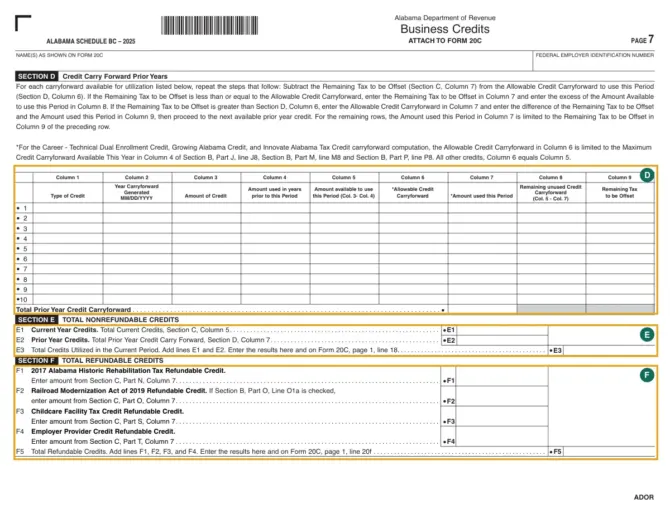
Section F collects the Column 7 excess of four refundable credits: F1 from Part N (2017 historic rehabilitation), F2 from Part O only when box O1a is checked, F3 from Part S (childcare facility) and F4 from Part T (employer provider). F5 adds them and goes to Form 20C, page 1, line 20f. The Employer Tax Credit in Part R is nonrefundable except for qualifying childcare providers, and those providers claim the refundable version in Part T.
When and where to file Schedule BC with Form 20C
Schedule BC has no signature line and no mailing address of its own. It is attached to Form 20C, which an authorized officer of the corporation signs. The 2025 Form 20C instructions put the filing date one month after the due date of the corresponding federal income tax return, including extensions, moved to the next business day when it falls on a weekend or state holiday. That extra month is for filing only: the full tax is due by the original due date.
Several steps come before the return: MAT submissions for the asterisked credits, the Form AR-C for a capital credit project organized as a C corporation, and, for workforce housing credit received through a pass-through entity, the allocation in MAT. The return also needs a signed copy of the federal return and copies of the Schedules K-1 for each entity the corporation held an interest in.
Paper returns go to the Alabama Department of Revenue, Income Tax Administration Division, Corporate Tax Section, Montgomery, AL. Returns with a payment and payment voucher go to P.O. Box 327435, Montgomery, AL 36132-7435; returns with no payment or a refund go to P.O. Box 327430, Montgomery, AL 36132-7430; federal audit change returns go to P.O. Box 327451, Montgomery, AL 36132-7451. Payments of $750 or more must be made electronically, and a check for less than $750 is mailed with an Alabama BIT-V voucher, placed loose in the envelope and not stapled to the return.
The official 2025 schedule and its separate instructions are on ALDOR’s Business Credits form page (Form Year 2025). Questions on preparing Form 20C go to the Corporate Income Tax Section at 334-242-1170, Option 6. For capital credit and enterprise zone credit questions, the instructions list ALDOR at P.O. Box 327001, Montgomery, AL 36132-7001, 334-242-1175; for the employer and childcare facility credits, incentives@revenue.alabama.gov.
Official PDF: Schedule BC — Official PDF (revenue.alabama.gov)