An Alabama estate or trust that passes income to beneficiaries files Form 41 and gives each beneficiary a Schedule K-1 showing their share. A beneficiary who also got a federal K-1 from the same trust now holds two documents, and the Alabama one is the one that goes on the Alabama return.
The 2025 version is a single page, headed “Fiduciary Income Tax Beneficiary Information”, for tax years beginning in 2025.

Why the trust has to issue one
The 2025 Form 41 instructions treat it as part of a complete return. A properly completed Alabama Schedule K-1, or Schedule G for a grantor trust, has to be attached for each person or entity that was a beneficiary at any time during the year. The return also needs a complete copy of the federal Form 1041 with all federal K-1s, statements and attachments. Leaving out the federal copy counts as improper preparation, and the return can be treated as delinquent.
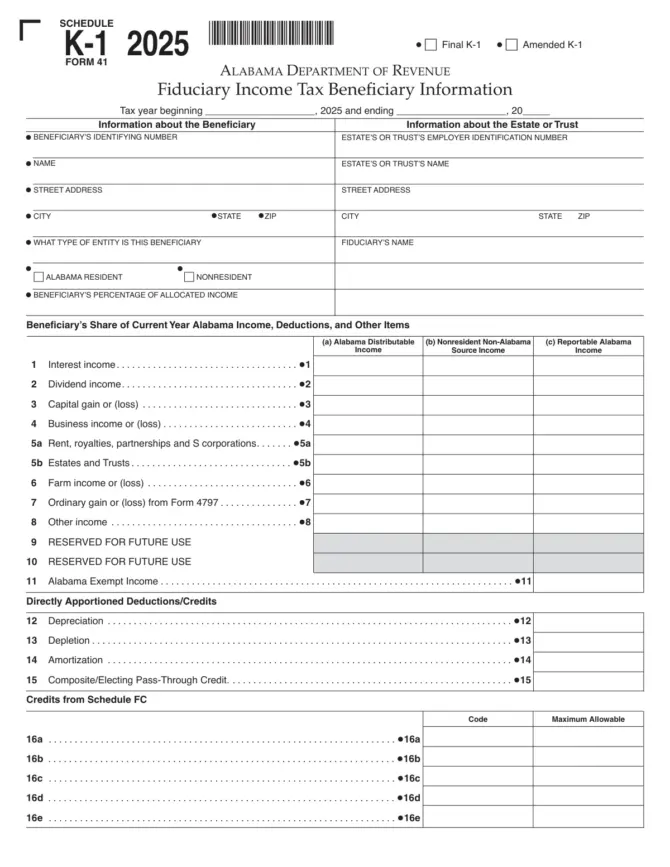
The top half: who and how much
The beneficiary block asks for the identifying number, name and address, what type of entity the beneficiary is, whether they are an Alabama resident or a nonresident, and the beneficiary’s percentage of allocated income. The estate or trust block takes its EIN, name, address and the fiduciary’s name. Two boxes at the top mark a final K-1 or an amended K-1.
The three columns
Every income line on the K-1 has three amounts, and the instructions for Schedule K, which summarizes all the K-1s, explain them:
| Column | What it holds |
|---|---|
| (a) Alabama Distributable Income | The beneficiary’s share of the distribution deduction the trust takes on page 1, line 2, from Alabama and non-Alabama sources |
| (b) Nonresident Non-Alabama Source Income | For a nonresident beneficiary, the part that did not come from Alabama |
| (c) Reportable Alabama Income | Column (a) minus column (b) |
Column (c) is what the beneficiary reports to Alabama, whether they live in the state or not. For a resident, column (b) is normally empty, so (a) and (c) match.
Character carries through
Interest stays interest, a capital gain stays a capital gain. Section 40-18-25(b) of the Code of Alabama requires the income to keep the character it had when the estate or trust received it, and the trust allocates its distribution deduction across the classes of income to make that happen, generally following Internal Revenue Code sections 652 and 662.
Line by line
Lines 1 to 8, income
Interest, dividends, capital gain or loss, business income, rents and royalties together with partnership and S corporation income (5a), income from other estates and trusts (5b), farm income, ordinary gain from federal Form 4797, and other income. Lines 9 and 10 are reserved and stay blank.
Line 11, Alabama exempt income
The beneficiary’s share of income that Alabama exempts, shown separately from the taxable lines.
Lines 12 to 14, directly apportioned deductions
Depreciation, depletion and amortization passed to the beneficiary.
Line 15, composite or electing pass-through credit
If the trust received composite payments or an electing pass-through entity credit from a partnership or S corporation and allocates part of it to the beneficiary, the beneficiary’s share shows here. On the trust’s own Form 41, that allocated amount is entered as a negative number on line 8g.
Lines 16a to 16e, credits from Schedule FC
Up to five credits the trust passes through from its Schedule FC, each on its own line.
Points the instructions insist on
- An Alabama K-1 for every beneficiary during the year; the federal K-1 does not replace it.
- Column (b) holds a nonresident beneficiary’s non-Alabama source income.
- A complete copy of the federal 1041 with the return; without it the return can be treated as delinquent.
- Grantor trusts complete Schedule G rather than K-1s.
Deadline and payment
Form 41 for a calendar year is due on or before April 15 of the following year. Fiscal-year returns are due on the 15th day of the fourth month after the year ends, moved to the next business day if that falls on a weekend or holiday. A federal extension is recognized for filing, but not for payment: tax is due by the original date.
Under the 2025 instructions, filing late brings a penalty of 10% of the tax due or $50, whichever is greater, even when no tax is owed. Paying late adds 1% a month, up to 25%. Estimated payments are not required for estates and trusts in Alabama; voluntary ones go in with Form FDT-V.
Official PDF: Schedule K-1 (41) — Official PDF (revenue.alabama.gov)
Sources
- Alabama Department of Revenue, Schedule K-1 (Form 41) 2025, Fiduciary Income Tax Beneficiary Information (revenue.alabama.gov)
- Alabama Department of Revenue, 2025 Form 41 Instructions (revenue.alabama.gov)