An Alabama tax representative needs authority for the particular taxes and periods they will handle. Form 2848A records that scope in Part I and requires the representative’s declaration on page 2. A taxpayer signature on the first part does not complete the representative’s part.

Who needs a separate power of attorney?
Alabama’s individual-audit guidance identifies 2848A as the form for appointing someone to act before the Department of Revenue. It must identify the taxpayer, tax or assessment, representative and effective date of representation.
The official PDF linked from that guidance is revised September 2018. It requires a separate form for each taxpayer. Where the matter concerns a joint-return year, each spouse files their own power of attorney even if both appoint the same person.
The authorization can concern different tax types. For a business privilege tax matter associated with BPT-V, describe the underlying tax and period in section 3; the payment voucher itself does not give another person representative authority.
Complete the taxpayer, representative and tax-matter sections
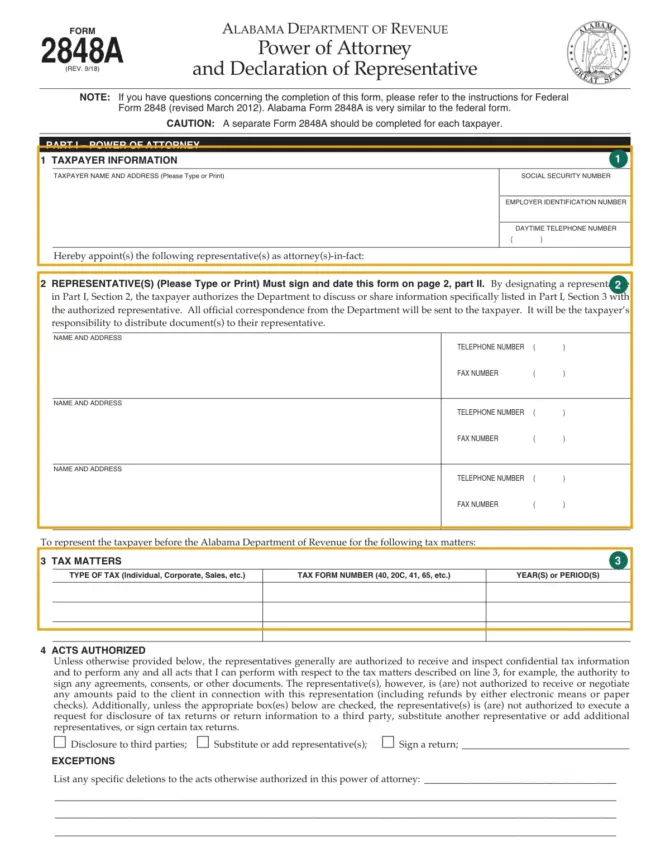
Sections 1 to 3 identify whose information can be discussed, with whom, and for which matters. The marked form follows these section numbers.
| Section | Required details | Record to consult |
|---|---|---|
| 1 | Taxpayer name, address and applicable identifying numbers | The taxpayer’s tax account and identification records |
| 2 | Each representative’s name, address and contact numbers | The appointed representative’s details |
| 3 | Tax type, form number and years or periods | The return, notice or assessment covered by the authority |
| 4 | Additional permitted acts and any express limitations | The authority the taxpayer intends to grant |
Section 2 says official correspondence will still be sent to the taxpayer, who must distribute it to their representative. Appointing someone therefore does not remove the need to monitor notices received directly from the department.
What section 4 authorizes
The printed authority covers inspection of confidential tax information and acts concerning the matters in section 3, including agreements and consents. It excludes receiving or negotiating money paid to the client, including refunds.
Separate boxes address disclosure to third parties, substituting or adding representatives, and signing certain returns. These are additional permissions, not boxes to select automatically. The exceptions area lets the taxpayer remove specific acts from the otherwise granted authority.
Keeping an earlier authorization in effect
Section 5 says filing the new form automatically revokes earlier powers of attorney for the same matters and periods. To retain an earlier authorization, select the retention box and attach a copy of each power that should remain effective.
That rule is limited to the overlapping tax matters and periods described by the form. Read the old and new scopes together before deciding whether an attachment is needed.
Signatures and the representative’s declaration
The taxpayer signs and dates section 6 and prints their name. A person signing in a representative capacity for the taxpayer supplies the applicable title and certifies their authority to execute the form. The form says an unsigned or undated power will be returned.
Part II requires each appointed representative to enter a designation from the form’s list, the relevant jurisdiction or enrollment information, a signature and a date. For designations d through f, the jurisdiction column contains the person’s title, position or relationship. The form also states that an unsigned or undated declaration causes the power to be returned.
Official copy and submission route
Use the two-page PDF linked below. The form itself does not supply one universal filing address. For an audit, obtain the submission route from the auditor or taxpayer service center handling the matter, as identified in the department’s audit guidance. Do not send it to a payment-voucher address merely because that tax is listed in section 3.
Official PDF: Form 2848A — Official PDF (revenue.alabama.gov)