Alabama’s 2026 Form 40ES separates the estimated-tax calculation from the payment slip. Keep the worksheet and payment record; detach the voucher when sending a check or money order. The amount paid on that slip is the installment being sent, which may differ from the annual estimate on worksheet line 11.

Who must consider estimated payments for 2026?
The form’s general rule has two conditions. You expect to owe at least $500 after withholding and credits, and withholding plus credits will be below the smaller of 90% of the 2026 tax or 100% of the tax on a full 12-month 2025 return.
For higher-income taxpayers, the prior-year percentage changes to 110%. The form applies this rule when 2025 Alabama adjusted gross income exceeds $150,000, or $75,000 when the 2026 filing status is married filing separately. Apply both parts of the general rule; the $500 figure alone is not the whole test.
Completing the worksheet and voucher
The marked image shows worksheet lines used to move from expected income to the estimated balance. The deduction and exemption entries refer to the Form 40 or 40NR instructions.
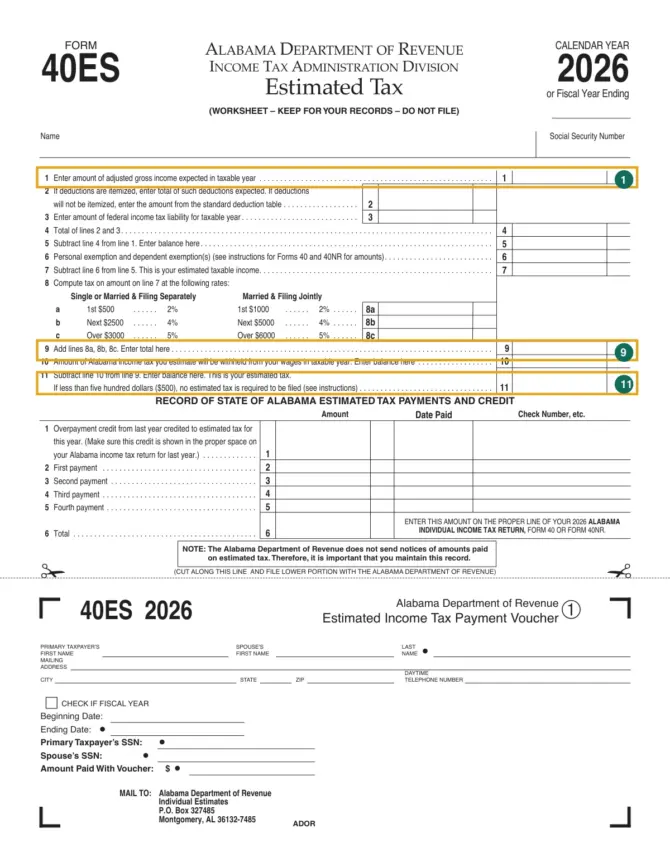
| Entry | What to calculate or enter | Supporting information |
|---|---|---|
| Worksheet 1–7 | Expected income less the specified deductions and exemptions | Income projection and the state return instructions |
| Worksheet 8–9 | Tax using the printed rate bands, then the total | The rates for the applicable filing status on this worksheet |
| Worksheet 10–11 | Expected Alabama withholding and the resulting estimated tax | Payroll records and projected withholding |
| Voucher identity fields | Taxpayer name, SSN, address and spouse’s details for a joint voucher | The taxpayers’ identifying information |
| Amount paid with voucher | The payment being enclosed | The installment calculation after applicable credits |
For single or separate filers, the worksheet applies 2% to the first $500, 4% to the next $2,500 and 5% above $3,000. Joint filers use $1,000, the next $5,000 and the amount above $6,000 for those bands.
The record section keeps prior-year overpayment credit, payments, dates and check details. Alabama says it does not send notices showing estimated amounts paid, so that record is needed when completing the annual return.
The four payment dates and later changes
The 2026 installment dates printed in the instructions are April 15, June 15 and September 15, 2026, and January 15, 2027. The form provides a next-business-day rule for a date falling on a Saturday, Sunday or state holiday.
If the requirement first arises later in the year, follow the schedule on page 2. For example, it lists January 15, 2027 for requirements met after September 1 and before January 1, with all of line 11 due under that row. Changes after an earlier voucher may require adjusting the remaining installments.
Farmers have a separate rule when at least two-thirds of taxable-year gross income comes from farming. The instructions allow payment of the whole estimate by January 15, 2027, or filing and paying the return by March 1, 2027 under the stated exception.
Where to send the payment
Mail the detached voucher with payment to Alabama Department of Revenue, Individual Estimates, P.O. Box 327485, Montgomery, AL 36132-7485. Make checks or money orders payable to the Alabama Department of Revenue. Use the 2026 voucher only for its printed year; fiscal-year filers supply the beginning and ending dates.
These are individual income tax estimates. A business privilege tax payment uses a different document, BPT-V, and should not be put on a 40ES slip.
Official PDF: Form 40ES — Official PDF (revenue.alabama.gov)