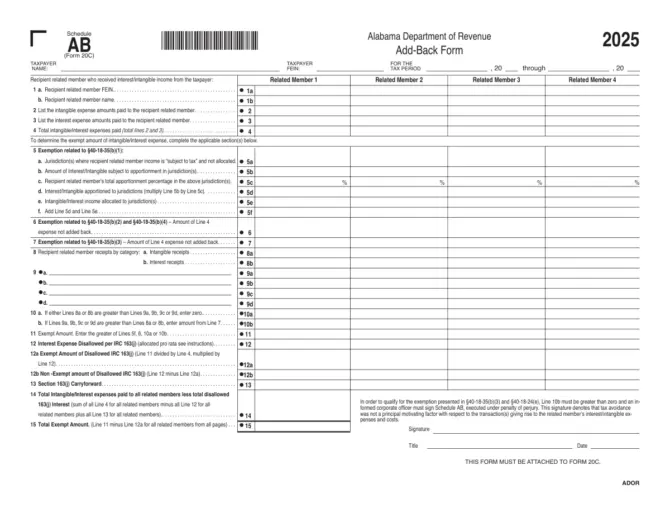
Under section 40-18-35(b) of the Code of Alabama, interest and intangible expenses paid to a related member are added back to apportionable income unless the taxpayer establishes that an exception applies. Schedule AB, attached to Form 20C, is where the corporation shows it.
The 2025 schedule has a column for each related company that received the payments, four to a page, with extra pages for more. A partnership paying a related member uses Schedule PAB instead.

Who counts as a related member
The instructions point to section 40-18-1(13) and (15): a corporation, association, disregarded entity or subchapter K entity. A disregarded entity or partnership is a related member in its own right, separate from its owner. On lines 8 and 9 that means only the receiving entity’s own receipts count, not its owner’s.
Lines 1 to 4: what was paid
The recipient’s FEIN and name come first. Then the intangible expenses paid to it (line 2), the interest paid to it (line 3) and their total (line 4). For a partnership, the instructions say to multiply the total payment by the partner’s ownership percentage.
Three ways out of the add-back
Line 5: the income was taxed elsewhere
Section 40-18-35(b)(1). The recipient’s matching income was subject to a net income tax, after allocation and apportionment, in Alabama, another state, or a treaty country where it is resident. List the jurisdictions (5a), the expense subject to apportionment (5b) and the recipient’s total apportionment percentage there (5c). Multiply to get 5d, add amounts allocated rather than apportioned (5e), and total them on 5f. Leave out combined or consolidated return states where the intercompany expense is eliminated.
Line 6: unreasonable, or agreed in writing
Sections 40-18-35(b)(2) and (b)(4). Either detailed financial data and workpapers showing why the add-back is unreasonable, or a signed Alternative Adjustment Agreement with the Commissioner. Under (b)(4), a detailed calculation of interest passed through the related member to an unrelated third party. The instructions warn that a business purpose, arm’s length pricing and economic substance are not enough on their own for (b)(2).
Lines 7 to 10: not a financing or IP company
Section 40-18-35(b)(3) needs two things. First, the recipient is not primarily engaged in holding intangibles or financing related entities. Lines 8 and 9 test that by comparing its intangible and interest receipts with its other receipts, such as sales of tangible property or rent. If interest or intangible receipts are the larger, line 10a is zero and the exception fails. If another category is larger, line 10b takes the line 7 amount.
Second, avoiding tax was not a principal purpose of the transactions. An informed corporate officer signs the schedule under penalty of perjury to say so. Without that signature, only part of the (b)(3) exception is met.
Line 11 onward: the exempt amount and 163(j)
Line 11 takes the greatest of 5f, 6, 10a or 10b, not more than line 4. Lines 12 to 13 deal with interest disallowed federally under IRC section 163(j). The disallowed amount is spread pro rata across related members. The instructions’ example: $10,000,000 of total interest, $5,000,000 to related party C and $2,000,000 disallowed puts $1,000,000 on line 12 for C. Line 12a is the part that would have been exempt anyway, 12b the rest. A 12b amount comes back on line 13 in the year the 163(j) carryforward is used.
For a status 5 consolidated Alabama return, the 163(j) limit is worked out for the group first and then shared out to each entity.
Totals and Form 20C
Line 14 is the total of every line 4, less every line 12, plus every line 13. Line 15 is the total exempt amount, line 11 less line 12a across all members. The instructions send line 14 to line 6a of Schedule A on Form 20C, and the exempt amount to line 6b. Attach it to Form 20C.
Official PDF: Schedule AB — Official PDF (revenue.alabama.gov)
Sources
- Alabama Department of Revenue, Schedule AB (Form 20C) Add-Back Form, 2025 (revenue.alabama.gov)
- Alabama Department of Revenue, Instructions for Schedule AB (Form 20C), 2025 (revenue.alabama.gov)