A Delaware contractor pays gross receipts tax on what it receives for construction work, but the money it passes on to licensed subcontractors comes off that total. Form 1280, the Statement of Payments Made by General Contractors to Subcontractors, is the list that backs up the deduction: one block per subcontractor with its employer ID, Delaware business license number, business code and the amount paid in the month. The Division of Revenue still posts the November 2007 revision of the form on its Contractors page.
Who files Form 1280 and which payments count
Title 30, chapter 25 of the Delaware Code treats anyone furnishing labor, or labor and materials, for construction, alteration, repair or demolition of buildings, roads, bridges, sewers, water and gas mains and other improvements to real property as a contractor. That covers general contractors and subcontractors, residents and nonresidents, and construction transportation contractors. Under section 2501, a contractor’s gross receipts do not include sums paid to a subcontractor if two conditions hold: the subcontractor is licensed and subject to the same chapter for those sums, and a written agreement between the two states the exact sums payable.
The Division’s 2018 tax tips for contractors limit the deduction to payments made to people who are themselves taxed as contractors. Form 1280 adds a test of its own: the subcontractor’s business code must be 331, 332, 333, 335, 336 or 337, and a subcontractor listed under any other code is disallowed. In the Division’s table of license categories, 331 is contractors, 332 developers, 333 construction transportation and 335 nonresident contractors.
The license has to be current when the work is done. The line-by-line instructions on page 3 say payments to subcontractors without a current business license will be denied, and a license obtained after the work does not make the payment deductible for earlier periods. A Delaware contractor’s license costs $75 a year under section 2502(a) and runs until January 1.
How to fill out Form 1280, line by line
Page 1 has room for five subcontractors and page 2 for ten more (blocks 6 to 15), with its own month/year field at the top. Page 3 holds the official instructions and the list of expenses that do not count. The numbers in the image below match the form’s line numbers; marker 8 was added for the signature row, which has no number on the form.
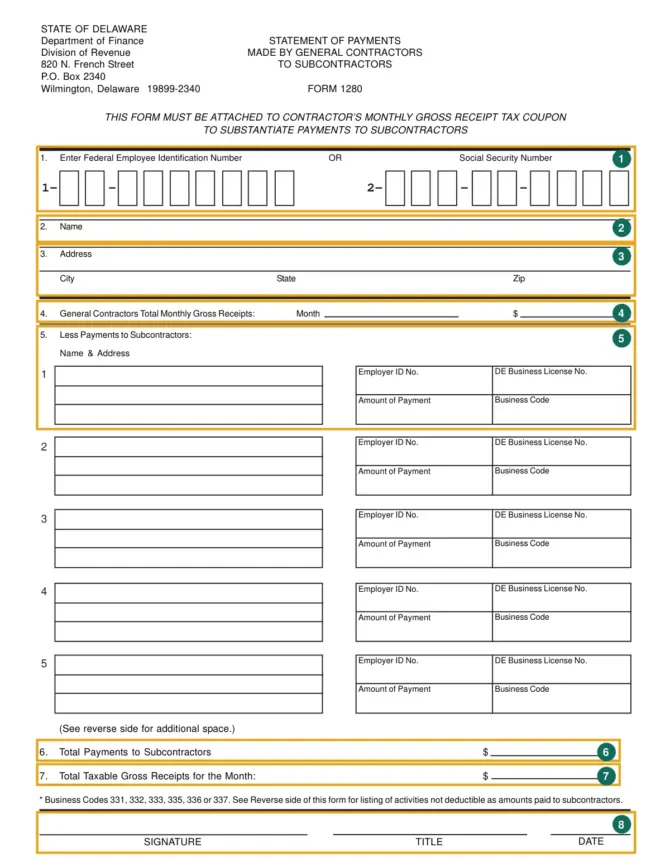
| Line | What the form asks for | What to enter |
|---|---|---|
| 1 | Federal Employee Identification Number or Social Security Number | The account number of the business you are filing for. The instructions say it is printed in your annual gross receipts coupon book. The form asks for one or the other. |
| 2 | Name | The contractor’s business name exactly as it appears on the Delaware business license. |
| 3 | Address, city, state, ZIP | The contractor’s mailing address. |
| 4 | General Contractors Total Monthly Gross Receipts, month and amount | The month and year of the gross receipts return and the total gross receipts reported for it. The same total goes on line 1 of the gross receipts coupon. |
| 5 | Less Payments to Subcontractors (blocks 1 to 5, then 6 to 15 on page 2) | For each subcontractor: business name and mailing address, employer ID number, Delaware business license number, total paid to it, and its business code. |
| 6 | Total Payments to Subcontractors | The sum of every amount in line 5, both pages. It also goes on line 2 of the coupon. |
| 7 | Total Taxable Gross Receipts for the Month | Line 4 minus line 6. It also goes on line 3 of the coupon. |
| 8 | Signature, title, date | Signed and dated, with the signer’s title. |
Line 5 asks for the total of all payments made to each subcontractor during the period, so a subcontractor paid three times in the month appears once with the combined amount. Form 1280 has no instruction for more than 15 subcontractors. Form 1280-DEV, which uses the same line 5, says at its Part A total to attach a separate schedule if more space is needed.
Line 7 carries the word “taxable”, but it is the figure before the monthly deduction. Section 2502(c) sets the contractor rate at 0.6472% of gross receipts and allows $100,000 off each month, or $300,000 a quarter for quarterly filers, and the 2018 tax tips subtract that deduction after the subcontractor payments. Say a contractor took in $240,000 in March 2026 and paid two licensed subcontractors $40,000 and $22,500. Line 6 is $62,500 and line 7 is $177,500. After the $100,000 deduction, $77,500 is taxed at 0.006472, which is $501.58, and the tax tips say Delaware rounds tax due to the nearest dollar, so $502.
A business with branches or separate companies under common ownership or common direction and control gets one monthly or quarterly deduction for the whole enterprise (section 2502(c)).
Payments that cannot be deducted
Page 3 of Form 1280 lists activities and expenses that are not deductible as amounts paid to subcontractors:
- accounting, advertising, attorneys, architects, engineers, surveyors and inspections
- cleaning, sanitation, trash removal, exterminators and security
- construction management, environmental studies, horticulture and interior designers or decorators
- delivery or transportation charges and hauling
- employment agencies or temporary employees
- equipment rental and trailer rentals
- material supplied without labor
- operating expenses and utility expenses
- realtors
- taxes or other fees paid to any state, county, city or municipality
On material, the tax tips allow the deduction for subcontractors who provided construction labor, or materials together with the labor to install them. A supplier who only delivers lumber falls under “material supplied without labor”. The tax tips draw the same line for movers: a drayperson hired to bring material onto a site stays a drayperson, but one moving dirt or equipment from one part of the site to another needs a contractor’s license.
When Form 1280 is due
Form 1280 goes with the gross receipts return for the same period, so it shares that return’s due date. Monthly returns are due on the 20th of the following month and quarterly returns on the last day of the month after the quarter ends (section 2502(c) and the Division’s gross receipts FAQ). New businesses start as quarterly filers. The Division’s 2026 due date table gives these dates for the coming periods:
- Monthly filers: October 2026 is due November 20, 2026; November is due December 21, 2026; December is due January 20, 2027.
- Quarterly filers: the July to September 2026 quarter is due November 2, 2026; October to December is due February 1, 2027.
A gross receipts return filed late carries a penalty of 5% per month plus interest of 0.5% per month from the original due date. Tax shown on a timely return but not paid adds 1% per month, up to 25%. The FAQ cites 30 Del. C. sections 533 and 534 for these amounts. A subcontractor payment that the Division denies raises the taxable figure for that period.
Form 1280’s own wording (“monthly gross receipt tax coupon”, “Total Monthly Gross Receipts”, “for the Month”) was written for monthly filers. Page 3 of Form 1280-DEV refers to the “monthly or quarterly gross receipts coupon”, but neither form explains how a quarterly filer fills the month field on line 4. Ask the Business Tax Department before filing a quarterly return with Form 1280.
Where Form 1280 goes and the official PDF
The form says it must be attached to the contractor’s monthly gross receipts tax coupon, and the 2018 tax tips say to enter the subcontractor total in the block on the coupon and attach Form 1280. Since January 1, 2021, gross receipts returns have to be filed electronically: Technical Information Memorandum 2020-2 lists them among the forms accepted only by electronic means, and the 2026 due date table sends filers to the Delaware Taxpayer Portal at tax.delaware.gov. The gross receipts FAQ says registering on the portal takes the FEIN or Social Security number and the business license number, and points to TIM 2020-2 for the cases where paper filing may still be allowed.
None of the Division’s pages checked for this guide say how Form 1280 reaches the Division alongside a return filed on the portal, whether by upload or separately. The Contractors page gives the Business Tax Department at (302) 577-8780 and DOR_BusinessTax@delaware.gov for questions. The form’s header prints the Division of Revenue at 820 N. French Street, P.O. Box 2340, Wilmington, Delaware 19899-2340.
The fillable Form 1280 PDF is revision 11/2007, the version linked from both the Contractors page and the Business Tax Forms 2025-2026 page. The “Tax Tips” PDF linked from the Contractors page is an older edition that still shows a rate of .6537%; the current rate in section 2502(c)(1) and in the 2018 edition is 0.6472%.
A mistake on a return already filed is corrected with the Amended GR Return when it covers one tax period in the current calendar year. Changes covering more than one period, or periods in an earlier year, go on a Claim for Revision, according to the gross receipts FAQ.
Related Delaware contractor forms
- Form 1280-DEV, Deductions for Amounts Paid to Subcontractors by Contractors and Deductions for Development of Realty: used only by business codes 332 and 336. It has the same lines 1 to 7, but line 6 also takes in Part B (realty development costs) and Part C (miscellaneous costs of lots sold), or Part D, an election to deduct 30% of gross receipts from property sales in place of Parts B and C.
- Form 5060, Statement of Contracts Awarded by General Contractors and Subcontractors: required from contractors who use nonresident subcontractors, within 10 days after entering into the contract. Section 2503 sets a civil penalty of up to $10,000 for each failure.
- Nonresident contractor bond forms: the 2018 tax tips say nonresident contractors post a surety or cash bond of 6% of contracts over $20,000.
Official sources
- Delaware Division of Revenue, Form 1280, Statement of Payments Made by General Contractors to Subcontractors (Revised 11/2007)
- Delaware Division of Revenue, Contractors
- Delaware Division of Revenue, Business Tax Forms 2025-2026
- Delaware Code, Title 30, Chapter 25, Contractors’ License Requirements and Taxes
- Delaware Division of Revenue, Tax Tips for Contractors and Real Estate Developers (2018)
- Delaware Division of Revenue, Gross Receipts Tax FAQs
- Delaware Division of Revenue, Gross Receipts Tax Due Dates for Calendar Year 2026
- Delaware Division of Revenue, Technical Information Memorandum 2020-2, Electronic Filing Requirement
- Delaware Division of Revenue, Form 1280-DEV (Revised 11/2007)
- Delaware Division of Revenue, Form 5060 (Revised 11/2007)
- Delaware Division of Revenue, Detailed List of Division of Revenue Licenses and Tax Rates
- Delaware Division of Revenue, Tax Tips for Contractors, older edition linked from the Contractors page