Form FID-EST is the voucher a trust subject to Delaware fiduciary income tax mails with each quarterly estimated fiduciary income tax payment. The 2026 version, titled Declaration of Estimated Fiduciary Income Tax and printed with revision 20250808, covers tax year 2026; its instructions are revised 05/19/25. One page holds the trust and fiduciary details, two amount lines and a signature block, and the quarter you pick from a dropdown fills in the due date.
Which trusts must file FID-EST for 2026
The test is the value of the trust’s assets, not its income. If the fair market value of the assets of a resident or nonresident trust equals or exceeds $1 million for any taxable year, the trust has to file estimated tax declarations on FID-EST for the following taxable year. A trust whose assets reached $1 million during 2025 therefore files FID-EST for 2026. The same sentence appears in the 2025 FID-TAX instructions under “Requirements to File Estimated Tax”.
The form’s name field reads “Name of Trust or Estate”, but the filing requirement in both instruction booklets speaks only of trusts and says nothing about estates. Resident or nonresident status follows the FID-TAX definitions: a trust is resident if it was created by the will of a decedent domiciled in Delaware, was created by or consists of property of a person domiciled in Delaware, or meets one of the Delaware trustee conditions during more than half the taxable year. A trust with three individual trustees, only one of them living in Delaware, is nonresident under the instructions’ own example.
How to fill out the 2026 FID-EST
The fillable PDF has no printed line numbers except 1 and 2 on the amount lines, so the image uses letters for the other areas. Each quarter gets its own copy of the page.
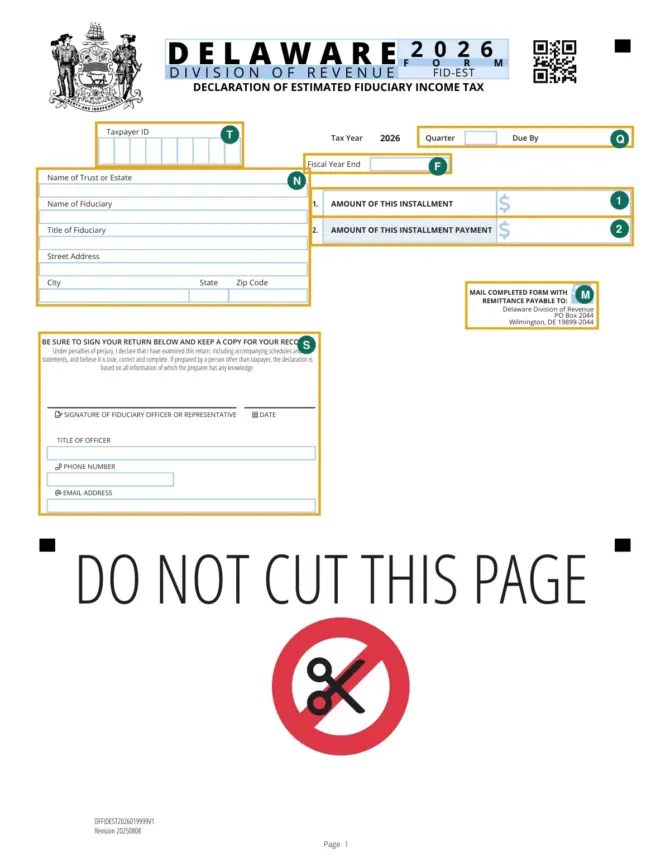
| Mark | Field on the form | What goes in it |
|---|---|---|
| T | Taxpayer ID | The trust’s nine-digit ID. The fillable version accepts digits only and rejects an entry that is not nine digits long. |
| Q | Tax year, quarter, due by | Tax year 2026 is preprinted. Choose quarter 1 to 4 and the Due By box fills in Apr 30, 2026, Jun 15, 2026, Sep 15, 2026 or Jan 15, 2027. |
| F | Fiscal year end | Only for a trust that files on a fiscal year. The fiscal-year due dates are in the instructions (see the due dates section). |
| N | Name of trust or estate, name and title of fiduciary, address | The trust’s name, the trustee or other fiduciary and that person’s title, then street, city, state and ZIP code. |
| 1 | Amount of this installment | The installment due for the quarter (see below on how the instructions describe the two lines). |
| 2 | Amount of this installment payment | The amount sent with this voucher. Both lines print “.00” after the dollar field. |
| S | Signature block | Signature of the fiduciary officer or representative under a penalties-of-perjury declaration, date, title of officer, phone and email. |
| M | Mailing block | Payee and address: Delaware Division of Revenue, PO Box 2044, Wilmington, DE 19899-2044. |
The 2026 instructions do not refer to line 1 or line 2 by number. The only related wording is in paragraph B under “Changes in Income or Deduction(s)”: once a declaration is filed and the estimate rises or falls substantially, you enter the adjusted amount “in the space provided” on each remaining FID-EST. Which of the two lines that means is not stated. For questions, the FID-TAX instructions print the Wilmington office at (302) 577-8200.
On the check or money order, write the taxpayer ID and the tax period the payment is for. The instructions also say not to staple the payment to the form. The page itself carries “DO NOT CUT THIS PAGE” in large type and tells you to sign it and keep a copy.
Working out the 2026 estimate
The FID-EST instructions include a two-line computation: line 1 is estimated taxable income, line 2 is the estimated tax taken from this schedule. The brackets match the rate schedule printed on page 2 of the 2025 FID-TAX return.
| Estimated taxable income | Tax |
|---|---|
| $0 to $2,000 | $0 |
| Over $2,000 to $5,000 | 2.2% of the amount over $2,000 |
| Over $5,000 to $10,000 | $66.00 plus 3.90% of the amount over $5,000 |
| Over $10,000 to $20,000 | $261.00 plus 4.80% of the amount over $10,000 |
| Over $20,000 to $25,000 | $741.00 plus 5.20% of the amount over $20,000 |
| Over $25,000 to $60,000 | $1,001 plus 5.55% of the amount over $25,000 |
| $60,000 and over | $2,943.50 plus 6.60% of the amount over $60,000 |
Take a trust that expects $35,000 of Delaware taxable income for 2026. The tax is $1,001 plus 5.55% of $10,000, which is $555, for $1,556 in all. The instructions allow the whole amount to be paid with the first declaration or in equal installments, so four installments of $389 each.
If the trust’s situation changes after a declaration is on file and the estimate moves substantially, the remaining vouchers carry the adjusted amount.
FID-EST due dates for 2026
For a calendar-year trust the fillable form’s dropdown gives these dates: quarter 1, April 30, 2026; quarter 2, June 15, 2026; quarter 3, September 15, 2026; quarter 4, January 15, 2027. As of November 1, 2026 only the fourth installment is still ahead.
The instructions are not consistent about the first date. Under “When and Where to File a Declaration” they say the declaration and payment are due on or before April 30. Under “Payment of Estimated Tax” they list equal installments on or before May 1, June 15, September 15 and January 15 of the following year. The form and the first paragraph say April 30; the payment paragraph says May 1. The later dates agree in both places. Neither document says which date governs, so a first-quarter payment made on May 1, 2026 is a point to confirm with the Division before relying on it.
A fiscal-year trust uses the 30th day of the fourth month of its fiscal year, the 15th day of the sixth and ninth months, and the 15th day of the first month of the next fiscal year.
A trust that was not required to file on April 30 can become required later in the year when its expected income or deductions change. The instructions set the late filing date by when the change happens:
- After April 1 and before June 2: file by June 15.
- After June 1 and before September 2: file by September 15.
- After September 1: file by January 15 of the following year.
The estimate can then be paid in full with that declaration or in equal installments on the remaining dates.
Underpayment penalty and the two exceptions
An underpaid installment draws a penalty of 1½% per month, or fraction of a month, on the underpayment for as long as it lasts. The FID-TAX instructions add interest of ½% per month, or fraction of a month, on any underpayment or late payment of tax from the date the payment was due.
The FID-EST instructions name two cases where the penalty does not apply, both on condition that each installment is paid on time:
- the installments are at least 90% of the amount due on the trust’s income tax return for the year, or
- they are based on tax computed with last year’s taxable income and this year’s tax rate.
The second route lets a trust size its 2026 installments from its 2025 taxable income run through the 2026 schedule above.
How FID-EST payments reach the FID-TAX return
On the 2025 FID-TAX, the latest return on the forms page, line 13, “Estimated Tax Paid and Payments with Extensions”, collects the total estimated tax payments, including amounts paid with Form FID-EXT. The same return lets an overpayment be carried forward on line 19c, “Amount to be credited to 2026 tentative tax”.
Other fiduciary forms go to PO Box 2044 but do different jobs. FID-EXT asks for more time to file FID-TAX and carries the estimated balance for the year. FID-VCH is the payment voucher for a balance due on a FID-TAX that was filed electronically. The corporate voucher, Form CIT-VCH, is mailed to the same box, and the Division’s payment page lists corporate and fiduciary estimated tax together under businesses.
Where to get FID-EST and where to send it
The 2026 Form FID-EST and its instructions are on the Division of Revenue’s personal income tax forms page, under Fiduciary Tax Forms. The same list still carries the 2025 FID-EST (revision 20240627) for 2025 installments. The instructions also give the Public Service Bureau number, (302) 577-8200, for replacement forms.
Make the check or money order payable to Delaware Division of Revenue and mail it with the signed page to:
Delaware Division of Revenue
PO Box 2044
Wilmington, DE 19899-2044
The Division’s payment page also offers “Pay Corporate or Fiduciary Estimated Tax” through the Delaware Taxpayer Portal at tax.delaware.gov. That page does not say whether a portal payment needs the paper voucher as well.
Questions about FID-EST
Does an estate have to make Delaware estimated payments?
The estimated tax requirement in the FID-EST and FID-TAX instructions is the $1 million asset test for resident and nonresident trusts; estates are not named in it. The form’s name line allows either a trust or an estate.
Can the full year be paid with the first voucher?
The instructions allow the estimated tax to be paid in full with the declaration or in equal installments on the due dates.
Which FID-EST do I use for a 2025 installment?
The 2025 FID-EST, revision 20240627, is still on the forms page. Its fourth installment was due January 15, 2026.
Official sources
- Delaware Division of Revenue, Form FID-EST, Declaration of Estimated Fiduciary Income Tax, 2026, revision 20250808
- Delaware Division of Revenue, Fiduciary Estimated Income Tax, Form FID-EST 2026 instructions (revised 05/19/25)
- Delaware Division of Revenue, Form FID-EST, 2025, revision 20240627
- Delaware Division of Revenue, Personal Income Tax Forms Current Year (2025-2026)
- Delaware Division of Revenue, Fiduciary Income Tax Return, Form FID-TAX 2025 instructions (revised 11/14/25)
- Delaware Division of Revenue, Form FID-TAX, 2025, revision 20250903
- Delaware Division of Revenue, Form FID-EXT, 2025, revision 20250808
- Delaware Division of Revenue, Form FID-VCH instructions, 2025
- Delaware Division of Revenue, Form CIT-VCH, 2025, revision 20250528
- Delaware Division of Revenue, Payment