Delaware Form BUS-NAC is how a business or individual turns an approved neighborhood assistance investment into a state tax credit. The credit is half of the approved investment, capped at $50,000, and it reaches the tax return through a separate credit schedule. BUS-NAC replaced the older Form 2001AC; the current form is Revision 20250924, and its instructions were revised on 02/27/26.
Who can claim the Neighborhood Assistance Tax Credit
The BUS-NAC instructions describe the credit as available for investing in organizations or programs that benefit impoverished areas or low-to-moderate income families in Delaware. Qualifying investments include housing or economic programs, such as neighborhood associations and community development corporations, and services like job training, crime prevention or education for people other than the investor’s own employees.
Individuals, S corporations, C corporations, LLCs, partnerships (including limited liability partnerships) and trusts or estates can claim it. The order of steps matters:
- The Director of the Delaware State Housing Authority approves the investment proposal and issues an approval letter.
- The applicant sends that letter with a completed BUS-NAC to the Division of Revenue for tax credit approval.
- After approval, the credit is carried to Form BUS-CRS for business returns or Form PIT-CRS for personal income tax returns.
How to fill out BUS-NAC, Parts A and B
The form is one page. The letters and numbers in the image were added for this guide; the line numbers match the form.
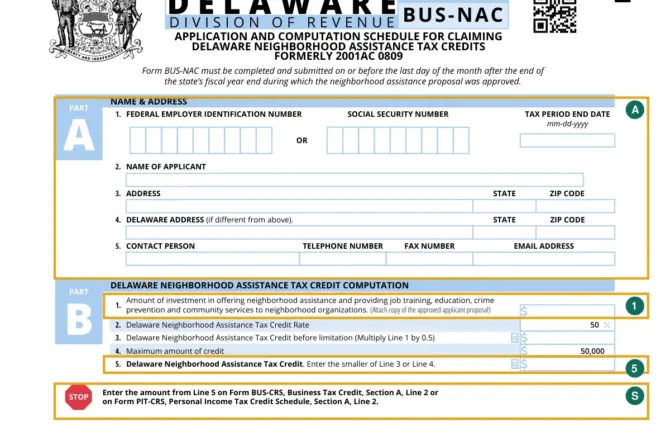
| Part and line | What to enter |
|---|---|
| A, line 1 | The applicant’s federal employer identification number or, for an individual, Social Security number, and the end date of the tax period in which the credit is claimed (mm-dd-yyyy). |
| A, lines 2 to 4 | The name of the corporation or individual, its address, and a Delaware address if different. |
| A, line 5 | The person who completed the form, with telephone, fax and email. |
| B, line 1 | The investment amount approved by the Director of the Delaware State Housing Authority. Attach a copy of the approved proposal. |
| B, line 2 | The credit rate, printed as 50%. |
| B, line 3 | Line 1 multiplied by 0.5: the credit before limitation. |
| B, line 4 | The maximum credit, printed as $50,000. |
| B, line 5 | The smaller of line 3 or line 4. This is the credit. |
The instructions word line 3 as “Multiply Line 1 by Line 2”, where line 2 is the 50% rate; the form prints the same step as “Multiply Line 1 by 0.5”. A $60,000 approved investment gives $30,000 on line 3 and $30,000 on line 5. A $150,000 investment gives $75,000 on line 3, so line 5 is capped at $50,000.
The $1,000,000 annual cap: what the two documents say
Both documents limit the total credits to $1,000,000 a year, but they describe the limit differently:
- The instructions say credits approved by the housing director for all applicants for Neighborhood Tax Credits may not exceed $1,000,000 in any fiscal year. Credits are awarded in chronological order by the date and time each contribution is approved by the Delaware State Housing Authority, and the part of an award that pushes the total over $1,000,000 carries over to the next fiscal year with priority.
- The note printed on the form refers to the Delaware Land & Historic Resource Conservation Tax Credits, a $1,000,000 limit per calendar year, and a share of $1,000,000 calculated by a fraction for each applicant when total applications exceed it.
The two passages do not match. Applicants affected by the cap can confirm the current allocation method with the Division of Revenue at DOR_CorpTax@Delaware.gov, the contact given in the instructions.
Deadline, mailing address and attaching the credit
The form says BUS-NAC must be completed and submitted on or before the last day of the month after the end of the state’s fiscal year in which the neighborhood assistance proposal was approved. Mail the official BUS-NAC, with the approval letter and a copy of the approved proposal, to:
Delaware Division of Revenue
820 North French St.
P.O. Box 8763
Wilmington, DE 19899-8763
Line 5 is entered on Form BUS-CRS, Business Tax Credit, Section A, line 2, or on Form PIT-CRS, Personal Income Tax Credit Schedule, Section A, line 2. To receive the credit, the instructions require the credit schedule and the neighborhood assistance form (still called Form 2001AC there) to be attached to each applicable income tax return, along with a copy of the Delaware State Housing Authority approval letter. The form is listed under Business Tax Credits on the Division of Revenue’s business tax forms page.