Form BUS-RDC is where a business computes the Delaware research and development tax credit for one taxable year and applies to the Division of Revenue for it. The form offers two methods, one built on Delaware research spending above a base amount and one built on the federal research credit, and you pick one of them every year. BUS-RDC replaced Form 2071AC (the form prints “Formerly 2071AC 0007”); the current edition is Revision 20250805, with instructions revised 10/03/25. According to those instructions, the credit has been refundable since January 1, 2017, when the $5,000,000 cap on total credits issued by the state was removed.
Who uses BUS-RDC and what goes with it
Section 2070 of Title 30 of the Delaware Code lets a taxpayer elect the credit for a taxable year. The election is annual and independent of the method used for the federal credit, and terms in the subchapter carry their Internal Revenue Code meaning (§ 2071). In setting standards for which research expenses count as Delaware expenses, the Director may consider where the services were performed (§ 2072).
The form’s transfer instructions cover four kinds of claimant: C corporations, S corporations, partnerships, and individuals or sole proprietors. Every application needs a copy of federal Form 6765 attached. If the corporation files a consolidated corporate income tax return, the form asks for a pro forma Form 6765 prepared for the corporate applicant alone.
Keep the records behind the numbers. The Division’s FAQ on the Delaware tax credit schedule lists “records supporting qualified expenses and the calculation” as what an R&D claimant must keep.
How to fill out BUS-RDC: Part A and Method A
The numbers in the image were added for this guide: 1 frames Part A, 2 Method A, 3 Method B, 4 the Form 6765 reference on Method B line 1, 5 the transfer instructions and 6 the signature line.
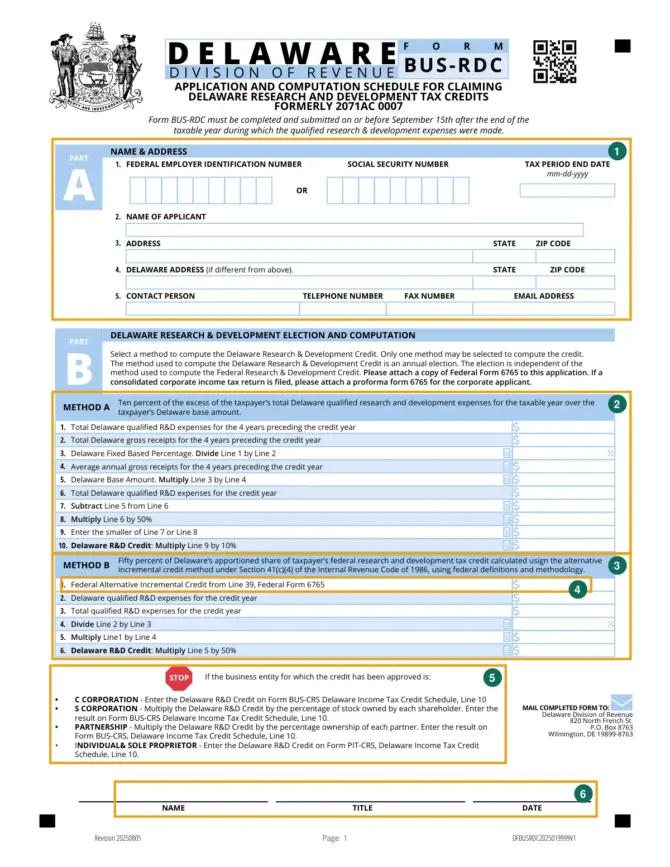
| Part and line | What to enter |
|---|---|
| A, line 1 | Federal employer identification number or Social Security number, and the tax period end date (mm-dd-yyyy) |
| A, lines 2 to 4 | Applicant’s name, address, and a Delaware address if it is different |
| A, line 5 | Contact person with telephone, fax and email |
| Method A, line 1 | Total Delaware qualified research expenses for the four years immediately before the credit year |
| Method A, line 2 | Total Delaware gross receipts for the same four years |
| Method A, line 3 | Line 1 divided by line 2: the Delaware fixed base percentage |
| Method A, line 4 | Average annual gross receipts for those four years |
| Method A, line 5 | Line 3 multiplied by line 4: the Delaware base amount |
| Method A, line 6 | Delaware qualified research expenses for the credit year |
| Method A, line 7 | Line 6 minus line 5; enter zero if the result is zero or less |
| Method A, line 8 | Line 6 multiplied by 50% |
| Method A, line 9 | The smaller of line 7 or line 8 |
| Method A, line 10 | Line 9 multiplied by 10%: the credit |
A worked Method A figure, using our own numbers for a company with $240,000,000 of gross receipts and $12,000,000 of Delaware research expenses over the four prior years: line 3 is 5%, line 4 is $60,000,000 and the base amount on line 5 is $3,000,000. With $4,000,000 of Delaware research expenses in the credit year, line 7 is $1,000,000 and line 8 is $2,000,000, so line 9 is $1,000,000 and line 10 gives a $100,000 credit. Line 8 limits the credit when the base amount is small: the excess counted on line 9 can never be more than half of the credit-year expenses.
Method B and the Form 6765 reference
Method B takes 50% of Delaware’s apportioned share of the federal credit. Line 1 is the federal credit, line 2 the Delaware qualified research expenses for the credit year, line 3 all qualified research expenses for the year, line 4 is line 2 divided by line 3, line 5 is line 1 multiplied by line 4, and line 6, the credit, is line 5 multiplied by 50%.
What line 1 should hold is where the documents part ways:
- The form and its instructions describe Method B as using the alternative incremental credit method under Section 41(c)(4) of the Internal Revenue Code, and line 1 asks for the “Federal Alternative Incremental Credit from Line 39, Federal Form 6765”.
- 30 Del. C. § 2070(a)(1) words the second method as 50% of Delaware’s apportioned share of the federal credit calculated using the alternative simplified credit method under § 41(c)(5).
- On the IRS’s current Form 6765 (Rev. December 2024), Section B is the alternative simplified credit, and line 39 is a yes-or-no question about acquiring or disposing of a major portion of a trade or business.
Anyone electing Method B should confirm with the Division of Revenue which federal amount it expects on line 1, at DOR_CorpTax@Delaware.gov, the contact in the BUS-RDC instructions.
Other points where the form and other official texts differ
- Small businesses. § 2070(a)(2) substitutes 20% for 10% and 100% for 50% for a small business, defined as a taxpayer with average annual gross receipts (as determined under IRC § 41(c)(1)(B)) not over $20,000,000, a threshold the statute adjusts annually under § 515. BUS-RDC prints only the 10% and 50% rates and has no line for the small-business calculation.
- Where the credit goes. BUS-RDC sends C corporation credits, and the shares of S corporation shareholders and partners, to Form BUS-CRS line 10, and individual and sole proprietor credits to Form PIT-CRS line 10. On the 2025 BUS-CRS (Revision 20250528), line 10 is the carryover from previous years for research credits from tax years before 2018, and line 32 is “Research & Development Credits For Tax Years 2018 and Later”. The BUS-RDC instructions date the change to January 1, 2017.
- Approval. The BUS-RDC instructions say the Division of Revenue must first approve any taxpayer electing the credit, and the form itself refers to “the business entity for which the credit has been approved”. The Division’s tax credit schedule FAQ lists the R&D credit among credits that do not require program approval, as long as the supporting records are kept.
The same address, DOR_CorpTax@Delaware.gov, is the place to ask which reading applies to a given claim.
Deadline, mailing address and the tax return
The form must be completed and submitted on or before September 15 after the end of the taxable year in which the qualified research expenses were made. Sign it with name, title and date, then mail the official BUS-RDC to:
Delaware Division of Revenue
820 North French St.
P.O. Box 8763
Wilmington, DE 19899-8763
After approval, the instructions say the approved credit is carried to the appropriate line of Form BUS-CRS, and BUS-CRS and BUS-RDC are both attached to each annual income tax return approved for the credit. The credit applies against the tax for the year in which the expenses were taken into account; partnerships allocate it among partners under IRC § 41(f)(2)(B), and any amount the taxpayer cannot use is paid as a refund (§ 2070(b) and (c)). BUS-RDC sits under Business Tax Credits on the Division’s business tax forms page.
Sources
- Form BUS-RDC, Revision 20250805 (formerly 2071AC 0007).
- BUS-RDC instructions, revised 10/03/25.
- Delaware Code, Title 30, Chapter 20, Subchapter VIII (§§ 2070-2075).
- Form BUS-CRS, Delaware Income Tax Credit Schedule, Revision 20250528.
- Delaware Division of Revenue, Delaware Tax Credit Schedule (CRS) FAQ.
- IRS Form 6765, Credit for Increasing Research Activities (Rev. December 2024).
- Delaware Division of Revenue, business tax forms 2025-2026.