Schedule K-1 (Form 1065) is the one-page statement a partnership prepares for each partner, showing that partner’s share of the year’s income, deductions, credits and other items. The partnership attaches every K-1 to its Form 1065 and gives each partner a copy; the partner then uses the amounts on a personal or business return. The current form is the 2025 version (Cat. No. 11394R), used for calendar year 2025 and for fiscal years that begin in 2025. This guide follows the form from both sides: what the partnership enters in Parts I, II and III, and where the Partner’s Instructions send each amount.
Who prepares a K-1 and who receives one
The Form 1065 instructions require the partnership to prepare and give a Schedule K-1 to each person who was a partner at any time during the year. A partner who left in June still gets one, with the item J percentages as they stood immediately before the interest ended. When a married couple each hold an interest, each spouse gets a separate K-1.
A foreign partnership with U.S. partners files Form 1065, but it does not have to file or furnish K-1s for its foreign partners if it meets all four conditions listed in the instructions: no income effectively connected with a U.S. trade or business, not a withholding foreign partnership, all required Forms 1042 and 1042-S filed, and the foreign partners’ tax fully satisfied by withholding at source. A foreign partner that is a pass-through entity through which a U.S. person holds an interest still gets a K-1.
A partner does not file the K-1 with the partner’s own return. The Partner’s Instructions say to keep it for your records unless you are specifically required to attach it; the example they give is box 15, code O, backup withholding, where you attach a copy of the K-1 (or a statement with the partnership’s name, address, EIN and the withholding amount) to Form 1040 or 1040-SR.
When the K-1 is due and what late or wrong K-1s cost
Each partner must receive the K-1 on or before the day the partnership return is required to be filed. A domestic partnership files Form 1065 by the 15th day of the 3rd month after its tax year ends, which is March 15 for a calendar year. A due date on a Saturday, Sunday or legal holiday moves to the next business day, so the instructions say 2025 calendar-year returns were on time if filed by March 16, 2026. Form 7004 is the extension request for the partnership return and must be filed by the regular due date.
The penalty for each K-1 not furnished to a partner on time, or furnished with missing or incorrect information, is $340 per schedule. For a calendar year the cap is $4,098,500 for entities with gross receipts over $5,000,000 and $1,366,000 for those at or below that amount. Intentional disregard raises each penalty to $680 or, if greater, 10% of the items that should have been reported, with no cap. A late Form 1065 carries a separate penalty of $255 per month, up to 12 months, multiplied by the number of partners during the year.
Partnerships with more than 100 partners must file Form 1065 and the K-1s electronically. Since 2024, a partnership that files 10 or more returns of any type during the year must also e-file.
How to fill out Parts I and II (items A to N)
Parts I and II on the left half of the form identify the partnership and the partner and carry the year’s ownership, liability and capital figures. The letters in the marked image match the items discussed below; the numbers mark Part III boxes covered in the next section.
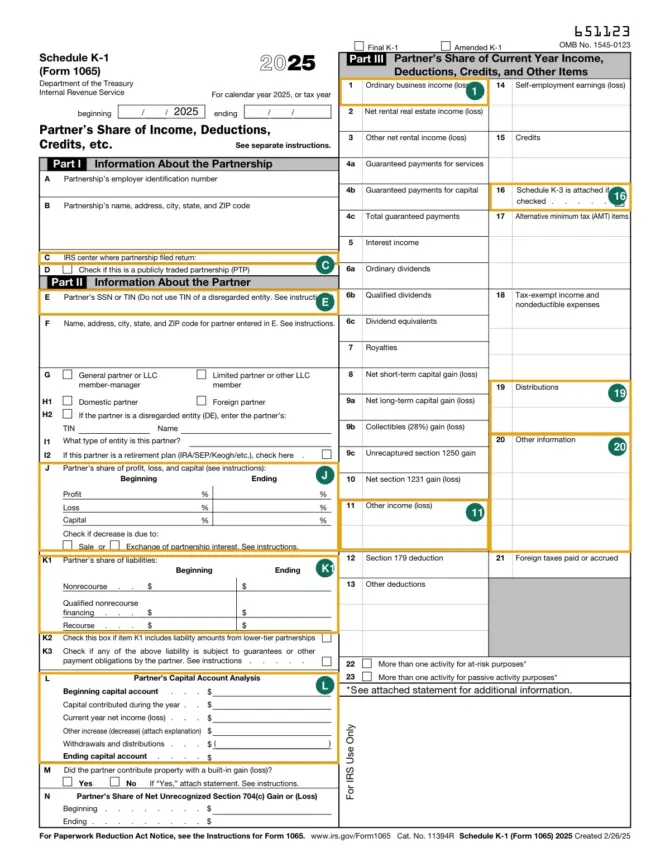
| Item | What the partnership enters | What the partner does with it |
|---|---|---|
| Top of form | Tax year dates for a fiscal or short year. “Amended K-1” is checked on a K-1 filed with an amended Form 1065. | A partner on a calendar year reports a fiscal-year K-1 on the return for the year in which the partnership’s year ends. |
| A, B | Partnership EIN, name and address. The EIN may never be truncated. | Used to identify the partnership, for example in Form 3800, Part III, column (c). |
| C | “e-file” if Form 1065 is filed electronically; otherwise the name of the IRS service center. | Information only. |
| D | Checked for a publicly traded partnership (PTP). | Passive income and losses from a PTP follow the separate PTP rules, not Form 8582. |
| E, F | SSN or ITIN for an individual, EIN for others. For an IRA partner, the custodian’s number. For a disregarded entity, the beneficial owner’s TIN and address. | The partner’s copy may show only the last four digits; the IRS copy is never truncated. |
| G | General partner or LLC member-manager, limited partner or other member. Both boxes, plus a statement, if the partner holds both kinds of interest. | Matters for material participation tests and self-employment tax. |
| H1, H2 | Domestic or foreign partner; name and TIN of a disregarded-entity partner (“None” if it has no TIN). | Information only. |
| I1, I2 | Entity type (individual, corporation, estate, trust, partnership, DE, exempt organization, foreign government or nominee with a code such as I, C or IRA); I2 is a checkbox for a retirement plan partner. | Information only. |
| J | Profit, loss and capital percentages at the beginning and end of the year under the partnership agreement; capital is zero if the capital account is zero or negative. “Sale” or “Exchange” is checked when a share decreased for that reason. | If Sale or Exchange is checked, see box 20 codes AB, AC and AD for gain with special treatment. |
| K1, K2, K3 | Share of nonrecourse liabilities, qualified nonrecourse financing and recourse liabilities; K2 if amounts come from lower-tier partnerships; K3 if guarantees or other payment obligations exist. | All three amounts count toward basis; generally only qualified nonrecourse financing and recourse amounts count toward at-risk. |
| L | Capital account on the tax-basis method: beginning balance, contributions, current year net income (loss), other increase (decrease) with an explanation, withdrawals and distributions, ending balance. | Not your basis. The Partner’s Instructions say item L can’t be used to figure adjusted basis, mainly because it excludes your share of liabilities. |
| M | “Yes” if the partner contributed property with a built-in gain or loss during the year, with a statement of each property, date and amount (or totals by date when more than 10 properties). | Relevant to box 20 code W and box 19 code B. |
| N | Partner’s share of net unrecognized section 704(c) gain or loss at the beginning and end of the year. | Information for future allocations and dispositions. |
Item L can be left blank when the answer to question 4 of Schedule B on Form 1065 is “Yes”. The beginning capital account is last year’s ending figure, or zero for a partner who joined through a contribution this year. The lines above “Ending capital account” have to add up to it, and the ending balance may be negative.
The Form 1065 instructions explain the “Amended K-1” box but give no separate rule for the “Final K-1” box, and they have no text for item I2 beyond the label printed on the form.
Part III, boxes 1 to 23: where each amount goes
Part III shows the partner’s share before any of the partner’s own loss limits. The table follows the Partner’s Instructions for an individual filing a 2025 Form 1040 or 1040-SR; other partners report each box as their own return instructs.
| Box | Item | Where an individual partner reports it |
|---|---|---|
| 1 | Ordinary business income (loss) | Schedule E (Form 1040), line 28: column (i) or (k) if you materially participated; column (h) for passive income; passive losses through Form 8582 to column (g) |
| 2, 3 | Rental real estate and other rental income (loss) | Schedule E, line 28; generally passive, with the $25,000 special allowance rules for active participation in box 2 |
| 4a, 4b, 4c | Guaranteed payments for services, for capital, and the total | Schedule E, line 28, column (k) |
| 5 | Interest income | Form 1040, line 2b |
| 6a, 6b, 6c | Ordinary dividends, qualified dividends, dividend equivalents | Line 3b and line 3a; 6c is not reported on Form 1040 |
| 7 | Royalties | Schedule E, line 4 |
| 8, 9a | Net short-term and long-term capital gain (loss) | Schedule D, lines 5 and 12 |
| 9b, 9c | Collectibles (28%) gain, unrecaptured section 1250 gain | Worksheets in the Schedule D instructions |
| 10 | Net section 1231 gain (loss) | Form 4797, line 2, column (g), with “From Schedule K-1 (Form 1065)” across columns (b) to (f) |
| 11 | Other income (loss), by code | Depends on the code |
| 12 | Section 179 deduction | Form 4562, Part I |
| 13 | Other deductions, by code | Codes A to G are charitable contributions by AGI limit; others by code |
| 14 | Self-employment earnings (loss) | Code A on Schedule SE; codes B and C for the optional methods |
| 15 | Credits, by code | Form 3800, Part III, or the credit’s own form, as the instruction for each code says |
| 16 | Schedule K-3 attached | If checked, use Schedule K-3 for international items |
| 17 | AMT items, by code | Form 6251 |
| 18 | Tax-exempt income and nondeductible expenses | Code A on Form 1040, line 2a; codes A and B raise basis, code C lowers it |
| 19 | Distributions, by code | Reduce basis; see the next section |
| 20 | Other information, by code | Code Z is section 199A information for Form 8995 or 8995-A; others by code |
| 21 | Foreign taxes paid or accrued | Reduces basis; Form 1116 uses Schedule K-3, not this box |
| 22, 23 | More than one activity for at-risk or passive purposes | A statement breaks the amounts out by activity |
Codes, asterisks and “STMT”
Boxes 11, 13, 14, 15, 17, 18, 19 and 20 hold a letter code in the narrow left column and a dollar amount on the right. The code ranges in the 2025 List of Codes are:
- box 11: codes A to S, with G, H and T to X reserved, plus ZZ
- box 13: codes A to AE, with Q, T, U and AF to AJ reserved, plus ZZ
- box 14: codes A to C
- box 15: codes A to BC, with AN and BD to BG reserved, plus ZZ
- box 17: codes A to F; box 18: codes A to C
- box 19: codes A to G, with E reserved
- box 20: codes A to AZ, with BA to BD reserved, plus ZZ
Code ZZ in boxes 11, 13, 15 and 20 means “Other” and comes with an explanation. The full list, with the form and line each code goes to, is printed at the end of the Partner’s Instructions. An asterisk after a code means a statement is attached. When an item can’t be shown as one dollar figure, the partnership enters the code and an asterisk on the left and “STMT” on the right. If there are more coded items than entry spaces, the last space gets only an asterisk and “STMT”. On the statement, items are listed by box number and code, for example “Box 13, code J, Section 59(e)(2) expenditures, $1,000”.
Box 19 distributions and Form 7217
Box 19 separates distributions by what was distributed and why:
| Code | What it reports |
|---|---|
| A | Cash and marketable securities treated as money, other than for services |
| B | The partnership’s basis in property distributed when section 737 applies to built-in gain property you contributed within the last 7 years |
| C | The partnership’s basis in other property, with a statement of each property’s basis and fair market value |
| D | Deemed distributions of money from a net decrease in your share of liabilities under section 752(b) |
| F, G | Cash or securities (F) and other property (G) distributed to you for performing services; guaranteed payments stay in box 4a |
Codes A, D and F reduce your basis but not below zero; any excess over basis is generally capital gain reported on Form 8949 and Schedule D. Since tax year 2024, a partner who actually received property subject to section 732 files a separate Form 7217 with the return for each date of receipt. A distribution of only money or marketable securities treated as money needs no Form 7217.
What changed on the 2025 Schedule K-1
The What’s New sections of the 2025 Partner’s Instructions and the 2025 Form 1065 instructions list these K-1 changes:
- Box 13, code X now also covers qualified sound recording production expenses, added to section 181 by P.L. 119-21.
- Box 19 has additional codes in use and new instructions on where to report each category of distribution.
- Box 20, code AR: after 2025 an EIN will be required for IRA partners allocated unrelated business taxable income. PTPs don’t have to include it for tax year 2025.
- Box 20, code AZ is new and reports reimbursement of preformation expenditures.
- Box 20, code ZZ carries the information a partner needs for the section 1062 election to pay tax on gain from selling qualified farmland property to qualified farmers in four equal annual installments, for tax years beginning after July 4, 2025. The partner attaches Form 1062, Schedule A (Form 1062) and a copy of the covenant.
Before you use the numbers: limits applied by the partner
Losses and deductions shown on the K-1 may be larger than what you can claim. The Partner’s Instructions list four limits in the order they apply: basis, at-risk, passive activity, and excess business loss (Form 461). Tracking basis is the partner’s job, and the instructions include a Worksheet for Adjusting the Basis of a Partner’s Interest in the Partnership that starts from item K1 liabilities, adds the income boxes and subtracts distributions and losses.
For passive activities, individuals use Form 8582 for losses and Form 8582-CR for credits; corporations use Form 8810. Box 23 is checked when the partnership attaches a statement splitting items among several activities. The instructions give the material participation tests, such as more than 500 hours during the year, and limited partners can meet only tests 1, 5 or 6.
If you report an item differently from the partnership in a partnership that has not elected out of the centralized audit regime, you must file Form 8082 with your return to explain the difference. Skipping Form 8082 can bring the accuracy-related penalty.
What leads to a corrected K-1 or a penalty
- Writing “See attached” in an entry space. The Form 1065 instructions say to complete every applicable entry space; an incomplete return can draw penalties.
- Truncating the partner’s TIN on the copy filed with the IRS, or truncating the partnership’s own EIN anywhere. Truncation is allowed only on the partner’s copy.
- Putting the disregarded entity’s TIN in item E. Item E takes the beneficial owner’s TIN; the DE’s own name and TIN go in item H2.
- Entering the IRA owner’s SSN for an IRA partner instead of the custodian’s identifying number.
- Using box 21 to complete Form 1116 or 1118. The Partner’s Instructions point to Schedule K-3 for that.
- A partner changing figures on the K-1 copy. The Partner’s Instructions say to ask the partnership for a corrected K-1 and to make sure it sends a copy to the IRS.
Correcting a K-1 and reporting a sale of an interest
The fix depends on the partnership’s audit regime. A partnership filing an amended Form 1065 electronically files an amended K-1 for each partner whose figures were wrong, gives that partner a copy and checks “Amended K-1” at the top. A partnership under the centralized partnership audit regime of the Bipartisan Budget Act of 2015 (BBA) does not amend K-1s; it files an administrative adjustment request with Form 8082. A paper amended return or AAR goes on Form 1065-X.
A partner who sells or exchanges an interest in a section 751(a) exchange must notify the partnership in writing within 30 days, or by January 15 of the following year if earlier. The notice gives the names and addresses of both parties, the transferor’s identifying number (and the transferee’s, if known) and the exchange date. Sales of PTP interests reported by a broker on Form 1099-B are excepted. Missing the notice can bring a penalty for each failure; Form 8308 and its instructions have the details.
Where to get the 2025 form and instructions
The 2025 Schedule K-1 (Form 1065) PDF is listed on the IRS page About Form 1065, along with the Instructions for Schedule K-1 (Form 1065). The partnership’s side of the form is in the Instructions for Form 1065, under “Specific Instructions (Schedule K-1 Only)” and the Part III instructions for Schedules K and K-1. Typed or computer entries should use 10-point Helvetica Light Standard so the IRS can scan them.
A substitute K-1 needs no IRS approval if it is an exact copy, with the same box numbers, titles, order and format and the OMB number. The partnership must then give each partner the Partner’s Instructions or its own item-by-item instructions. Other substitutes need approval from the IRS Substitute Forms Program. If the partnership’s address or responsible party changes after it files, the Form 1065 instructions point to Form 8822-B.
There is no separate mailing address for the K-1. It travels inside Form 1065, which is e-filed or mailed to the service center that the Form 1065 instructions assign by state and total assets. The K-1 has no signature line and no payment goes with it: the IRS page on Form 1065 says a partnership does not pay tax on its income but passes it through to the partners, and Form 1065 itself is not considered a return until a partner or LLC member signs it.
Questions about Schedule K-1 (Form 1065)
Do I attach my partnership K-1 to Form 1040?
Generally no. The Partner’s Instructions say to keep it for your records unless you are required to attach it, as with backup withholding in box 15, code O.
My K-1 shows only the last four digits of my SSN. Is that a problem?
That is allowed on the partner’s copy. The partnership reports your full number on the copy it files with the IRS.
The partnership’s tax year ends in February 2026. Which return gets the K-1?
Your 2026 return. A calendar-year partner reports the amounts for the year in which the partnership’s fiscal year ends.
Can the ending capital account in item L be used as my basis?
No. Item L uses the tax-basis capital method and leaves out your share of partnership liabilities, so the Partner’s Instructions say it can’t be used to figure your adjusted basis. Use the basis worksheet in those instructions.
Official sources
- Internal Revenue Service, Schedule K-1 (Form 1065), Partner’s Share of Income, Deductions, Credits, etc., 2025
- Internal Revenue Service, Partner’s Instructions for Schedule K-1 (Form 1065) (2025)
- Internal Revenue Service, Instructions for Form 1065 (2025), including Specific Instructions (Schedule K-1 Only)
- Internal Revenue Service, About Form 1065, U.S. Return of Partnership Income