Kentucky Form 51A111 documents a sales and use tax exemption for machinery for new and expanded industry. A manufacturer or production processor can complete it; when a contractor buys, leases or rents the qualifying machinery under contract, the contractor and manufacturer or processor execute the certificate jointly.
The Department of Revenue publishes the 51A111 (9-21) certificate. Although that revision date is September 2021, the department’s February 17, 2025 forklift memorandum still identifies Form 51A111 for property meeting the machinery exemption requirements.
Who can use the machinery exemption certificate?
The exemption concerns qualifying property purchased, leased or rented, including related installation charges. The certificate cites KRS 139.480(10) and 103 KAR 30:120. Signing it does not make an otherwise taxable machine exempt.
The department’s KY-TAM-25-01 explains the tests for machinery, direct manufacturing use, first incorporation into a Kentucky facility and replacement machinery. Its statutory discussion allows specified replacement cases, including greater productive capacity measured in units of production, a different function or product, or an increase of at least 10% in recycled-material consumption.
The memorandum gives a concrete forklift distinction: greater lifting capacity alone does not establish increased manufacturing output. A new forklift added for continuous movement of in-process goods into final packaging may qualify under the circumstances described there. That factual explanation helps with the form’s manufacturing-function entry; it is not a blanket exemption for every forklift in a factory.
How to fill out Form 51A111
Work from the supplier’s transaction details and the machinery’s actual use at the plant. The form has unnumbered lines; the image markers group the supplier, plant, machinery description and two execution blocks.
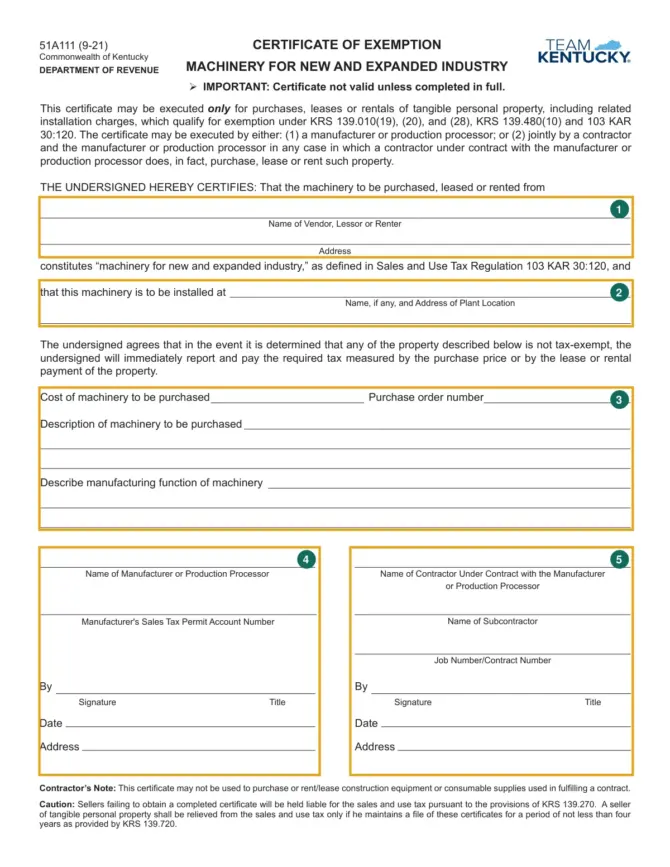
| Form area | What to enter | Supporting information |
|---|---|---|
| Vendor, lessor or renter, marker 1 | The supplier’s name and address. | The party selling or providing the machinery. |
| Installation location, marker 2 | The plant’s name, if it has one, and full address. | The location where the machinery will be installed. |
| Machinery details, marker 3 | Cost, purchase order number, a description of the machinery and its manufacturing function. | The order and facts showing what the equipment does in production. |
| Manufacturer or processor, marker 4 | The business name and its sales tax permit account number. Complete the signature and title, date and address lines. | The manufacturer or processor’s account details and execution of the certificate. |
| Contractor block, marker 5 | The contractor’s name, subcontractor’s name, job/contract number, signature and title, date and address, for a jointly executed contractor transaction. | The contract and the parties purchasing the qualifying machinery. |
The machinery description identifies the equipment. The manufacturing-function line explains its production use. For replacement equipment whose eligibility depends on increased output, the department’s memorandum calls for measurable production units; a description limited to lifting capacity does not answer that question.
Contractor purchases and excluded equipment
The contractor route applies when the contractor actually purchases, leases or rents the qualifying property under contract with the manufacturer or processor. Use the two execution blocks for the joint certificate.
The printed contractor note excludes construction equipment and consumable supplies used to fulfill the contract. A contractor cannot use this certificate for those items simply because the project installs exempt production machinery.
Official PDF and seller records
Obtain the official one-page Form 51A111 and give the completed certificate to the supplier for the exempt transaction. The certificate’s seller warning says it is invalid unless completed in full and that a seller without a completed certificate is liable for the sales and use tax. It directs sellers to retain the certificates for at least four years.
The signed statement also commits the purchaser to report and pay the required tax immediately if the property is determined not to be exempt. The tax is measured by the purchase price or the lease/rental payment, as applicable.
For a question about the machinery’s eligibility, the memorandum lists DORtaxpolicy@ky.gov. The department’s Sales and Use Tax page gives 502-564-5170 for assistance. Resolve uncertain production or replacement facts before certifying the transaction.