A Kentucky farmer who is building a new grain bin, replacing the ventilation system in a poultry house or putting in aquaculture ponds can buy the materials, machinery and equipment for that project without the 6% sales tax by giving the vendor Form 51A159, the On-Farm Facilities Certificate of Exemption for Materials, Machinery and Equipment. The Department of Revenue’s version is 51A159 (9-21), two pages. When a contractor does the buying, the farmer and the contractor sign the same certificate together. Nothing is sent to the Department; the vendor keeps the certificate.
Which purchases belong on 51A159
The opening paragraph of the form limits it to tangible personal property that will be incorporated into the construction, repair or renovation of an on-farm facility that is exempt under KRS 139.480. Page 2 draws the line with the companion form: Form 51A158, the Farm Exemption Certificate, has to be used for feed and feed additives, farm machinery, farm work stock, water, gasoline, special fuels, liquefied petroleum gas and farm chemicals, even when they are for one of these same facilities.
In practice that splits one farm’s paperwork in two. The steel, fans and drying equipment that go into a new grain drying and storage building are 51A159 purchases. The LP gas that later runs the dryer and the tractor that hauls grain to it are 51A158 purchases.
The certificate can be signed in two ways, both printed at the top of page 1:
- by the farmer alone, when the farmer buys the items directly from the retailer;
- jointly by the farmer and a contractor who is under contract with the farmer and buys the property to carry out the construction contract.
The seven kinds of facilities on the form
The farmer checks the line for the facility the property will go into. Page 2 explains what each line covers and cites the subsection of KRS 139.480. For every line the exemption reaches equipment, machinery, attachments and materials built into the facility; the table lists the extra conditions and the examples page 2 gives.
| Line on page 1 | What page 2 says | KRS 139.480 |
|---|---|---|
| On-farm grain/soybean facility | Facilities used exclusively for storing, drying, processing or handling grain or soybeans | (13) |
| On-farm livestock or poultry raising facility | Facilities used exclusively for raising chickens or livestock. Examples include vent board equipment, waterer and feeding systems, brooding, ventilation, alarm and curtain systems | (14) |
| On-farm ratite raising facility | Breeding and producing ratite birds, feathers, hides, eggs, meat and by-products. Includes incubation systems and egg processing equipment, plus waterer, feeding, brooding, ventilation, alarm and curtain systems | (23) |
| On-farm llama or alpaca raising facility | Production of hides, breeding stock, fiber and wool products, meat and by-products. Waterer and feeding, ventilation and alarm systems | (25) |
| On-farm buffalo raising facility | Production of hides, breeding stock, meat and by-products. Waterer and feeding, ventilation and alarm systems | (28) |
| On-farm aquaculture facility | Producing products of aquaculture. Includes ponds, tanks and raceways, aeration and heating, processing and storage systems, and harvest and transport equipment | (29) |
| On-site cervid facility | Production of hides, breeding stock, meat and cervid by-products | (30) |
For aquaculture, page 2 also quotes the definition in KRS 260.960: the science, art and business of producing and raising aquatic organisms under controlled or semi-controlled conditions. On the llama and alpaca line the form prints the citation as “KRS 130.480(25)”; every other line refers to KRS 139.480.
How to fill out Form 51A159
Page 1 has five entries above the purchaser’s statement and two signature blocks below it, one for the farmer and one for the contractor. The form has no printed line numbers; the numbers in the image and the table were added for this page.
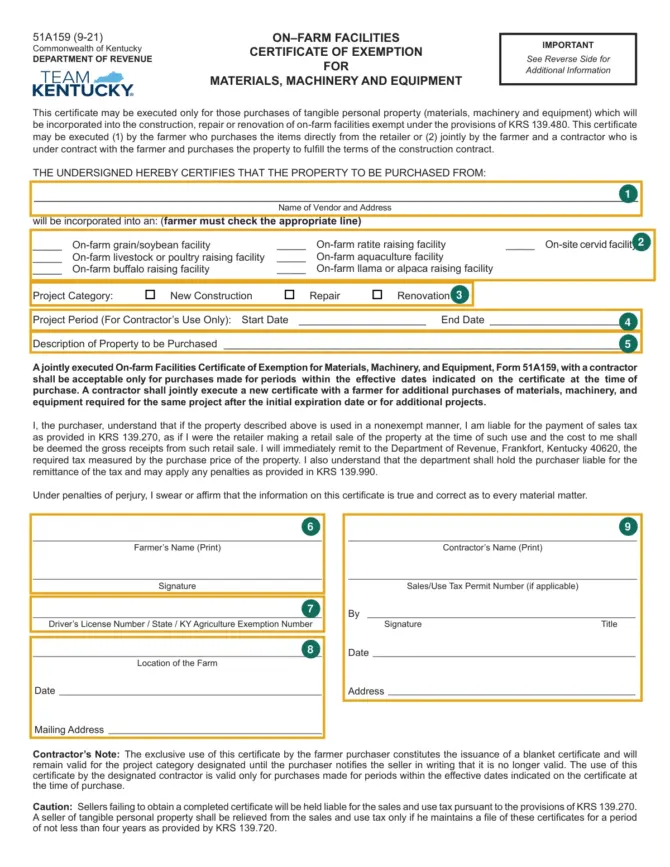
| Marker | Printed label | What goes there |
|---|---|---|
| 1 | Name of Vendor and Address | The business the property is bought from. A separate certificate goes to each vendor. |
| 2 | Facility lines (farmer must check the appropriate line) | One of the seven facilities from the table above. |
| 3 | Project Category | New Construction, Repair or Renovation. |
| 4 | Project Period (For Contractor’s Use Only), Start Date, End Date | Filled in when a contractor signs. These are the dates that limit the contractor’s purchases. |
| 5 | Description of Property to be Purchased | The materials, machinery and equipment for the project. |
| 6 | Farmer’s Name (Print), Signature | The farmer signs under penalties of perjury. |
| 7 | Driver’s License Number / State / KY Agriculture Exemption Number | The farmer’s license number and issuing state, and the AE Number. |
| 8 | Location of the Farm, Date, Mailing Address | Where the facility is and where the farmer receives mail. |
| 9 | Contractor’s Name (Print), Sales/Use Tax Permit Number (if applicable), By, Title, Date, Address | Left blank when the farmer buys alone. On a joint certificate, the contractor’s details and the signature of the person signing for the contractor. |
The form does not say when the contractor’s sales and use tax permit number applies; it only prints “if applicable”. The purchaser’s statement between markers 5 and 6 is the same on both kinds of certificate: if the property is used in a nonexempt manner, the purchaser owes the sales tax under KRS 139.270 as if the purchaser were the retailer, measured by the purchase price, and remits it to the Department of Revenue, Frankfort, Kentucky 40620. The Department can hold the purchaser liable and apply penalties under KRS 139.990.
Buying through a contractor: the project dates
The two ways of signing work differently over time. When only the farmer uses the certificate, the contractor’s note at the bottom of page 1 calls it a blanket certificate: it stays valid for the project category checked until the farmer tells the vendor in writing that it is no longer valid.
A jointly executed certificate is acceptable only for purchases made within the effective dates shown on it at the time of purchase. The bold paragraph in the middle of page 1 adds two cases in which the contractor and the farmer have to sign a new certificate:
- more materials, machinery or equipment are needed for the same project after the first expiration date;
- the contractor takes on an additional project.
A contractor finishing a hog barn late, for example, cannot keep buying tax free on the old certificate once the end date has passed, and cannot use it for a second building on the same farm.
The Agriculture Exemption Number on the certificate
KRS 139.481 requires farmers to apply for an Agriculture Exemption (AE) Number and use it to claim the farm exemptions. The Department’s FAQs for the AE Number program (September 17, 2026) say any transaction claiming an agriculture exemption without one is invalid, and that sellers may keep accepting Forms 51A158 and 51A159 as long as the customer’s AE Number is on them. Sellers can check a number in the Department’s online lookup.
The same FAQs say current AE Numbers expire on December 31, 2026, and renewals run four years. The renewal FAQ page says a renewed number is valid through December 31, 2030, and it can be renewed on Form 51A801 sent to DOR.webresponsesalestax@ky.gov or online at MyTaxes after requesting a PIN letter. Form 51A801 (09-26) adds that renewal does not exempt every purchase automatically; each purchase still has to meet the requirements printed on Form 51A158 or 51A159, and the farmer may issue either certificate to each vendor with the AE Number.
An out-of-state farmer building on a Kentucky farm also needs a Kentucky AE Number. If a Kentucky seller ships the property to a farm outside the state, the FAQs treat the sale as exempt interstate commerce without one and tell the seller to ask the destination state about taxability. Other states have their own certificates; Nebraska, for instance, handles exempt and contractor purchases on Nebraska Form 13.
What makes a 51A159 purchase taxable
- Feed, fuel, LP gas, water, farm chemicals or farm machinery bought on 51A159. Page 2 sends these to Form 51A158.
- No AE Number. The FAQs call an agriculture exemption claimed without it invalid.
- A contractor purchase outside the start and end dates on the joint certificate, or for a second project.
- Property that ends up used in a nonexempt manner. The farmer then owes the tax on the purchase price under KRS 139.270.
- A vendor without a completed certificate. The caution on page 1 makes the seller liable for the sales and use tax and relieves it only if it keeps a file of these certificates for at least four years under KRS 139.720.
Where to get Form 51A159 and who answers questions
The Form 51A159 (9-21) PDF is on the Kentucky Department of Revenue site. It has no fillable fields; print it and fill it in by hand. Page 2 carries the facility definitions; keep it with page 1, since the certificate refers the signer to the reverse side. The signed certificate goes to the vendor or, on a joint certificate, to the vendor the contractor buys from.
Page 2 directs questions about the certificate to the Division of Sales and Use Tax at (502) 564-5170; the AE Number FAQs add option 1 for sales tax and the address DOR.webresponsesalestax@ky.gov. Whether a particular building or piece of equipment qualifies is a question for the Division or a tax adviser; this page describes the form and is not tax advice.
Questions about Kentucky Form 51A159
Does Form 51A159 cover repairs to an existing barn?
Repair and Renovation are both project categories on the form, next to New Construction. The barn has to be one of the seven facility types, such as a facility used exclusively for raising livestock or poultry.
Can a contractor use 51A159 without the farmer’s signature?
The form allows two signers: the farmer alone, or the farmer and the contractor jointly. A contractor under contract with the farmer buys on a jointly executed certificate with the project start and end dates filled in.
Is a horse barn covered?
The AE Number FAQs say raising horses does not qualify for an AE Number, and an agriculture exemption claimed without that number is invalid.
Official sources
- Kentucky Department of Revenue, Form 51A159 (9-21), On-Farm Facilities Certificate of Exemption for Materials, Machinery and Equipment
- Kentucky Department of Revenue, FAQs for Agriculture Exemption Number Program (9-17-26)
- Kentucky Department of Revenue, FAQs for Agriculture Exemption Renewal Program
- Kentucky Department of Revenue, Form 51A801 (09-26), Sales and Use Tax Application for Agriculture Exemption Renewal
- Kentucky Department of Revenue, Form 51A158 (9-21), Farm Exemption Certificate
- Kentucky Department of Revenue, Sales & Use Tax