A Nebraska retailer buying stock for resale gives the supplier Form 13 to explain why sales tax is not being collected. The same form also has separate sections for exempt purchases and contractors. Choose the section that describes the transaction; a nonprofit name or a federal employer identification number does not establish a Nebraska sales tax exemption.

Who can issue a Nebraska Form 13?
Section A covers property or taxable services bought for resale in the purchaser’s ordinary business. The purchase can be resold unchanged or incorporated into something else that will be sold. For example, goods bought for a shop’s resale inventory belong in Section A; the shop’s own use of an item is not the resale described by that section.
Section B records an exempt purchase under one of the six categories printed on page 2. These include qualifying governmental purchases, exempt intended uses, organizations holding a Nebraska exemption certificate, specified common-carrier purchases, manufacturing equipment, and qualifying occasional sales. Each category has its own conditions. The July 2022 instructions warn that most nonprofit organizations do not qualify for sales and use tax exemption.
How to fill out the certificate fields
Begin with both parties’ names and mailing addresses. Then select a single purchase or a blanket certificate and one of the three reasons for exemption. Use the invoice, purchase order and applicable state registration or exemption documents to complete the matching fields.
| Field or section | What belongs there | Record to use |
|---|---|---|
| Single purchase | The invoice or purchase order number for this transaction. | The supplier’s invoice or your purchase order. |
| Blanket | Select this for covered future purchases. The form says it continues until the purchaser revokes it in writing. | Your continuing purchasing arrangement with this seller. |
| Section A | Describe the property or service and your business; select wholesaler, retailer, manufacturer or lessor. Supply the applicable sales tax number or explain why there is none. | Business registration and the goods or services being purchased for resale. |
| Section B, category number | The number from the page 2 list that supports the purchase. | The applicable exemption and its conditions. |
| Section B, categories 2 and 5 | Describe the purchase and its intended use. | Order specifications and the activity in which the item will be used. |
| Section B, categories 3 and 4 | The Nebraska exemption ID beginning 05. Do not substitute an EIN. | The state exemption certificate. |
| Signature block | An authorized signature, printed name, title and date. | The person authorized to make the certificate’s declaration. |
A wholesaler or manufacturer completing Section A does not have to provide an ID number under the form’s instructions. An out-of-state purchaser can enter its home state’s sales tax number. Section B does not require a Nebraska ID for categories 1, 2 or 5. These exceptions do not remove the need to identify the parties and explain the exemption.
Contractors: Section C, part 1 or part 2
The two marked parts correspond to the contractor’s option in Nebraska’s Contractor Registration Database. Part 1 is for Option 1 or Option 3 contractors purchasing building materials and fixtures; it asks for the Nebraska sales or use tax ID. Part 2 is for an Option 2 contractor acting under a purchasing agent appointment for an exempt entity.
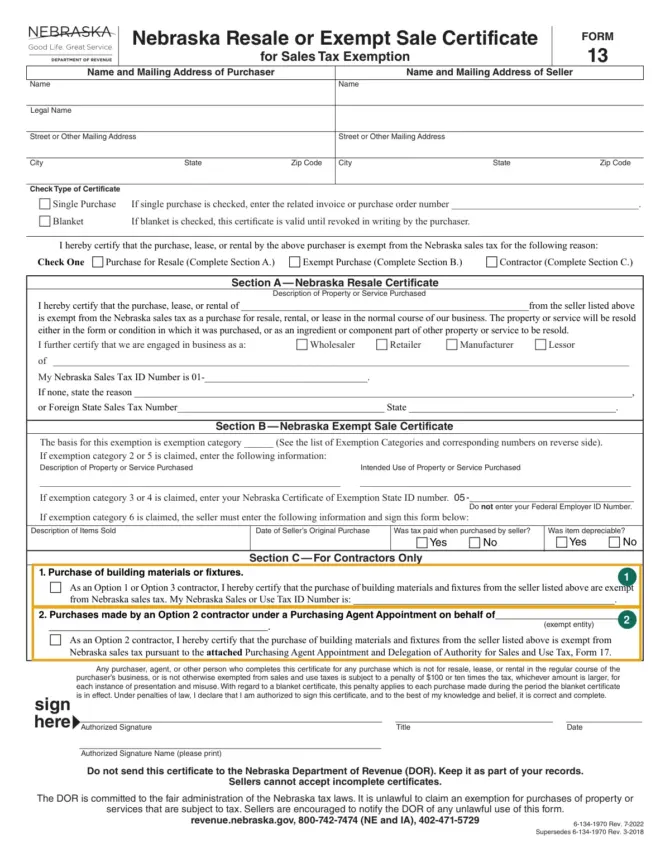
For part 2, identify the exempt entity and attach its properly completed Form 17. Give both documents to the supplier when buying the building materials. An appointment for a construction project does not turn all of the contractor’s purchases into exempt purchases.
When and where do you send Form 13?
Give the completed certificate to the seller at the time of purchase. The seller keeps it for audit records; it is not sent to the Nebraska Department of Revenue. The official PDF contains both the certificate and the instructions.
Category 6 has a different direction of delivery. For a qualifying occasional sale of used business or farm equipment, the seller completes and signs the certificate and gives it to the purchaser. The equipment must have been used productively as a depreciable capital asset for more than one year, and the seller must previously have paid tax on it. The purchaser retains that certificate.
Incomplete certificates and unsupported exemptions
The face of Form 13 says sellers cannot accept incomplete certificates. In Section B, entering an EIN in the state exemption-number field does not supply the requested 05 number. Selecting category 3 also does not cover a facility or activity outside the organization’s qualifying license.
The instructions specifically prohibit qualifying nonprofit educational and health-care entities from issuing Form 13 or Form 17 for construction purchases before the required accreditation, licensing or certification. Resolve that eligibility question before using a certificate.