An exempt Nebraska project owner uses Form 17 to appoint a contractor to buy building materials for a specified construction project. The appointment has a start date, an end date and a signature date. Materials incorporated into real estate outside those limits can remain taxable even when the owner is exempt.
Who can appoint a purchasing agent?
The April 2023 Form 17 instructions allow qualifying sales-tax-exempt governmental units, nonprofit organizations and educational institutions to issue the appointment. A nonprofit organization or educational institution must have applied for and received Nebraska’s Exempt Organization Certificate of Exemption. Where licensing or certification is also required, the exemption covers the licensed facilities or activities.
A manufacturer cannot use Form 17 to authorize its contractor to buy manufacturing machinery and equipment tax-free. The instructions also distinguish an exempt hospital’s existing activities from a new, not-yet-licensed facility: the hospital cannot issue Form 17 for that unlicensed facility. A refund claim after licensing and receipt of the exemption certificate is a separate procedure.
Completing the project and appointment dates
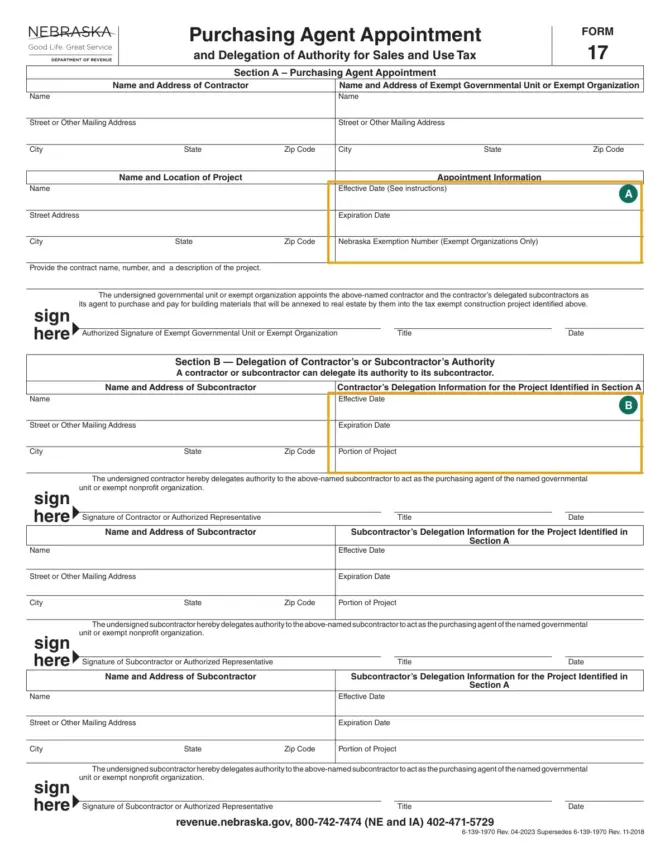
Section A identifies the owner, the contractor and the construction project. The marked areas show the appointment information in Section A and the first delegation’s dates and project scope in Section B. Use actual dates; the instructions reject an expiration entry such as “upon completion.”
| Form area | Entry to make | Source for the entry |
|---|---|---|
| Section A, parties | The contractor’s name and address and the exempt owner’s name and address. | The construction contract and owner’s records. |
| Project location and description | The project name, street address, contract name or number, and description of the work. | The project contract and site details. |
| Appointment information | Beginning and expiration dates; the Nebraska exemption number for an exempt organization. | The agreed appointment period and state exemption certificate. |
| Section A signature | The authorized official’s signature, title and signing date. | The governmental official or exempt organization’s officer authorized to sign. |
| Section B, subcontractor | The subcontractor’s contact details, delegation dates and portion of the project. | The subcontract and authority received from the appointing party. |
| Section B signature | The delegating contractor’s or subcontractor’s authorized signature, title and date. | The owner, partner or corporate officer of that business. |
An individual outside the listed signers may sign with an attached power of attorney.
When must the owner issue Form 17?
The owner must issue the appointment before the contractor annexes building materials to the project. Regardless of the date typed in the effective-date box, the appointment starts on the later of that date and the owner’s signature date. Option 2 and Option 3 contractors owe sales or use tax on materials annexed before that point.
The exemption is limited to materials for the identified project, incorporated into property belonging or to belong to the owner, during the appointment period. If work involving annexation continues past the expiration date, the owner must issue a new Form 17. For written on-call repair or maintenance agreements, an appointment can cover service calls for up to a calendar year; both the written agreement and Form 17 must be renewed for each calendar year.
Passing purchasing authority to subcontractors
A general contractor completes Section B on a copy of the owner’s Form 17 and issues a separate form to each subcontractor. The contractor should keep copies and give the owner copies of its delegations. A subcontractor with delegated authority can pass authority onward for all or part of its work.
Each further delegation identifies the receiving subcontractor and its portion of the project. If Section B is full, the subcontractor can complete Section B of a blank Form 17 and give the next subcontractor copies of both the received form and the additional form. The chain of authority stays with the paperwork.
A delegation takes effect on the later of its stated effective date and the delegating party’s signature date. Materials must fall within the project portion and the date limits in both Sections A and B. A subcontractor cannot extend the owner’s appointment merely by entering a later expiration date.
Which copies go to the contractor and supplier?
The owner gives the original Form 17 to the contractor and keeps a copy. An Option 2 contractor gives its supplier Form 13, Section C, block 2, together with a copy of Form 17. Option 1 and Option 3 contractors give suppliers a properly completed Form 13; the Form 17 instructions say they do not need to provide Form 17 to those suppliers.
Tools, equipment, supplies and taxable services used to perform the work remain taxable under the instructions. Scaffolding, barricades and pest-control services are listed examples. The appointment covers qualifying building materials incorporated into the project, so it should not be used as a blanket exemption for the contractor’s operating costs.
Official PDF: Form 17 — Official PDF (revenue.nebraska.gov)