The Inland Revenue Affidavit, Form CA24, was the sworn account of a deceased person’s assets, debts and beneficiaries that executors and intending administrators delivered before the Probate Office would issue a grant. Since 14 September 2020 the online Statement of Affairs (Probate) Form SA.2 has taken its place. Revenue still publishes one paper version, the CA24 2000 edition, for estates where the death happened before 5 December 2001 and no grant has yet been taken out.
Which deaths still need a paper CA24
Revenue’s CA24 page draws the line at 5 December 2001. If the person died on or after that date, the paper affidavit is no longer accepted for a Grant of Probate or Letters of Administration, and the application starts with Form SA.2 in myAccount or ROS. The Tax and Duty Manual for the SA.2 says the online form also absorbed the Corrective Affidavit (CA26), the request for a second grant (A3C) and the request for an IT8 clearance (CA4). If the death was before 5 December 2001, the same page tells you to complete the CA24 2000 edition on paper.
The form itself is narrower. Its heading reads “to be used where the deceased died on or after 1 December, 1999”, while the Revenue page gives no earlier limit. For a death between 1 December 1999 and 4 December 2001 both documents point to this form. For a death before 1 December 1999 they disagree, and neither says which affidavit replaces it. Confirm the form with the National CAT Helpline on 01 738 3673 before anyone swears it.
Page 1: general information and the sworn declaration
Page 1 covers the deceased and the people applying for the grant, and it is the page that gets sworn. At the top, the Probate Office or the District Probate Registry is chosen by deleting the one that does not apply; for a registry, the town is written on the dotted line. The numbers in the image match the table below.
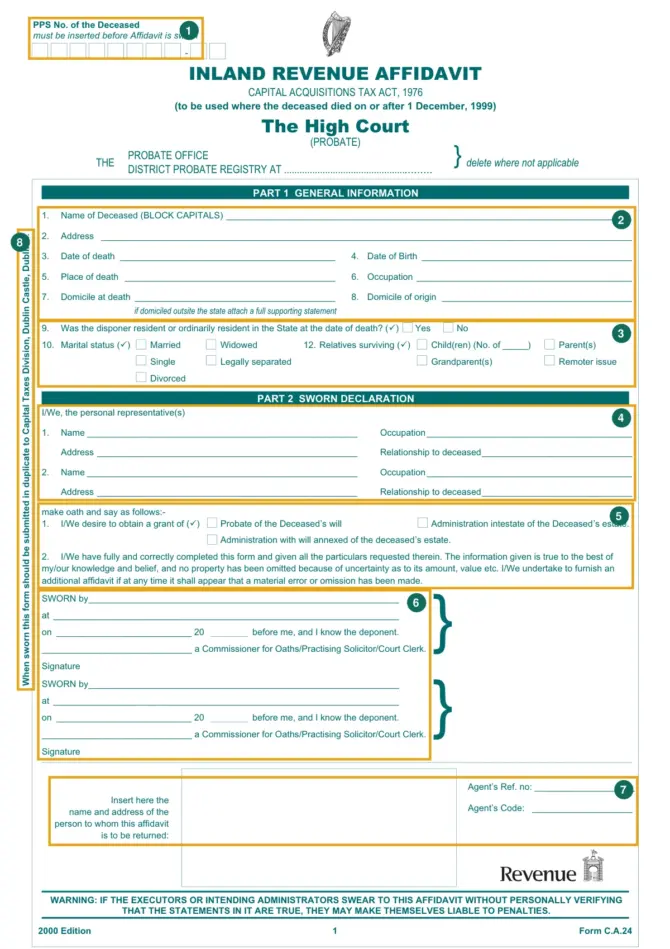
| Marker | On the form | What goes in |
|---|---|---|
| 1 | PPS No. of the Deceased | The deceased’s PPS number. The form says it must be inserted before the affidavit is sworn. |
| 2 | Part 1, items 1 to 8 | Name in block capitals, address, dates of death and birth, place of death, occupation, domicile at death and domicile of origin. If the deceased was domiciled outside the State, attach a full supporting statement. |
| 3 | Part 1, items 9, 10 and 12 | Tick boxes: whether the deceased was resident or ordinarily resident in the State at death, marital status (five choices, including legally separated and divorced) and which relatives survived, with the number of children. The printed numbering skips item 11. |
| 4 | Part 2, personal representatives | Name, occupation, address and relationship to the deceased for up to two deponents. |
| 5 | Grant applied for | One tick: probate of the will, administration intestate, or administration with will annexed. Paragraph 2 below the ticks is the declaration that the form is complete and an undertaking to file an additional affidavit if a material error or omission comes to light. |
| 6 | Jurat | Each deponent swears separately, with place and date, before a Commissioner for Oaths, a practising solicitor or a court clerk, who signs. |
| 7 | Return details | Name and address of the person the affidavit should be returned to, plus the agent’s reference number and agent’s code where an agent acts. |
| 8 | Side note | The printed address, Capital Taxes Division, Dublin Castle. Revenue’s page now gives a different address (see below). |
The warning across the foot of page 1 says that executors or intending administrators who swear the affidavit without personally checking that its statements are true may make themselves liable to penalties.
Parts 3 and 4: what the estate owned and owed
Every value is the gross market value at the date of death, and the columns on the 2000 edition are printed in pounds (£). Neither the form nor Revenue’s CA24 page says whether figures should now be entered in pounds or euro, so ask the CAT Helpline before filling in the money columns.
Part 3 is property in the State passing under the will or intestacy, including property under Part IX or section 56 of the Succession Act, 1965. A copy of the will and any codicil must be attached.
| Part 3 item | What it asks for |
|---|---|
| 1 | Houses, apartments and land, with the details on Form CA6 (schedule of lands and buildings) attached |
| 2 and 3 | Household contents such as furniture, antiques and jewellery; cars and boats |
| 4(a), 4(b) | Farming assets such as livestock, bloodstock and machinery; other business assets such as goodwill, stock-in-trade and book debts |
| 5 | Accounts with banks, building societies, insurance companies, the post office and credit unions: name and branch, account number, value. Leave out accounts that pass by survivorship or nomination; they belong in Part 5. |
| 6 | Life policy proceeds, except policies written in trust for named beneficiaries, which go in Part 5 |
| 7 | Debts owed to the deceased, by debtor |
| 8 | Quoted shares with holding size and price per unit, dividends on shares quoted ex-dividend at the date of death, and unquoted shares by type and class, with valuations attached |
| 9 and 10 | Unpaid purchase money on a sale contracted in the deceased’s lifetime; any other property. The gross total is (A). |
| 11 | Irish debts and funeral expenses payable in the State, by creditor. The total is (B), and A minus B is the net Irish estate. |
An Irish debt, in the form’s footnote, is one owed to a person resident in the State, or owed to a non-resident but contracted to be paid in the State or charged on property here. Part 4 repeats the exercise for property outside the State: description and location give the gross total (C), foreign debts and funeral expenses payable abroad give (D), and C minus D is the net foreign estate.
Part 5: the questionnaire
The note on page 4 says every question in Part 5 must be answered with a tick in the yes or no box. Where any of questions 1 to 6 is yes, attach a copy of the relevant instrument and give full particulars in the panel on page 4: the property, its value and the names and addresses of the beneficiaries and any trustees.
- 1: a limited interest held by the deceased, such as an annuity, a right of residence or a life interest
- 2: a gift or other benefit taken on or after 2 December 1988 under a disposition made by the deceased
- 3: dispositions subject to a power of revocation, by discretionary trust, by surrender of a limited interest, or giving free or cheap use of property on or after 2 December 1988
- 4 to 6: nominations, an interest in expectancy, and a general power of appointment exercised or not exercised
- Joint property (printed as “8” on page 4): for each item, the property, its value, the other holders and their relationship, when it went into joint names, who provided it and in what shares, why, how the income was shared, and the title under which it passes
- Superannuation and insurance money payable on the death that is not already in Parts 3 or 4, with any ex-gratia amount marked by an asterisk and the premium payer named if not the deceased alone
- Section 60 policies (attach a copy and give the amount), children named as objects of a discretionary trust set up by the deceased, Social Welfare assistance and any Department claim on the estate
- Where a spouse survived, the position on the election under section 115 of the Succession Act, 1965
The joint-property question carries a footnote: where the deceased provided money or property held in joint names, this may have given rise to a resulting trust in the deceased’s favour, depending on the actual or presumed intention.
Parts 6 and 7: who benefits
Part 6 lists each beneficiary whose total benefit under the will or the Succession Act, 1965 is more than £10,000, with relationship and approximate value. If nobody falls into it, tick the box provided. It need not be completed for a beneficiary whose benefits are summarised in Part 7.
In Part 7 one of two boxes must always be ticked. The first confirms that the part has been completed for every person whose benefits on the death, from any source under the same group threshold, exceeded 80% of that threshold, alone or added to earlier aggregable benefits. The second confirms that nobody crossed that 80% line. Reliefs and exemptions are ignored in both calculations. Each person listed needs a PPS number, domicile and residence, the title to the benefit, and details of earlier aggregable benefits, or “none” in the date column. The foot of the page says a self-assessment return, Form IT38, is required for each beneficiary named within four months of the valuation date.
What goes with the affidavit
- A copy of the will and every codicil, if there is one
- Form CA6 with the details of each house, apartment or piece of land in Part 3
- Valuations for quoted and unquoted shares, and a statement for any other bank or similar assets not listed individually
- A supporting statement on domicile where the deceased was domiciled outside the State
- Copies of instruments behind any yes answer to Part 5 questions 1 to 6, and a copy of any section 60 policy
- For a non-domiciled or non-resident deceased with a non-domiciled beneficiary, a statement on that beneficiary’s domicile
- A second copy: the affidavit goes to Revenue in duplicate
Where to get the CA24 2000 edition and where to send it
The CA24 2000 edition is a six-page PDF linked from Revenue’s page on completing an Inland Revenue Affidavit. The PDF has fillable fields, but the affidavit is still printed and sworn, and the person taking the oath signs the jurat.
The side note on page 1 still names the Capital Taxes Division at Dublin Castle. Revenue’s CA24 page, published 27 October 2026, gives this address for sending it, in duplicate:
Office of the Revenue Commissioners
Personal Division
National Capital Acquisitions Tax (CAT) Unit
9/15 Upper O’Connell Street
Dublin 1
D01 YT32
Ireland
Revenue’s page prints the Eircode as “DO YT32”; Revenue’s Form A3(C) gives the same street address with D01 YT32.
Correcting a CA24 after it is lodged
Revenue accepts corrections only for material errors or omissions, such as property nobody knew about or property listed that was never part of the estate. A fall in property values after the death does not count. For a CA24 lodged on a death between 1 April 1975 and 4 December 2001, Revenue’s corrections page points to the Corrective Affidavit, Form CA26 2001 edition, sent to the Revenue Commissioners with supporting documents.
Questions about the CA24
Can I still file a CA24 for someone who died in 2015?
Revenue says the CA24 is no longer available where the death was on or after 5 December 2001. Applications from 14 September 2020 start with Form SA.2 through myAccount or ROS.
Does the CA24 have to be sworn?
Each personal representative swears it before a Commissioner for Oaths, a practising solicitor or a court clerk, and the PPS number has to be on the form first. Revenue’s manual for the SA.2 that replaced it says the SA.2 is not a sworn document.
Who gets the CA24 back?
The box at the bottom of page 1 asks for the name and address of the person the affidavit is to be returned to. Agents also fill in their reference number and agent’s code there.
Sources
- Revenue, Inland Revenue Affidavit, Form CA24, 2000 Edition
- Revenue, Completing an Inland Revenue Affidavit (CA24), published 27 October 2026
- Revenue, Statement of Affairs (Probate) Form SA.2
- Revenue, Correcting Form SA.2 or completing Form CA26, published 1 July 2026
- Revenue, Tax and Duty Manual, CAT Part 02, Statement of Affairs (Probate) Form SA.2
- Revenue, Inland Revenue Affidavit (CA24) Glossary
- Revenue, Form A3(C), pre 5 December 2001