Trustees in Ireland report the income and capital gains of a trust on Form 1, the same self-assessment return Revenue issues to estates, receiverships, unincorporated bodies and corporations liable to income tax. The front page of the 2025 return has a box for each of these, and you put an X in the one that fits. The 2025 return covers the year ended 31 December 2025, runs to 20 pages of panels lettered A to L, and ends with a payslip for anyone paying by cheque. A trust gets several pages of its own: trust type, trustees, settlors, beneficiaries, money and assets moving into and out of the trust, and the surcharge on undistributed income.
Who fills in Form 1 for a trust or estate
Every page of the return has a box for the tax reference number of the trust or estate. Line 1(b) asks for the address of the first named trustee or personal representative, and the declaration on page 1 asks for the signature, the date and the capacity in which the person signs. Two other bodies are sent elsewhere by the form itself: partnerships file Form 1 (Firms), and individuals file Form 11.
A trust needs an income tax registration before it can file. Revenue’s Tax and Duty Manual Part 38-01-03a says trusts and estates can register through eRegistration on ROS, and that trusts not represented by an agent may use a paper form. Form TR1 is for resident trusts; a non-resident trust registering for income tax in Ireland uses TR1(FT). For a trust, the contact person on the registration is the trustee.
If an agent prepares the return, the contact block on page 1 takes the agent’s TAIN, a contact name, the client’s reference and a phone number or email address.
Panel A: the trust, its trustees and the people connected to it
Panel A starts on page 2 and continues to page 5. Lines 1 to 4 are on page 2, shown below. Line 1 is only for changes that Revenue has not already been told about; lines 3 to 10 are where most of the trust-specific detail goes.
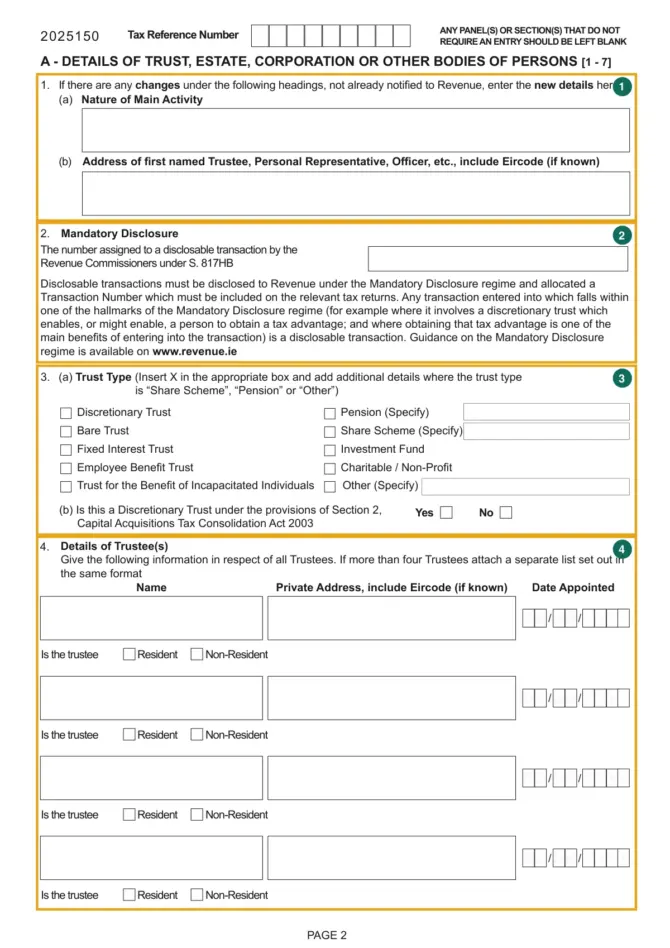
| Line | What it asks for | Points to watch |
|---|---|---|
| 1(a), 1(b) | Nature of the main activity; address of the first named trustee, personal representative or officer, with Eircode if known | Fill in only if the details changed and Revenue has not been notified. |
| 2 | Transaction number given by Revenue under section 817HB for a disclosable transaction | The form gives a discretionary trust used to obtain a tax advantage as an example of a hallmark under the Mandatory Disclosure regime. |
| 3(a) | Trust type: discretionary, bare, fixed interest, employee benefit, trust for incapacitated individuals, pension, share scheme, investment fund, charitable or non-profit, other | Pension, share scheme and other need a description in the box beside them. |
| 3(b) | Yes or No: is it a discretionary trust under section 2 of the Capital Acquisitions Tax Consolidation Act 2003 | A separate question from the tick in 3(a). |
| 4 | Every trustee: name, private address, date appointed, resident or non-resident | Room for four; attach a list in the same layout for more. |
| 5, 6, 8 | Settlors, protectors and any other person exercising control: name, address, PPSN | Two of each fit on page 3; add a list if there are more. |
| 7 | Each beneficiary or class of beneficiaries: name, address, tax identification number, whether a beneficiary for the full year | Give start or end dates for part-year beneficiaries and tick (f) if the person is no longer a beneficiary when you file. |
| 9 | Distributions of assets, including cash, out of the trust: beneficiary, type of asset, value, date | Asset types run from cash and shares to development land and works of art. |
| 10 | Transfers of assets, including cash, into the trust: settlor, disponer or donor, type of asset, value, date | Answer the Yes or No question first; four donors fit on page 5. |
Lines 9 and 10 each open with a Yes or No question about whether there was a distribution or a transfer during the year. If the answer is No, the rest of that line stays blank.
Income of the trust: Panels B to F
Each income panel has its own block of line numbers. A trust with only deposit interest and some rent may use a handful of lines in Panels B and C and leave the rest blank, as the form instructs for every panel that does not apply.
| Panel and lines | What goes there |
|---|---|
| B, 101 to 109 | Irish investment income: untaxed interest (government stocks, exchequer bills, credit union dividends), deposit interest gross of DIRT, dividends from Irish companies and REITs, settlement, covenant and estate income, patent royalties and section 757 patent sales, annuities taxed at the standard rate, investment undertaking deemed disposals at 25%, 41% or 60%, other income |
| C, 201 to 216 | Irish rents: residential lettings (with the Residential Tenancies Act 2004 registration tick at 202), then commercial property and land, capital allowances, losses forward and Non-Resident Landlord Withholding Tax |
| D, 301 to 321 | Foreign income in euro: UK, EU and other interest and dividends, US and Canadian dividends, foreign trade income, foreign rents, foreign bank accounts opened in 2025, foreign life policies, offshore funds and other offshore products |
| E, 401 to 459 | Trading or professional income of the trust or estate, capital allowances, loss claims, Professional Services Withholding Tax and the extracts from accounts at 416 to 459 |
| F, 501, 502 | Exempt woodlands profits and other exempt income |
In Panel D, foreign tax goes in only where it is available as a credit against Irish tax; where it is allowed only as a deduction, the income is entered net of it. Foreign rental losses at line 312 can be set only against foreign rental profits. Line 216 for Non-Resident Landlord Withholding Tax carries its own limit: the amount claimed must not be more than 20% of the gross rent shown.
Panel E applies where the trust or estate has trading or professional income. Pages 12 and 13 must then be completed, unless line 418 (accounts already sent with another return) or line 419 (the income comes through a partnership, whose tax reference goes in 419(a)) applies. The accounts themselves are not sent. Under line 436 the form reminds you that a Form 46G is needed where the trade paid any one person more than €6,000 for services in 2025.
Panel G: the 20% surcharge on undistributed trust income
Panel G is for discretionary trusts that keep income instead of paying it out. Section 805 of the Taxes Consolidation Act 1997 adds a surcharge of 20% to income that is accumulated or payable at the trustees’ discretion and is not distributed in the year it arose or within 18 months after the end of that year. Revenue’s Tax and Duty Manual Part 32-02-01 lists what is outside it: income treated as the settlor’s, the undistributed income of a charitable trust, and income from investments of a trust that exists only to provide pensions, lump sums and gratuities on retirement or death. Beneficiaries who later receive the income get no credit for the surcharge.
| Line | Entry on the 2025 form |
|---|---|
| 503 (A) | Trust income for the year ended 31 December 2022 |
| 504(a) | Allowable trust expenses |
| 504(b) | Distributions of income arising in 2022 made on or before 30 June 2025 |
| 505 (B) | Lines 504(a) and 504(b) added together and multiplied by 100/80 |
| 506 | Undistributed income, (A) minus (B) |
| 507 | Surcharge at 20% of line 506 |
The manual says the surcharge belongs to the later year of assessment, the year in which the 18 months run out, and goes into the trust’s return for that year and into its preliminary tax. Its own example takes income arising in 2018, an 18-month period ending on 30 June 2020, and a surcharge for 2020. Discretionary trust tax that is properly chargeable to income counts as an expense; capital gains tax does not.
The income year printed on the 2025 form does not follow that pattern. The 2024 form asked for 2022 income with distributions up to 30 June 2024. The 2025 form keeps 2022 as the income year at line 503 but moves the distribution date at 504(b) to 30 June 2025, which by the manual’s rule is the cut-off for income that arose in 2023. Ask your Revenue office which year’s income belongs on the 2025 return before you complete Panel G.
Capital gains of the trust: Panels I and J
Gains on disposals by the trustees during 2025 go in Panel I (lines 701 to 721), and assets the trust bought in 2025 are counted in Panel J (line 722). Line 701 sorts disposals into eleven asset types, from quoted shares to other assets, with the number of disposals, the area in hectares and the total consideration. Lines 702 to 704 are ticks for disposals or acquisitions between connected parties or otherwise not at arm’s length, and for market value used in place of cost. Line 705 is for relief claims, each entered as the consideration: disposal of a principal private residence, retirement relief within or outside the family, and any other relief you name.
Lines 706 to 718 take the figures down to the net chargeable gain and the losses carried forward to 2026. Line 708 asks for the name, tax reference and amount where a loss at line 707 arose on a disposal to a connected person. If the trust has an overall loss for 2025, lines 717 and 718 can be left out.
The net gain is then split by date of disposal, because Revenue collects CGT in two instalments. Line 719 takes gains arising from 1 January to 30 November 2025, and line 720 those from 1 to 31 December 2025, each divided between gains at 33%, gains at 40% (with foreign life policies on a line of their own) and venture fund capital at 15%, plus a line for land disposed of under a compulsory purchase order. Revenue’s CGT payment page gives the dates: tax on disposals up to 30 November is paid by 15 December of the same year, and on December disposals by 31 January of the next year. The return itself is due by 31 October of the year after the disposal, even where reliefs or losses leave no tax to pay.
Panels H and K, bank details and the Expression of Doubt
Panel H (lines 601 to 604) is for payments the trust makes: rents paid to non-residents with standard rate tax deducted, the clawback of tax relief at source on employees’ medical insurance (enter the relief, not the premiums), other charges and annuities paid under deduction of tax, and relief for significant buildings and gardens under section 482.
Panel K (lines 801 to 833) lists the property-based incentive schemes, from urban renewal to aviation services facilities. If you ticked line 201 (rental relief at 205(c) or 213(b)) or line 408 (trade capital allowances) because a claim includes one of these reliefs, the scheme and the amount claimed for the year go here. The form warns that these are “specified details” under sections 1052 and 1084, and that an incomplete Panel K can bring a penalty or a surcharge.
Page 20 takes an IBAN and BIC for refunds. Revenue cannot pay a refund into a foreign account outside SEPA, and later refunds go to the same account unless you tell Revenue otherwise. The same page has the Expression of Doubt under section 959P: insert T and set out the facts, the point of law, the tax in doubt, the documents you are sending with the return and any Revenue guidelines you looked at. It is not a space for general notes.
Panel L: the trustees’ self-assessment and the payslip
Line 901 is the income tax self-assessment and line 902 the capital gains tax self-assessment, each signed and dated separately with the capacity of the signatory. The form says you do not have to complete these panels if you submit the return to Revenue on or before 31 August 2026, and that an individual who fails to make a self-assessment may face a €250 penalty.
Lines 901(f) and 902(d) are for the late filing surcharge under section 1084: 5% of the tax due, capped at €12,695, if the return is up to two months late, and 10%, capped at €63,485, after that. Lines 901(g) and 902(e) carry a 10% surcharge where the Local Property Tax return or payment is not in order on the day you file, even if the return itself is on time. Line 901(h) is the preliminary tax already paid for 2025, without any balance you are paying with the return.
The payslip on the last page covers two amounts: the 2025 balance and preliminary tax for 2026. The form sets the minimum preliminary tax at the lower of 90% of the final 2026 liability or 100% of the final 2025 liability. A cheque goes to the Collector-General with the payslip; ROS and myAccount payments need no payslip.
When Form 1 is due and where to file it
Revenue publishes the 2025 Form 1 as a PDF; the 2024 form is at form1-2024.pdf in the same folder. The notice on page 1, issued under sections 879 and 959I, asks for the 2025 return, and for payment of any balance of tax for 2025, on or before 31 October 2026.
Part 38-01-03a lists Form 1 as the specified return for trusts, with preliminary tax and the balance due as the specified liabilities, and says electronic filing is mandatory unless Revenue has granted an exemption. Revenue can exclude a taxpayer who does not have the capacity to file and pay online; the request is made in writing, and a refusal can be appealed to the Tax Appeals Commission within 30 days.
Revenue eBrief No. 034/26 moved the 2026 date to Wednesday 18 November 2026 for customers who both pay and file their 2025 Form 11 through ROS, and for certain CAT returns. The eBrief does not name Form 1. Revenue’s ROS Pay and file page refers to “returns due on 31 October 2026” generally, so check with your Revenue office before relying on 18 November for a trust return.
A paper return goes Freepost, with no stamp needed, to:
Office of the Revenue Commissioners
Collector General’s Division
PO Box 354
Limerick
The form asks for blue ink, dates written day, month, year, and a separate schedule in the same layout if a panel runs out of space. A paper filer who later finds an error contacts the Revenue office; returns filed on ROS can be amended there.
Questions about Form 1 for trusts
Is there a separate Form 1 for trusts?
Revenue issues one Form 1 for trusts, estates, receiverships, unincorporated bodies, corporations liable to income tax and other bodies named on page 1. The trust ticks “Trust” on page 1 and completes the trust lines in Panel A and, for a discretionary trust, Panel G.
Do I list every beneficiary of a discretionary trust?
Line 7 asks for all beneficiaries or classes of beneficiaries, with name, address and tax identification number. Where there are more than two, attach a list in the same format.
Does an estate in administration use Form 1?
The return has an “Estate” box on page 1, and line 1(b) asks for the address of the first named personal representative. Panel E covers an estate that carries on a trade, with extracts from accounts at lines 416 to 459.
Official sources
- Revenue, Form 1, Tax Return and Self-Assessment for the year 2025
- Revenue, Form 1, Tax Return and Self-Assessment for the year 2024
- Revenue, Tax and Duty Manual Part 32-02-01, Surcharge on Undistributed Income of Trusts (reviewed August 2026)
- Revenue, Tax and Duty Manual Part 38-01-03a, Guidelines for Registration (reviewed September 2026)
- Revenue, eBrief No. 034/26, Pay and File Extension Date 2026
- Revenue, Pay and file (ROS help)
- Revenue, Pay and file system: how does it work?
- Revenue, When and how do you pay and file CGT?