Form 11 is the Income Tax return and self-assessment that Revenue expects from every “chargeable person” in Ireland: the self-employed, landlords, proprietary directors, and PAYE workers whose side income has crossed the limits printed on page 1. The 2025 edition (form code 2025120, RPC020497_EN_WB_L_1) covers the year ended 31 December 2025 and does three things at once: it returns income, charges and capital gains, it claims credits and reliefs, and in Panel P it carries your own calculation of the tax due. Page 2 states that this paper form is only to be used for the 2025 tax year.
The paper version has 42 pages and sixteen lettered panels, A to P, plus a bank details page and two appendices for extra trades and employments. The same return can be filed on the Revenue Online Service (ROS), which has its own screens built on the same line numbers. This guide follows the paper form and notes where ROS differs.
Who has to file a Form 11 for 2025
The notes on page 1 and Revenue’s Guide to Completing 2025 Pay & File Self-Assessment Returns (pages 4 and 5) list the situations that make you a chargeable person for 2025:
- you have trading or professional income from a business, trade, profession or vocation;
- you have PAYE income and your gross income from all non-PAYE sources, deposit interest subject to DIRT included, is €30,000 or more;
- you have PAYE income and your net assessable non-PAYE income, after expenses, capital allowances and losses forward, is €5,000 or more;
- you are a proprietary director, meaning you own or control more than 15% of a company’s ordinary share capital;
- you opened a foreign bank account in 2025 in a non-cooperative jurisdiction or one outside DAC2, CRS or FATCA reporting;
- you have foreign income, rental income or other non-PAYE income such as dividends, settlements or maintenance that is not taxed through PAYE.
Two exclusions are printed on the form itself. An income tax gain on exercising, assigning or releasing a share option under section 128 does not by itself make you a chargeable person, although a capital gain on later selling those shares is taxed under self-assessment. And the Capital Gains Tax self-assessment system applies to every individual, directors included.
Revenue also publishes Form 11S, a shorter extract of Form 11 with the same line numbers but fewer panels. The guide says a chargeable person uses the full Form 11 unless everything relevant to them fits on Form 11S. PAYE employees and pensioners who are not chargeable persons file Form 12 or Form 12S instead, and someone with a capital gain but no Income Tax return to make uses Form CG1. If you think you are no longer a chargeable person, the guide points to ceasing your Income Tax registration in ROS (Manage Tax Registrations) or, if you are not on ROS, on Form TRCN1 sent to your Revenue office.
Paper or ROS: the mandatory e-filing rule
Page 1 warns that a mandatory e-filer under section 917EA must file through ROS even if Revenue posted them a paper Form 11. Revenue’s Mandatory e-filing page says most business customers are legally obliged to file and pay electronically and that not using ROS can bring a penalty of €1,520 on each transaction. The helpsheet asks you to check the categories on revenue.ie before posting a paper return.
ROS also does the calculation for you. Registration has three steps: apply for a ROS Access Number (RAN), which is posted to your home address; apply for a digital certificate using that RAN; then download the certificate with the system password Revenue sends by text or email. The helpsheet says to allow at least six working days for this. If you already have a myAccount login you may be able to register for ROS under Manage My Record. The ROS Technical Helpdesk is on (01) 738 3699, +353 1 738 3699 from abroad, or roshelp@revenue.ie.
Deadlines, surcharges and preliminary tax
The due date printed on page 2 for posting the 2025 return is 31 October 2026, and on that date any balance of 2025 tax is also payable. Revenue’s Filing your tax return page gives a later date, 18 November 2026, for anyone who both files and pays on ROS; Tax and Duty Manual Part 38-01-04J adds that the ROS date also covers filing when there is nothing to pay. By the same 31 October you pay preliminary tax for 2026.
A return filed after the due date carries a surcharge on the tax due. The guide (page 11) sets it at 5% of the tax due, capped at €12,695, for a return filed after 31 October 2026 and on or before 31 December 2026, and 10%, capped at €63,485, after 31 December 2026. A separate 10% surcharge is added if, when you file, your Local Property Tax return is missing or the LPT has not been paid or put on an agreed payment arrangement; once LPT is brought up to date, that surcharge is capped at the LPT owed. Revenue’s Pay and file page notes the LPT surcharge can apply even when Income Tax is paid and filed on time.
Form 11 and the helpsheet say Revenue calculates the tax for paper returns filed on or before 31 August 2026. The guide (pages 10 and 62) says that date was extended to 30 September 2026. Both dates are past, so a paper Form 11 filed now needs its own self-assessment in Panel P; leaving it out can cost a €250 penalty. If the two dates matter for a return already sent, Revenue’s Forms & Leaflets Service is on +353 1 738 3675.
Preliminary tax is your estimate of Income Tax, PRSI and USC for the current year. Revenue’s preliminary tax page says it must be at least the lowest of 90% of this year’s tax, 100% of last year’s, or 105% of the year before last; the 105% option applies only to direct debit payers and not where that year’s tax was nil. In your first year in self-assessment you can pay 100% of the previous year’s liability, which is normally nil.
How the 2025 Form 11 is laid out
Each entry has a line number, and the helpsheet and guide use the same numbers. Panel A on pages 3 and 4 must always be completed; any panel that does not apply to you is left blank.
| Panel | Lines | Pages | What goes there |
|---|---|---|---|
| A Personal details | 1 to 28 | 3 to 5 | Civil status, spouse or civil partner, residence and domicile, mandatory disclosure numbers, EU de minimis aid |
| B Self-employed income | 101 to 168 | 6 to 9 | Primary trade, capital allowances, losses, farming, PSWT, extracts from accounts |
| C Irish rental income | 201 to 218 | 10 to 12 | Residential and commercial lettings, rental reliefs, NLWT |
| D and E PAYE, BIK, pensions | 219 to 249 | 13 to 16 | Each employment or pension, refunds, non-PAYE pay, employment expenses, social welfare, lump sums, directorships |
| F Foreign income | 301 to 325 | 17 to 20 | Foreign pensions, interest, dividends, rents, employments, offshore products, foreign bank accounts |
| G Irish other income | 401 to 413 | 20 to 21 | Fees, untaxed interest, deposit interest, Irish dividends, IREF and investment undertakings |
| H Exempt income | 414 to 419 | 21 | Artists exemption, woodlands, Rent-a-Room, childcare services |
| I Charges and deductions | 501 to 513 | 22 to 23 | Maintenance, covenants, pension contributions, sportspersons relief |
| J Personal tax credits | 514 to 552 | 23 to 29 | Credits, investment reliefs, rent, mortgage interest, donations, health expenses |
| K Restriction of reliefs | 601 to 603 | 30 | High-income individuals, figures from Form RR1 |
| L Capital gains | 801 to 826 | 30 to 32 | Disposals, reliefs, losses, gains by rate and period |
| M Chargeable assets acquired | 827 | 32 | Number and cost of assets bought in 2025 |
| N Capital acquisitions | 828 | 33 | Tick box for a gift or inheritance received in 2025 |
| O Property based incentives | 901 to 935 | 33 to 34 | Annual cost of each property or area-based relief claimed |
| P Self-assessment | 936 to 937 | 34 to 35 | Your own Income Tax and CGT calculation |
| Bank details, expression of doubt | no line numbers | 36 | IBAN and BIC for refunds, genuine doubts under section 959P |
| Appendix 1 and 2 | 101 to 168, 219 to 232 | 37 to 42 | Trade 2 and employments beyond the main pages |
Panel A: personal details, residence and de minimis aid (lines 1 to 28)
Line 1 is only for a return made on behalf of someone who has died: date of death, the personal representative’s name and address, and the date of the grant of probate or letters of administration. Line 2 is your date of birth, which the helpsheet says feeds age-related reliefs. Line 3 (civil status) must always be answered, line 4 only if your status changed in 2025, and line 5 picks joint assessment, separate assessment or single treatment. When the basis is joint assessment, line 6 asks for your spouse’s or civil partner’s PPSN, name, date of birth, gender and date of marriage or civil partnership, and the helpsheet warns that leaving it out can delay processing. Revenue’s manual for the ROS form adds that the spouse’s PPSN links both records, so a wrong number links the wrong person.
Lines 7 and 8 cover dependent children and the date of death for the widowed person with dependent child credit. Line 9, which also must always be answered, asks whether you or your spouse are within the high-income individuals’ restriction; a “yes” means completing Form RR1 2025 and Panel K. Lines 10 to 13 are tick boxes for permanent incapacity, proprietary directorship, a full medical card and PRSI exemption with the reason.
Lines 14 to 18 deal with residence. You are resident for 2025 after 183 days in Ireland in the year, or 280 days across 2024 and 2025 combined (the guide adds that the two-year test does not apply if you spent 30 days or less in Ireland in either year). Line 14 also records ordinary residence, domicile and nationality; lines 15 to 18 are for non-residents and include the claim for a portion of allowances under section 1032(2), which needs your income chargeable in the State and your world income. Lines 19 and 20 take mandatory disclosure and cross-border arrangement reference numbers.
Page 5 (lines 21 to 28) is a declaration for EU de minimis aid. It is only needed when you claim Living City Initiative allowances under section 372AAC or 372AAD, aviation services facilities allowances, the section 216F exemption for musical instrument profits, or registered farm partnership relief under section 667C. You give the aid in this return and any other de minimis aid received in the past three years; the general ceiling is €300,000 and the agricultural one €50,000 over three years.
Panel B: self-employed income and the extracts from accounts
Pages 6 to 9 take the primary trade, including farming and partnership income. A second trade goes in Appendix 1 on pages 37 to 40; with more than two, the appendix is photocopied.
Lines 101 to 109. Say whose income it is, describe the trade clearly (line 102), answer whether it includes construction, forestry or meat-processing operations within Relevant Contracts Tax (line 103), and tick line 104 if you are a sub-postmaster or Social Welfare Branch Manager. Line 106 is new for 2025: a joint election for a medical partnership under section 1008A(4), with the partnership’s name. Line 108 holds the adjusted net profit or loss for the accounting period, and line 109 the assessable profit, entered even when it equals line 108(a) and shown as 0.00 for a loss. The helpsheet explains the basis: for accounts made up to 30 June, the 2025 assessable profit is the profit of the year to 30 June 2025.
Lines 110 to 116. Relevant lease elections under section 299, balancing charges, capital allowances carried forward and claimed for 2025: machinery and plant (with energy-efficient equipment, childcare and fitness equipment, gas vehicles and farm safety equipment split out), industrial and farm buildings, and specified relief allowances. Tick line 113 and complete Panel O if any amount relates to a property-based incentive.
Lines 117 to 123. Line 117 claims 2025 trading losses and unused capital allowances against other income, with a printed claim deadline of 31 December 2027 and a €31,750 cap on a relevant loss under section 381B. Line 118 carries forward prior-year losses and line 119 terminal loss relief on a ceased trade. Lines 120 and 121 are for farmers: relief for qualifying farmers under section 667B, registered farm partnerships, share farming, income averaging elections and succession farm partnerships. Line 122 is the gross Professional Services Withholding Tax for the 2025 basis period before any interim refund, never Relevant Contracts Tax. Line 123 is PRSI paid direct by sub-postmasters and Social Welfare Branch Managers.
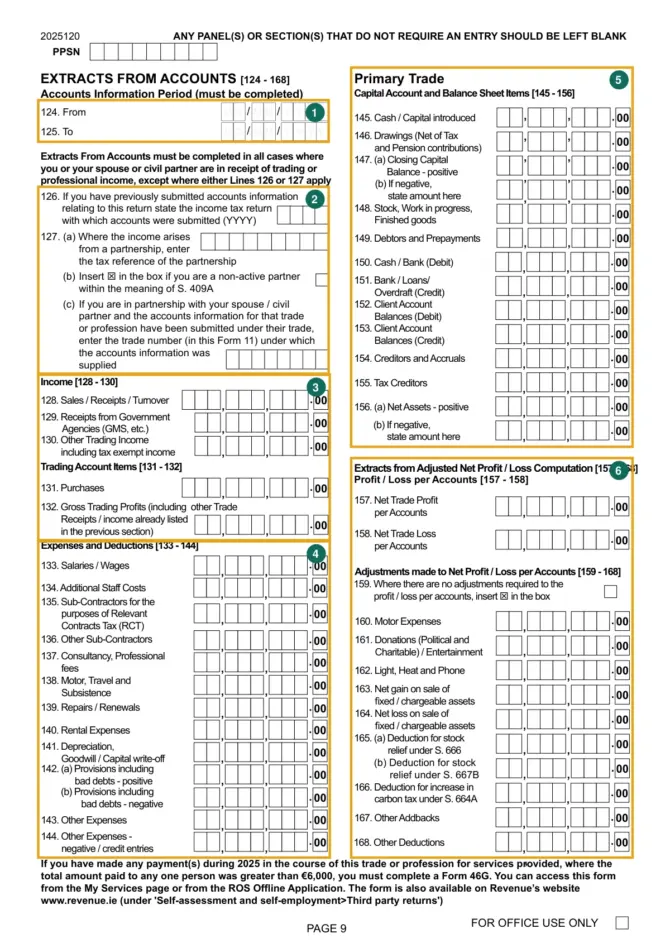
Lines 124 to 168, the extracts from accounts. You prepare accounts but do not send them; the helpsheet says every sole trader completes the extracts regardless of turnover, unless line 126 (accounts already submitted with another year’s return) or line 127 (a partnership, identified by the partnership’s tax reference from its Form 1 (Firms) return) applies. The accounting period at lines 124 and 125 must always be filled in. Lines 128 to 144 are the trading account and expenses, 145 to 156 the capital account and balance sheet, 157 and 158 the profit or loss per accounts, and 159 to 168 the adjustments to reach the tax figure (tick 159 if there are none). The helpsheet stresses that these pages are not a tax computation. The note under the page adds that payments over €6,000 to any one person for services in 2025 mean a separate Form 46G.
Panel C: Irish rental income (lines 201 to 218)
Residential lettings (lines 201 to 208) and commercial property, land and other Irish rents (lines 209 to 215) are entered separately for you and your spouse. Line 202 confirms registration with the Residential Tenancies Board for every tenancy in 2025; the helpsheet says the interest deduction at line 205(b) depends on it. Line 205(d) is pre-letting expenditure under section 97A on a property vacant for at least 12 months and let between 25 December 2017 and 31 December 2026. Keep a separate computation for each property; Rent-a-Room income stays out of this panel and goes in Panel H.
Line 207 claims Residential Premises Rental Income Relief. You tick the four conditions (RTB registration, not let to a connected person, LPT compliance, a valid tax clearance certificate) and give the LPT ID, net rental income and ownership share of the property with the highest net profit. The helpsheet limits the 2025 relief to the lowest of €800, 20% of your Case V income from qualifying premises, or 20% of your total Case V income, and it is for individual landlords only. Line 208 is Retrofitting Rental Properties Relief for up to two properties, with the date of the work, LPT ID, the contractor’s VAT number, cost and SEAI grant; the deduction is the lesser of €10,000 or the cost not covered by the grant.
Lines 212(c) and (d) cover exempt farmland lease income under section 664 and the 7-year holding rule for land acquired on or after 1 January 2024. Lines 215 to 217 hold capital allowances, the section 305 election to use unused building allowances against other income (capped at €31,750 where section 409A applies) and losses forward. Line 218 is for non-resident landlords: the gross rent that suffered Non-resident Landlord Withholding Tax and the NLWT deducted, which may not exceed 20% of that rent.
Panels D and E: PAYE income, pensions and employment expenses
Panel D (lines 219 to 232) takes two employments or pensions on pages 13 and 14; Appendix 2 on pages 41 and 42 takes two more and is photocopied beyond four. For each one: employer’s PAYE number and name, the gross taxable income and USC income from the final 2025 payslip, net tax and USC deducted or refunded, and line 223, the source of income (employment, directorship, SARP, public sector classes, pensions, ARF or PRSA distributions). The helpsheet says the choice at line 223 affects which reliefs you can claim later in the return. Proprietary directors enter only tax actually remitted to Revenue, and line 224(c) separates bonuses earned in one year and paid in the next. Lines 230 to 232 cover SARP relief, the research and development credit surrendered by an employer, and foreign tax deducted from Irish pay in a treaty state.
Panel E (lines 233 to 249) starts with PAYE and USC refunded by Revenue in 2025 and tax underpaid that reduced your credits (lines 233 to 235); refunds made through payroll belong at line 224 instead. Line 236 is Irish employment income not taxed under PAYE, and line 237 benefits not taxed at source, such as free or discounted shares. Lines 238 and 239 take pay for duties performed in Ireland for a foreign employment and employment pensions, where PAYE was not deducted, and line 241 superannuation or AVC contributions your employer did not deduct. Line 240 claims employment expenses: flat-rate expenses, other expenses incurred wholly, exclusively and necessarily, and Remote Working Relief, which is 30% of the electricity, heat and broadband cost for the days worked from home, less anything your employer reimbursed. Line 242 is the Foreign Earnings Deduction. Social welfare goes at lines 243 to 245, pension lump sums at 246, convertible securities and share option elections at 247 and 248, and line 249 lists each company in which you or your spouse were a proprietary director, with its tax number and your percentage holding.
Panels F, G and H: foreign, other Irish and exempt income
Panel F (lines 301 to 325) is entered in euro. Foreign tax goes on the form only when it is a credit against Irish tax; if it is only a deduction, the income is entered net of it, and if it was refunded abroad you enter the gross income and no foreign tax. The panel runs from UK dividends and foreign pensions (301 to 303) through EU, UK and non-EU interest (304 to 307), foreign employments and transborder relief (308 and 309), split year treatment (310), US and Canadian dividends (311 to 313), foreign trade and rental income (314 to 316, where foreign rental losses can only be set against foreign rental profits), to Irish tax on encashment (320). Lines 321 to 324 ask for details of a foreign bank account opened in 2025 in a listed jurisdiction, foreign life policies, offshore funds and other offshore products. Line 325 claims additional double taxation relief.
Panel G (lines 401 to 413) takes Irish fees and commissions, untaxed interest, deposit interest and credit union dividends with DIRT, dividends from Irish resident companies (REIT dividends separately), settlements, covenants and maintenance received, patent royalties and patent rights sales, annuities taxed at source, deemed disposals of investment undertakings, Irish Real Estate Fund taxable events and withholding tax, and income chargeable under section 811B. Line 413 is a catch-all for income not shown anywhere else. Panel H (lines 414 to 419) records exempt income: the artists exemption, woodlands, Rent-a-Room income (exempt up to €14,000 for 2025, per the helpsheet), childcare services income (exempt up to €15,000 gross, subject to conditions) and other exempt income.
Panels I and J: charges, pension contributions and credits
Panel I (lines 501 to 513) covers the clawback of tax relief at source for employers who paid staff medical insurance, maintenance paid to a former spouse or civil partner under a legally enforceable arrangement (child maintenance is ignored), covenants, other charges, interest paid to non-residents, and pension contributions, with line 506 naming the earnings the pension relief is claimed against. For retirement annuity contracts (507), PRSAs (508) and qualifying overseas pension plans (509) you can claim relief for 2025 on contributions paid between 1 January 2026 and 31 October 2026, as well as those paid in 2025; line 510 is the total. Line 511 is retirement relief for certain sportspersons, line 512 interest on a loan to buy into a partnership, and line 513 expenditure on significant buildings and gardens under section 482.
Panel J (lines 514 to 552) holds the credits. The ones with figures in the helpsheet and guide for 2025:
| Line | Credit or relief | 2025 figure or condition |
|---|---|---|
| 514 | Home Carer tax credit | Up to €1,950, reduced by half the home carer’s income over €7,200 |
| 515, 516 | Employee and Earned Income tax credits | Up to €2,000 each, combined maximum €2,000 |
| 519 | Dependent Relative tax credit | Up to €305; none if the relative’s income exceeds €18,028 |
| 527 | Incapacitated Child tax credit | Form ICC1 with a Form ICC2 certified by a medical practitioner |
| 529 | Mortgage Interest tax credit | Loan balance at 31 December 2022 above €80,000 and below €500,000; LPT ID needed |
| 532 | Fisher tax credit | €1,270, at least 80 days at sea in 2025 |
| 533 | Seafarer allowance | Up to €6,350, at least 161 days at sea in 2025 |
| 535 | Rent tax credit | Up to €1,000, or €2,000 for a jointly assessed couple |
| 537, 538 | Donations to sports bodies and National Governing Bodies | At least €250, not already surrendered on an SPR1 or SPR2 |
Other lines in the panel: blind person and assistance dog credits (517, 518), employing a carer (520), permanent health benefit (521), the SURE, EII and Start-up Capital Incentive investment reliefs with company details and statements of qualification (522 to 524), tuition fees for the academic year starting on or after 1 August 2025 (525), the Single Person Child Carer Credit with primary, relinquishing and secondary claimant sections (526), medical insurance paid by an employer (528, since premiums you pay yourself get relief at source), owner occupier relief (530), the Home Renovation Incentive balance brought forward (531), sea-going naval personnel (534) and the year of marriage review (536). The rent tax credit at line 535 asks you to confirm you get no HAP, RAS or other State housing support for the tenancy, that the landlord is not a Minister, Housing Authority or Housing Association, and which of the residence, work or study, or child-in-education conditions applies, followed by the RTB number if known, address, tenancy dates, rent paid in 2025 and the landlord’s details.
Health expenses close the panel. Nursing home costs go at lines 539 to 544, less amounts from the HSE, health insurance or a compensation claim. Non-routine dental work (from the dentist’s Med 2) and other qualifying health expenses go at lines 545 to 552, with line 546 taking expenses already claimed through real time credits in 2025.
Panels K to O: high-income restriction, capital gains and property incentives
Panel K (lines 601 to 603) is filled in from a completed Form RR1 2025. The helpsheet says the restriction applies when your adjusted income is at least the income threshold (normally €125,000), the specified reliefs you used are at least €80,000, and those reliefs exceed 20% of your adjusted income.
Panel L (lines 801 to 826) is required for every disposal of a chargeable asset in 2025, even where the CGT was already paid on CGT Payslip A or CGT Payslip B. Line 801 lists disposals by asset type with numbers and consideration; lines 802 to 805 flag connected-party and market-value transactions; lines 806 and 807 claim reliefs for principal private residence, retirement relief under sections 598 and 599 (with consideration and date of disposal), a site to a child and farm restructuring; lines 808 and 809 claim to defer CGT on a relevant disposal under section 599(4A)(c). Lines 810 to 823 work from gains and losses to the net chargeable gain, with the personal exemption at line 818 (a maximum of €1,270 per spouse, not transferable, used after losses). Lines 824 and 825 split the net gain by rate (33%, 40%, 10% for section 597AA, 15% for venture fund capital) between 1 January to 30 November 2025 and 1 to 31 December 2025, and line 826 claims relief for foreign tax.
Panel M (line 827) counts assets bought in 2025 and their cost by type. Panel N (line 828) is a single tick box for a gift or inheritance received in 2025; the panel itself states that ticking it does not replace a Capital Acquisitions Tax return (Form IT 38), which is a separate obligation, for example when the gift or inheritance plus earlier ones from the same group exceeds 80% of the group threshold. Panel O (lines 901 to 935) lists each property or area-based incentive (urban, town, seaside and rural renewal, Living City Initiative, nursing homes, hotels, childcare buildings and others), split between investor-lessor and owner-occupier. You enter the annual cost of the relief for the year, without amounts carried forward, and the panel warns that incomplete details can lead to penalties under section 1052 or a surcharge under section 1084.
Panel P: completing the self-assessment (lines 936 and 937)
Line 936 is the Income Tax self-assessment. (a) is total income before deductions and reliefs; for a trade, the adjusted net profit before losses forward and capital allowances. (b) breaks down the tax chargeable: income tax after deductions but before credits, USC for you and your spouse separately, PRSI on trading and investment income for each of you (not PRSI on Irish employment income), and the total. (c) and (d) bring the figure down to tax payable or overpaid after credits such as DWT, DIRT, PAYE and PSWT, with any interim PSWT refund at (c)(iii). (f) is the late filing surcharge, (g) the LPT surcharge, (h) preliminary tax paid for 2025 (not a balancing payment you are making now) and tax deferred under section 657(6A), and (i) the balance payable or overpaid.
Line 937 does the same for CGT: chargeable gains, tax chargeable, tax deferred or now due under section 599(4A), tax payable, surcharges, tax already paid to the Collector-General and the balance. Revenue’s manual on the ROS form says the “tax payable” figure is the full CGT liability even where it was paid when the asset was sold; entering zero because it is already paid is a common error. Each of 936 and 937 has its own declaration, signature and date. The helpsheet is explicit that if you make your own self-assessment and do not sign the panel’s declaration, you have not made one.
Page 36: bank details and an expression of doubt
Give an IBAN (up to 34 characters) and BIC (up to 11) only if you want refunds paid to your account; a non-SEPA foreign account cannot receive one. Jointly assessed couples give the spouse’s or civil partner’s details too. The expression of doubt under section 959P is for a genuine doubt about how tax law applies to an item in the return: the facts, the doubt and the legislation behind it, the tax in doubt, the supporting documents (which accompany the return) and the Revenue guidelines you consulted. It is not a box for general notes. The guide says the return and the documents must arrive by the return filing date, and if Revenue does not accept the doubt as genuine you can appeal to the Tax Appeal Commissioners within 30 days.
What changed on the 2025 Form 11
Revenue’s Tax and Duty Manual Part 38-01-04J lists the updates to the 2025 ROS Form 11. Those that also appear on the paper form:
- Line 106 is a new field confirming a joint election for a medical partnership under section 1008A(4).
- Line 22 asks for the profits covered by a section 216F claim for musical instrument production, maintenance and repair.
- Lines 803, 808 and 809 are new Capital Gains fields to claim deferral of CGT on a relevant disposal under section 599(4A)(c) and to declare deferred CGT now due; retirement relief claims at lines 806 and 807 now ask for the consideration and date of disposal.
- Line 531 brings back the Home Renovation Incentive so an unused balance carried forward can be claimed.
- Line 522 (SURE) has new Investment Amount and Deduction Amount columns.
- Lines 537 and 538 replace the earlier sports body donation fields, covering approved sports bodies and National Governing Bodies (added to ROS on 20 April 2026).
- The rent tax credit wording now covers “digs” and rent-a-room payments for a child on an approved course.
- The field for gross rents payable to non-residents has been removed from the charges and deductions panel.
- Credit values for 2025: personal credit €2,000 (married or civil partners €4,000), employee and earned income credits €2,000, widowed person €2,540, home carer €1,950.
Four new Professional Services Withholding Tax fields exist on ROS only; the paper form keeps a single gross amount at line 122.
Getting Form 11, posting it and paying
The 2025 Form 11 and its helpsheet are on Revenue’s Tax return forms page, with the 2021 to 2024 editions listed as older versions; Revenue has not published a 2026 Form 11, so the 2025 return is the current one. Paper copies of forms and leaflets are available from the Forms & Leaflets Service on +353 1 738 3675.
The guide asks for blue ink and capital letters, entries inside the boxes only, and no lists, schedules, “per attached” or “as before”. Sign and date the declaration on page 1, giving your capacity if you sign as executor, guardian, administrator or authorised agent. Post the return in any envelope with “Freepost” written above the address; no stamp is needed:
Office of the Revenue Commissioners
Collector-General’s Division
PO Box 354
Limerick
The paper form does not take payment. Revenue’s preliminary tax page lists the ways to pay: ROS (ROS Debit Instruction, debit or credit card), myAccount (a once-off Single Debit Instruction or a card) or direct debit set up through ROS; only Visa and MasterCard are accepted. To correct a paper return, Revenue’s Pay and file page tells you to contact your Revenue office; ROS returns are amended on ROS. Supporting documents, business accounts included, are kept for six years.
Official PDF: Form 11 — Official PDF (revenue.ie)
What gets a Form 11 sent back or queried
- Incomplete returns, or entries such as “per attached” and “as before”, are sent back for completion, and the guide warns a surcharge can follow if the corrected return arrives late.
- No signature on the Panel P declaration means no self-assessment, with a possible €250 penalty.
- Entering the full electricity, heat or broadband bill at line 240(b)(iii) instead of the allowable 30%: Revenue’s manual says this led to requests for receipts and delayed returns and refunds.
- Claiming a married credit with a wrong spouse PPSN at line 6, which links the wrong records.
- Entering capital losses in full when they exceed the gain, using the personal exemption before losses, or not using the €1,270 exemption at all, which the manual lists as common misunderstandings in Panel L.
- Filing on time but with Local Property Tax unfiled or unpaid, which adds the 10% surcharge at line 936(g).
Questions about Form 11
Do I send my accounts or receipts with Form 11?
Only documents the form asks for: the Mortgage Interest tax credit (the 31 December 2022 loan balance and the 2022 and 2025 interest certificates), the Incapacitated Child credit (ICC1 and ICC2) and an expression of doubt. Business accounts are summarised in the extracts from accounts and kept for six years.
My spouse and I both have income. Do we file one Form 11 or two?
One return showing both spouses’ or civil partners’ income, gains and gifts, unless you have made a formal election to be dealt with separately. Revenue’s manual says separate assessment is elected between 1 October of the previous year and 31 March of the year it applies to.
I already paid the CGT when I sold. Do I still fill in Panel L?
Yes, the helpsheet requires Panel L for every 2025 disposal even if the tax was paid, and the gain must be reported in the year after the disposal even when reliefs or losses leave nothing to pay.
How long do I have to claim a refund for an earlier year?
The guide cites a four-year limit under section 865: a claim for 2022 must reach Revenue by 31 December 2026.
Sources
- Revenue Commissioners, Income Tax Return and Self-Assessment for the year 2025, Form 11 (2025120)
- Revenue Commissioners, 2025 Tax Return Helpsheet, Form 11
- Revenue Commissioners, Guide to Completing 2025 Pay & File Self-Assessment Returns
- Revenue Commissioners, Tax and Duty Manual Part 38-01-04J, Income Tax return form 2025, ROS Form 11
- Revenue Commissioners, Tax return forms
- Revenue Commissioners, Filing your tax return
- Revenue Commissioners, Pay and file system, how does it work?
- Revenue Commissioners, What is preliminary tax?
- Revenue Commissioners, What forms do you need to complete?
- Revenue Commissioners, Mandatory e-filing