Form 54 Claims 2025 asks for the claimant’s full income position, not only the amount of DIRT deducted. Its seven pages cover credits and reliefs, health expenditure, capital disposals, a signed declaration and repayment bank details. Use this edition for 2025; earlier years have their own forms.
Who can claim and when this form is unnecessary?
The form covers repayment of income tax deducted at source, including annuities, covenants, deposit interest retention tax (DIRT) and dividend withholding tax. It can be completed by the individual, an authorised adviser, an executor or administrator finalising pre-death tax affairs, or a guardian, trustee or other permitted representative of a minor or incapacitated person. State the representative capacity in the declaration. Do not send another 2025 claim if one has already been made.
For the DIRT refund conditions printed on this edition, the claimant or spouse/civil partner may qualify by being at least 65 before January 1, 2026 and exempt from tax for 2025. Alternatively, the under-65 condition concerns permanent mental or physical incapacity to maintain oneself and credits/reliefs exceeding the year’s tax liability.
The 2025 age exemption limits printed here are €18,000 for a single, widowed or surviving civil partner and €36,000 combined for a married couple/civil partners, increased by €575 for each of the first two dependent children and €830 for each later child. Marginal relief can apply slightly above the limit for people aged at least 65. The form is also suitable for under-65 individuals whose liability is covered by personal credits; that statement does not remove the specific DIRT refund conditions.
Revenue’s current DIRT page also identifies deducted interest on qualifying Mother and Baby Institutions Payment Scheme monies and CervicalCheck Relevant Payment monies, and the first-year exemption situation. First-time-buyer refunds use the Help to Buy route identified there. Confirm the appropriate claim basis with Revenue when one of those specific cases applies.
Completing pages 1 and 2: identity and every income source
Enter the PPSN, name and address on page 1. Mark the declaration indicator if DIRT-exempt account declarations were made in 2025. A repayment may cover DIRT deducted between January 1 and the account becoming exempt.
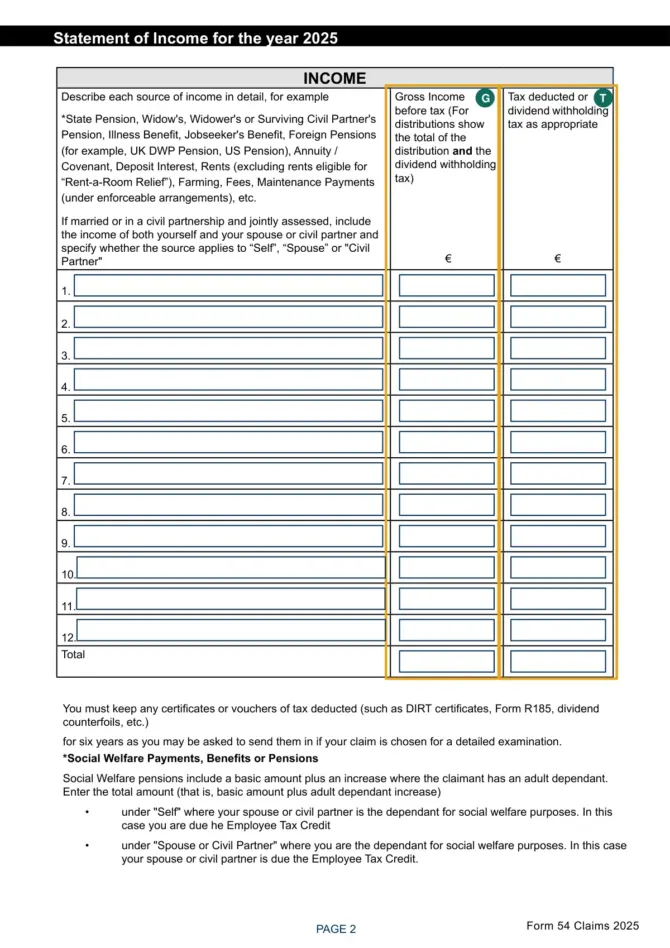
| Field | What to enter or check |
|---|---|
| Page 2, rows 1–12 | Describe each income source, gross income and tax deducted/DWT. Include pensions, annuities, covenants, interest, taxable rent, farming, fees and enforceable maintenance where applicable. |
| Joint assessment | Include both people’s income and identify each source as Self or Spouse/Civil Partner. |
| Dividend distributions | Gross amount includes the distribution plus dividend withholding tax, not only the net received. |
| Social welfare pensions | Include the basic pension and adult dependant increase together. Attribute that total to the pension claimant as explained in the note, which affects the Employee Tax Credit. |
| Total and evidence | Complete the income and tax totals. Keep DIRT certificates, R185, dividend counterfoils and other tax evidence for six years. |
For the social welfare note, where your spouse is the adult dependant, the total goes under Self; if you are the dependant, it goes under Spouse/Civil Partner. Do not list exempt Rent-a-Room receipts in taxable rents on page 2 when separately claiming the page 3 relief.
Page 3: personal status, incapacity and exempt receipts
Mark the applicable civil status for 2025: single, married, widowed, separated, divorced, civil partner, surviving civil partner, separated civil partner or former civil partner. Supply the spouse/civil partner name when required and the applicable marriage/partnership, death, separation, divorce or dissolution date. A marriage or partnership formed after December 31, 2024 needs its date here.
Enter the dependent-child count for the increased exemption. Mark Self and/or Spouse/Civil Partner for permanent incapacity; a first claim under that heading requires a medical certificate describing its nature and extent. For the Age Tax Credit area, enter the requested dates of birth where a person was born before January 1, 1961.
Rent-a-Room receipts have separate Self and Spouse/Civil Partner amounts; the form states a €14,000 gross limit for 2025 and requires the residence and other relief conditions. Childcare Services has separate gross-before-expense amounts and exemption checkboxes for each person; its stated €15,000 limit also has conditions under section 216C TCA 1997. Do not treat either amount alone as proof of eligibility.
Pages 4 and 5: health costs, charges and other relief claims
Keep nursing-home expenses separate from non-routine dental and other health expenses. For an approved nursing home enter the expense, resident’s PPSN, home’s name/address/Eircode, then deduct public/local authority payments, insurance and other compensation. Total those deductions and calculate the net claim.
The second health block has separate dental and other qualifying costs, followed by the same three reimbursement categories, deduction total and net claim. Amounts received or receivable must be taken into account. For non-routine dental costs, obtain Med 2 signed and certified by the dentist; retain it and receipts for six years rather than submitting Med 2 with this return.
Page 5’s charges area asks for payment type, whether tax was deducted by you, recipient name/address/Eircode, relationship and gross payment. It covers applicable annuities, maintenance, covenants and rent paid to a nonresident.
| Field | What to enter or check |
|---|---|
| Other relief amount boxes, first group | Dependent Relative; employing a carer for an incapacitated person; Incapacitated Child; Single Person Child Carer; Home Carer. |
| Other relief amount boxes, second group | Rent Paid for Private Residential Accommodation; Widowed Person/Surviving Civil Partner; Blind Person; Guide Dog; Assistance Dogs for Adults and Children. |
| Other relief amount boxes, final group | Permanent Health Benefit; Retirement Annuity Contract; PRSA; Tuition Fees; HRI tax credit due for 2025 from the HRI online claim. |
Use the amount permitted for the specific relief, not automatically the gross expense or the maximum credit. Retain supporting documents for six years. The boxes list claim categories; the form does not replace the individual relief’s eligibility and calculation requirements.
Pages 6 and 7: disposals, signature and SEPA account
For 2025 chargeable disposals, enter each person’s asset description and sale proceeds, mark whether it was the principal private residence, and mark any claim for full residence relief. If the asset was not the principal private residence and a chargeable gain arose, the notes direct completion of CG1. This repayment form does not calculate the gain or replace the required CGT return.
Sign and date the page 6 declaration, then give address, telephone, Eircode, representative capacity and the person for whom it is made where relevant. For a minor’s claim provide the minor’s date of birth. The declaration covers all income sources, disposals and claimed reliefs.
Page 7 requests the repayment IBAN, maximum 34 characters, and BIC, maximum 11. For joint assessment in 2025 also provide the spouse/civil partner bank details requested. Revenue cannot pay directly to a foreign account outside SEPA. The form says later Revenue refunds use the notified account unless changed. Leave the official-use repayment calculation to Revenue.
When and where to send the claim
Repayment claims must be made within four years after the end of the tax year. For 2025 this gives December 31, 2029; the form’s example says a 2022 claim must reach the process by December 31, 2026. Do not use the 2025 edition to replace an earlier-year claim.
Send the signed form to the claimant’s Revenue office at its return address. The front page permits any envelope with Freepost above that address and no stamp. If the return-address area is blank, obtain the correct office destination from Revenue rather than sending a claim to an assumed central address.
Retain the submitted claim and six-year evidence. The form warns that false claims or unsupported reliefs can lead to civil or criminal sanctions. Ask Revenue to resolve uncertain eligibility or representative authority before claiming a repayment.
Official PDF: Form 54 Claims — Official PDF (revenue.ie)