A business can owe no additional VAT and still need an annual VAT Return of Trading Details. RTD records VAT-exclusive trading values by category and rate. It does not calculate the tax payable or refund. The linked February 2026 Revenue PDF is the official guidance with examples; the return itself is completed in ROS.
Who files and which accounting period is selected?
VAT-registered persons must complete the annual RTD. Revenue makes it available with the final VAT3 of the relevant VAT accounting year and displays it in ROS. The manual warns that the VAT year-end may differ from the financial year-end. Select the period actually shown in ROS; seek correction if its year-end is wrong.
In File a Return, select VAT and RTD, then the period. Outstanding or late RTDs can also be found in the Revenue Record under Returns, Tax Type VAT and Document Type VAT RTD. Use No Trade Details to Declare where there was genuinely no trading activity. Defer lets the filer return later; it does not extend the deadline.
Completing the four sections and their rate boxes
Use net invoice values excluding VAT throughout. Negative figures cannot be entered. In the traditional layout enter 00 when no amount belongs in a box, and review each of the four sections independently.
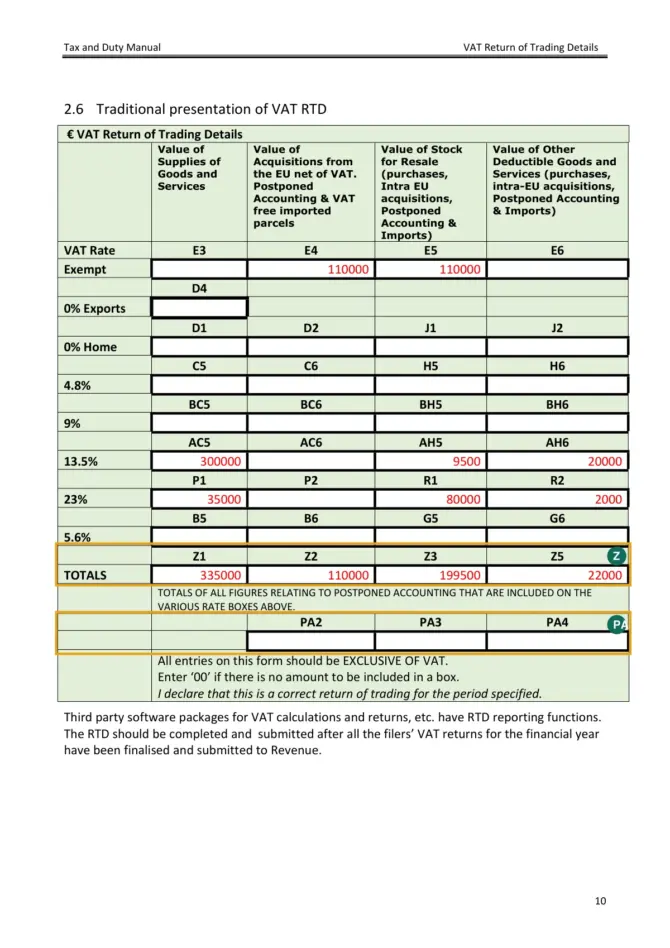
| Field | What to enter or check |
|---|---|
| 1: Supplies | Net domestic supplies at the relevant Irish rate; exempt supplies in E3, zero-rated intra-EU supplies to registered traders and non-EU exports in D4, other domestic zero-rate supplies in D1. Relevant reverse-charge receipts also enter this section. |
| 2: Acquisitions | Intra-EU goods/services and non-EU goods imported using postponed accounting, at the applicable Irish VAT rate. These correspond to the VAT3 E2, ES2 and PA1 categories. |
| 3: Purchases for resale | All domestic, EU and non-EU goods/services purchased for resale, including imports and postponed-accounting purchases. |
| 4: Other deductible purchases | Non-resale purchases and overheads eligible for input credit, subject to the filer’s deductibility rate. Do not include personal or non-deductible amounts as if fully recoverable. |
| Exempt and domestic zero rows | Exempt: E3/E4/E5/E6 across sections 1–4; domestic zero: D1/D2/J1/J2. The exports/qualifying intra-EU supply box is D4 in section 1 only. |
| Agricultural and second reduced rows | C5/C6/H5/H6 for the agricultural-rate row; BC5/BC6/BH5/BH6 for the second-reduced row. |
| Reduced and standard rows | AC5/AC6/AH5/AH6 for the reduced row; P1/P2/R1/R2 for the standard row. |
| Flat-rate addition and totals | B5/B6/G5/G6 is the flat-rate-addition row. Section totals are Z1, Z2, Z3 and Z5; the fourth total is Z5, not Z4. |
| Postponed-accounting subtotals | PA2, PA3 and PA4 separately total postponed-accounting values already included in sections 2, 3 and 4 rate boxes. They are not extra purchases. |
The manual’s form examples contain historical rates and sample amounts, including the flat-rate-addition row. Use the Irish VAT rate applicable to the transaction period and the corresponding category in ROS; do not copy a sample’s rate or amounts into the current year. Where rates changed within the period, the manual directs using the same rate-category row for both rates and keeping the supporting breakdown.
Cross-border and special transactions that affect more than one section
Every transaction included in section 2 also belongs in section 3 or 4, according to resale or deductible non-resale use. PA2 totals the postponed-accounting amounts in D2, C6, BC6, AC6, P2, B6; PA3 uses J1, H5, BH5, AH5, R1, G5; PA4 uses J2, H6, BH6, AH6, R2, G6. Reconcile these subtotals to their component entries without adding them a second time to the section totals.
Exclude intra-EU supplies to nonregistered customers where Irish VAT was not charged or VAT was accounted for through OSS. Do not complete E3 if all supplies are exempt and registration exists solely for intra-EU acquisitions. The old VAT-free imported-parcel category no longer applies from July 1, 2021.
For services received from outside the EU that require self-accounting, include the net value in section 1 at the relevant Irish rate and in section 3 or 4 as appropriate. This is distinct from treating a non-EU service as a postponed-accounting goods import.
A construction principal records reverse-charge services received in section 1 at AC5 or P1, as appropriate, and the corresponding eligible purchase in section 3 or 4. A subcontractor’s supply to the principal is reported at zero rate in D1 or D4 according to the transaction. Follow the manual’s construction examples for the relevant rate and resale category.
For the second-hand-goods margin scheme and Travel Agents Margin Scheme, supplies use the margin, not the full selling price. Capital Goods Scheme adjustments are excluded from RTD even where this prevents a direct reconciliation with VAT3 totals. If an EU supplier incorrectly charged VAT on a transaction being treated as an intra-EU acquisition, the manual directs seeking a corrected invoice and excluding the VAT-charged invoice from that acquisition treatment.
When the annual return is due and what non-filing can affect
The ROS deadline is the 23rd of the month following the month of the relevant year-end. The manual’s example gives September 23 for an August 31 year-end. Its footnote gives a 19-day deadline for cases exempt from mandatory electronic filing that do not pay and file through ROS. Confirm the actual VAT accounting period and due date shown on the account.
Outstanding prior-year RTDs can hold up repayments under other taxheads. Missing annual returns can also affect RCT deduction-rate reviews, tax clearance and the ability to initiate a phased payment arrangement. Deferring the screen is not evidence that a filing obligation has been met.
Where to submit, retain the declaration and correct an error
Complete the ROS return after the relevant VAT returns for the year have been finalised. Submit the correctness declaration through ROS as the accountable person or an authorised filer, then keep the acknowledgement, period, notice number and the invoice breakdown supporting each box. The manual’s PDF examples show an acknowledgement, not a blank paper form to post or upload.
Amended RTDs can be filed, but not on the same day as the original return; another amendment is likewise blocked on the day an amended return was submitted. Revenue records can take up to three days to update according to the manual.
For accidental errors, omissions or an incorrect RTD year-end, send MyEnquiries the return identification and the changes required. Use VAT and ROS – Query re completion of return. A VAT58 refund belongs to the separate unregistered-farmer scheme; it does not replace an annual RTD required of a VAT-registered trader.
Official PDF: VAT RTD — Official PDF (revenue.ie)