Form 12 is the paper Income Tax return for people in Ireland whose main income comes through PAYE: employees, pension recipients and non-proprietary company directors who pay all their Income Tax under PAYE. One document does two jobs. It is a return of income, charges and capital gains for the year ended 31 December 2025, and it is the claim form for that year’s tax credits, allowances and reliefs. The 2025 edition runs to 20 pages and 83 numbered panels, from personal details on page 4 to property incentives on page 20.
Revenue’s Tax and Duty Manual Part 37-00-09 says PAYE customers may choose to file a Form 12 or may be asked to by Revenue, and that the online version in PAYE Services in myAccount is simpler than the paper one because it shows certain information from your Revenue record. The paper form is for people who complete it by hand and post it.
Who files Form 12 and who moves to Form 11
The notes on page 1 draw the line between Form 12 and Form 11, the self-assessment return. You are a “chargeable person” and must file Form 11 for 2025 if you have PAYE income and either of these applies:
- gross income from all non-PAYE sources, deposit interest subject to DIRT included, of €30,000 or more;
- net assessable non-PAYE income, again including DIRT income, of €5,000 or more.
Below €5,000 of net non-PAYE income (after losses, capital allowances and other reliefs), where that income is coded against your PAYE credits or fully taxed at source, you stay on Form 12. Two panels repeat the point. Panel 14, for trade or professional income, tells you to use the form only if your total gross non-PAYE income is within those thresholds. Panel 26 says anyone with income from childcare services is a chargeable person and files Form 11. Page 1 also notes that the Capital Gains Tax self-assessment system applies to all individuals, directors included; on Form 12, capital gains go in panel 82.
Revenue also publishes Form 12S, a shorter paper return for the same groups. Its notes send anyone claiming credits it does not list, such as the remote working credit, or anyone with rental income, back to Form 12. Someone who is neither a PAYE taxpayer nor in self-assessment, and only wants back tax deducted at source from dividends or deposit interest, uses Form 54 Claims, which the Manual says is not suitable for salaries, wages or pensions.
Deadline on the 2025 form and the four-year window
Page 1 carries a notice under section 879 of the Taxes Consolidation Act 1997 requiring a return on this form, for 1 January to 31 December 2025, on or before 31 October 2026, and the return address box repeats that date. That date has passed. Revenue’s page on the PAYE Income Tax Return gives the general limit: a return has to be submitted within four years after the end of the tax year it relates to.
The same page, published on 16 July 2026, still says that from January 2025 returns can be made for 2021 to 2024, and the Statement of Liability page says requests can currently be made for 2021 to 2024. Form 12S, the short version, gives a different example in its notes: claims for 2022 must be made by 31 December 2026. If you are unsure whether a particular year is still open, ask your Revenue office before posting the form; the Form 12S notes give its number as 01 738 3636.
Revenue’s tax return forms page lists the 2025 Form 12 as the current edition and keeps the 2021 to 2024 versions under its related forms. A return for an earlier year goes on that year’s own form.
How Form 12 is laid out
Page 3 has an index of the panels. Any panel or section that does not apply to you is left blank.
| Panels | Page | What goes in |
|---|---|---|
| 1 to 3 | 4 to 5 | Return for a deceased person, civil status and basis of assessment, residence and split-year treatment, non-proprietary directorships |
| 4 to 13 | 5 to 6 | Wages, pensions, AVC withdrawals, pension lump sums, social welfare payments, ARF and PRSA distributions, redundancy or retirement payments, Foreign Earnings Deduction, untaxed benefits in kind |
| 14 to 15 | 7 | Trade or professional income within the thresholds, and Professional Services Withholding Tax |
| 16 to 25 | 7 to 10 | Fees, Rent-a-Room relief, Irish rental income and its reliefs, maintenance received, deposit interest, taxed income, Irish dividends |
| 26 to 29 | 10 | Exempt income and the property relief surcharge |
| 30 to 45 | 10 to 11 | Foreign dividends, pensions, employment, rents and interest |
| 46 to 54 | 12 to 13 | Charges and payments: rent to a non-resident landlord, maintenance paid, covenants, pension contributions, Mortgage Interest Tax Credit |
| 55 to 80 | 14 to 19 | Tax credits, allowances and reliefs for 2025 |
| 81 | 19 | Gifts and inheritances received in 2025 |
| 82 | 19 | Capital gains and chargeable assets |
| 83 | 20 | Property based incentives claimed in 2025 |
The entry rules on page 3 are strict about format. Write in capital letters inside the boxes, mark choices with a T, and write dates as DD/MM/YYYY. Every amount is in euro, foreign income included, without the € sign. Where a box ends in .00, give whole euro: round income down and round credits, reliefs, expenses and tax paid up. Where .00 is not printed, enter the cents.
Panels 1 to 7: your status, directorships and PAYE income
Page 5 is where most PAYE income is entered. The figures for panels 4 and 5 come from your final payslip for 2025, separately for you and for a spouse or civil partner.
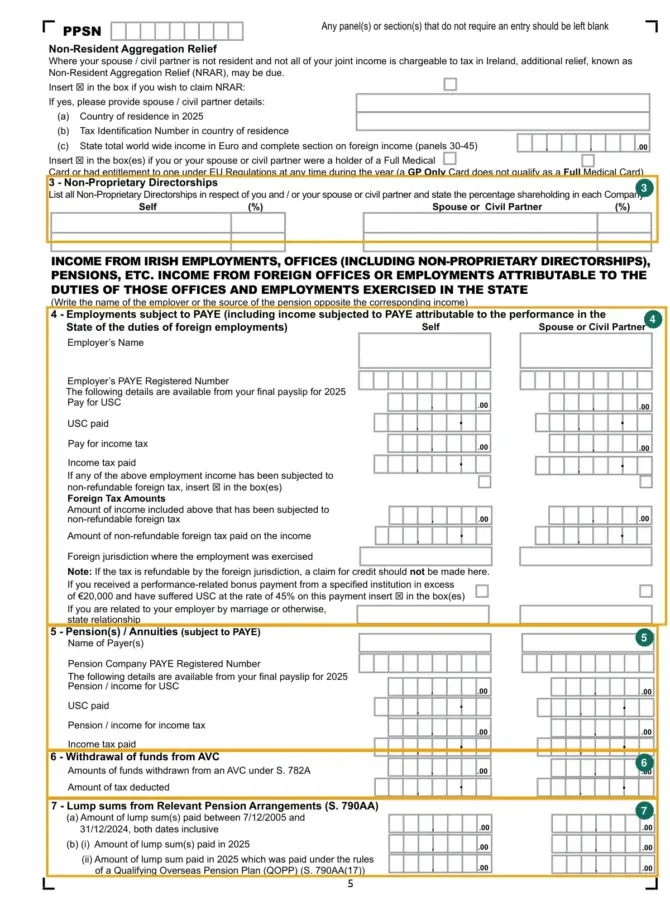
| Panel | What you enter |
|---|---|
| 1 | Only if you file for someone who has died: date of death, the personal representative’s name and address, and the date of the grant of probate or letters of administration. For a married couple, only where the deceased was the assessable spouse. |
| 2 | Civil status, any change in 2025 with its date, joint or separate assessment or single treatment, number of qualifying children, residence status (non-resident, not ordinarily resident, not domiciled) and any arrival or departure date for split-year treatment. The full medical card box sits on page 5; a GP-only card does not count. |
| 3 | Each non-proprietary directorship held by you or your spouse or civil partner, with the percentage shareholding. |
| 4 | Each employer’s name and PAYE registered number, pay for USC, USC paid, pay for income tax and income tax paid. Separate boxes cover income that suffered non-refundable foreign tax, a bonus over €20,000 from a specified institution that suffered USC at 45%, and any family relationship to the employer. |
| 5 | The same four payslip figures for each pension or annuity taxed under PAYE, with the payer’s PAYE registered number. |
| 6 | Funds withdrawn from an AVC under section 782A and the tax deducted. |
| 7 | Lump sums from pension arrangements under section 790AA: amounts paid from 7 December 2005 to 31 December 2024, amounts paid in 2025, and any part paid under a qualifying overseas pension plan. |
Page 5 also asks about Non-Resident Aggregation Relief, which may be due where your spouse or civil partner is not resident and not all of your joint income is taxable in Ireland. Claiming it means giving their country of residence, foreign tax number and total worldwide income in euro, and completing the foreign income panels 30 to 45.
Panels 8 to 29: welfare, lump sums, rents and investment income
Panel 8 takes taxable Department of Social Protection payments received in 2025, such as the State Pension, Illness Benefit, Jobseeker’s Benefit, Carer’s Allowance and Maternity or Paternity Benefit. A State Pension paid with an increase for an adult dependant is entered in full by the pensioner. The pensioner gets the employee credit; the spouse or civil partner does not get it for the adult dependant payment.
Panels 9 to 13 hold distributions from an ARF or PRSA, payments on starting a job or on redundancy or retirement (gross amount and the part chargeable to tax), the Foreign Earnings Deduction under section 823A, benefits in kind your employer did not tax through PAYE, and employment income that was not under PAYE at all. A Foreign Earnings Deduction claim needs a statement from your employer, attached to the return, showing your departure and return dates and where you worked abroad.
Panel 14 covers a small trade or profession run alongside a PAYE job: gross income, adjusted profit or loss and capital allowances. If you want to set a 2025 trading loss against other income under section 381, or use unused capital allowances under section 392, the claim must be made by 31 December 2027, and relief for a “relevant loss” is capped at €31,750.
Irish rental income has several panels of its own. Rent-a-Room income from a qualifying residence goes in panel 17 and stays out of panel 20, unless you tick to opt out of the relief and declare it as ordinary rent. Panel 18 (Residential Premises Rental Income Relief) and panel 19 (Retrofitting Rental Properties Relief) start with tick-box confirmations: RTB registration, no letting to a connected person, LPT compliance and a valid tax clearance certificate. Panel 19 then asks, for up to two properties, for the date of the work, the LPT ID, the contractor’s VAT number, the cost and any grant. Panel 20 is the rental account itself: gross rent, repairs, interest allowed under section 97(2J), pre-letting expenses under section 97A and capital allowances. A non-resident landlord whose rent suffered Non-resident Landlord Withholding Tax enters it there too; the claim cannot exceed 20% of the gross rent.
Panels 21 to 25 take untaxed maintenance received (leave out any amount for children), Irish government stocks and other untaxed income, deposit interest and credit union dividends with and without DIRT, taxed annuities, covenants and estate income, and Irish dividends with a separate line for REIT dividends. If you are exempt from income tax and you or your spouse or civil partner are 65 or over, or permanently incapacitated, there is a box for that in panel 23. Panel 28, for exempt income from personal injury compensation, asks you to attach documents showing any tax deducted. Panel 29 applies only where aggregate income for 2025 is €100,000 or more, and asks for the specified property reliefs used.
Foreign income, panels 30 to 45
Every foreign amount is converted to euro. The panels split income by type and country: dividends from Great Britain and Northern Ireland (entered net), the US, Canada and elsewhere; foreign pensions, with the country paying them; lump sums from foreign pension arrangements under section 200A; salary for work done outside the State where Transborder Relief is not claimed; foreign rents; EU and non-EU deposit interest, with UK deposit interest counted as non-EU; and UK and other foreign royalties, annuities and interest. Foreign tax is claimed only where it is not refundable by the foreign tax authority. Panel 38 states that a foreign rental loss can be set only against foreign rental profits.
Pension contributions and mortgage interest, panels 46 to 54
Panels 50 to 53 cover AVCs, PRSA and PEPP contributions, retirement annuity contracts and qualifying overseas pension plans. Each asks for the amount paid in 2025 that has not yet been relieved, amounts already relieved through payroll, any carry-forward, and a separate line for contributions paid between 1 January 2026 and 31 October 2026 that you want treated as paid in 2025.
Panel 54, the Mortgage Interest Tax Credit, is only valid with an LPT Property ID and three documents attached: one confirming the mortgage balance on 31 December 2022, and the lender’s interest certificates for 2022 and 2025. The qualifying loan on 31 December 2022 must have been more than €80,000 and less than €500,000. You enter the interest paid in 2022 and 2025 and the number of days you paid it, with lines for a second and third person paying the same mortgage. Every field in the panel has to be completed.
Claiming credits and reliefs, panels 55 to 80
Page 14 says all the credits, allowances and reliefs you are entitled to for 2025 must be claimed on this form. Some panels need evidence with a first claim; others only need you to keep it.
| Panel | Credit or relief | What the form asks for |
|---|---|---|
| 55 to 57 | Home Carer, Employee (PAYE) and Earned Income tax credits | A tick; for Home Carer, the type of dependant cared for |
| 58 | Employment expenses and remote working relief | Flat-rate expenses tick, other unreimbursed expenses, superannuation not deducted by the employer; for remote working, any payment of up to €3.20 a day from your employer, days worked at home, broadband and heat or electricity costs, and amounts already claimed through Real Time Credits |
| 59 | Blind Person’s Tax Credit | A tick; the ophthalmic surgeon’s certificate is kept, not sent |
| 60, 61 | Guide dog and assistance dog allowances | Number of dogs; the Irish Guide Dogs letter, or the statement from the ADEu-accredited organisation, goes with the first claim |
| 62 | Dependent Relative Tax Credit | Number of relatives; not due if the relative’s 2025 income exceeded €18,028 |
| 63 | Single Person Child Carer, widowed parent, increased exemption, Incapacitated Child | Child’s name, date of birth and PPSN; Form SPCC1 or SPCC2 with a first single person child carer claim; Forms ICC1 and ICC2 with a first incapacitated child claim |
| 64 to 66 | Employing a carer, permanent health insurance, medical insurance | Net cost or premiums not relieved at source, with names and dates of birth for medical insurance |
| 67 to 69 | SURE, EII and Start-up Capital Incentive | Amount subscribed, company name and tax number, date of the statement of qualification |
| 70 to 77 | Tuition fees, sportspersons’ retirement relief, sports body donations, fisher, seafarer and naval credits, Transborder Relief | Course fees per student; donations of at least €250 with the project number; days at sea; for Transborder Relief, at least 13 continuous weeks in a treaty country and a day in the State in each of those weeks |
| 78 | Health expenses | Nursing home costs, non-routine dental, other expenses, less refunds from the HSE, insurers or compensation |
| 79 | Rent Tax Credit | Three confirmations, option (a) or (b), then RTB number, address, tenancy dates, rent paid and landlord details |
| 80 | Help to Buy | Nothing on paper: the refund claim must be made online |
For health expenses you do not send Form Med 1 or a Med 2 with the return, but the receipts and the completed Med 2 for non-routine dental work have to be kept for six years after each year you claim. A first claim for Living City Initiative relief cannot be made on paper at all; page 17 sends you to the online Form 12 in myAccount.
Gifts, capital gains and property incentives: panels 81 to 83
Panel 81 is a single tick if you received a gift or inheritance in 2025. It does not replace a Capital Acquisitions Tax return. The form lists when a Form IT 38 is needed: the gift or inheritance, added to earlier aggregable benefits in the same group received on or after 5 December 1991, exceeds 80% of the relevant threshold; you claim agricultural or business relief; you took a deemed gift through a cheap or interest-free loan; or Revenue asks in writing.
Panel 82 reports disposals of chargeable assets in 2025 by you or your spouse or civil partner, such as land, shares or antiques. After gains, losses, any amount relieved under section 604A and the personal exemption (up to €1,270 per spouse or civil partner, not transferable), net gains are split by rate and by period: gains arising from 1 January to 30 November 2025, and gains arising from 1 to 31 December 2025, each at 33% or 40%. With an overall Capital Gains Tax loss for 2025, the rate lines need not be completed.
Panel 83 lists the property based incentive schemes, such as urban and rural renewal, hotels, nursing homes and the Living City Initiative, with owner-occupier and investor-lessor columns. The form warns that leaving it incomplete or wrong can bring a penalty under section 1052 or a surcharge under section 1084.
The declaration on page 1 and bank details on page 2
The declaration covers all sources of income, all disposals and acquisitions of chargeable assets, and the gifts, inheritances, credits and reliefs claimed. Sign and date it, mark whether you sign as the taxpayer, a tax adviser or in another capacity, and give your main residence address, Eircode and phone number. An agent adds a TAIN and client reference. A non-assessable spouse or civil partner who elects to be the assessable one for 2025 must enclose a letter saying so.
Page 2 asks for an IBAN and BIC for you and, under joint assessment, for your spouse or civil partner. Refunds are paid to those accounts. A refund cannot be paid straight to a foreign account outside SEPA.
Page 1 states the penalties: civil penalties and criminal sanctions apply to a false return or to claiming credits that are not due, and on conviction on indictment the fine can reach €126,970, or double the difference between the tax declared and the tax found to be due, with possible imprisonment.
What goes in the envelope with Form 12
The form itself names the enclosures. Depending on the panels you filled in:
- a letter electing to be the assessable spouse or nominated civil partner, if that applies to you;
- your employer’s statement of travel dates and work locations, for the Foreign Earnings Deduction (panel 11);
- documents showing tax deducted from personal injury compensation (panel 28);
- the December 2022 mortgage balance document and the 2022 and 2025 interest certificates (panel 54);
- the guide dog letter or assistance dog statement, first claim only (panels 60 and 61);
- Form SPCC1 or SPCC2, or Forms ICC1 and ICC2, first claim only (panel 63).
Health receipts, the Med 2 and the blind person’s certificate stay with you.
Getting Form 12 and where to send it
The blank 2025 Form 12 is on revenue.ie, and Revenue’s Forms & Leaflets Service posts copies on 01 738 3675 (+353 1 738 3675 from outside the Republic). It goes to your Revenue office, in any envelope with “FREEPOST” written above the address, and no stamp is needed. The downloadable form leaves the return address box empty; page 1 says to take the address from recent Revenue correspondence or from the Contact us page on revenue.ie, where the PAYE helpline page finds your office from your PPSN.
To file the same return online, sign in to myAccount, complete two-factor authentication, choose “Review your tax for the previous 4 years” under PAYE Services and select “Request” for the year. Revenue says the Statement of Liability for an online return arrives in about five working days, and it tells you whether you overpaid or underpaid Income Tax and USC or are square.
Form 12 page 2 points to Revenue’s Guide to Completing 2025 Pay & File Self-Assessment Returns for more detail on individual entries. This page describes the form; it is not tax advice for your own circumstances.
Official PDF: Form 12 — Official PDF (revenue.ie)
Questions about Form 12
Is the online return in myAccount the same as the paper Form 12?
Both are the PAYE Income Tax Return. Revenue’s Manual says the online version is simpler because it shows information already on your Revenue record, which the paper form leaves you to fill in yourself.
My employer paid me €3.20 a day for working from home. Do I still enter it?
Panel 58 has a box for it and asks for the total received in 2025. If the payment was less than your allowable costs, or there was none, you can claim a share of heating, electricity and broadband costs, less what the employer paid.
Sources
- Revenue Commissioners, Income Tax Return for the year 2025, Form 12 (RPC019899_EN_WB_L_1)
- Revenue Commissioners, Tax return forms
- Revenue Commissioners, PAYE Income Tax Return
- Revenue Commissioners, Statement of Liability
- Revenue Commissioners, Tax and Duty Manual Part 37-00-09, Use of Tax Returns and Other Forms
- Revenue Commissioners, Income Tax Return 2025, Form 12S
- Revenue Commissioners, PAYE, Jobs and pensions helpline