Form RTSO1 is the one-page payslip that went with a payment of Relevant Tax on a Share Option (RTSO) to the Collector-General. It covers a gain made by exercising, assigning or releasing an unapproved share option before 1 January 2024. RTSO is the Income Tax and Universal Social Charge (USC) on that gain, and the form adds employee PRSI to the same payment. For gains realised from 2024 onwards the employer collects the tax through payroll and no RTSO1 is filed.
Who still uses Form RTSO1
The form itself limits it to gains realised prior to 1 January 2024. If you exercised an option in 2023 or earlier and have not yet paid the tax, or are correcting an earlier payment, this is still the form. Revenue continues to link it from its page on calculating and paying RTSO (published 13 March 2026), and the copy on revenue.ie carries no printed date; the PDF file was last modified on 10 January 2024.
From 1 January 2024 the system changed. Finance Act 2023 moved the tax on option gains to the employer, who now deducts Income Tax, USC and PRSI through PAYE using the rates on your Revenue Payroll Notification. That applies whatever date the option was granted. You are no longer a chargeable person just because you exercised, assigned or released an option, and you do not file an Income Tax return for that event. A later sale of the shares is different: it still has to be reported on a return, and any Capital Gains Tax paid.
One Revenue page puts the change a year later. The “Share options” page in the Filing your tax return section (published 19 March 2026) talks about gains realised on or after 1 January 2025 and sends readers to the unapproved share option schemes section for gains before 2025. Form RTSO1, the RTSO page and Tax and Duty Manual Share Schemes Chapter 3 (updated November 2025) all give 1 January 2024. If your gain was realised during 2024 and your employer did not put it through payroll, ask the Collector General’s Division on 01 738 3663 or through MyEnquiries in myAccount or ROS which treatment applies before paying.
Both short options (exercisable within seven years of grant) and long options (exercisable more than seven years after grant) used RTSO1 for pre-2024 exercises. With a long option granted below market value, tax was already charged at grant, and that amount is credited against the tax due on exercise.
Working out the gain and the RTSO
The gain is the market value of the shares on the day you exercised, less what you paid for the shares and anything you paid for the option itself. On an assignment or release, the amount you received takes the place of the market value. If the exercise price was set in a foreign currency, Tax and Duty Manual Chapter 3 says to convert at the Central Bank of Ireland rate for that currency on the day of exercise, assignment or release.
For gains before 2024 the tax had to be calculated at the higher rates: Income Tax at 40% and USC at 8%, with employee PRSI at the rate of your PRSI class for that year (Revenue’s 2023 examples use 4%). If your income from all sources for the year was going to be taxed only at the standard rate, you could apply in writing, through myAccount or to your Revenue office, to pay Income Tax at 20% and a lower USC rate. That approval had to be in place before you paid; without it, the higher rates apply. The gain is not counted as income for the 3% USC surcharge.
Take an employee who exercised 2,000 options at €1.50 a share on 14 September 2023, when the shares were worth €4.25. The gain is 2,000 × €2.75 = €5,500. At 40% Income Tax (€2,200), 8% USC (€440) and 4% PRSI (€220), the total RTSO, USC and PRSI is €2,860. The 30 days include the day of exercise, so payment and form were due by 13 October 2023.
Filling in RTSO1 box by box
The top of the page holds your name and address; the declaration and figures are on the payslip below the dashed line. Both amount boxes take whole euro only, with the cent already printed as .00. The numbers on the image match the table.
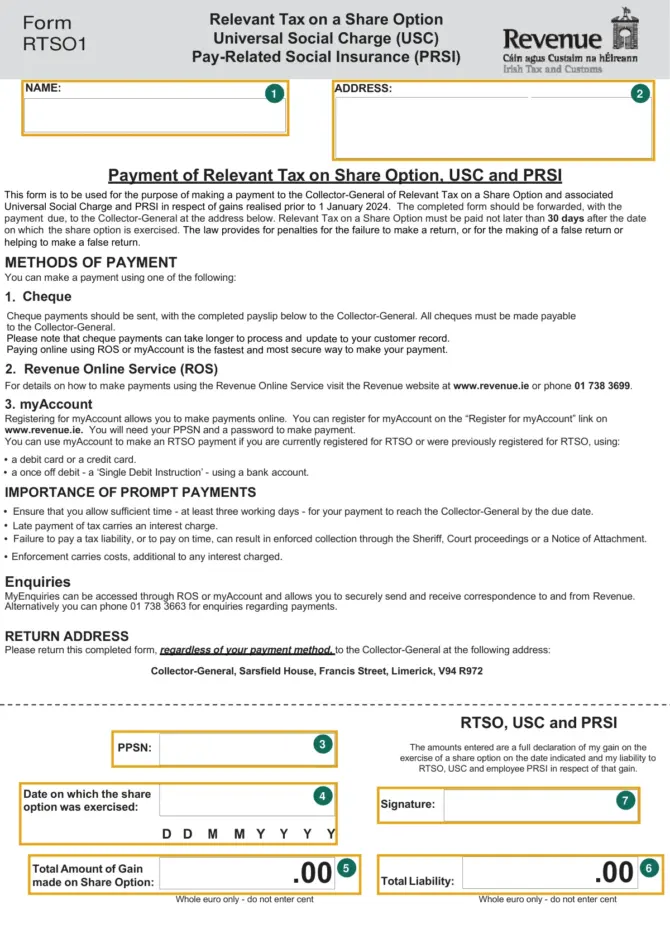
| No. | Box | What goes in it |
|---|---|---|
| 1 | Name | Your full name |
| 2 | Address | Your postal address |
| 3 | PPSN | Your Personal Public Service Number |
| 4 | Date on which the share option was exercised | Eight digits, DDMMYYYY, for example 14092023 |
| 5 | Total Amount of Gain made on Share Option | The gain worked out above, in whole euro |
| 6 | Total Liability | Income Tax plus USC plus employee PRSI on that gain, as one figure in whole euro |
| 7 | Signature | Your signature under the declaration that the amounts are a full declaration of the gain and of your RTSO, USC and employee PRSI |
The payslip has a single box for the exercise date, and Tax and Duty Manual Chapter 3 runs the 30 days for both the payment and the RTSO1 from the date of exercise.
Paying the RTSO and posting the form
The completed form goes to the Collector-General whichever way you pay; the form underlines “regardless of your payment method”. The postal address printed on it is:
Collector-General, Sarsfield House, Francis Street, Limerick, V94 R972
There are three ways to pay:
- by cheque made payable to the Collector-General, sent with the completed payslip; the form warns that cheques take longer to reach your record
- through the payments facility in ROS; the form gives 01 738 3699 for help with ROS payments
- through myAccount by debit or credit card or a once-off Single Debit Instruction from a bank account, if you are currently or were previously registered for RTSO
If you have never been registered for RTSO, Revenue’s RTSO page sends you to Manage your tax registrations in myAccount first. The form asks you to allow at least three working days for a payment to reach the Collector-General by the due date. Payment queries go to 01 738 3663 or MyEnquiries.
Official PDF: Form RTSO1 — Official PDF (revenue.ie)
Late payment, penalties and the Form 11 return
RTSO paid after the 30 days carries interest for each day or part of a day from the due date until payment: 0.0219% a day from 1 January 2023, and 0.0322% a day before that. Tax and Duty Manual Chapter 3 says a penalty of €3,000 can be imposed where an RTSO1 return has not been filed, and penalties of up to €5,000 for an incorrect one. The form adds that unpaid tax can be collected through the Sheriff, court proceedings or a Notice of Attachment, with costs on top of interest. If you find you underpaid, Revenue’s RTSO page points to its Making a disclosure guidance.
Paying RTSO was not the only obligation. Anyone who exercised before 2024 was a chargeable person for that year and had to file an Income Tax return, Form 11, by 31 October of the following year, entering the RTSO already paid in the relevant section. For a 2023 exercise that meant 31 October 2024. The late filing surcharge under section 1084 applies even if all your other income was taxed under PAYE. RTSO is left out when testing whether you paid enough preliminary tax, but it is credited against your final liability for the year.
Selling the shares is a separate Capital Gains Tax matter. Tax and Duty Manual Chapter 3 gives 15 December as the payment date for disposals from 1 January to 30 November and 31 January of the next year for December disposals; for 2026 disposals, the first payment uses CGT Payslip A.
Questions about RTSO1
I exercised my options in 2025. Do I send an RTSO1?
Revenue’s short option page says an exercise after 1 January 2024 is taxed by the employer through payroll and no RTSO1 is needed. If you sold shares in 2025, including in a cashless exercise, the disposal still goes on a 2025 Income Tax return due by 31 October 2026.
Does a cashless exercise change the RTSO?
The Income Tax position is the same when your employer sells shares to fund the option price and the tax. The sale of the shares may give rise to Capital Gains Tax, which Revenue asks you to consider separately.
Do I need an RTSO1 for an option I was granted but have not exercised?
A short option has no tax at grant, so there is nothing to pay. Tax at grant on a long option priced below market value is collected by your employer through payroll, not on RTSO1.
Official sources
- Form RTSO1, Relevant Tax on a Share Option, USC and PRSI
- How to calculate and pay Relevant Tax on Share Options
- Unapproved share option schemes
- Taxation of a short option and Taxation of a long option
- Tax and Duty Manual, Share Schemes Manual Chapter 3, Unapproved Share Options (November 2025)
- Share options (self-assessment)
- Share options (filing your tax return)
- Unapproved share options (employers)
- Collector General’s Division contact details