Form IT38S is the short paper return for Capital Acquisitions Tax, the tax Revenue charges on gifts and inheritances. It is the paper version of the short IT38: one gift or one inheritance, from one person, with no relief claimed except the €3,000 small gift exemption. Anything wider, such as Agricultural Relief, a credit for Capital Gains Tax or a life interest in a house, has to go on the full Form IT38 in myAccount or ROS.
The form has four pages. Page 1 takes the beneficiary’s details and any agent, page 2 the disponer, the dates, the group threshold and the tax calculation in boxes A to G, and page 3 is a payslip for people paying by cheque. Page 4 sets out payment methods and the Collector-General’s address. The current PDF on revenue.ie carries the reference RPC014859_EN_WB_L_1, and Revenue published a separate IT38S helpsheet dated 2026.
Who has to file, and who can use the paper IT38S
A beneficiary must file an IT38 return when the total taxable value of the gifts and inheritances received within one group threshold since 5 December 1991 exceeds 80% of that threshold. The obligation applies even if no tax ends up payable. Below that level no return is required for the benefit, unless you claim Agricultural or Business Relief or the gift arises from certain interest-free loans between close relatives. Revenue may also ask the disponer, the person who gave the gift, to submit an IT38 in the same 80% situations.
Page 1 of the form allows the paper version only if all three of these hold:
- no relief, exemption or credit is claimed, apart from the small gift exemption
- the benefit is an absolute interest, with no conditions or restrictions
- the property came from one disponer only and is not part of a larger benefit, or a series of benefits, taken on the same day
In every other situation the return must be filed electronically. Revenue’s credits page says the same for the Capital Gains Tax credit, double taxation credits and credit for prior CAT on the same event: each is claimed only on the online Form IT38. If you claim Agricultural or Business Relief, a CAT return is required whatever the value, and that also rules out the paper form. Gifts and inheritances taken by a spouse or civil partner are exempt from CAT.
Two typical IT38S cases: a son receives a cash gift from his mother with no strings attached, or a niece inherits an apartment outright under her aunt’s will. A widow receiving a life interest in the family home, or an heir claiming a credit for tax paid abroad, would use the online return instead.
When to file and pay: the 31 October deadline
CAT runs on a year ending 31 August. The date that decides your deadline is the valuation date, the date the market value of the gift or inheritance is fixed, and not the date of death or the date of the gift. Section 46 of the Capital Acquisitions Tax Consolidation Act 2003, quoted on page 3 of the form, requires you to pay and file by the following 31 October.
| Valuation date | Pay and file by |
|---|---|
| 1 September 2025 to 31 August 2026 | 31 October 2026 |
| 1 September 2026 to 31 December 2026 | 31 October 2027 |
Pay and file online through ROS or myAccount and the 2026 deadline moves to 18 November 2026, but only when both the payment and the return are made online. The 2026 helpsheet says there is no extension for paper returns, so an IT38S posted with a cheque still has to reach Revenue by 31 October.
For a gift, the valuation date is generally the day you receive it. For an inheritance it is the earliest of three dates: the day the executor or administrator is entitled to retain the asset for you (in most cases the date of the Grant of Probate, according to the helpsheet), the day it is actually retained for you, or the day it is handed over. In some cases, such as property passing by survivorship, it is the date of death.
Late filing adds a surcharge to the CAT due for the year: 5% of the tax, up to €12,695, where the return is less than two months late, and 10%, up to €63,485, where it is more than two months late. Late payment also carries daily interest; for valuation dates from 1 July 2009 the rate is 0.0219% a day.
What to have ready before you fill it in
- PPSN, full name, address and Eircode for you (the beneficiary) and for the disponer
- the date of the gift, or the date of death for an inheritance
- the valuation date and the market value of the benefit on that date
- the taxable value of any earlier gifts or inheritances in the same group threshold since 5 December 1991, leaving out gifts covered by the €3,000 small gift exemption
- the group threshold that applied on the date of the gift or death
- a way to pay: online, cheque or bank draft, card by phone, or bank transfer from abroad
If the disponer lives abroad and has no PPSN, the helpsheet says to contact Client Identity Services in the Department of Social Protection; the CAT overview page gives their number as (071) 967 2616, or +353 71 967 2616 from outside Ireland. If the disponer has died and never had an Irish PPSN, send Revenue an enquiry asking for a temporary PPSN.
The helpsheet also tells you to register for CAT in ROS or myAccount and gives the menu path Manage my Taxes, Tax Registrations. Revenue’s “How do you file?” page, published 21 November 2025, describes the myAccount route as Manage My Record, Tax Registrations, then Register on the CAT line.
How to fill in page 1: beneficiary and filer details
Write in block capitals and blue ink, and enter amounts in whole euro with no cent. Section 1 is the beneficiary: PPSN, the year of the return, then forename, surname, address and Eircode. Section 2 is only for a filer who is not the beneficiary, such as a solicitor acting for the family: name, address, phone, email, client reference, DX number if there is one, and the Tax Advisor Identification Number (TAIN).
The year box needs care. Page 1 of the form labels it “Return of gift and / or inheritance tax for the year ending 31st August”, while the 2026 helpsheet describes the same box as the tax year ending 31/10/xx. The two documents use different end dates for the same box. If you are unsure which year to enter, the National CAT Unit is on 01 738 3673 (09.30 to 13.30, Monday to Friday).
Page 2: disponer, dates and the group threshold
Page 2 repeats your PPSN and the year at the top, then asks for the disponer’s PPSN, name, address and Eircode. Tick Gift or Inheritance, then Real Property, Other Property or both; the helpsheet describes “other” as anything that is not a property. The three date lines take the date of the gift or inheritance, the valuation date and, for an inheritance only, the date of the disponer’s death.
The last tick box is the group threshold. It depends on your relationship to the disponer on the date of the gift or inheritance:
| Group | Beneficiary’s relationship to the disponer |
|---|---|
| A | Child, including an adopted child and a stepchild; a minor child of a deceased child; a parent who inherits an absolute interest from their child |
| B | Brother or sister; nephew or niece; grandparent or grandchild; a parent who takes a gift |
| C | Everyone else, including uncles and aunts receiving from a nephew or niece, cousins, in-laws and friends |
The threshold amount is the one in force on the date of the gift or the date of death, not the valuation date and not the day you fill in the form.
| Date of gift or death | Group A | Group B | Group C |
|---|---|---|---|
| On or after 7 October 2026 | €420,000 | €44,000 | €22,000 |
| 2 October 2024 to 6 October 2026 | €400,000 | €40,000 | €20,000 |
| 9 October 2019 to 1 October 2024 | €335,000 | €32,500 | €16,250 |
These figures come from Revenue’s CAT group thresholds page, published 7 October 2026. The threshold table in the 2026 IT38S helpsheet stops at the €400,000, €40,000 and €20,000 band “on or after 2 October 2024” and does not list the higher amounts from 7 October 2026. Revenue’s thresholds page also lists the older bands back to 7 December 2011.
Boxes A to G: working out the tax on page 2
The assessment block runs from the value of the benefit down to the taxable excess, and the last line applies the rate. The helpsheet explains each box as follows.
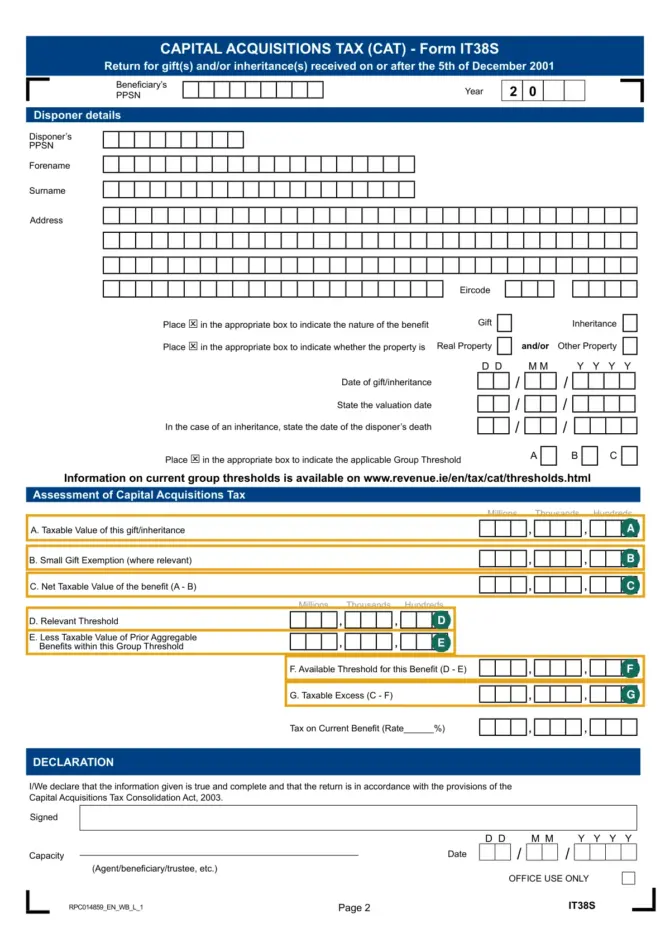
| Box | What you enter |
|---|---|
| A | The taxable value of this gift or inheritance |
| B | The small gift exemption of €3,000, for a gift only; leave blank for an inheritance |
| C | Net taxable value, A minus B; for an inheritance it equals A |
| D | The group threshold amount for the date of the gift or death |
| E | Taxable value of earlier gifts and inheritances in the same group since 5 December 1991 |
| F | Available threshold, D minus E; zero if earlier benefits already exceed the threshold |
| G | Taxable excess, C minus F |
| Tax on current benefit | G multiplied by the rate, which you also write in the rate space |
The rate for gifts and inheritances taken on or after 6 December 2012 is 33%. The small gift exemption covers up to €3,000 a calendar year from each disponer, applies to gifts only, and the exempt amount is not counted for aggregation.
An example with invented figures: on 20 November 2026 a niece receives €60,000 in cash from her aunt, which is Group B. Box A is €60,000, box B €3,000 and box C €57,000. Box D is €44,000, the Group B threshold for a gift on or after 7 October 2026. She inherited €10,000 from her grandfather some years ago, so box E is €10,000, box F €34,000 and box G €23,000. At 33% the tax on the current benefit is €7,590. Her valuation date falls between 1 September and 31 December 2026, so she pays and files by 31 October 2027.
The declaration and the page 3 payslip
The declaration at the foot of page 2 states that the information is true and complete under the Capital Acquisitions Tax Consolidation Act 2003. Sign it, date it and write your capacity: agent, beneficiary or trustee, for example. The helpsheet says Revenue cannot accept an IT38 return that is not signed and dated and will send it back.
Page 3 is a CAT payslip, which the helpsheet says you complete only if you pay by cheque. It takes the beneficiary’s PPSN and name, an amount for Inheritance Tax, an amount for Gift Tax and the total net amount, then a signature and date. The notes printed on the form describe the Inheritance Tax and Gift Tax amounts as the CAT payable on benefits with valuation dates in the year ending 31 August, and the total as the two added together. The helpsheet’s page 5 says to copy the amount from section G into the Gift or Inheritance Tax line, then says the total net amount is the figure entered at “Tax on Current Benefit”. Box G is the taxable excess, and the tax is a separate line, so the two documents point to different figures. The National CAT Unit (01 738 3673) can confirm which amount Revenue expects on your payslip.
Where to send Form IT38S and how to pay
Revenue’s “How do you file?” page says to calculate the tax yourself, sign the completed form and return it with payment to the Collector-General, PO Box 354, Limerick. The payslip notes on page 3 and the instructions on page 4 give the same address. Page 4 lists the Collector-General at Sarsfield House, Limerick for payment enquiries; questions about the liability itself go to Revenue.
Ways to pay with a paper return:
- cheque or bank draft payable to the Collector-General, sent with the payslip; do not enclose cash, and allow at least three working days for it to arrive
- credit card by phone on 01 738 3665, with the beneficiary’s name, PPSN, the CAT tax head and the period ready
- single debit instruction or card through myAccount
- Electronic Fund Transfer, for non-resident customers without a SEPA account, to the Office of the Revenue Commissioners UTD EFT Public Bank Account at Danske Bank, IBAN IE37DABA95159920003514, BIC DABAIE2D, quoting your name and PPSN and then emailing the details to moneytrans@revenue.ie
Revenue’s “How to pay your CAT” page, published 24 July 2026, says cheque payments should go to the Capital Acquisitions Tax Unit with a covering letter giving your name, PPSN, Gift or Inheritance Tax and the period, and that the cheque and the IT38 return must reach Revenue before 31 October. That page names a different recipient from the form and the “How do you file?” page. The National CAT Unit’s postal address is Self-Assessment Services, Personal Division, PO Box 13755, Ennis, Co. Clare; phone 01 738 3673 if you are unsure where your cheque should go.
If you received land or buildings, or a limited interest, Revenue’s payment page describes paying by instalments over up to five years. A limited interest cannot go on the IT38S, but a gift or inheritance of land can; you file the return and then contact the Collector-General’s Division through MyEnquiries or in writing to ask for the arrangement.
Official PDF: IT38S — Official PDF (revenue.ie)
What gets an IT38S sent back, surcharged or charged interest
- A return that is not signed and dated: the helpsheet says Revenue cannot accept it and the form will be returned.
- Using the paper form while claiming a relief, exemption other than the small gift exemption, or a credit, or for a benefit with conditions attached; page 1 says those returns must be made electronically.
- Relying on the 18 November online extension with a paper return. The extension needs both online payment and online filing; paper returns stay at 31 October.
- Filing late: a 5% surcharge up to €12,695 for less than two months, 10% up to €63,485 after that.
- Paying late: interest, and page 4 warns that unpaid tax can be collected through the Sheriff, court proceedings or attachment, with extra costs.
Page 1 also warns that you may be liable to penalties or prosecution for not making a true and complete return, and that records must be kept for six years in case the return is selected for examination.
Correcting a filed IT38S or adding another benefit
You can submit an amended paper IT38S if the three conditions still hold: no reliefs or credits beyond the small gift exemption, an absolute benefit, and property from one disponer that is not part of a larger benefit. Include all benefits for the period on the amended form, not only the new one, and add an explanatory note. CAT paid on the original return is credited against the revised amount. If the conditions no longer hold, for example because a second disponer is now involved, the amended return must be filed online in myAccount or ROS.
Questions about Form IT38S
Can I file the IT38S online?
The short IT38 can be filed online in myAccount or ROS, and both calculate the tax for you. The IT38S PDF is the paper version and is posted to the Collector-General.
Do I need to file if my inheritance is below the threshold?
You file once the total taxable value of benefits in the same group since 5 December 1991 exceeds 80% of the group threshold, even if no tax is due. Below that, no return is required for the benefit. Agricultural or Business Relief claims and certain interest-free family loans have their own reporting rules regardless of that limit, and a relief claim needs the online return.
Which threshold applies if my parent died in September 2026 and probate came through in 2027?
For an inheritance the threshold is normally the one in force on the date of death, so €400,000 for Group A. The later valuation date, often the Grant of Probate, decides only the pay and file deadline.
Is a €3,000 gift from my grandmother taxable?
Gifts of up to €3,000 from any one person in a calendar year are exempt and are not counted towards your threshold. No CAT return is needed just to claim that exemption.
Sources
- Form IT38S, Return for gift(s) and/or inheritance(s) received on or after 5 December 2001 (RPC014859_EN_WB_L_1)
- Who should complete a Form IT38 Short Return, IT38S helpsheet 2026
- Revenue: How do you file? (published 21 November 2025)
- Revenue: Completing your gift or Inheritance Tax return (IT38)
- Revenue: Filing obligations
- Revenue: How and when do you pay and file? (published 29 October 2026)
- Revenue: What charges are there for late filing?
- Revenue: CAT group thresholds (published 7 October 2026)
- Revenue: CAT groups
- Revenue: How to pay your Capital Acquisitions Tax (published 24 July 2026)
- Revenue: National Capital Acquisitions Tax (CAT) Unit contact details