Form IC1 is the claim a non-resident individual sends to Revenue to get back Relevant Contracts Tax (RCT) that a principal contractor withheld from payments for work done in Ireland. RCT covers construction, forestry and meat processing operations carried out in the State, and it applies even when the principal and the subcontractor are both based abroad. The form’s full title is “Tax Repayment Claim Form for Relevant Contracts Tax Form IC1 (Individual) RCT”; the copy on revenue.ie carries the reference RPC020395_EN_WB_L_1 and is a two-page fillable PDF, with the claim on page 1 and Revenue’s notes on page 2.
Who claims on Form IC1, and who uses Form IC3
Revenue’s page on RCT for non-resident subcontractors splits the claim forms by legal form: an individual subcontractor completes Form IC1, a company completes Form IC3. Partnerships do not get refunds as such. The May 2026 guide “Tax Obligations of Non-Resident Principal and Sub contractors” says the refund is paid to each partner according to their share in the partnership, each partner must be registered for RCT under their own PPS number, and each partner fills in their own IC1.
The usual starting point is a deduction on a payment. Before paying a subcontractor, the principal notifies Revenue, and Revenue answers with a deduction authorisation setting the rate at zero, 20% or 35% (Tax and Duty Manual Part 18-02-01). If tax was deducted, the principal has to give the subcontractor a copy of the deduction authorisation or its details. That deducted amount is what IC1 claims back. A subcontractor already on the 0% rate has nothing withheld, so there is nothing to reclaim for those payments.
An individual needs a Personal Public Service Number (PPSN) when claiming. Someone who has to register for Irish tax in the first place, for example because the work creates a permanent establishment, registers on Form TR1(FT).
What goes in the envelope with Form IC1
- Form IC1, with the bottom section certified by the tax authority of your country of residence.
- An RCT questionnaire for each contract you accepted. Revenue’s questionnaire says every section must be completed.
- Proof of the deductions. The Revenue web page asks for a copy of the deduction authorisation; the notes on page 2 of IC1 ask for the original Relevant Contracts Tax Payment Notification Acknowledgement form. Your principal holds these.
- Residents of the United States: a Form 6166 certificate of residence for each year claimed, which the IRS issues.
- Residents of Spain: a Residencia Fiscal en España certificate if the Spanish tax authority will not stamp the form.
The IC1 notes also ask that all your Irish tax returns are up to date.
How to fill in Form IC1, section by section
Page 1 has eight areas. The numbered frames in the image match the rows of the table.
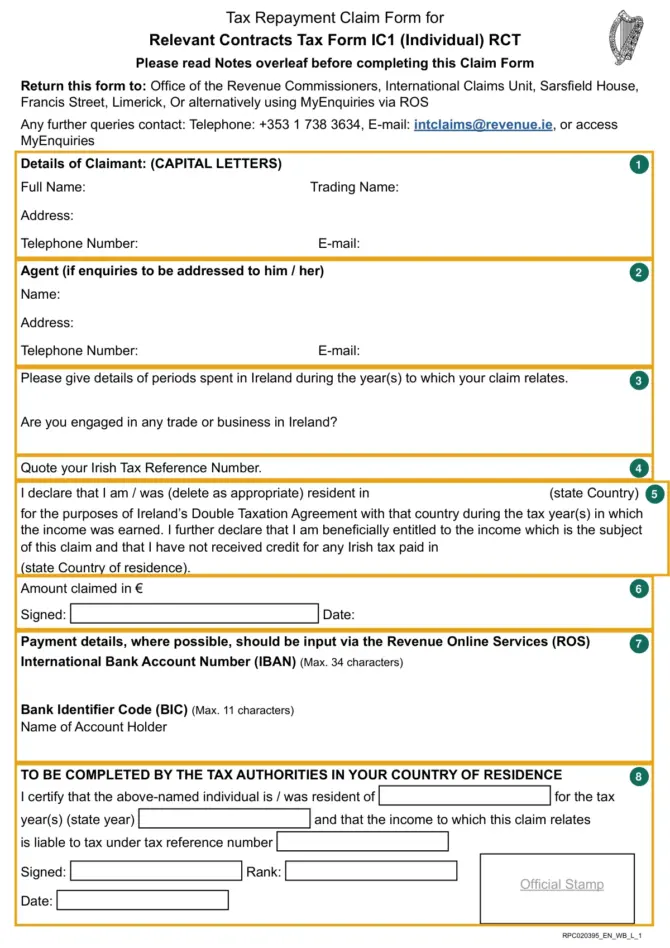
| Frame | Section of IC1 | What you write |
|---|---|---|
| 1 | Details of Claimant | Full name and trading name, address, telephone and e-mail, all in capital letters. |
| 2 | Agent | Only if Revenue should send its queries to an agent: name, address, telephone, e-mail. |
| 3 | Time in Ireland and trade | The periods you spent in Ireland in the year or years the claim covers, and whether you carry on a trade or business in Ireland. |
| 4 | Irish Tax Reference Number | Your Irish tax reference number. Revenue’s guide for non-resident contractors says an individual must hold a PPSN when claiming. |
| 5 | Residence declaration | The country where you are or were resident under its Double Taxation Agreement with Ireland in the year the income was earned. You also declare that you are beneficially entitled to the income and have not had credit for the Irish tax in that country. |
| 6 | Amount and signature | The amount claimed in euro, your signature and the date. |
| 7 | Payment details | IBAN (up to 34 characters), BIC (up to 11 characters) and the account holder’s name. The form asks for bank details to be entered on ROS where possible. |
| 8 | Certificate of the foreign tax authority | Left blank by you. Your home tax authority confirms your residence for the stated years and the tax reference under which the income is taxable, then signs, adds rank and date, and stamps it. |
The questions in frame 3 matter because of the permanent establishment rules. Revenue’s guide notes that Ireland’s tax treaties count a building site or construction or installation project lasting more than six months (longer under some agreements) as a permanent establishment, and profits from one are liable to Irish income tax. The RCT questionnaire repeats this with yes/no questions on a place of management, branch, site office, workshop, a person negotiating contracts for you, and the building site itself.
The certificate from your home tax authority
Frame 8 is completed outside Ireland, by your own tax office, which signs and stamps it. Revenue’s web page says the authority must certify the form for the year in which the income was earned. Tax and Duty Manual Part 18-02-05 (updated October 2024) adds that one certification currently covers three years, that Revenue can still ask for certification for a claim at any time, and that the three-year period is under review. The May 2026 guide describes the form as “generally valid for 3 years”.
For a US resident, Form 6166 is required for each year claimed in addition to IC1. For a Spanish resident whose tax office will not stamp the form, the notes accept a Residencia Fiscal en España certificate.
When a refund can be claimed, and the four-year limit
Whether you can claim during the year depends on your other Irish obligations. The May 2026 guide on non-resident contractors says refunds throughout the year are only for applicants who are not required to be registered for income tax or corporation tax. If you are required to be registered, no claim is processed until the tax return for that year has been filed and the liability paid. Tax and Duty Manual Part 18-02-05, written for subcontractors generally, is stricter in its wording: it says RCT repayments can only be made after the end of the tax year, and that a credit is first set against the tax for that year, then preliminary tax, then other liabilities. If you are relying on an in-year refund, ask the International Claims unit (contact details below) which rule they will apply to your claim.
The time limit is printed on IC1 itself: under section 17 of the Finance Act 2003, a claim can only be made within four years after the end of the calendar year in which the tax was deducted. RCT deducted in 2022 can be claimed until 31 December 2026.
Repayments are made electronically to the bank account given on the form or on ROS.
Where to send Form IC1
The blank form is on revenue.ie as form-ic1.pdf, linked from the page “RCT for non-resident subcontractors”. Revenue’s documents do not give the same office for returning it:
| Document | Office named |
|---|---|
| Form IC1, page 1 (RPC020395_EN_WB_L_1) | International Claims Unit, Sarsfield House, Francis Street, Limerick, or MyEnquiries via ROS; telephone +353 1 738 3634 |
| Tax Obligations of Non-Resident Principal and Sub contractors (May 2026) | International Claims Unit, Sarsfield House, Francis Street, Limerick V94 R972; telephone +353 1 738 3634 |
| Web page “RCT for non-resident subcontractors” (published 19 May 2026) | International Claims Section in Nenagh |
| RCT questionnaire (RPC017051_EN_WB_L_1) | International Claims Section, Government Offices, Nenagh, Co. Tipperary E45 T611; telephone +353 1 738 3634 |
| Tax and Duty Manual Part 18-02-05 (October 2024) | International Claims Section, Collector General’s Division, Government Offices, Nenagh, Co. Tipperary; telephone +353 (0) 67 63400 |
All of them give the same e-mail address, intclaims@revenue.ie. The form itself offers MyEnquiries on ROS as an alternative to post. If you are posting the claim, confirm the current address with the unit at intclaims@revenue.ie or on +353 1 738 3634 before sending originals.
One more inconsistency on the form: the heading of page 2 says the notes are to be read with “Form IC3 (Company) RCT”, and the Spanish note refers to stamping “the IC3 form”. That page is nonetheless printed as part of Form IC1. If you are unsure whether a note applies to an individual’s claim, the International Claims unit answers at the e-mail address above.
Official PDF: IC1 — Official PDF (revenue.ie)
What holds up an RCT refund
- An incomplete RCT questionnaire. The questionnaire states that failing to provide the information will delay processing.
- Outstanding returns, balances or documents. The May 2026 guide says these will result in delays in processing the refund.
- A claim from someone who must be registered for income tax, filed before that year’s return is in and the tax is paid: Revenue does not process it until both are done.
- No certification from the home tax authority, or a certification for a different year.
- A claim lodged more than four years after the end of the year in which the RCT was deducted.
- A deduction your principal made without a deduction authorisation. Part 18-02-05 says such an amount is not RCT, and pursuing the principal is a matter for the subcontractor.
Questions about claiming back RCT on Form IC1
Do I need a new IC1 certificate every year?
Revenue’s guidance describes a certification as generally covering three years, though Revenue can ask for a fresh one for any claim. US residents send a Form 6166 for each year claimed.
Do I have to register for Irish VAT to get the refund?
Non-resident subcontractors providing construction services within RCT are not required to register for VAT, according to the questionnaire notes and the Revenue page, though they may register to reclaim input VAT. VAT registration questions go to Business Taxes Registration, PO Box 1, Wexford, businesstaxesregistration@revenue.ie.
I hired my own subcontractor on the Irish job. Does that change anything?
Note 2 of the RCT questionnaire says that if you subcontracted any part of your contract, you have to register for RCT as a principal contractor and operate RCT yourself, using Form TR1(FT) or TR2(FT).
What if my workers were in Ireland for more than 60 days?
The questionnaire’s Note 3 says that employees working in Ireland for more than 60 days in total in the year, and in any event for a continuous period of more than 60 working days, oblige you to register as an employer and possibly operate Irish PAYE.
Official sources
- Form IC1, Tax Repayment Claim Form for Relevant Contracts Tax (Individual) RCT, RPC020395_EN_WB_L_1
- RCT for non-resident subcontractors (published 19 May 2026)
- Tax Obligations of Non-Resident Principal and Sub contractors engaged in construction work in the Republic of Ireland (May 2026)
- Relevant Contracts Tax Questionnaire, RPC017051_EN_WB_L_1
- Form IC3, Tax Repayment Claim Form for Relevant Contracts Tax (Company) RCT
- Tax and Duty Manual Part 18-02-05, Relevant Contracts Tax for Subcontractors (October 2024)
- Tax and Duty Manual Part 18-02-01, Relevant Contracts Tax (February 2026)