TR1 is the paper form an Irish-resident individual, partnership, trust, unincorporated body or sporting body uses to register with Revenue for Income Tax, VAT, employer PAYE/PRSI, Relevant Contracts Tax (RCT) or Capital Gains Tax. The edition on revenue.ie carries the print code RPC019737_EN_WB_L_1, and the PDF was produced in August 2025. It runs to eight pages with panels numbered up to 58, although most applicants fill in only the parts that match the taxes they tick.
Which parts you complete depends on who is registering. A person completes A1, A3 and whichever of Parts B to F apply. A partnership, trust, club or other body completes A2 and A3 instead of A1, then the same tax parts.
Who uses TR1 and who registers online instead
The first page sends several groups elsewhere. An individual who needs Income Tax only is told to use eRegistration in myAccount. Revenue’s sole trader page describes the steps: sign in to myAccount, open “Manage My Record”, choose “Tax registrations”, select Income Tax and confirm your NACE code, the date the business started and expected turnover. A tax agent acting for an individual or body applies through the Revenue Online Service (ROS), not on paper.
TR1 also lists who should not use it at all:
- an employee starting a first job, who uses the Jobs & Pensions service in myAccount;
- a company, which uses ROS through its agent or Form TR2;
- liquidators, receivers and unincorporated bodies represented by an agent, who use ROS;
- a non-resident body that only wants a number for a grant or tax clearance, which uses Form TC1;
- a voluntary non-profit organisation, which uses Form TR3;
- a collection agent for a non-resident landlord, which has its own Collection Agent Registration form.
A person or body not resident in Ireland uses TR1(FT). Revenue’s trust and partnership page adds that an executor or administrator without an agent can register an estate on Form TR4.
Revenue’s eRegistration page names the customers who cannot register online and must send a paper form: individuals not eligible for myAccount or ROS, non-assessable spouses, unincorporated bodies and non-profit organisations with no agent, executors and collection agents. Other pages are stricter about paper. The registration overview (27 October 2026) says a paper application sent when an online one should have been made is not processed and comes back with an instruction to use ROS. The VAT registration page (6 October 2026) says a business established in the State completes TR1 online and allows the paper version only in exceptional circumstances. Neither page sets out a test for those circumstances. If you are unsure which route applies to you, Business Registrations can be reached on 01 738 3630 or businesstaxesregistrations@revenue.ie.
TR1 panel by panel
Asterisked panels are required, choices are marked with an X, and the form is completed in block letters. The page 1 note warns that registration may be delayed if information is missing.
| Section | Panels | Who fills it in and what goes there |
|---|---|---|
| A1, individuals | 1 to 12 | Name, gender, nationality, date of birth, private address with Eircode, PPSN, phone and email, GNIB or IRP number, immigration stamp number, civil status and spouse or civil partner |
| A2, partnerships, trusts and bodies | 14 to 17 | Name of the body, responsible person, any earlier tax number, and every partner, trustee or officer |
| A3, business details | 18 to 32 | Trading name, online sales, legal format, business address, type of business, software, start date, accounts date, turnover, advisor, landlord, previous owner |
| B, Income Tax (non-PAYE) | 33 to 35 | Tick box, main source of income, refund account |
| C, VAT | 36 to 47 | Start date, reason, cash receipts basis, goods or services, turnover, EU trade, VIES, refund account, property, postponed accounting |
| D, employer PAYE/PRSI | 48 to 51 | Number of staff, first employee’s start date, payroll system, PAYE agent |
| E, RCT | 52 to 56 | Principal or subcontractor, start date, ROS status, earlier principal registration |
| F, Capital Gains Tax | 57 and 58 | Tick box and start date |
| Declaration | Page 7 | Name, signature, capacity, date and the signer’s phone number |
One note on page 1 affects what happens after registration: anyone completing Part A2 or Part C will have to pay and file through ROS.
Filling in Part A for an individual
The marked image shows the A1 panels on page 1 that hold personal identifiers: 1 (forename), 5 (date of birth), 6 (private address and Eircode), 7 (PPSN), 9 (GNIB or Irish Residence Permit number), 10 (immigration stamp number), 11 (civil status) and 12 (spouse or civil partner).
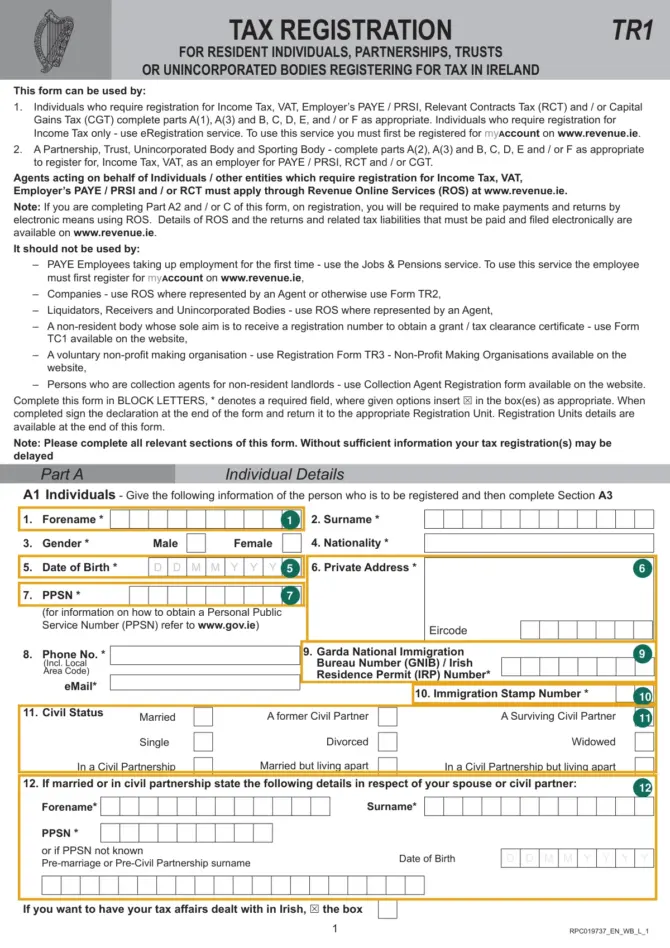
Your PPSN goes in panel 7, and the form points to gov.ie for anyone who does not have one. Revenue’s sole trader page explains that a sole trader’s Tax Reference Number is the same as the PPSN, but the PPSN only becomes a tax reference once you register.
Panels 9 and 10 carry an asterisk, so the form treats the GNIB or IRP number and the immigration stamp number as required. TR1 gives no instruction for an applicant, such as an Irish citizen, who holds neither document, and the Revenue pages used for this guide do not cover the point either. Ask Business Registrations (01 738 3630) what to enter rather than leaving the panels blank without explanation.
Panel 11 has nine civil status options, from single to “in a civil partnership but living apart”. If you are married or in a civil partnership, panel 12 asks for your spouse’s or partner’s forename, surname and PPSN; where the PPSN is not known, give their pre-marriage or pre-civil partnership surname and date of birth. Below panel 12 is a box to tick if you want Revenue to deal with you in Irish.
Partnerships, trusts and clubs: section A2
Panel 15 names a responsible person: the chairperson or secretary of a group, or the precedent partner of a partnership, with address, Eircode and phone. Panel 16 is for a tax number the body used before. Panel 17 lists every partner, trustee or officer with private address, capacity (precedent partner, partner, trustee, treasurer and so on), PPSN and shareholding, on a separate sheet if needed. The heading of panel 17 states that a minimum of two partners is required.
Revenue’s trust and partnership page says that once the trust or partnership is registered, it must file returns and make payments through ROS.
Business details in section A3
Panel 18 applies only to an administrator, liquidator or receiver, who gives the registration number the entity held before. Panel 19 is the trading name, and panel 20 asks what percentage of sales you expect to make online and for the website. Panel 21 is the legal format: sole trader, partnership or other.
Panel 22 is the business address if it differs from your private address; the form says a tax advisor’s or accountant’s address is not acceptable. Panel 23(a) picks one category (mainly retail, mainly wholesale, mainly manufacturing, building and construction, forestry or meat processing, service and other). Panel 23(b) wants a precise description. The form gives “dairy farmer”, “investment income” and “clothing manufacturer” as examples and rules out terms such as “shopkeeper” or “consultant”. A property activity may also need panel 46.
Panels 26 to 28 are required: the date the business or activity began, the date annual accounts will be made up to, and expected turnover over the next twelve months. Panel 29 records an accountant or tax advisor, with their Tax Advisor Identification Number (TAIN) and your client reference, and panel 30 shows whether VAT3 returns or employer PAYE/PRSI correspondence go to that advisor.
If you rent the premises, panel 31 wants the landlord’s own name and private address, not an estate agent or rent collector, plus the rent, whether it is weekly, monthly or yearly, the date rent started and the lease term. Send a copy of the lease. Panel 32 covers a business bought from someone else: their name, current address and VAT or registered number.
Income Tax and VAT, Parts B and C
Part B is for Income Tax outside PAYE. Tick panel 33 and choose the main source in panel 34: trade, foreign income (including salary and pension), rental income, investment income or other. Panel 35 is the account for Income Tax refunds, with an IBAN of up to 34 characters and a BIC of up to 11.
Part C opens with panel 37. In 37(a) you give the date VAT registration should start. Panel 37(b) asks whether registration is only for EU acquisitions, an option the form limits to farmers and non-taxable entities. In 37(c) you choose one reason: turnover over the legal limits, an election to register, or business-to-business services received under the reverse charge (attach a copy of the invoice). If the business has not started or turnover is below the threshold, the form treats the application as an election, and an election can only take effect from the current VAT period. Receivers cannot elect.
Revenue’s thresholds page gives €42,500 for services only and €85,000 for goods, with further rules for mixed supplies and goods made from zero-rated materials. A business that has not yet supplied anything can still register to reclaim VAT on start-up costs, according to Revenue’s “Who needs to register for VAT?” page.
The remaining VAT panels in order:
- 38: cash receipts basis, allowed where expected turnover is under €2,000,000 or at least 90% comes from unregistered customers such as hospitals, schools or the public.
- 39: goods, services or both, with the storage and distribution address in Ireland and the courier or delivery firms used for sales.
- 40 and 41: taxable turnover from 1 January this year to the date of application, and for the whole previous calendar year, split between goods and services.
- 42 and 43: four questions on supplying or acquiring goods or services in other EU states; any yes makes panel 43 mandatory (customers, due diligence, transport, proof that goods left the State, distribution chain).
- 44: estimated annual EU supplies in four bands from under €635,000 to over €10m, and whether goods supplies will exceed €50,000 a quarter. Intra-EU suppliers must file VIES returns.
- 45: account for VAT refunds.
- 46: developers and landlords give the property address, purchase or development date, planning reference and a signed statement that the property will give rise to a VAT liability, for example under the landlord’s option to tax. For a partnership, trust or body, the precedent acting partner or responsible person signs it.
- 47: postponed accounting for goods imported from outside the EU, with details of goods, suppliers, customers, record-keeping and evidence of the business address. You must hold a Customs & Excise registration first, and late proofs mean postponed accounting is refused.
Employer PAYE, RCT and Capital Gains Tax
Part D asks how many staff work 30 hours or more a week and how many work less, the date your first employee started or will start, and whether payroll is computerised or manual. The form reminds employers that payroll is reported to Revenue in real time and that this needs a ROS digital certificate. Panel 51 names an agent for PAYE/PRSI correspondence if different from panel 29. Revenue’s employer registration page lists PREM Reg as the paper method for someone already registered for Income Tax, and says Revenue can register an employer compulsorily; that notice can be appealed to the Tax Appeals Commission within 30 days.
Part E is RCT. Principal contractors must handle RCT through ROS and must also register for VAT under the reverse charge for construction services, which means completing Part C as well. Panel 52 asks whether you are a principal only, principal and subcontractor, or subcontractor only, with the number of subcontractors for a principal. Panel 53 is the RCT start date; panel 54 asks whether you, or an agent willing to carry out all RCT functions, are registered for ROS, with the agent’s TAIN; panels 55 and 56 cover any earlier registration as a principal and the date it ended.
Part F is a tick box (panel 57) and the date from which Capital Gains Tax registration is needed (panel 58).
When to send TR1
TR1 has no single deadline. Revenue’s VAT pages say you become an accountable person on completing the transaction that takes turnover over the threshold, and must apply within 30 days of it. VAT registration normally takes effect from the date on the form, and Revenue’s manual on VAT registration (Part 38-01-03b, May 2026) says backdating to an earlier date is possible only where annual turnover exceeds the threshold. If panel 37(a) is left blank, the manual tells staff to contact you rather than assume a date. Revenue’s VAT page also asks for any change in the information supplied to be notified within 30 days.
Signing TR1 and where to post it
The declaration on page 7 has to be completed before Revenue registers you for any tax. Give your name in block letters, signature, capacity (individual, secretary, precedent partner, trustee and so on), date and your phone number.
Page 8 lists three registration units:
| Applicant | Registration unit |
|---|---|
| Associates of existing Large Corporates Division (LCD) customers | Office of the Revenue Commissioners, Large Corporates Division, Anne Street, Wexford, Y35 E29K; largecasesdiv@revenue.ie; 01 738 3637 |
| Financial institutions (not credit unions), stockbrokers, Central Bank-regulated investment funds, REITs, IDA-supported companies with over 300 employees, aircraft leasing, insurance and reinsurance entities, ICAVs, debt securitisation entities, remote bookmakers | Office of the Revenue Commissioners, High Wealth & Financial Services Division, Anne Street, Wexford, Y35 E29K; HWFSDiv@revenue.ie |
| All other customers | Business Registrations, Office of the Revenue Commissioners, P.O. Box 1, Wexford; businesstaxesregistrations@revenue.ie; 01 738 3630 (+353 1 738 3630 from abroad) |
Applicants outside the LCD and High Wealth lists use the last row. Sole traders, trusts and partnerships registered this way then file returns and make payments through ROS, according to Revenue’s registration pages.
Official PDF: TR1 — Official PDF (revenue.ie)
Why Revenue sends a TR1 back
Revenue’s VAT registration manual includes the standard letter staff use to return a TR1, TR2 or PREM Reg that cannot be processed. The reasons on that letter that apply to TR1 are:
- the form is not signed;
- no business address or phone number;
- no description of the main business or activity;
- missing PPS numbers for the individual or partners;
- no date of registration for VAT or PAYE;
- employees mentioned but Part D not completed;
- no bank account details.
A paper TR1 sent by someone who could have registered online is also returned unprocessed, with a request to use ROS.
Questions about TR1
I am a PAYE employee starting a side business. Do I need TR1?
If you need Income Tax only, TR1 directs individuals to eRegistration in myAccount, where Revenue’s sole trader page shows how to add Income Tax self-assessment. TR1 comes in when you also need VAT, employer PAYE, RCT or Capital Gains Tax and cannot register online.
Can a partnership with one partner use TR1?
Panel 17 states that a minimum of two partners is required. A business run by one person is a sole trader, one of the legal formats in panel 21, and that person completes section A1.
Can I register for VAT on TR1 before I start trading?
You can, as an election: panel 37(c) treats an application from a business that has not started as an elect-to-register case, and the start date can be no earlier than the current VAT period.
Official sources
- Form TR1, Tax registration for resident individuals, partnerships, trusts or unincorporated bodies (RPC019737_EN_WB_L_1)
- How to register for tax as a sole trader
- How to register for tax as a trust or partnership
- eRegistration
- Registering for tax: overview
- How do you register for VAT?
- Who needs to register for VAT?
- VAT thresholds
- Registration of employers for PAYE: how to register
- Tax and Duty Manual Part 38-01-03b, Guidelines for VAT Registration (May 2026)